Modern users expect more from the apps they use every day. Whether it’s a fintech platform, payroll solution, insurance app, digital bank, employee benefits portal, or consumer super app, customers increasingly want to save, invest, and grow their wealth without switching between multiple applications.
For businesses, this presents a significant opportunity. Adding investment products to an existing app can increase user engagement, improve retention, and create new revenue streams. The good news is that businesses no longer need to become financial institutions or build complex financial infrastructure to make this happen.
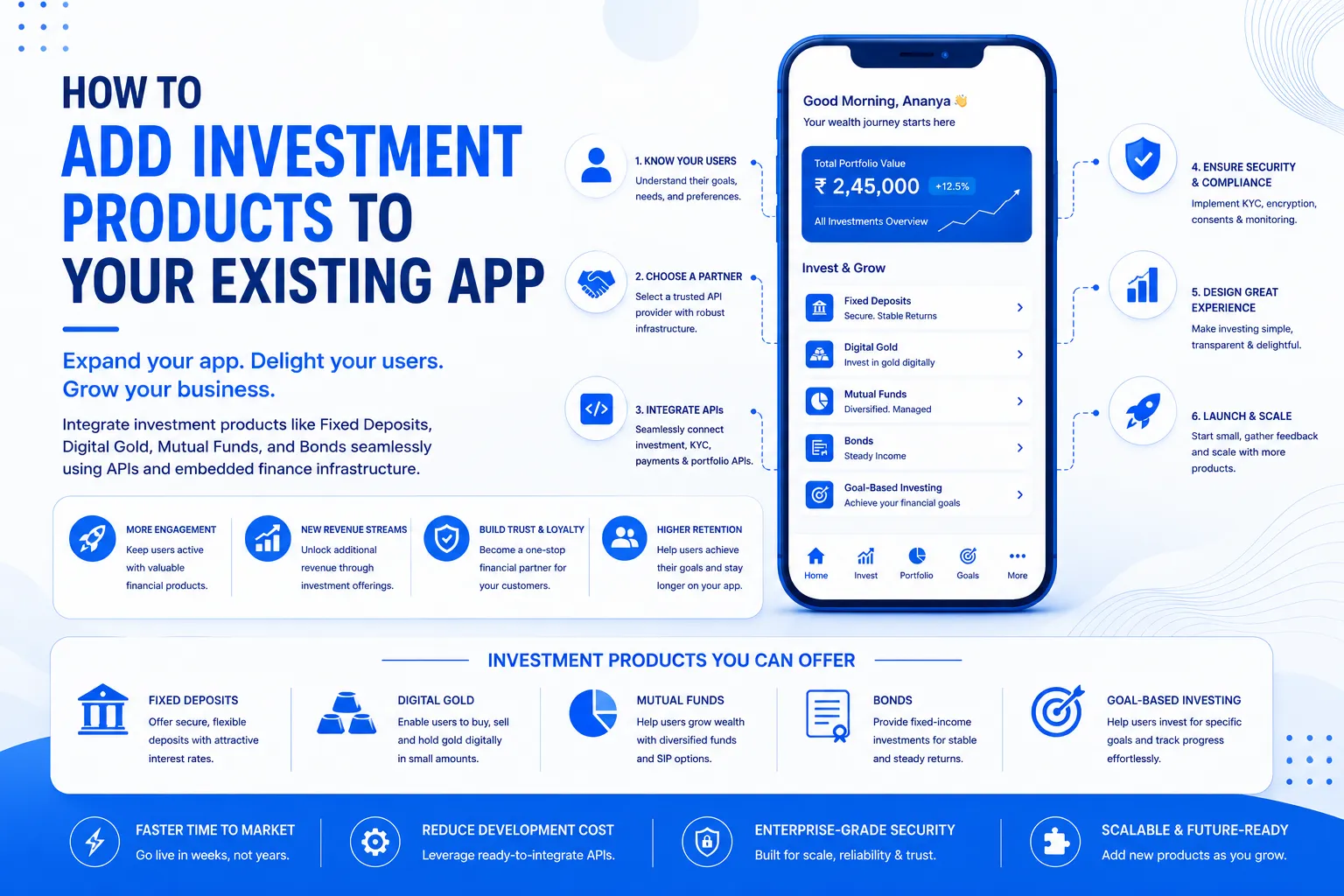
With API-driven embedded finance platforms, organizations can integrate products like Fixed Deposits, Digital Gold, Mutual Funds, and Bonds directly into their existing applications.
In this guide, we’ll explain how businesses can add investment products to an app, the technology involved, and the best practices for delivering a seamless customer experience.
Why Add Investment Products to Your App?
Customers are looking for convenience. Instead of downloading separate applications for investing, they prefer platforms that offer multiple financial services in one place.
Adding investment products helps businesses:
- Increase customer engagement
- Improve user retention
- Generate additional revenue streams
- Strengthen customer loyalty
- Differentiate from competitors
- Increase customer lifetime value
Rather than becoming just another app, businesses can become an essential part of their customers’ financial lives.
Which Investment Products Can You Offer?
Modern embedded finance platforms support a wide range of investment products.
Fixed Deposits
Fixed Deposits offer stable returns over fixed tenures and appeal to customers seeking low-risk investment options.
Ideal for:
- First-time investors
- Goal-based saving
- Capital preservation
Digital Gold
Digital Gold allows users to purchase and hold gold online without physical storage.
Benefits include:
- Fractional investments
- High liquidity
- Easy accessibility
- Long-term wealth preservation
Mutual Funds
Mutual Funds provide professionally managed, diversified investment portfolios suitable for long-term wealth creation.
Features often include:
- SIPs
- One-time investments
- Portfolio tracking
- Fund discovery
Bonds
Government and corporate bonds provide predictable income while helping users diversify investment portfolios.
Goal-Based Investing
Customers increasingly invest for specific objectives such as:
- Retirement
- Home ownership
- Children’s education
- Emergency funds
- Travel
Goal-based investing makes wealth management more personalized and meaningful.
Step 1: Understand Your Customers
Before integrating investment products, identify what your users actually need.
Consider:
- Customer demographics
- Financial literacy
- Risk appetite
- Spending behavior
- Long-term financial goals
For example:
A payroll platform may prioritize recurring investments and Fixed Deposits, while a consumer rewards app might begin with Digital Gold.
Choosing products based on customer needs improves adoption and engagement.
Step 2: Choose an Embedded Finance Partner
Rather than building financial infrastructure internally, businesses typically integrate with an API platform that provides access to regulated investment products.
A strong infrastructure partner should offer:
- Multiple investment products
- Secure APIs
- Digital KYC
- Payment integration
- Portfolio management
- Compliance support
- Reporting capabilities
This significantly reduces development effort while accelerating product launches.
Step 3: Integrate Investment APIs
APIs connect your frontend application with backend financial systems.
Typical API capabilities include:
Product Discovery
Allow customers to browse available investment options.
Customer Onboarding
Create investment accounts through digital registration workflows.
Digital KYC
Verify customer identity while meeting regulatory requirements.
Investment Execution
Enable customers to invest in selected products directly within the app.
Portfolio Management
Display investments, returns, holdings, and performance.
Notifications
Provide investment confirmations, maturity alerts, and portfolio updates.
A well-designed API architecture ensures a seamless customer experience.
Step 4: Design a Simple Investment Journey
Technology is only part of the solution.
User experience plays a critical role in adoption.
Businesses should focus on:
Easy Navigation
Investment products should feel like a natural extension of the existing app.
Clear Information
Explain products using simple language rather than financial jargon.
Personalized Recommendations
Suggest investments based on customer behavior and financial goals.
Progress Tracking
Allow users to monitor investments through intuitive dashboards.
Mobile Optimization
Ensure the entire investment journey is optimized for smartphones.
Reducing friction encourages customers to invest more frequently.
Step 5: Prioritize Security and Compliance
Financial products require enterprise-grade security.
Businesses should implement:
- Data encryption
- Multi-factor authentication
- Secure API gateways
- Digital KYC
- Audit trails
- Consent management
- Fraud monitoring
Many embedded finance providers include these capabilities as part of their infrastructure.
Step 6: Launch Incrementally
Businesses do not need to launch every investment product on day one.
A phased rollout often delivers better results.
For example:
Phase 1
- Fixed Deposits
Phase 2
- Digital Gold
Phase 3
- Mutual Funds
Phase 4
- Bonds
Phase 5
- Goal-based investing
This approach reduces complexity while allowing businesses to learn from customer feedback.
Which Businesses Can Add Investment Products?
Investment products are valuable across many industries.
Fintech Companies
Expand beyond payments into wealth management.
Digital Banks
Offer diversified financial products.
Payroll Platforms
Enable salary-linked investing.
Insurance Companies
Combine protection with investment opportunities.
Employee Benefit Platforms
Support workplace financial wellness.
Consumer Super Apps
Deliver all-in-one financial experiences.
E-commerce Platforms
Introduce Digital Gold and savings products as loyalty features.
Benefits of API-Driven Integration
Using APIs instead of building financial infrastructure internally provides several advantages.
Faster Time to Market
Launch investment products in weeks rather than years.
Lower Development Costs
Avoid building complex backend systems.
Better Scalability
Add new products as customer demand grows.
Improved Customer Experience
Deliver seamless investing within existing digital journeys.
Built-In Compliance
Leverage integrated KYC, reporting, and security workflows.
Enterprise-Grade Security
Protect customer data using proven financial infrastructure.
How Finspring Helps Businesses Add Investment Products
Building financial infrastructure independently requires significant engineering, regulatory expertise, and operational resources.
Finspring simplifies this process by providing API-driven infrastructure that enables businesses to integrate investment products into their existing applications through a single platform.
With Finspring, businesses can quickly launch:
- Fixed Deposits
- Digital Gold
- Mutual Funds
- Bonds
- Additional embedded investment products
Instead of managing backend complexity, organizations can focus on customer experience, product innovation, and business growth while leveraging secure, scalable financial infrastructure.
The Future of Digital Apps Is Embedded Finance
Customers increasingly expect financial services to be available wherever they already spend their time.
Businesses that add investment products today position themselves to increase engagement, strengthen customer relationships, diversify revenue streams, and create long-term competitive advantages.
With modern APIs making implementation faster and simpler than ever before, adding investment products to an existing app is no longer a large-scale technology project—it has become a strategic growth opportunity.
Frequently Asked Questions (FAQs)
Can any business add investment products to an app?
Yes. Fintech companies, digital banks, payroll platforms, insurance providers, employee benefits platforms, consumer apps, and other digital businesses can integrate investment products using API-driven infrastructure.
Which investment products should businesses launch first?
Many businesses begin with Fixed Deposits or Digital Gold due to their broad customer appeal, then expand into Mutual Funds, Bonds, and goal-based investing.
How do APIs help add investment products?
APIs provide secure integrations for onboarding, KYC, payments, investment execution, portfolio management, reporting, and compliance without requiring businesses to build financial infrastructure from scratch.
Is regulatory compliance included with embedded finance platforms?
Many infrastructure providers include features such as digital KYC, compliance workflows, reporting, audit trails, and secure payment processing to simplify regulatory requirements.
How does Finspring help businesses launch investment products?
Finspring provides API-driven financial infrastructure that enables businesses to integrate products such as Fixed Deposits, Digital Gold, Mutual Funds, and Bonds into their existing applications through a single, scalable integration, helping them launch faster while reducing operational complexity.