A Strategic Shift in Deposit Mobilisation for Modern Banks
Term deposits, including Fixed Deposits (FDs), remain a foundational pillar of bank balance sheets. They provide predictable, low-risk funding and support long-term lending and treasury strategies. However, traditional branch-centric deposit mobilisation models are increasingly constrained by rising operational costs, limited geographic reach, and changing customer behaviour. Aggregator-led FD distribution has emerged as a powerful alternative. By partnering with digital aggregator platforms, banks are unlocking new customer segments, accelerating deposit growth, and improving cost efficiency—without expanding their physical footprint.
This article examines how aggregator-led FD distribution works, why it is becoming critical for term deposit growth, and how banks can operationalise it effectively using modern API and AI-driven infrastructure.
What Is Aggregator-Led FD Distribution?
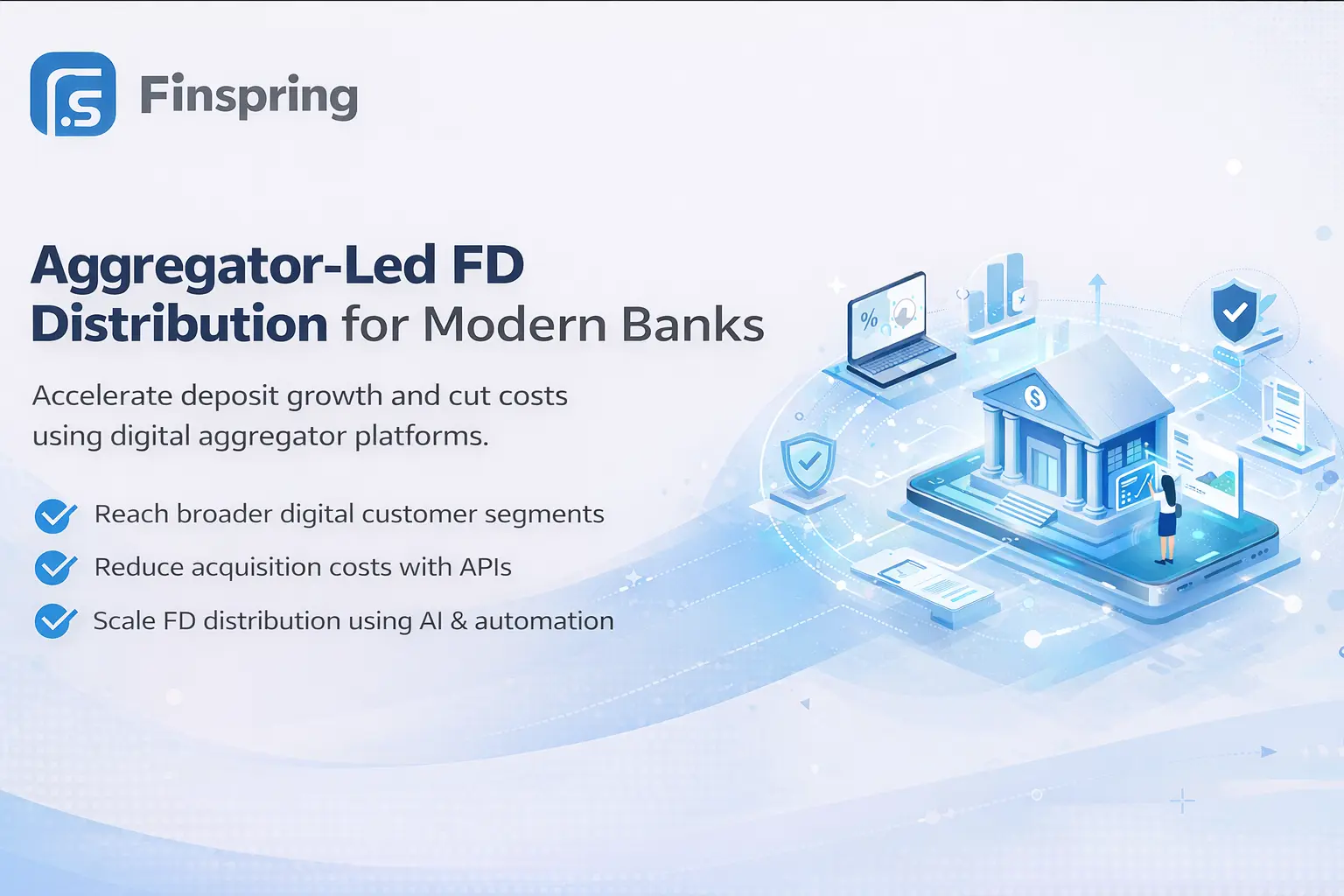
Aggregator-led FD distribution refers to a model where banks distribute their term deposit products through third-party digital platforms that aggregate offerings from multiple financial institutions.
These platforms typically provide:
- Product discovery and comparison
- Digital onboarding and KYC
- Application routing to the bank
- Status tracking and customer communication
Importantly, the deposit itself continues to sit with the regulated bank. Aggregators function as distribution and acquisition channels, not deposit holders.
Why Traditional FD Distribution Is Reaching Its Limits
While branches and direct relationship managers remain relevant, they face structural limitations when used as the primary growth engine.
Key Constraints of Branch-Led Deposit Growth
- High fixed costs (real estate, staffing, operations)
- Limited reach beyond branch catchment areas
- Manual, slower onboarding processes
- Lower appeal to digital-first customers
- Difficulty scaling quickly during rate-led campaigns
As customer acquisition increasingly shifts online, banks need scalable distribution layers that operate beyond physical infrastructure.
How Aggregator-Led Distribution Accelerates Term Deposit Growth
1. Expanded Reach Across Digital Customer Segments
Aggregators bring banks into high-intent digital environments where customers are already researching savings and investment products.
These include:
- Salaried professionals comparing rates
- Retirees seeking stable returns
- First-time digital investors
- Customers in Tier 2 and Tier 3 cities
Instead of waiting for customers to visit branches, banks meet them at the point of intent.
2. Lower and More Predictable Acquisition Costs
Aggregator partnerships typically operate on performance-linked commercial models such as cost-per-lead or revenue sharing.
| Channel | Cost Structure | Scalability |
|---|---|---|
| Branch Network | Fixed + Variable | Low |
| Direct Digital Ads | Variable, rising CPCs | Medium |
| Aggregator Platforms | Performance-based | High |
This allows banks to:
- Control acquisition spend
- Scale up or down quickly
- Optimise ROI at the channel level
3. Faster Deployment of FD Campaigns
Aggregator channels enable banks to launch and iterate deposit campaigns rapidly.
Banks can:
- Push rate-led offers instantly
- Test different tenures or minimum amounts
- Run limited-period promotions without branch training
This agility is particularly valuable in competitive interest-rate environments.
Aggregator Models Used for Term Deposit Growth
Banks typically adopt one or more of the following models.
Common Aggregator Engagement Models
| Model | Description | Best Used For |
|---|---|---|
| Lead-Based | Payment per verified lead | Market testing, pilot programs |
| Revenue Share | Commission on successful deposits | Long-term scale partnerships |
| Embedded Distribution | FD journeys embedded via APIs | High-volume, seamless acquisition |
Each model offers different levels of control, scale, and operational complexity.
The Role of APIs in Aggregator-Led FD Distribution
API infrastructure is the backbone of aggregator-led distribution.
APIs enable:
- Real-time rate and product sync
- Secure customer data exchange
- Digital KYC and onboarding
- Status updates and confirmations
Without robust APIs, aggregator partnerships become manual, error-prone, and difficult to scale.
How AI Enhances Aggregator-Led Term Deposit Growth
While aggregators expand reach, AI ensures efficiency and profitability.
Key AI-Driven Capabilities
| AI Capability | Impact on Term Deposits |
|---|---|
| Lead Scoring | Focuses on high-intent customers |
| Channel Analytics | Identifies top-performing aggregators |
| Offer Personalisation | Matches tenure and amount to customer profile |
| Drop-off Analysis | Reduces onboarding abandonment |
| Renewal Intelligence | Improves rollover and retention rates |
AI allows banks to move from volume-driven acquisition to quality-driven deposit growth.
Impact on Term Deposit Quality, Not Just Quantity
Aggregator-led distribution is often perceived as volume-focused. In practice, when combined with intelligent controls, it can improve deposit quality.
Banks can optimise for:
- Longer average tenure
- Higher average ticket size
- Better renewal probability
- Lower premature withdrawal rates
This ensures that growth strengthens the liability profile rather than diluting it.
Compliance and Risk Considerations
Scaling FD distribution through aggregators requires strong governance.
Key Risks and Mitigation Strategies
| Risk Area | Mitigation |
|---|---|
| Lead Quality | AI-based validation and scoring |
| Data Privacy | Consent-based data flows, encrypted APIs |
| Rate Accuracy | Real-time rate synchronisation |
| Regulatory Oversight | Centralised monitoring dashboards |
With the right infrastructure, banks retain full control over compliance while benefiting from external distribution.
Why Aggregator-Led FD Distribution Is Becoming Strategic
Aggregator-led FD distribution is no longer a tactical experiment. It is becoming a core component of deposit growth strategy.
Banks adopting this approach gain:
- Faster national reach
- Lower marginal acquisition costs
- Better visibility into customer behaviour
- Greater flexibility in managing deposit inflows
As competition for deposits intensifies, these advantages compound over time.
How Platforms Like Finspring.ai Enable Scalable FD Growth
To fully realise the benefits of aggregator-led distribution, banks need orchestration and intelligence layers.
Platforms like Finspring.ai help banks:
- Manage multiple aggregator partnerships centrally
- Monitor channel-level performance in real time
- Apply AI to optimise conversion and retention
- Maintain compliance and data governance at scale
This ensures that growth remains controlled, efficient, and sustainable.
Final Takeaway
Aggregator-led FD distribution is redefining how banks grow term deposits in a digital-first world.
Banks that succeed will:
- Extend distribution beyond branches
- Use APIs to enable seamless onboarding
- Apply AI to optimise quality and retention
- Treat aggregators as strategic partners, not just lead sources
In an environment where deposits are increasingly competitive, aggregator-led distribution—supported by intelligent infrastructure—offers banks a clear path to scalable, profitable term deposit growth.