Fixed deposits remain one of the most important liability products for banks. They provide stable funding, predictable costs, and regulatory comfort. Yet the way fixed deposits are distributed has become a strategic question.
For years, banks relied on direct sales models: branches, relationship managers, and bank-owned digital channels. While these channels still play a role, many banks are discovering that direct sales alone do not scale efficiently in today’s competitive, rate-sensitive environment.
At the same time, aggregator-led FD distribution has emerged as a parallel model, enabling banks to grow fixed deposit volumes through agent networks, wealth platforms, and digital intermediaries.
This raises a critical question:
Which model actually scales, and why?
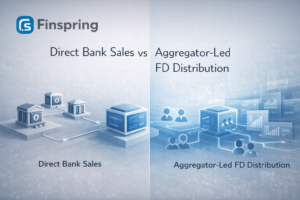
This article compares direct bank sales and aggregator-led FD distribution across cost, speed, reach, and operational efficiency to understand what drives sustainable scale.
Understanding Direct Bank FD Sales
Direct bank sales refer to fixed deposits sold through channels fully owned and managed by the bank.
Common Direct Sales Channels
-
Physical branches
-
Relationship managers
-
Bank websites and mobile apps
-
Call centers and in-house sales teams
Strengths of Direct Bank Sales
-
Full control over customer experience
-
Strong trust for existing customers
-
Tight integration with core banking systems
-
Clear compliance ownership
For renewals and existing customer deposits, direct sales work well. However, challenges arise when banks try to scale beyond their existing base.
Where Direct Bank Sales Hit Scaling Limits
1. Linear Growth With High Fixed Costs
Every incremental unit of growth requires:
-
More branches or staff
-
More training and compliance oversight
-
More operational expenditure
This creates a linear cost curve that becomes difficult to sustain at scale.
2. Limited New Customer Reach
Bank apps and branches largely serve:
-
Existing account holders
-
Customers already within the bank’s ecosystem
Acquiring new FD customers directly often requires expensive digital marketing or physical expansion.
3. Slow Market Response
Launching new FD campaigns or adjusting rates through bank-owned channels often involves:
-
App updates
-
Branch communication cycles
-
Internal approvals
This slows responsiveness in competitive rate environments.
What Aggregator-Led FD Distribution Looks Like
Aggregator-led distribution introduces an external digital layer between banks and customers.
Instead of selling FDs only through owned channels, banks distribute fixed deposits through:
-
Financial advisors
-
Wealth managers
-
Digital agents
-
Wealth and investment platforms
All of this is enabled through a single aggregator platform that standardizes onboarding, booking, reporting, and compliance.
Banks retain product ownership. Aggregators enable distribution.
Why Aggregator-Led FD Distribution Scales Better
1. Distribution Without Headcount Expansion
Aggregator platforms connect banks to existing agent and advisor networks.
Banks gain:
-
Immediate geographic reach
-
Access to relationship-driven demand
-
Distribution scale without hiring
This breaks the linear relationship between growth and internal cost.
2. Lower and More Predictable Acquisition Costs
Direct sales rely on:
-
Paid digital acquisition
-
Fixed staff costs
Aggregator-led models rely on:
-
Outcome-based distribution
-
Revenue sharing on funded deposits
This converts customer acquisition cost from a fixed burden into a controllable variable.
| Cost Dimension | Direct Bank Sales | Aggregator-Led Distribution |
|---|---|---|
| Marketing spend | High | Minimal |
| Sales cost | Fixed | Variable |
| CAC predictability | Low | High |
3. Faster Conversion Through Trusted Intermediaries
Fixed deposits are trust-heavy products.
Customers often prefer:
-
Known advisors
-
Long-term relationship managers
-
Local agents
Aggregator-led distribution digitizes these trust relationships, leading to:
-
Higher conversion rates
-
Faster closures
-
Lower follow-up overhead
Higher conversion directly improves scalability.
4. Single Integration, Multiple Channels
In a direct model, every new distribution initiative requires incremental setup.
With aggregators:
-
One integration unlocks many agents
-
New distributors onboard without bank-side effort
-
Scale compounds over time
This creates exponential reach instead of incremental reach.
Comparing What Actually Scales
| Dimension | Direct Bank Sales | Aggregator-Led FD Distribution |
|---|---|---|
| Cost structure | High fixed | Variable, outcome-based |
| Geographic reach | Limited | Nationwide |
| Speed to market | Slow | Fast |
| Scalability | Linear | Network-driven |
| Conversion efficiency | Moderate | High |
| Operational load | Bank-owned | Platform-managed |
Does Aggregator-Led Distribution Reduce Bank Control?
A common concern is loss of control. In practice, modern aggregator platforms often increase governance quality.
Banks retain control through:
-
Product rule engines
-
Eligibility and validation checks
-
Mandatory disclosures
-
Audit logs and reporting
Control shifts from physical presence to rule-based enforcement.
The Role of Direct Channels in a Scalable Model
This is not a zero-sum choice.
The most scalable banks use a layered distribution strategy:
-
Branches for trust-heavy and relationship-led deposits
-
Bank apps for existing customers and renewals
-
Aggregators for external reach and incremental growth
Each channel plays a distinct role without cannibalizing the others.
When Aggregator-Led Distribution Delivers the Most Impact
Aggregator-led FD distribution is especially effective when:
-
Banks want rapid geographic expansion
-
Fixed deposit rates are competitive and dynamic
-
Agent-led distribution remains strong
-
Cost-to-liability ratios matter
In these scenarios, direct sales alone struggle to keep pace.
How Platforms Like Finspring Enable Scalable FD Distribution
Finspring.ai enables banks to scale fixed deposit distribution by:
-
Connecting them to large agent and wealth networks
-
Providing single-platform, multi-bank access
-
Automating onboarding, booking, and reporting
-
Preserving full control over products and compliance
Banks grow FD volumes without expanding branches, rebuilding apps, or inflating acquisition costs.
What Actually Scales in the Long Run
Scaling fixed deposits is not about pushing harder through existing channels. It is about changing distribution architecture.
Direct bank sales scale well for:
-
Existing customers
-
Renewals
-
Relationship-led volumes
Aggregator-led distribution scales better for:
-
New customer acquisition
-
Nationwide reach
-
Cost-efficient growth
Banks that combine both models gain structural advantages that are difficult to replicate.
Conclusion
Direct bank sales provide control and trust but scale slowly and expensively. Aggregator-led FD distribution provides reach, speed, and cost efficiency without compromising governance.
The banks that grow fastest are not choosing one over the other. They are building hybrid, platform-led distribution strategies where direct channels and aggregators work together.
In a competitive deposit market, the question is no longer whether aggregator-led distribution scales better.
It is whether banks can afford to rely on direct sales alone.
Read how modern FD Aggregator platforms work, here.