The fintech ecosystem is evolving rapidly, and with it, the underlying infrastructure powering financial products is also changing. Two terms that often come up in this space are Banking-as-a-Service (BaaS) and API infrastructure. While they are sometimes used interchangeably, they represent fundamentally different approaches to building financial systems. For startups, fintech platforms, and even traditional institutions, understanding this difference is critical—especially when evaluating API banking infrastructure companies. The choice between BaaS and API-first infrastructure can directly impact speed, compliance, scalability, and long-term flexibility.
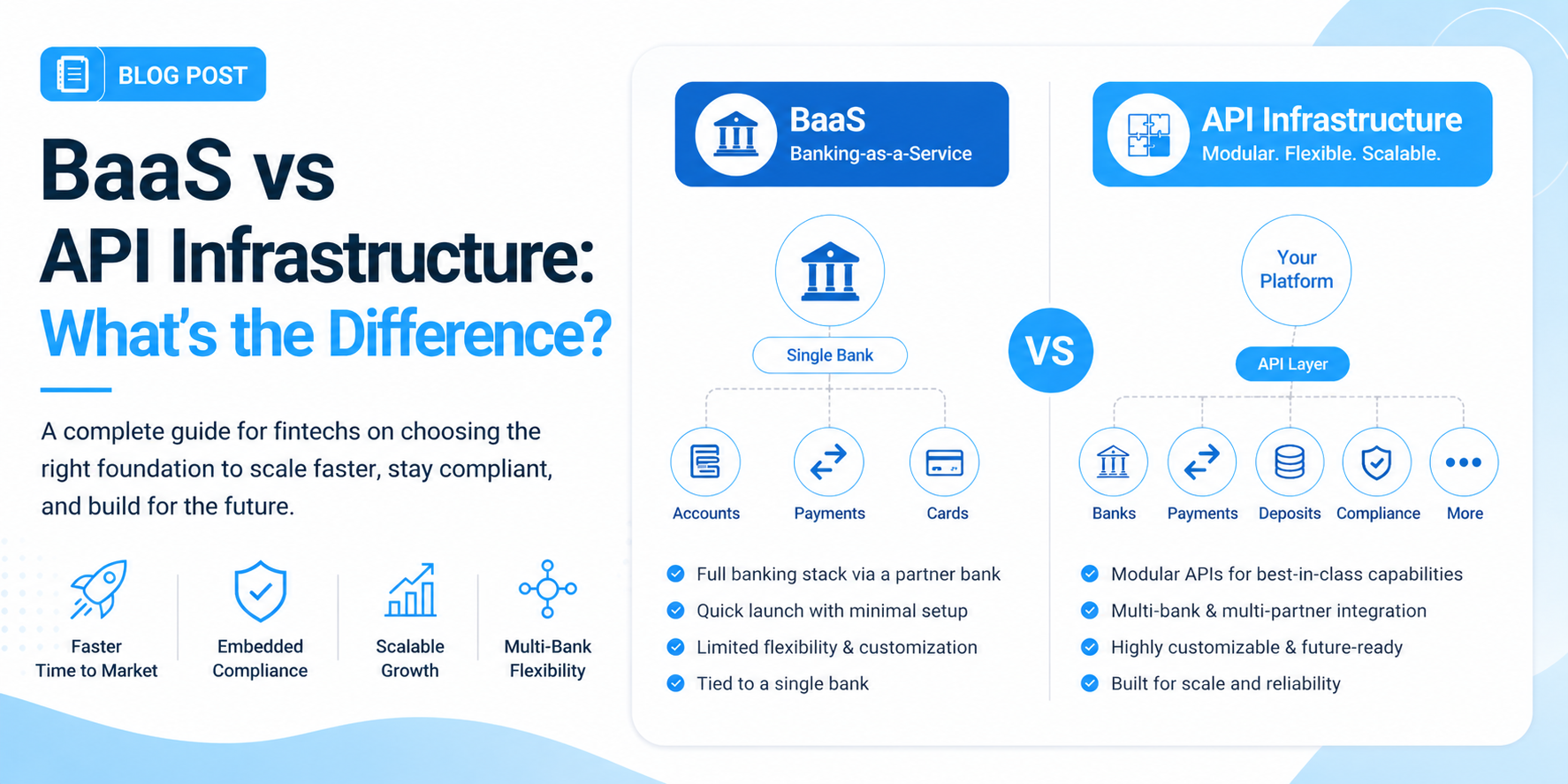
This article breaks down the difference between BaaS and API infrastructure, explains when to use each, and positions how platforms like Finspring fit into this evolving landscape.
What is Banking-as-a-Service (BaaS)?
Banking-as-a-Service refers to a model where licensed banks provide their core banking capabilities—such as account creation, payments, and lending—through APIs to third-party platforms. In this model, the fintech platform essentially builds on top of a bank’s infrastructure.
BaaS providers typically offer:
- Bank accounts (savings/current)
- Payment processing
- Card issuance
- Lending capabilities
- Regulatory coverage via the partner bank
This allows fintech companies to launch financial products without obtaining their own banking license.
What is API Infrastructure in Fintech?
API infrastructure, on the other hand, refers to a modular, API-first system that enables platforms to integrate specific financial capabilities without being tightly coupled to a single bank or provider.
Instead of offering a full banking stack, API infrastructure focuses on:
- Specific product layers (e.g., deposits, payments, compliance)
- Multi-partner integrations
- Real-time monitoring and reliability
- Scalability across use cases
This is where API banking infrastructure companies differentiate themselves—they provide the building blocks, not the entire bank.
Key Differences: BaaS vs API Infrastructure
| Aspect | Banking-as-a-Service (BaaS) | API Infrastructure |
|---|---|---|
| Core Model | Full banking stack via a partner bank | Modular APIs for specific capabilities |
| Flexibility | Limited (tied to one bank) | High (multi-bank / multi-partner) |
| Speed to Market | Fast initially | Fast and scalable long-term |
| Customization | Restricted by provider | Highly customizable |
| Compliance | Handled by partner bank | Embedded and automated across systems |
| Scalability | Can become restrictive | Designed for scale |
Why the Confusion Exists
The confusion between BaaS and API infrastructure comes from the fact that both use APIs and both enable fintech products. However, the depth and purpose of these APIs are very different.
- BaaS APIs expose banking capabilities
- API infrastructure exposes financial building blocks
This distinction becomes important as platforms grow and require more flexibility.
When BaaS Works Best
BaaS is ideal for platforms that want to:
- Launch quickly with minimal setup
- Offer full banking services (accounts, cards, etc.)
- Avoid dealing directly with regulatory frameworks
Typical use cases:
- Neobanks
- Wallet apps
- Early-stage fintech startups
In these cases, BaaS provides a shortcut to market entry.
Limitations of BaaS at Scale
While BaaS is effective for initial launches, it often creates challenges as platforms grow.
Key limitations:
- Vendor Lock-In
Platforms are tightly coupled with a single bank, making it difficult to switch or expand. - Limited Customization
Product features are restricted by what the BaaS provider supports. - Scaling Constraints
As transaction volumes increase, performance and flexibility can become bottlenecks. - Dependency Risk
Any issue with the partner bank directly impacts the platform.
Why API Infrastructure is Gaining Momentum
As fintech platforms mature, they move toward API-first infrastructure to overcome the limitations of BaaS. This approach allows them to:
- Integrate multiple banks and partners
- Customize product flows
- Scale independently
- Maintain control over user experience
This is why modern API banking infrastructure companies are becoming central to fintech growth.
The Rise of Specialized API Infrastructure
Instead of relying on a single provider for everything, fintech platforms are now adopting a best-of-breed approach:
- Payments via one provider
- Data via another
- Deposits via a specialized infrastructure platform
This shift enables platforms to:
- Optimize performance
- Reduce dependency
- Improve scalability
Where Finspring Fits In
Finspring operates in the API infrastructure layer, specifically focusing on fixed deposit (FD) and deposit distribution infrastructure.
Unlike BaaS providers that offer full banking stacks, Finspring provides:
- Plug-and-play FD APIs
- Multi-bank integration
- Embedded compliance workflows
- Real-time monitoring and SLA tracking
- Full lifecycle management (booking, maturity, reporting)
This positions Finspring as a specialized API banking infrastructure company focused on deposits—a category that is becoming increasingly important as users seek stability alongside growth.
Why API Infrastructure is Better for FD Distribution
FD distribution requires:
- Access to multiple banks
- Real-time confirmation and tracking
- Compliance-heavy workflows
- Reliable lifecycle management
BaaS models are not optimized for this because they are:
- Bank-specific
- Limited in flexibility
API infrastructure platforms like Finspring solve this by:
- Aggregating multiple banks
- Standardizing workflows
- Automating compliance
- Ensuring real-time reliability
BaaS vs API Infrastructure for FD Use Case
| Stage | BaaS Approach | API Infrastructure Approach |
|---|---|---|
| Integration | Single bank | Multi-bank via APIs |
| Product Flexibility | Limited | High |
| Compliance | Bank-dependent | Embedded and automated |
| Scalability | Restricted | Designed for scale |
| User Experience | Standardized | Customizable |
Strategic Decision: What Should You Choose?
The choice between BaaS and API infrastructure depends on your stage and goals.
Choose BaaS if:
- You need to launch quickly
- You want a full banking stack
- You are in early-stage development
Choose API Infrastructure if:
- You want flexibility and control
- You plan to scale across products
- You need multi-partner integrations
- You are building specialized financial products like FDs
The Future: Hybrid Infrastructure
The future of fintech is not about choosing one over the other—it is about combining both.
Platforms will:
- Use BaaS for core banking capabilities
- Use API infrastructure for specialized layers
This hybrid approach allows them to:
- Launch quickly
- Scale efficiently
- Optimize performance
Why API Banking Infrastructure Companies Will Define the Next Phase
As fintech evolves, the focus is shifting from building products to building systems that enable products. API banking infrastructure companies are at the center of this shift because they:
- Enable modular development
- Support multi-product ecosystems
- Reduce operational complexity
- Improve scalability
They are not just service providers—they are growth enablers.
Conclusion
The debate between BaaS and API infrastructure is not about which is better—it is about what fits your stage and strategy.
BaaS provides speed at the beginning.
API infrastructure provides flexibility and scale over time.
For platforms looking to expand into deposit products like FDs, specialized API infrastructure providers like Finspring offer a clear advantage. By enabling multi-bank integration, compliance automation, and real-time reliability, Finspring helps platforms move beyond basic functionality into scalable financial ecosystems.
In the end, the strongest fintech platforms are not built on a single system.
They are built on the right combination of infrastructure layers.