As fintech platforms scale, compliance becomes one of the most complex and resource-intensive aspects of operations. Every user onboarding, transaction, and product lifecycle event must adhere to strict regulatory frameworks. Traditionally, this has meant manual checks, fragmented workflows, and delayed execution. However, the emergence of API-driven compliance platforms is transforming how compliance is handled—shifting it from a bottleneck to an automated, scalable system.
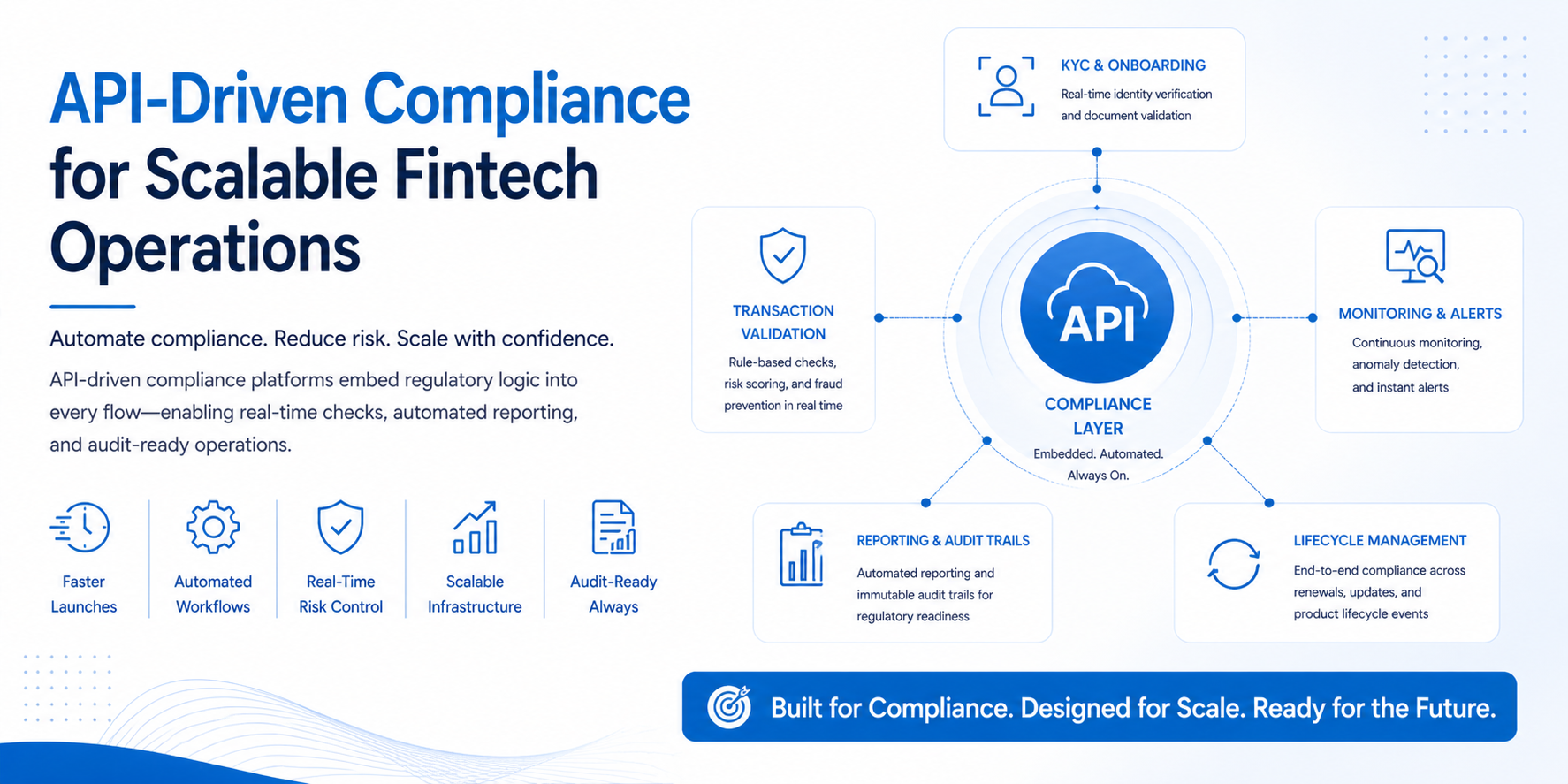
API-driven compliance platforms embed regulatory logic directly into programmable interfaces, enabling fintechs to automate compliance processes in real time. This approach not only reduces operational overhead but also ensures that compliance scales seamlessly alongside product growth.
What Are API-Driven Compliance Platforms?
API-driven compliance platforms are infrastructure systems that expose compliance capabilities—such as KYC verification, transaction monitoring, audit logging, and reporting—through APIs. Instead of building compliance workflows manually, fintech platforms can integrate these APIs to automatically enforce regulatory requirements at every stage of the user and transaction lifecycle.
This fundamentally changes how compliance is managed. Rather than being a separate function handled after product development, compliance becomes an integrated, real-time layer within the core system architecture, ensuring that every action taken on the platform is inherently compliant.
Why Traditional Compliance Models Fail to Scale
Traditional compliance systems were designed for slower, branch-based banking environments. As fintech shifts toward digital, real-time operations, these systems struggle to keep up. The reliance on manual processes, approval chains, and disconnected tools creates delays and inconsistencies that directly impact growth.
Key limitations of traditional compliance models include:
- Manual dependency, which increases processing time and error rates
- Fragmented workflows, requiring coordination across multiple teams and systems
- Delayed validation, where compliance checks occur after transactions instead of during them
- Limited scalability, making it difficult to handle increasing transaction volumes
These limitations make it clear that a new approach is required—one that aligns with the speed and scale of modern fintech systems.
How API-Driven Compliance Automates the Process
API-driven compliance platforms automate compliance by embedding checks and validations directly into the transaction flow. Instead of waiting for approvals or running separate verification processes, compliance is handled programmatically and instantly.
Key Automation Layers:
1. Automated KYC & Onboarding
APIs enable real-time identity verification by integrating with:
- Government databases
- Identity verification services
- Document validation systems
This allows platforms to:
- Verify users instantly
- Reduce onboarding time
- Eliminate manual document checks
2. Real-Time Transaction Validation
Every transaction can be validated against regulatory rules as it occurs. This includes:
- Transaction limits
- Risk scoring
- Fraud detection
Instead of flagging issues after completion, API-driven systems prevent non-compliant transactions from being executed.
3. Continuous Monitoring & Alerts
API-driven platforms provide real-time monitoring capabilities that:
- Track anomalies
- Detect unusual patterns
- Trigger alerts for potential violations
This ensures that compliance is not a one-time check but a continuous process.
4. Automated Reporting & Audit Trails
Compliance requires detailed reporting and record-keeping. APIs automate:
- Data collection
- Report generation
- Audit trail creation
This ensures that platforms remain audit-ready at all times, without manual effort.
5. Lifecycle Compliance Management
Beyond onboarding and transactions, compliance must be maintained throughout the product lifecycle. APIs handle:
- Renewals
- Status updates
- Event tracking
This ensures that compliance is maintained consistently across all stages.
Traditional vs API-Driven Compliance
| Aspect | Traditional Compliance | API-Driven Compliance Platforms |
|---|---|---|
| Execution | Manual and delayed | Automated and real-time |
| Integration | Fragmented systems | Unified API layer |
| Scalability | Limited | High and system-driven |
| Error Rate | High | Low due to automation |
| Audit Readiness | Reactive | Continuous |
Key Benefits of API-Driven Compliance Platforms
1. Faster Product Launches
By automating compliance workflows, platforms can reduce launch timelines significantly. There is no need to build or validate compliance systems from scratch, allowing teams to focus on product development and user experience.
2. Reduced Operational Overhead
Automation eliminates the need for:
- Manual checks
- Repetitive workflows
- Cross-team coordination
This leads to more efficient operations and lower costs.
3. Improved Accuracy and Consistency
APIs enforce standardized rules across all transactions, reducing:
- Human errors
- Inconsistencies
- Compliance gaps
This ensures that every action is handled uniformly.
4. Real-Time Risk Management
With continuous monitoring and instant validation, platforms can:
- Detect issues early
- Prevent violations
- Respond proactively
This significantly reduces risk exposure.
5. Scalability
As transaction volumes grow, API-driven systems can scale without additional operational burden. This makes them ideal for platforms aiming for rapid expansion.
Use Case: FD Infrastructure with API-Driven Compliance
In FD distribution, compliance requirements include:
- KYC verification
- Documentation validation
- Transaction tracking
- Regulatory reporting
Without API-Driven Compliance:
- Manual onboarding delays
- Multiple approval layers
- Slow reporting processes
With API-Driven Compliance:
- Instant onboarding
- Automated transaction validation
- Real-time reporting
| Stage | Without API Automation | With API Automation |
|---|---|---|
| Onboarding | Manual KYC checks | Instant verification via APIs |
| Booking | Approval delays | Pre-validated workflows |
| Reporting | Manual compilation | Automated real-time reports |
| Audit | Time-consuming | Instant readiness |
Challenges in Implementing API-Driven Compliance
While the benefits are clear, implementation requires careful planning. Key challenges include:
- Integration complexity, especially with legacy systems
- Regulatory alignment, ensuring APIs meet evolving standards
- Data security concerns, particularly when handling sensitive user information
- Dependency on external providers, which may impact reliability
However, modern infrastructure platforms address these challenges by offering secure, standardized, and scalable solutions.
The Role of Finspring
Finspring enables API-driven compliance within FD infrastructure by embedding regulatory workflows directly into its system. This allows fintech platforms to:
- Launch FD products faster
- Ensure compliance at every stage
- Reduce operational complexity
- Maintain audit-ready systems
By integrating once, platforms gain access to a fully compliant, scalable FD infrastructure, eliminating the need to build compliance systems independently.
The Future of Compliance Automation
The evolution of API-driven compliance is moving toward even greater intelligence and automation. Future developments will include:
- AI-driven compliance decision-making
- Predictive risk detection
- Real-time regulatory updates
- Deeper integration across financial ecosystems
As these capabilities evolve, compliance will become increasingly invisible yet powerful, operating seamlessly in the background.
Conclusion
API-driven compliance platforms represent a fundamental shift in how fintech systems handle regulatory requirements. By automating compliance through APIs, platforms can eliminate bottlenecks, reduce risk, and scale efficiently.
In modern financial infrastructure, compliance is no longer a separate function.
It is an integrated, automated, and essential part of the system.
Platforms that adopt API-driven compliance early will not only stay compliant—they will move faster, operate smarter, and grow without friction.