Fintech is designed to move fast. Product teams are built around speed, iteration, and rapid market entry. Yet, despite strong product ideas and clear user demand, many fintech platforms experience unexpected delays in launching and scaling financial products. In most cases, the root cause is not technology, talent, or strategy—it is compliance.
Compliance bottlenecks are one of the most underestimated constraints in fintech growth. While innovation pushes forward, compliance requirements operate on a different timeline, often creating friction between what can be built and what can be legally deployed. This gap slows down execution, increases operational complexity, and limits scalability.
What Are Compliance Bottlenecks in Fintech?
Compliance bottlenecks occur when regulatory requirements, approval processes, and operational checks delay or restrict product development and deployment. These bottlenecks are especially pronounced in sectors involving:
- Deposits (FDs, savings products)
- Lending
- Payments
- Investment platforms
Unlike traditional industries, fintech operates in a highly regulated environment, where every transaction, user interaction, and data flow must align with regulatory frameworks. When systems are not designed to handle this complexity efficiently, compliance becomes a point of friction rather than a support system.
Why Compliance Slows Fintech Growth
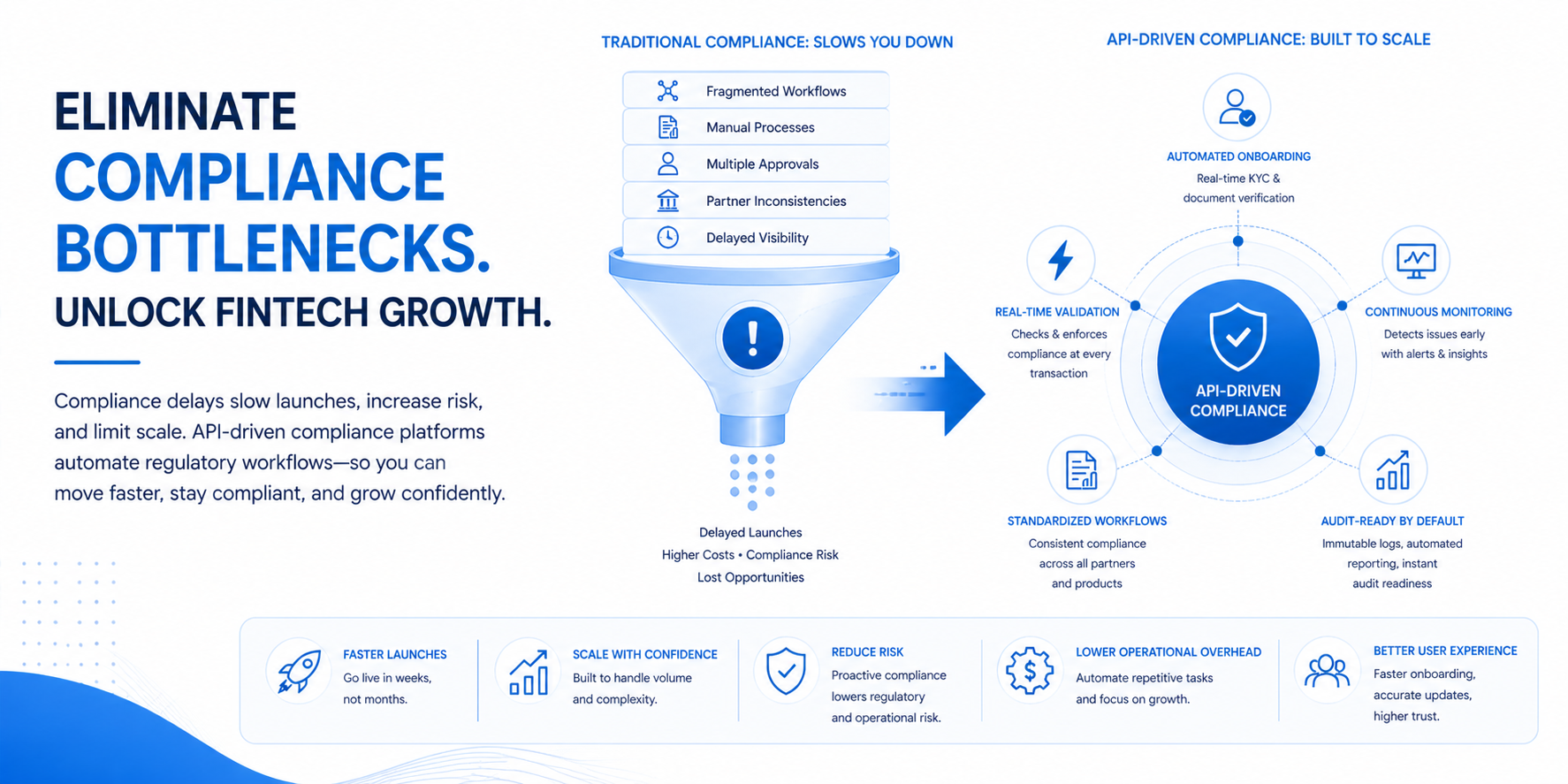
1. Fragmented Regulatory Workflows
In many fintech setups, compliance processes are scattered across:
- Legal teams
- Operations teams
- External vendors
- Manual documentation systems
This fragmentation creates delays because no single system owns the full compliance lifecycle. Each step requires coordination, validation, and often repeated checks, slowing down execution timelines significantly.
2. Manual Processes and Human Dependency
A large portion of compliance work still relies on:
- Manual KYC verification
- Document validation
- Approval chains
- Reporting compilation
These processes are not only time-consuming but also prone to errors. As transaction volumes increase, manual systems fail to scale, creating bottlenecks that directly impact growth.
3. Delayed Product Launch Cycles
Even when a product is technically ready, compliance validation can delay launches by weeks or months. This includes:
- Regulatory approvals
- Documentation checks
- Risk assessments
In fast-moving markets, these delays mean:
- Missed demand windows
- Lost competitive advantage
- Reduced revenue potential
4. Inconsistent Standards Across Partners
Fintech platforms often integrate with multiple partners, including banks and financial institutions. Each partner may have:
- Different compliance requirements
- Unique documentation formats
- Varying processing timelines
This lack of standardization forces platforms to customize workflows for each integration, increasing complexity and slowing down scalability.
5. Limited Real-Time Visibility
Many compliance systems lack real-time monitoring capabilities. As a result:
- Issues are detected late
- Violations are identified after the fact
- Teams react instead of preventing problems
This reactive approach increases risk and operational burden.
Traditional Compliance vs Api-driven Compliance Platforms
| Aspect | Traditional Compliance Approach | API-Driven Compliance Platforms |
|---|---|---|
| Workflow Management | Fragmented and manual | Centralized and automated |
| Speed | Slow and approval-heavy | Fast with real-time validation |
| Scalability | Limited | High and system-driven |
| Error Rate | High due to manual work | Reduced through automation |
| Visibility | Delayed | Real-time monitoring and alerts |
The Real Cost of Compliance Bottlenecks
Compliance delays are often viewed as operational issues, but their impact is far more strategic. They affect:
1. Revenue Growth
Delayed launches mean lost opportunities to capture user demand, especially in time-sensitive products like FDs.
2. Product Velocity
Teams spend more time managing compliance than building new features, reducing innovation speed.
3. Operational Efficiency
Manual processes increase costs and reduce productivity.
4. User Experience
Delays in onboarding, transaction processing, or confirmations reduce trust and satisfaction.
5. Risk Exposure
Inconsistent or delayed compliance increases the likelihood of regulatory violations.
Key Bottlenecks Across the Fintech Lifecycle
1. Onboarding Bottlenecks
- Slow KYC verification
- Document mismatches
- Manual approvals
2. Transaction Bottlenecks
- Delayed validations
- Partner dependencies
- Lack of real-time checks
3. Reporting Bottlenecks
- Manual data aggregation
- Inconsistent formats
- Audit preparation delays
4. Lifecycle Bottlenecks
- Renewal processing delays
- Status update inconsistencies
- Poor tracking systems
How API-Driven Compliance Platforms Solve This
API-driven compliance platforms are designed to embed compliance directly into the infrastructure layer, eliminating the need for separate processes and manual interventions.
Key Capabilities:
1. Automated Compliance Workflows
APIs handle:
- KYC validation
- Document verification
- Transaction checks
- This reduces human dependency and speeds up execution.
2. Real-Time Validation
Instead of post-processing checks, API-driven systems validate compliance:
- During onboarding
- During transactions
- During lifecycle events
This ensures issues are prevented rather than detected later.
3. Standardization Across Partners
API platforms create a uniform compliance layer across multiple banks and partners, removing the need for custom workflows.
4. Continuous Monitoring & Alerts
Real-time systems track:
- Anomalies
- SLA breaches
- Compliance deviations
This enables proactive issue resolution.
5. Audit-Ready Infrastructure
All data is:
- Logged
- Structured
- Accessible
This ensures that audits can be handled instantly without additional preparation.
Compliance as a Growth Enabler
When compliance is automated and embedded, it no longer slows down fintech growth. Instead, it enables:
- Faster product launches
- Scalable operations
- Reduced risk
- Better user experiences
This shift transforms compliance from a bottleneck into a strategic advantage.
Example: FD Distribution Without vs With Api-driven Compliance Platforms
| Stage | Without API-Driven Compliance | With API-Driven Compliance |
|---|---|---|
| Onboarding | Manual KYC delays | Instant automated verification |
| Booking | Multiple approval layers | Pre-validated workflows |
| Reporting | Manual compilation | Real-time automated reporting |
| Audit | Time-consuming | Instant readiness |
The Role of Finspring
Finspring addresses compliance bottlenecks by embedding regulatory workflows directly into its FD infrastructure. Through API-driven systems, platforms can:
- Launch FD products faster
- Ensure consistent compliance across partners
- Reduce operational overhead
- Maintain audit-ready systems at all times
- This allows fintech teams to focus on growth and distribution, while compliance runs seamlessly in the background.
The Future of Compliance in Fintech
As fintech ecosystems become more complex, compliance requirements will continue to evolve. The future will be defined by:
- Real-time regulatory updates
- AI-driven anomaly detection
- Fully automated reporting systems
- Deeper integration across financial products
Platforms that adopt API-driven compliance early will be better equipped to:
- Scale efficiently
- Navigate regulatory changes
- Maintain long-term trust
Conclusion
Compliance bottlenecks are one of the biggest hidden barriers to fintech growth. While they are often seen as unavoidable, they are largely a result of outdated systems and fragmented workflows.
By adopting API-driven compliance platforms, fintechs can eliminate these bottlenecks and transform compliance into a scalable, automated, and reliable system.
In modern financial infrastructure, growth is not just about building faster.
It is about building in a way that allows you to move without friction.