The banking industry is undergoing a structural transformation. Traditional, monolithic systems are no longer able to keep up with the pace of digital innovation, evolving customer expectations, and the need for rapid product deployment. In response, a new model is emerging—composable banking. At the center of this shift are api-first composable solutions for banks, which allow financial institutions to build flexible, modular systems instead of relying on rigid, all-in-one architectures. This approach is not just a technical upgrade—it is a strategic shift in how banks operate, innovate, and scale.
In this article, we break down what composable banking means, how it works, and why platforms like Finspring are becoming critical to enabling this transformation.
What is Composable Banking?
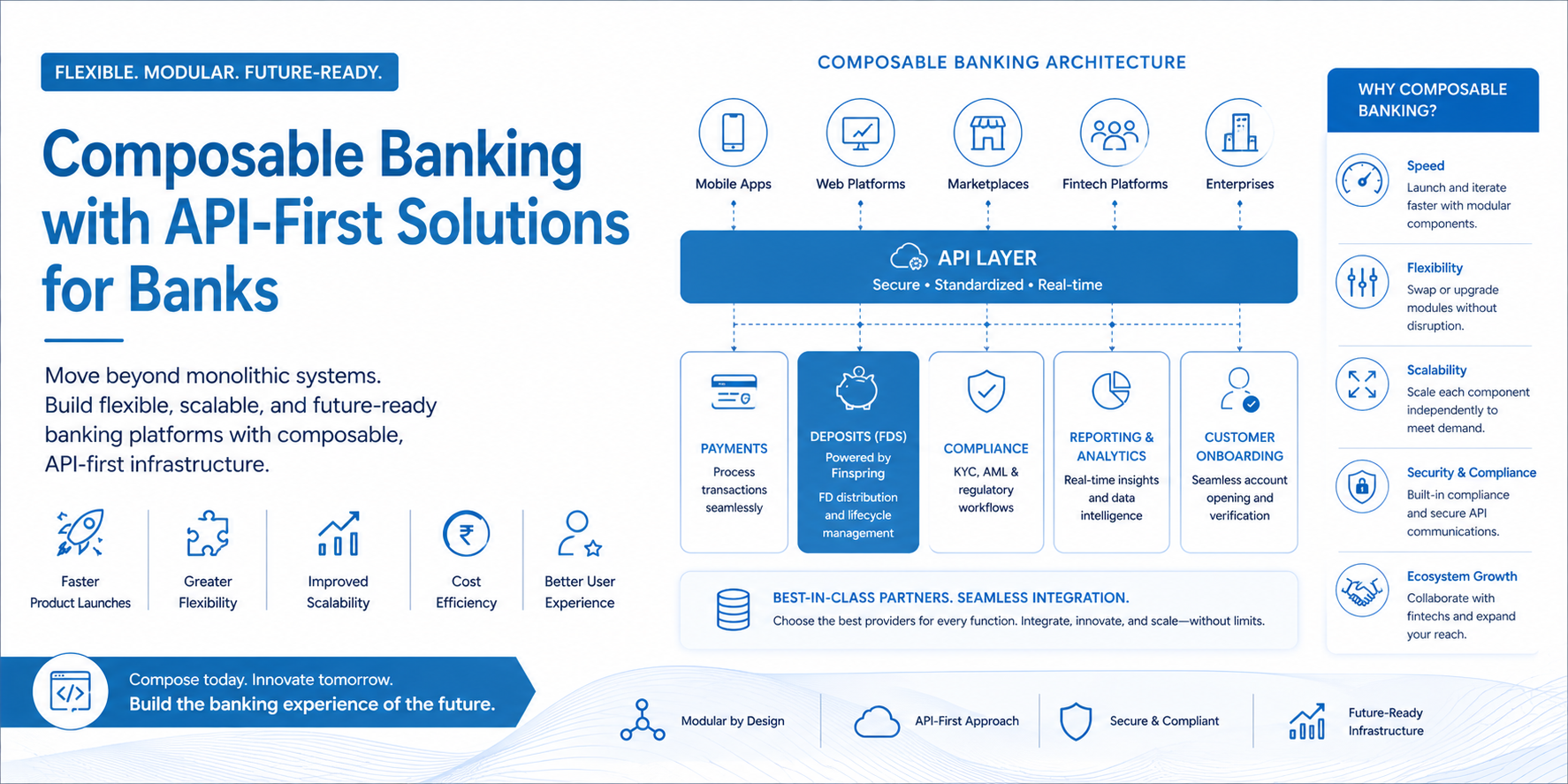
Composable banking is an architectural approach where banks build their systems using modular, interchangeable components rather than a single, monolithic core system. Each component handles a specific function—such as payments, deposits, compliance, or reporting—and can be independently integrated, updated, or replaced.
This modularity is made possible through APIs, which act as connectors between different components. Instead of building everything internally, banks can assemble their systems using api-first composable solutions for banks, selecting the best tools for each function.
Why Traditional Banking Systems Fall Short
Traditional banking infrastructure is built around:
- Centralized core systems
- Tight coupling between components
- Long development cycles
While this worked in the past, it creates significant limitations today:
Key challenges:
- Slow innovation: Adding new features requires changes across the entire system
- High costs: Maintaining and upgrading monolithic systems is expensive
- Limited flexibility: Adapting to market changes is difficult
- Integration complexity: Connecting with external platforms is time-consuming
These challenges make it clear that a new approach is needed—one that prioritizes speed, flexibility, and scalability.
How Composable Banking Works
Composable banking breaks down the financial system into independent modules that communicate through APIs. Each module performs a specific function and can be managed separately.
Typical components include:
- Payments module
- Deposit and FD module
- Compliance and KYC module
- Reporting and analytics module
- Customer onboarding module
Each of these components can be powered by different providers, creating a best-of-breed architecture.
API-First Composable Solutions for Banks
API-first composable solutions are the foundation of this architecture. These solutions are designed to:
- Expose functionality through APIs from the start
- Enable seamless integration between modules
- Support real-time communication
- Ensure scalability and reliability
This approach allows banks to:
- Build faster
- Integrate easily
- Scale efficiently
Traditional vs Composable Banking
| Aspect | Traditional Banking | Composable Banking |
|---|---|---|
| Architecture | Monolithic | Modular |
| Flexibility | Low | High |
| Speed of Innovation | Slow | Fast |
| Integration | Complex | API-driven |
| Scalability | Limited | High |
Benefits of Composable Banking
1. Faster Product Launches
With modular systems, banks can:
- Launch new products quickly
- Test ideas without full system changes
- Respond to market demand in real time
2. Greater Flexibility
Banks can:
- Replace individual components
- Integrate new partners
- Adapt to changing requirements
without disrupting the entire system.
3. Improved Scalability
Each module can scale independently, allowing banks to:
- Handle increased demand
- Optimize performance
- Reduce system bottlenecks
4. Cost Efficiency
Instead of maintaining large monolithic systems, banks can:
- Use specialized providers
- Reduce development costs
- Optimize resource allocation
5. Better User Experience
Composable systems enable:
- Faster transactions
- Seamless integrations
- Consistent performance
The Role of API Infrastructure in Composable Banking
API infrastructure is what makes composable banking possible. It provides:
- Standardized communication between modules
- Real-time data exchange
- Security and compliance layers
- Monitoring and reliability systems
Without strong API infrastructure, composable systems would become fragmented and difficult to manage.
Where Finspring Fits In
Finspring operates as a specialized API infrastructure provider within the composable banking ecosystem, focusing on FD and deposit distribution.
In a composable architecture, Finspring acts as the deposit module, enabling banks and fintech platforms to:
- Integrate FD products quickly
- Access multiple banks through a single API
- Automate compliance workflows
- Manage the entire FD lifecycle
This allows banks to add a deposit layer to their system without building it from scratch.
Example: Composable Banking with Finspring
| Module | Provider Type | Function |
|---|---|---|
| Payments | Payment API provider | Process transactions |
| Deposits (FDs) | Finspring | FD distribution and lifecycle |
| Compliance | KYC/AML provider | Regulatory checks |
| Reporting | Analytics platform | Data insights |
This modular setup allows banks to:
- Combine best-in-class solutions
- Scale each component independently
- Maintain flexibility
Why Composable Banking Matters for FD Distribution
Fixed Deposits are becoming increasingly important as users seek stable financial products. However, traditional systems make it difficult to:
- Integrate multiple banks
- Manage compliance
- Scale distribution
Composable banking solves this by allowing banks to:
- Add FD infrastructure as a module
- Use API-first solutions like Finspring
- Scale distribution across platforms
Challenges in Composable Banking
While powerful, composable banking comes with challenges:
1. Integration Complexity
Managing multiple modules requires:
- Strong API management
- Clear documentation
- Robust monitoring systems
2. Vendor Coordination
Working with multiple providers requires:
- SLA management
- Performance tracking
- Consistent standards
3. Security and Compliance
Each module must:
- Meet regulatory requirements
- Maintain data security
- Ensure system integrity
Best Practices for Implementing Composable Banking
1. Start with Core Modules
Identify key functions such as:
- Payments
- Deposits
- Compliance
and build modular systems around them.
2. Choose API-First Providers
Ensure that all components:
- Are API-driven
- Support real-time operations
- Provide scalability
3. Standardize Integration
Use consistent:
- Data formats
- API structures
- Communication protocols
4. Invest in Monitoring
Track:
- Performance
- SLAs
- System health
to ensure reliability.
The Future of Composable Banking
Composable banking will continue to evolve, driven by:
- Increased API adoption
- Growth of fintech ecosystems
- Demand for faster innovation
- Regulatory changes
Future systems will become:
- More modular
- More automated
- More interconnected
Conclusion
Composable banking represents the future of financial infrastructure. By adopting api-first composable solutions for banks, institutions can move beyond the limitations of traditional systems and build flexible, scalable architectures.
Platforms like Finspring play a critical role in this ecosystem by providing specialized infrastructure for FD and deposit distribution. This allows banks to integrate new capabilities quickly and scale efficiently.
In a world where speed and flexibility define success, composable banking is not just an option—it is a necessity.
Because the banks that win will not build everything themselves.
They will assemble the best systems and connect them seamlessly.