If you’ve explored fintech, banking technology, or modern financial products, you’ve likely encountered terms like API infrastructure, API-first platforms, or financial infrastructure APIs. These terms often sound highly technical, making many founders, operators, and even banking teams assume API infrastructure is something only engineers need to understand. In reality, understanding API infrastructure meaning is increasingly important for anyone building or distributing financial products. Whether you’re launching payment systems, embedded finance experiences, or fixed deposits (FDs), API infrastructure is often the invisible layer powering everything.
This guide explains API infrastructure in simple terms and explores why companies like Finspring rely on API-driven systems to make financial products scalable.
What Does API Infrastructure Mean?
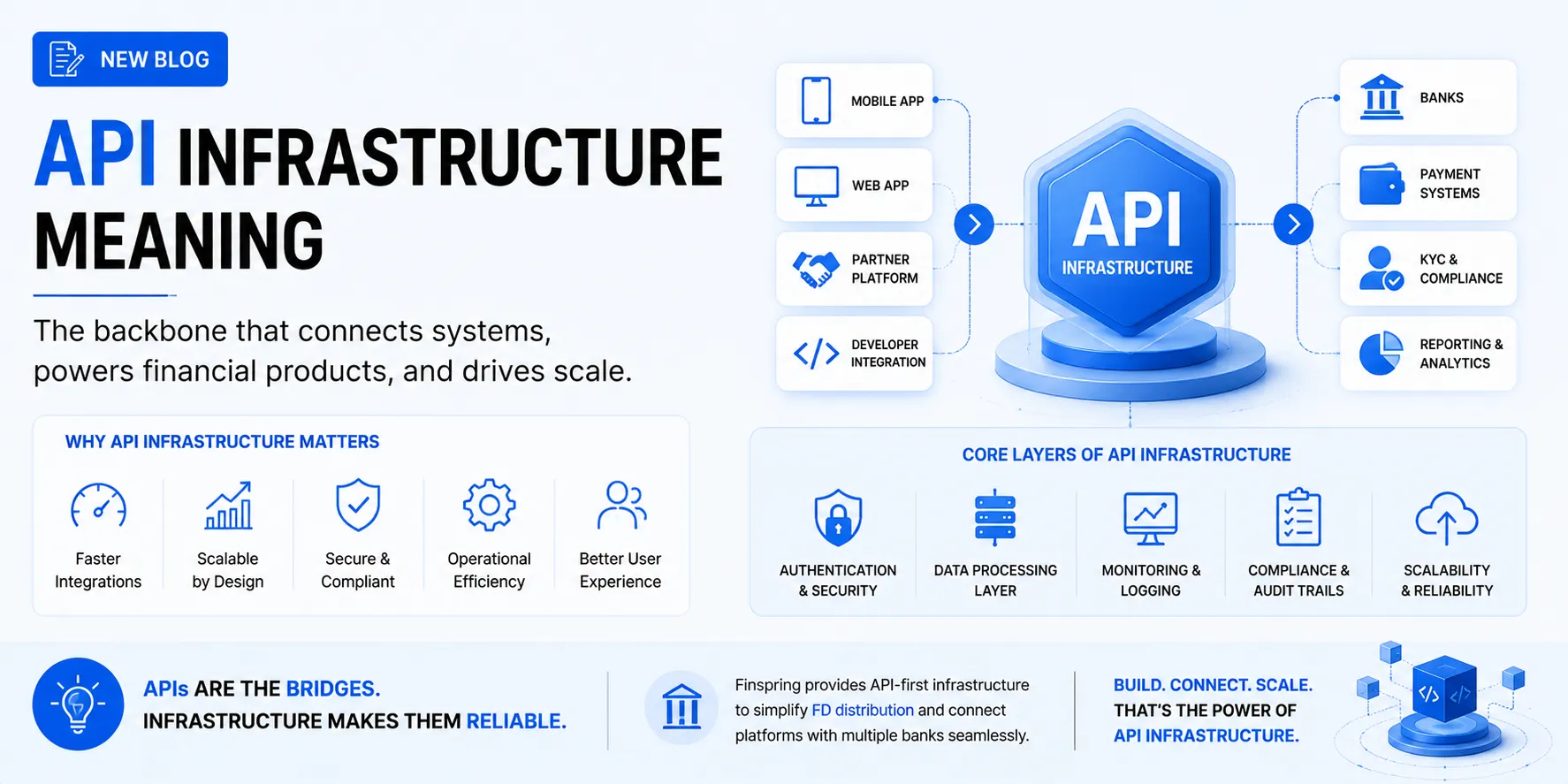
API infrastructure refers to the systems, architecture, tools, and workflows that allow different software platforms to communicate and exchange information through APIs (Application Programming Interfaces).
Think of APIs as bridges between systems.
API infrastructure is everything required to ensure those bridges:
- Work reliably
- Remain secure
- Handle large volumes
- Scale over time
- Support real-time communication
Without API infrastructure, digital financial ecosystems would become fragmented and difficult to operate.
A Simple Analogy: API Infrastructure as Roads
Imagine:
- Banks = Cities
- Apps = Buildings
- Financial products = Services
- APIs = Roads connecting everything
API infrastructure is the entire transportation system:
- Highways
- Traffic controls
- Security checkpoints
- Maintenance systems
- Monitoring tools
The roads alone are not enough. The supporting infrastructure matters.
Why API Infrastructure Exists
Traditional financial systems relied heavily on isolated software environments.
If a new platform wanted to integrate:
- Payments
- Deposits
- KYC verification
- Banking products
development was often slow and manual.
API infrastructure changed this by enabling systems to connect instantly.
Benefits include:
✓ Faster integration
✓ Better scalability
✓ Reduced development effort
✓ Easier expansion into new products
Core Components of API Infrastructure
Understanding API infrastructure becomes easier when broken into layers.
1. APIs (The Communication Layer)
APIs allow systems to request information or trigger actions.
Examples:
An app may request:
- Interest rates
- User verification
- FD availability
The API returns the response.
2. Authentication Systems
Infrastructure must determine:
“Who is allowed access?”
This includes:
- Tokens
- API keys
- Permissions
- Security protocols
Authentication protects sensitive financial information.
3. Data Processing Layer
Once requests arrive, backend systems:
- Validate information
- Process transactions
- Execute workflows
This layer handles actual logic.
4. Monitoring & Logging
Modern API infrastructure tracks:
- Response times
- Errors
- Usage volumes
- Failures
This supports reliability.
5. Compliance Layer
Financial products require:
- KYC
- Reporting
- Audit trails
- Monitoring
Compliance increasingly lives inside infrastructure.
How API Infrastructure Works (Simple Example)
Imagine a user books an FD through a fintech app.
The process may look like this:
Step 1:
User clicks:
Book Fixed Deposit
↓
Step 2:
App sends API request
↓
Step 3:
Infrastructure validates identity
↓
Step 4:
FD system checks rates and availability
↓
Step 5:
Transaction processed
↓
Step 6:
Confirmation returned instantly
The user sees only one action.
Behind the scenes, multiple infrastructure layers interact.
Traditional Systems vs API Infrastructure
| Area | Traditional Banking Systems | API Infrastructure |
|---|---|---|
| Integration | Manual | Automated |
| Speed | Slow | Real-time |
| Scalability | Limited | High |
| Updates | Complex | Flexible |
| User Experience | Fragmented | Seamless |
Why API Infrastructure Matters in Fintech
Fintech growth depends heavily on infrastructure.
Companies compete on:
- Speed
- Reliability
- Product expansion
- User experience
Strong infrastructure enables all four.
Without scalable APIs:
Launching products becomes slower.
Compliance becomes harder.
Distribution becomes fragmented.
Examples of API Infrastructure in Financial Products
API infrastructure powers:
Payments
Processing transactions between users and institutions.
Digital Onboarding
Handling:
- KYC
- Verification
- Authentication
Embedded Finance
Allowing financial products inside non-financial apps.
Deposit Products & FDs
Connecting platforms with banks.
Compliance Monitoring
Automating:
- Reporting
- Audit trails
- Alerts
Where Finspring Fits into API Infrastructure
Finspring operates within a specialized infrastructure layer focused on FD distribution and deposit products.
Instead of banks or fintechs building everything themselves, Finspring provides API-driven infrastructure enabling FD access through one integration.
This allows platforms to:
- Access multiple banks
- Launch FD offerings faster
- Automate compliance workflows
- Monitor infrastructure reliability
- Scale distribution efficiently
In simple terms:
Finspring turns complex FD operations into infrastructure that can be integrated programmatically.
Example: API Infrastructure for FD Distribution
Without infrastructure:
Platform → Individual bank integrations → Manual workflows → Higher complexity
With API infrastructure:
Platform → Finspring API → Multi-bank access → Automated workflows
Complexity decreases dramatically.
Benefits of API Infrastructure
Faster Product Launches
Teams build quickly using existing infrastructure.
Better Scalability
Systems handle increasing usage without major rebuilds.
Reduced Operational Burden
Automation minimizes repetitive manual work.
Improved Reliability
Monitoring ensures better uptime.
Easier Compliance
Compliance becomes embedded rather than separate.
Common Misconceptions About API Infrastructure
Myth 1:
APIs are only for developers
Reality:
Founders and operators increasingly need infrastructure understanding.
Myth 2:
Infrastructure equals backend coding
Reality:
Infrastructure affects:
- Growth
- Compliance
- Scaling
- Monetization
Myth 3:
Infrastructure matters later
Reality:
Poor infrastructure decisions create long-term bottlenecks.
The Future of API Infrastructure
Financial infrastructure is evolving toward:
- AI-driven workflows
- Real-time compliance
- Modular banking systems
- Embedded finance ecosystems
- Composable infrastructure
Infrastructure will become increasingly invisible to users but more important operationally.
Conclusion
Understanding API infrastructure meaning is becoming essential for anyone involved in financial products.
At its simplest:
API infrastructure enables systems to communicate efficiently.
At scale:
It determines how fast products launch, how reliably they operate, and how easily businesses grow.
Platforms like Finspring demonstrate how specialized infrastructure layers can simplify complex products like fixed deposits and make them accessible through APIs.
Because in modern finance, the companies that scale fastest often aren’t the ones with the most products.
They’re the ones with the strongest infrastructure behind them.