As the financial ecosystem becomes increasingly digital, banks, NBFCs, fintech platforms, and wealth management companies are looking for ways to distribute fixed deposit (FD) products through online channels. Fixed deposits continue to be one of the most trusted financial instruments for savings, and enabling digital access to these products creates new opportunities for customer acquisition and funding diversification.
However, integrating FD products from banks and NBFCs into digital platforms is not straightforward. Each financial institution has its own operational processes, APIs, compliance requirements, and reporting systems. Managing these integrations manually can create technical complexity, operational inefficiencies, and delays in product launches.
Finspring addresses these challenges by providing infrastructure specifically designed to simplify bank and NBFC FD integration. Through its SDK and API-driven platform, Finspring enables fintech platforms and financial institutions to integrate deposit products quickly and manage them through a unified system.
This article explains how Finspring simplifies the process of bank and NBFC FD integration, allowing financial platforms to offer fixed deposit products seamlessly while maintaining operational efficiency and compliance.
The Growing Demand for Digital FD Distribution
Fixed deposits have long been a core savings product in India’s financial landscape. Traditionally, customers opened FDs through physical bank branches or through direct relationships with financial institutions.
However, the rise of fintech platforms, digital banking apps, and wealth management services has changed how customers access financial products. Today’s users expect to manage their investments through digital interfaces that provide convenience, transparency, and flexibility.
As a result, digital platforms increasingly want to integrate FD products from multiple banks and NBFCs into their ecosystems.
Offering multiple FD options allows platforms to:
- provide users with diversified deposit choices
- compare interest rates and tenures
- create more comprehensive savings solutions
- strengthen customer engagement
To achieve this, however, platforms must establish reliable integration frameworks with financial institutions.
Challenges in Bank and NBFC FD Integration
Integrating FD products from banks and NBFCs presents several technical and operational challenges.
Fragmented Technology Systems
Different financial institutions use different core banking systems, APIs, and operational workflows. Integrating with each institution separately can require significant engineering effort.
Complex Operational Processes
FD products involve multiple operational processes, including onboarding, deposit booking, payment confirmation, maturity tracking, and reporting. Ensuring these processes work consistently across different institutions can be difficult.
Regulatory Compliance Requirements
Banks and NBFCs operate under strict regulatory frameworks. Integration systems must ensure that deposit transactions comply with KYC requirements, transaction monitoring rules, and reporting standards.
Data Synchronization
Accurate data synchronization between platforms and partner institutions is critical. Deposit records, payment confirmations, and lifecycle events must remain consistent across systems.
These challenges often slow down the integration process and increase operational risk.
Finspring’s Approach to FD Integration
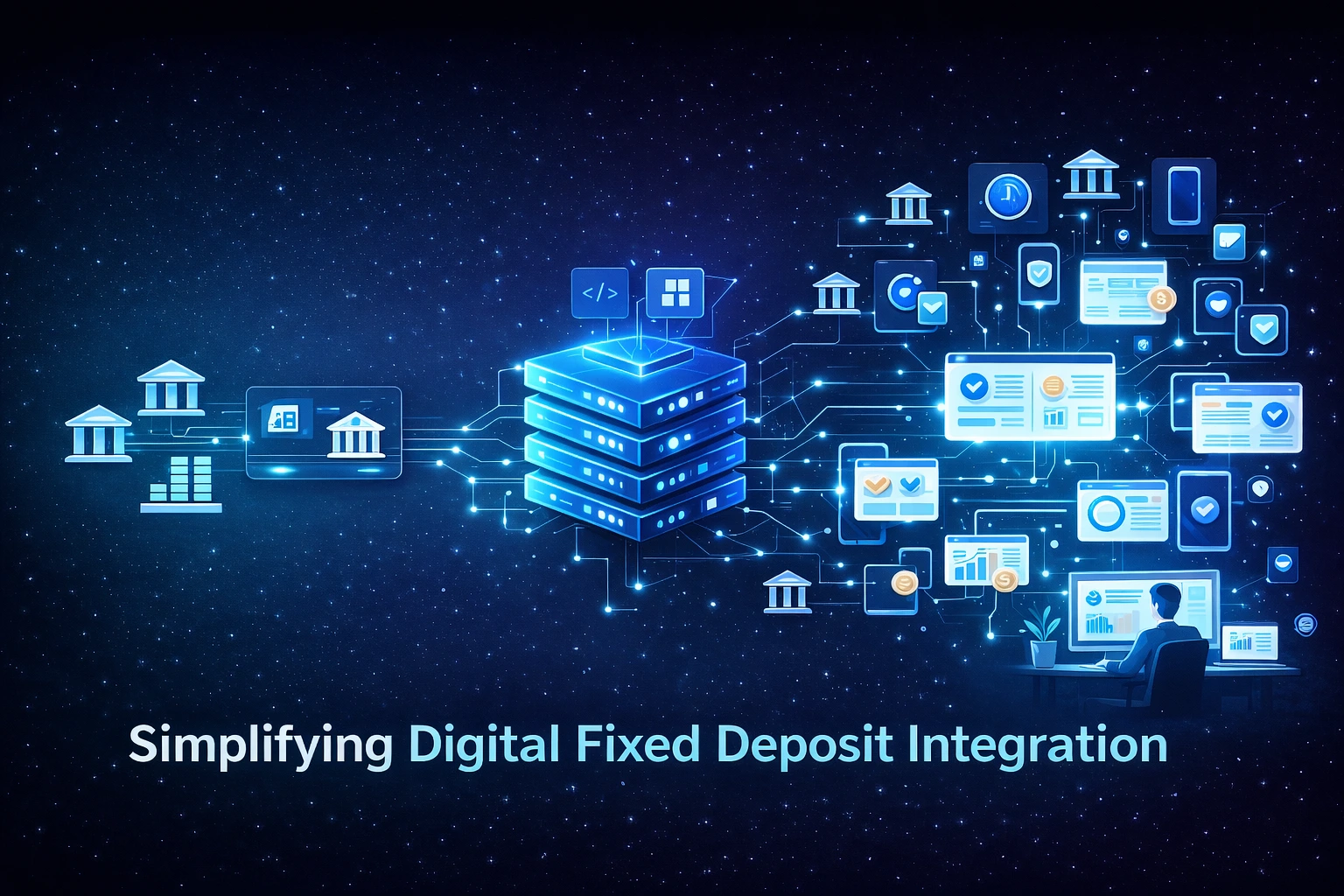
Finspring simplifies bank and NBFC FD integration by providing a standardized infrastructure layer that connects digital platforms with financial institutions.
Instead of building separate integrations for each bank or NBFC, platforms can integrate once with Finspring’s SDK and access multiple deposit providers through a unified interface.
This architecture reduces technical complexity and accelerates deployment timelines.
Unified API Layer for FD Integrations
One of the core components of Finspring’s infrastructure is its unified API framework.
The platform standardizes interactions with multiple financial institutions through a single set of APIs. Developers can use these APIs to access FD products, create deposit bookings, and retrieve deposit information without building custom integrations for each provider.
Key API functions include:
- retrieving available FD products
- booking fixed deposits
- accessing deposit lifecycle updates
- retrieving maturity and interest details
- managing deposit portfolios
By consolidating these functions into a unified API layer, Finspring simplifies the integration process for digital platforms.
Standardized Product Discovery
Different banks and NBFCs structure their deposit products differently. Interest rates, tenures, minimum investment amounts, and payout structures may vary across institutions.
Finspring’s infrastructure standardizes these product parameters so that digital platforms can present FD options in a consistent format.
Users can easily compare deposit options across multiple institutions based on:
- interest rates
- tenure durations
- investment requirements
- payout schedules
Standardized product discovery improves the user experience while simplifying integration logic for developers.
Seamless Deposit Booking Workflows
Deposit booking is a critical step in FD integration. The platform must coordinate user inputs, payment transactions, and deposit confirmations across multiple systems.
Finspring manages this process through its deposit booking engine.
The booking workflow includes:
- validating deposit parameters
- confirming payment completion
- creating deposit records
- synchronizing data with partner institutions
Because this workflow is managed within Finspring’s infrastructure, digital platforms do not need to build complex transactional systems internally.
This significantly reduces development effort and operational risk.
Payment Coordination and Transaction Validation
Fixed deposits require reliable payment confirmation before a deposit can be created. Payment failures or mismatches can lead to discrepancies between financial systems.
Finspring includes a payment orchestration layer that ensures deposit bookings occur only after successful payment validation.
This layer coordinates with payment systems such as:
- UPI
- net banking
- bank transfers
- Transaction details are recorded automatically, creating accurate financial records for reconciliation and reporting.
Deposit Lifecycle Synchronization
Once a deposit is created, the system must track its lifecycle across multiple systems.
Finspring ensures that deposit data remains synchronized between digital platforms and partner institutions throughout the lifecycle.
Lifecycle events include:
- deposit creation
- interest accrual
- tenure progression
- maturity events
- payout processing
By synchronizing lifecycle data across systems, Finspring ensures that both the platform and the financial institution maintain accurate deposit records.
Integrated Reporting and Reconciliation
Financial institutions require reliable reporting infrastructure to monitor deposit operations and maintain compliance.
Finspring provides built-in reporting tools that support reconciliation and operational monitoring.
These tools generate reports such as:
- deposit activity summaries
- transaction reconciliation records
- payout reports
- portfolio analytics
This integrated reporting infrastructure reduces the administrative burden associated with managing multiple deposit providers.
Scalability for Multi-Institution Distribution
As digital platforms expand their financial offerings, they often want to partner with multiple banks and NBFCs.
Finspring’s infrastructure is designed to scale efficiently as new deposit providers are added.
Instead of building separate integrations for each institution, platforms can access additional providers through the same integration framework.
This scalability allows platforms to expand their FD marketplace while maintaining operational simplicity.
Benefits of Simplified FD Integration
Finspring’s approach to bank and NBFC FD integration offers several advantages for digital platforms.
Faster Deployment
Platforms can launch FD products without building custom integrations for each institution.
Reduced Engineering Complexity
Unified APIs and standardized workflows simplify development and maintenance.
Improved Data Consistency
Automated synchronization ensures that deposit records remain accurate across systems.
Better User Experience
Customers can access multiple FD options through a single digital interface.
The Future of FD Distribution Infrastructure
The financial industry is moving toward open and modular infrastructure models where platforms can distribute multiple financial products through integrated ecosystems.
As more fintech platforms enter the savings and investment space, the ability to integrate deposit products efficiently will become increasingly important.
Infrastructure providers like Finspring play a crucial role in enabling this ecosystem by connecting banks, NBFCs, and digital platforms through standardized technology frameworks.
By simplifying bank and NBFC FD integration, Finspring helps financial institutions expand their reach while enabling digital platforms to offer trusted savings products to their users.
Conclusion
Integrating fixed deposit products from banks and NBFCs into digital platforms is a complex process that involves multiple technical, operational, and regulatory challenges.
Finspring simplifies this process through a unified infrastructure designed specifically for bank and NBFC FD integration. By providing standardized APIs, deposit booking workflows, payment orchestration, lifecycle synchronization, and reporting capabilities, the platform enables digital platforms to integrate FD products efficiently.
This streamlined approach allows fintech companies, wealth platforms, and financial institutions to expand their product offerings without the burden of building complex integration systems.
In a rapidly evolving digital finance ecosystem, platforms that can integrate financial products quickly and reliably will be best positioned to meet growing customer demand for accessible and transparent savings solutions.