As embedded finance continues to evolve, most conversations focus on speed, user experience, and distribution. However, beneath all of this lies a more fundamental requirement—compliance. In regulated financial ecosystems like India, compliance is not an additional layer; it is the foundation upon which everything else must operate. This is where compliance-first embedded finance infrastructure emerges as a defining category.
Compliance-first embedded finance infrastructure refers to systems that are designed with regulatory logic at their core, rather than treating compliance as a post-build requirement. Instead of adding compliance checks after product development, this approach ensures that every workflow, API call, transaction, and lifecycle event is inherently aligned with regulatory expectations from day one.
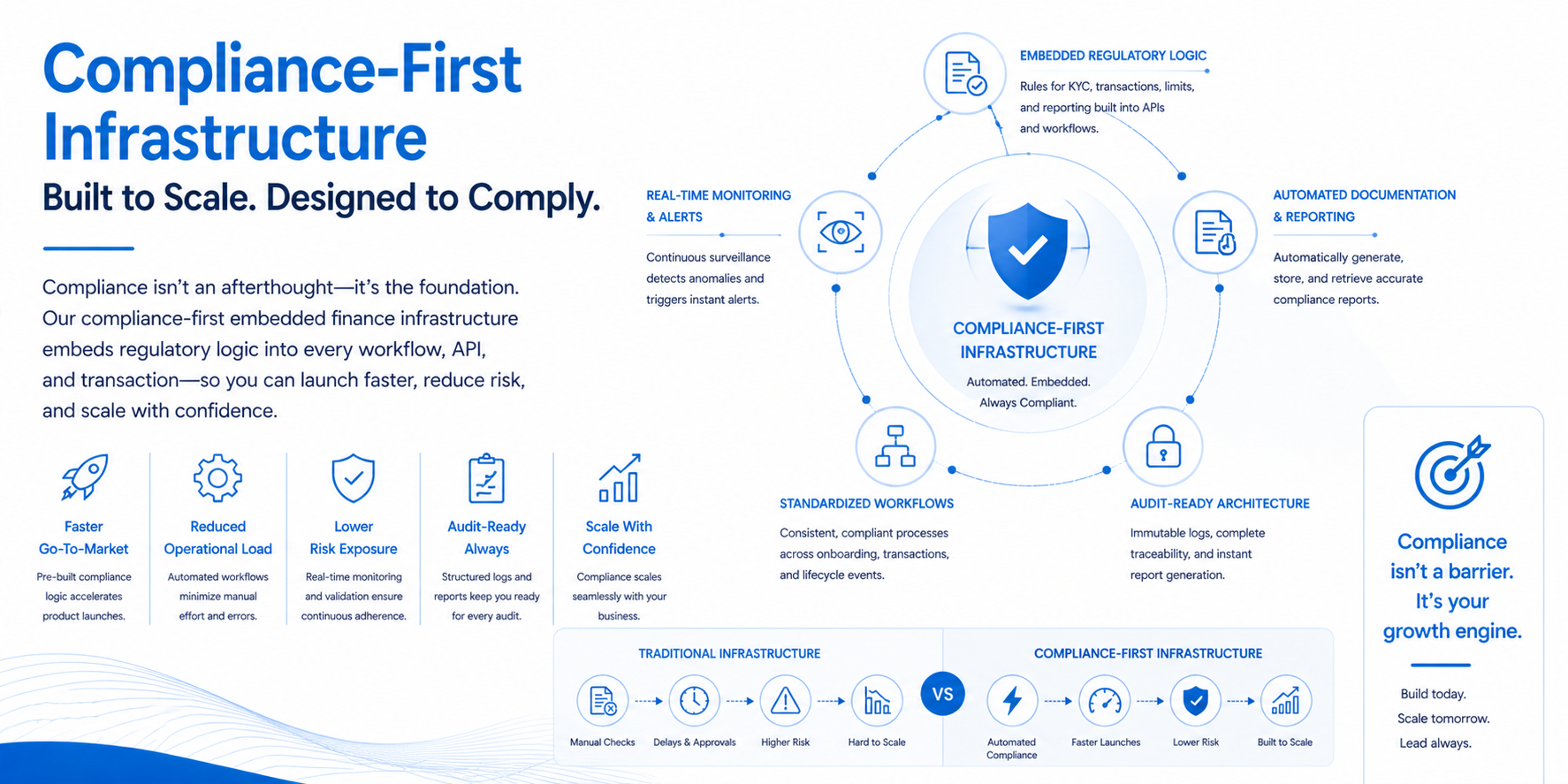
What is Compliance-first Embedded Finance Infrastructure?
Compliance-first infrastructure is a design philosophy and technical architecture where regulatory requirements are embedded directly into the infrastructure layer, ensuring that every financial operation automatically adheres to applicable laws, audit standards, and reporting norms without requiring manual intervention or retrofitting.
In traditional systems, compliance is often handled through:
- Manual checks
- External tools
- Post-transaction audits
In contrast, compliance-first systems:
- Automate regulatory workflows
- Standardize documentation and reporting
- Enable real-time validation and monitoring
This fundamentally shifts compliance from being a bottleneck to becoming an accelerator of growth.
Traditional vs Compliance-First Infrastructure
| Aspect | Traditional Infrastructure | Compliance-First Infrastructure |
|---|---|---|
| Compliance Approach | Added after development | Built into core architecture |
| Speed to Market | Slower due to approvals and rework | Faster due to pre-built regulatory logic |
| Risk Management | Reactive | Proactive and automated |
| Audit Readiness | Periodic and manual | Continuous and real-time |
| Operational Load | High | Reduced through automation |
Why Compliance-First Infrastructure is Becoming Critical
In today’s fintech ecosystem, regulatory scrutiny is increasing alongside innovation. Financial products—especially those involving deposits, lending, and payments—require strict adherence to frameworks defined by regulators such as the Reserve Bank of India (RBI). As platforms scale, managing compliance manually becomes not only inefficient but also risky.
A compliance-first approach addresses this challenge by ensuring that regulatory alignment scales with product growth, rather than becoming a limiting factor. This is particularly important for products like Fixed Deposits (FDs), where trust, documentation accuracy, and reporting integrity are critical.
Core Components of Compliance-First Infrastructure
1. Embedded Regulatory Logic
At the heart of compliance-first systems is embedded regulatory logic, where rules governing KYC, documentation, transaction limits, and reporting are integrated directly into APIs and workflows. This ensures that every transaction automatically adheres to regulatory requirements without additional checks.
2. Automated Documentation & Reporting
Compliance involves extensive documentation, including:
- KYC records
- Transaction logs
- Audit trails
A compliance-first system automates the generation, storage, and retrieval of these records, ensuring that platforms remain audit-ready at all times, rather than preparing for audits reactively.
3. Real-Time Monitoring & Alerts
Modern compliance is not just about static rules—it requires continuous monitoring. Compliance-first infrastructure includes real-time systems that:
- Track anomalies
- Detect irregular transactions
- Trigger alerts for potential violations
This allows platforms to respond immediately, reducing risk exposure.
4. Standardized Workflows
One of the biggest sources of compliance risk is inconsistency. Compliance-first systems standardize workflows across:
- Onboarding
- Transactions
- Lifecycle events
This ensures that every user and every transaction follows the same compliant process, regardless of scale.
5. Audit-Ready Architecture
Instead of scrambling during audits, compliance-first infrastructure ensures that:
- Data is structured and accessible
- Reports can be generated instantly
- Historical records are complete and accurate
This transforms audits from a stressful process into a routine check.
Key Benefits of Compliance-First Infrastructure
1. Faster Go-To-Market
When compliance is already built into the system, platforms can launch products faster without waiting for extensive validation cycles. This is especially important in time-sensitive markets where user demand shifts quickly.
2. Reduced Operational Complexity
By automating compliance workflows, platforms reduce the need for:
- Manual checks
- Reconciliation efforts
- Cross-team coordination
This leads to cleaner operations and better efficiency.
3. Lower Risk Exposure
Compliance failures can result in:
- Financial penalties
- Reputational damage
- Regulatory restrictions
Compliance-first infrastructure minimizes these risks by ensuring continuous adherence.
4. Improved Trust & Credibility
In financial services, trust is directly linked to reliability and compliance. Platforms that consistently deliver compliant experiences build stronger user confidence and long-term credibility.
Challenges Without Compliance-First Infrastructure
Platforms that do not adopt this approach often face:
- Delayed product launches due to compliance bottlenecks
- Increased dependency on manual processes
- Higher probability of errors and inconsistencies
- Difficulty scaling operations across multiple products
- Over time, these challenges compound, slowing growth and increasing risk.
Compliance-first Embedded Finance Infrastructure in Action (FD Example)
Let’s consider how this applies to FD distribution:
| Stage | Without Compliance-First Infra | With Compliance-First Infra |
|---|---|---|
| User Onboarding | Manual KYC checks, delays | Automated KYC validation |
| FD Booking | Multiple approvals required | Pre-approved compliant workflows |
| Reporting | Manual compilation | Real-time automated reporting |
| Audit | Time-consuming preparation | Instant audit readiness |
This illustrates how compliance-first infrastructure transforms execution speed, reliability, and scalability.
The Shift Toward Compliance as a Growth Enabler
Historically, compliance has been viewed as a constraint—something that slows down innovation. However, the shift toward compliance-first infrastructure reframes this perspective.
When compliance is:
- Automated
- Standardized
- Embedded
It no longer delays execution. Instead, it enables platforms to:
- Launch confidently
- Scale without friction
- Operate within regulatory boundaries effortlessly
This turns compliance into a competitive advantage.
The Role of Finspring in Compliance-First Infrastructure
Finspring is built on the principle that financial infrastructure should be compliance-ready from day one. By embedding regulatory workflows directly into its FD infrastructure, Finspring enables platforms to:
- Launch FD products without compliance delays
- Maintain audit-ready systems at all times
- Scale distribution without increasing operational risk
Through its plug-and-play SDK and API-driven architecture, Finspring ensures that compliance is not something platforms need to manage separately—it is already part of the system.
The Future of Compliance-first Embedded Finance Infrastructure
As fintech continues to evolve, compliance-first infrastructure will become the standard rather than the exception. Future systems will likely include:
- AI-driven compliance monitoring
- Predictive risk detection
- Real-time regulatory updates
- Deeper integration across financial products
The platforms that adopt this approach early will be better positioned to:
- Navigate regulatory changes
- Scale across markets
- Build long-term trust
Conclusion
Compliance-first infrastructure represents a fundamental shift in how financial systems are designed and operated. By embedding regulatory logic directly into the core architecture, platforms can move faster, operate more efficiently, and reduce risk significantly.
In a world where financial products are becoming increasingly digital and interconnected, compliance is no longer a backend requirement—it is a core product capability.
Platforms that recognize this shift will not only stay compliant—they will scale with confidence.