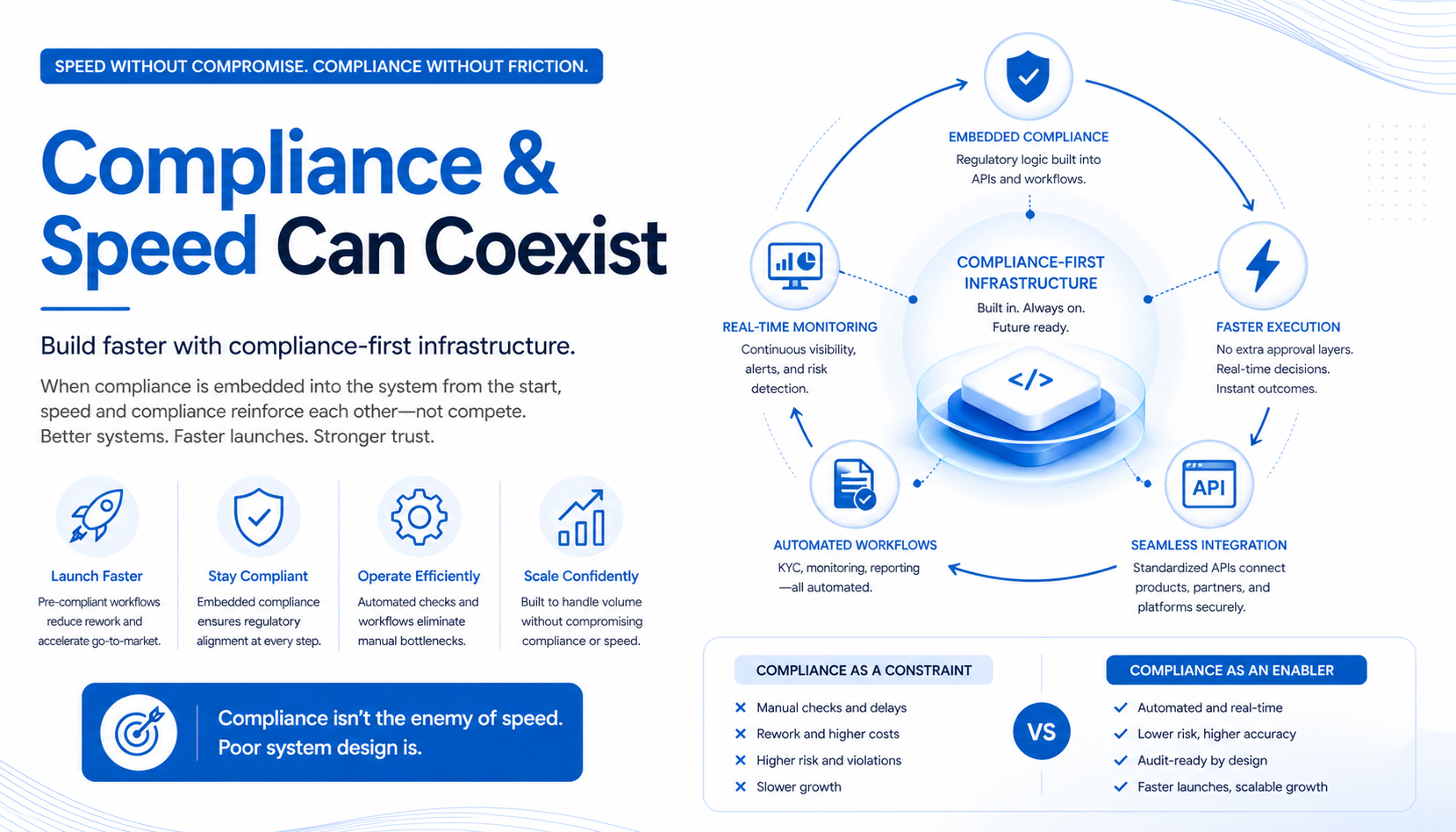
In fintech, one of the most persistent assumptions is that compliance and speed are inherently in conflict. Founders believe that moving fast requires cutting through regulatory friction, while compliance teams are expected to slow things down to ensure safety and adherence. This perceived tradeoff has shaped how financial products are built, often forcing teams to choose between rapid execution and regulatory alignment. But this assumption is fundamentally flawed. The real issue is not that compliance slows down speed—it is that most systems are not designed to handle compliance efficiently. When infrastructure is fragmented or compliance is treated as an afterthought, delays become inevitable. However, with compliance-first embedded finance infrastructure, speed and compliance can reinforce each other rather than compete.
Why the Compliance vs Speed Debate Exists
The perception of a tradeoff comes from how traditional fintech systems have been built. Most platforms start with a product-first approach, focusing on user experience and core functionality. Compliance is then layered on top, often late in the development cycle. This creates friction because systems must be reworked to meet regulatory requirements, leading to delays and inefficiencies.
In such setups, compliance introduces:
- Additional approval layers
- Manual verification processes
- Repeated checks across systems
This makes compliance appear as a constraint on speed, when in reality it is a consequence of poor system design.
The Reality: It’s a System Design Problem
Speed and compliance are not opposing forces. They operate on different layers:
- Speed depends on how efficiently systems execute tasks
- Compliance depends on how accurately systems follow rules
When systems are not designed to handle both simultaneously, friction emerges. The solution is not to compromise on either—but to build infrastructure that integrates both seamlessly.
Traditional Thinking vs Modern Infrastructure Thinking
| Perspective | Traditional Approach | Compliance-First Approach |
|---|---|---|
| View of Compliance | Constraint | Capability |
| Speed Strategy | Build fast, fix later | Build right, launch fast |
| System Design | Fragmented | Integrated |
| Execution | Reactive | Proactive |
| Outcome | Delays and rework | Faster, cleaner launches |
Where Speed Breaks Without Compliance
Many fintech platforms attempt to prioritize speed by bypassing or minimizing compliance considerations early on. While this may accelerate initial development, it creates long-term challenges that ultimately slow down growth.
Key failure points:
1. Rework After Development
When compliance is not considered upfront, systems must be redesigned to meet regulatory standards. This leads to:
- Extended development cycles
- Increased costs
- Delayed launches
2. Operational Bottlenecks
Manual compliance processes create dependencies across teams, slowing down:
- Onboarding
- Transactions
- Reporting
As volume increases, these bottlenecks become more severe.
3. Regulatory Risk
Skipping compliance or treating it as secondary increases the risk of:
- Violations
- Penalties
- Product shutdowns
This risk forces platforms to slow down later, negating any early speed advantage.
Where Compliance Breaks Without Speed
On the other hand, over-engineered compliance systems can also create problems when they are not designed for speed.
Common issues include:
- Overly complex workflows
- Excessive approval layers
- Lack of automation
- Slow response times
This leads to:
- Missed market opportunities
- Poor user experience
- Reduced competitiveness
The Shift: Compliance-First Embedded Finance
The solution lies in compliance-first embedded finance infrastructure, where compliance is built into the system at a foundational level. Instead of adding compliance later, regulatory logic is integrated directly into APIs, workflows, and data structures.
This approach ensures that:
- Every action is automatically compliant
- No additional approval layers are required
- Execution remains fast and consistent
How Compliance Enables Speed
When compliance is embedded into infrastructure, it removes the need for:
- Manual checks
- Repeated validations
- Cross-team coordination
This allows systems to operate more efficiently, enabling faster execution across all stages.
Key enablers:
1. Pre-Validated Workflows
When workflows are designed to meet regulatory requirements from the start, there is no need for additional approvals. This reduces delays and accelerates product launches.
2. Automated Compliance Checks
APIs can handle:
- KYC validation
- Transaction monitoring
- Reporting
This eliminates manual intervention and ensures real-time compliance.
3. Standardization Across Systems
A unified compliance layer ensures consistency across:
- Products
- Partners
- User journeys
This reduces complexity and improves scalability.
4. Real-Time Monitoring
Continuous monitoring ensures that:
- Issues are detected instantly
- Violations are prevented
- Systems remain aligned with regulations
Compliance vs Speed: A Practical Comparison
| Factor | Compliance as a Constraint | Compliance as an Enabler |
|---|---|---|
| Product Launch | Delayed | Accelerated |
| Operations | Manual and slow | Automated and efficient |
| Risk | High | Controlled |
| Scalability | Limited | High |
| User Experience | Inconsistent | Seamless |
Example: FD Infrastructure
In FD distribution, the impact of compliance vs speed is clearly visible.
Without Compliance-First Infrastructure:
- Manual KYC slows onboarding
- Multiple approvals delay booking
- Reporting requires manual effort
With Compliance-First Infrastructure:
- Instant onboarding through APIs
- Pre-compliant booking flows
- Automated reporting and audit readiness
| Stage | Without Integrated Compliance | With Compliance-First Infra |
|---|---|---|
| Onboarding | Delayed | Instant |
| Booking | Approval-heavy | Seamless |
| Reporting | Manual | Automated |
| Audit | Reactive | Continuous |
The Strategic Advantage
Platforms that resolve the compliance vs speed conflict gain a significant advantage. They can:
- Launch products faster than competitors
- Scale without operational friction
- Maintain regulatory alignment
- Deliver consistent user experiences
This combination creates a compounding effect, where speed and compliance reinforce each other over time.
The Role of Finspring
Finspring is built on the principle that compliance and speed should not compete. By embedding compliance directly into its FD infrastructure, Finspring enables platforms to:
- Launch FD products quickly
- Maintain continuous regulatory alignment
- Scale without increasing complexity
This allows fintech teams to focus on growth, while compliance operates seamlessly in the background.
The Future: No Tradeoff
As fintech infrastructure evolves, the idea of choosing between compliance and speed will become obsolete. Systems will be designed to handle both simultaneously, making compliance an invisible but powerful layer that supports rapid execution.
The platforms that adopt this mindset early will define the next phase of embedded finance.
Conclusion
The debate between compliance and speed is not a real tradeoff—it is a reflection of outdated system design. With the right infrastructure, compliance can accelerate growth rather than hinder it.
In modern fintech, success comes from building systems where:
- Compliance is automatic
- Speed is consistent
- Execution is frictionless
Because the fastest platforms are not the ones that bypass compliance.
They are the ones that build it into their foundation.