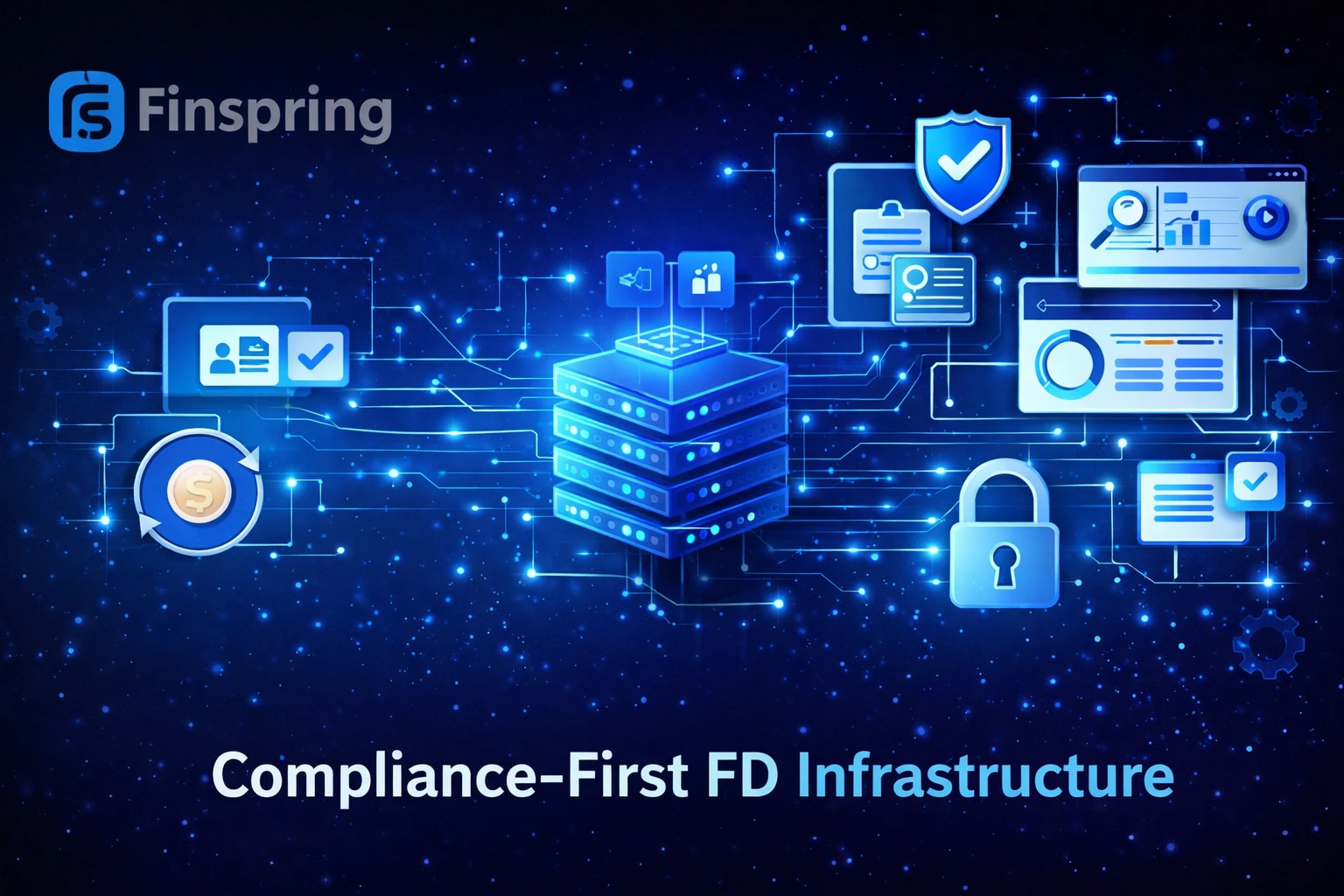
In financial services, compliance is not an optional feature—it is the foundation of trust, operational stability, and regulatory approval. For institutions offering fixed deposit (FD) products, compliance requirements extend across every stage of the deposit lifecycle. From onboarding and transaction monitoring to reporting and audit trails, financial institutions must maintain strict adherence to regulatory guidelines. For NBFCs, fintech platforms, and digital wealth providers, building this infrastructure internally can be extremely complex. Regulatory frameworks evolve frequently, and ensuring that technology systems consistently meet compliance requirements requires extensive expertise, monitoring, and engineering effort. Finspring addresses this challenge through a compliance-first FD infrastructure that embeds regulatory logic directly into its platform architecture. Instead of treating compliance as an external process layered on top of financial systems, Finspring integrates compliance checks and reporting mechanisms into the core infrastructure powering FD products.
This article explores how Finspring’s compliance-first FD infrastructure ensures regulatory alignment while enabling institutions to launch and manage FD products efficiently.
Why Compliance is Critical for Fixed Deposit Infrastructure
Fixed deposits represent a regulated financial product that requires strict operational oversight. Financial institutions managing deposit products must comply with regulatory guidelines that govern customer verification, deposit recordkeeping, financial reporting, and risk management.
These compliance obligations typically include:
- Know Your Customer (KYC) verification
- Anti-Money Laundering (AML) monitoring
- transaction recordkeeping and reporting
- deposit lifecycle tracking
- audit trail maintenance
- regulatory disclosures
Failure to comply with these requirements can lead to financial penalties, reputational damage, and regulatory action.
As financial services increasingly shift to digital platforms, the technology supporting deposit products must be designed with compliance at its core.
The Concept of Compliance-First Infrastructure
Traditional financial systems often treat compliance as a separate operational layer. Institutions may build their core financial systems first and then add compliance monitoring through external tools or manual workflows.
This approach introduces several risks:
- delayed detection of regulatory issues
- fragmented reporting systems
- operational inefficiencies
- increased compliance costs
A compliance-first FD infrastructure reverses this model. Instead of adding compliance later, regulatory logic is embedded directly into the system architecture.
Finspring follows this approach by integrating compliance mechanisms into every stage of the FD lifecycle.
Compliance Built Into the FD Lifecycle
Finspring’s infrastructure ensures that regulatory requirements are enforced throughout the deposit lifecycle.
1. Compliant Customer Onboarding
The first step in regulatory compliance begins with customer onboarding. Financial institutions must verify customer identities and ensure that users meet regulatory standards before allowing them to access financial products.
Finspring integrates onboarding workflows that support:
- identity verification processes
- KYC documentation validation
- risk screening and verification checks
- secure customer profile creation
By embedding these checks into the platform, Finspring ensures that only verified users can book deposits. This reduces the risk of fraudulent activity and ensures regulatory compliance from the start of the deposit journey.
2. Transaction Monitoring and Deposit Validation
Every deposit transaction must be validated and recorded accurately. Financial institutions are required to maintain clear records of deposit transactions for both operational and regulatory purposes.
Finspring’s platform manages deposit validation through automated transaction workflows.
Key compliance functions include:
- deposit parameter validation
- payment confirmation checks
- transaction logging
- deposit record creation
These automated checks ensure that deposits are processed according to defined operational rules while maintaining accurate records for reporting.
3. Automated Deposit Lifecycle Tracking
Regulators often require financial institutions to maintain detailed records of deposit activity throughout the lifecycle of each deposit.
Finspring’s infrastructure automatically tracks important lifecycle events, including:
- deposit creation
- interest accrual
- tenure progression
- maturity events
- deposit closure
Each event is recorded within the system, creating a complete lifecycle history for every deposit.
This automated tracking ensures that institutions can easily retrieve deposit data when required for audits or regulatory reviews.
4. Built-In Audit Trails
Audit trails are essential for financial accountability. Regulators require institutions to maintain clear records of all system activities and financial transactions.
Finspring embeds audit trail functionality directly into its platform.
Key audit capabilities include:
- system activity logging
- transaction history tracking
- user interaction records
- timestamped operational events
These records provide a transparent view of how deposits are processed and managed within the system.
Audit trails help institutions demonstrate compliance during internal reviews, external audits, or regulatory inspections.
5. Reconciliation and Financial Reporting
Accurate financial reconciliation is another critical compliance requirement. Institutions must ensure that deposit transactions, payments, and financial records remain synchronized.
Finspring provides built-in reconciliation systems that generate reports for operational monitoring.
Reporting capabilities include:
- transaction reconciliation reports
- deposit activity summaries
- payout records
- financial ledger alignment
These reports help institutions verify the accuracy of their financial data while maintaining compliance with reporting standards.
Security as a Compliance Foundation
Compliance and security are closely interconnected in financial systems. Protecting customer data and transaction records is essential for regulatory adherence.
Finspring’s compliance-first infrastructure incorporates several security layers designed to protect sensitive financial information.
Security measures include:
- encrypted data transmission
- secure authentication protocols
- role-based access controls
- data protection mechanisms
These safeguards ensure that deposit records and customer information remain secure while meeting regulatory expectations for data protection.
Regulatory Readiness Through System Architecture
One of the most valuable aspects of Finspring’s infrastructure is its ability to support regulatory readiness from day one.
Because compliance logic is embedded directly into the system architecture, financial institutions do not need to design separate compliance frameworks when launching FD products.
This architecture enables institutions to:
- launch FD offerings faster
- maintain consistent compliance standards
- simplify regulatory reporting processes
- reduce operational risk
By automating compliance workflows, Finspring reduces the burden on internal compliance teams while maintaining regulatory alignment.
Benefits of a Compliance-First FD Infrastructure
Adopting a compliance-first infrastructure offers several strategic advantages for financial institutions.
Reduced Regulatory Risk
Embedding compliance logic directly into the platform reduces the likelihood of regulatory violations.
Operational Efficiency
Automated compliance workflows eliminate many manual processes associated with reporting and monitoring.
Faster Product Deployment
Institutions can launch FD products without building extensive compliance systems from scratch.
Improved Transparency
Comprehensive audit trails and reporting tools provide clear visibility into deposit operations.
The Growing Importance of Embedded Compliance
As financial ecosystems become more digital and interconnected, regulators increasingly expect institutions to maintain robust monitoring and reporting capabilities.
Traditional compliance approaches that rely on manual processes or disconnected systems are becoming less effective in modern fintech environments.
Platforms like Finspring represent the next evolution in financial infrastructure—where compliance is not an afterthought but a core architectural principle.
By embedding regulatory logic into the platform, Finspring allows institutions to scale deposit products while maintaining the highest compliance standards.
Conclusion
Launching and managing fixed deposit products requires strict adherence to regulatory requirements. From customer onboarding to transaction monitoring and reporting, financial institutions must ensure that every stage of the deposit lifecycle meets compliance standards.
Finspring addresses this challenge through its compliance-first FD infrastructure, which embeds regulatory logic directly into the system architecture. By integrating onboarding verification, transaction monitoring, lifecycle tracking, audit trails, and reporting capabilities into the platform, Finspring enables institutions to manage FD operations with confidence and transparency.
This approach not only simplifies regulatory compliance but also accelerates product deployment and improves operational reliability.
In an increasingly regulated digital finance landscape, adopting a compliance-first FD infrastructure is essential for institutions seeking to launch and scale fixed deposit products while maintaining trust, transparency, and regulatory alignment.