India’s financial ecosystem is undergoing a structural shift. As digital adoption accelerates and user expectations evolve, traditional banking distribution models are being redefined. At the center of this shift is the rise of deposit aggregators.
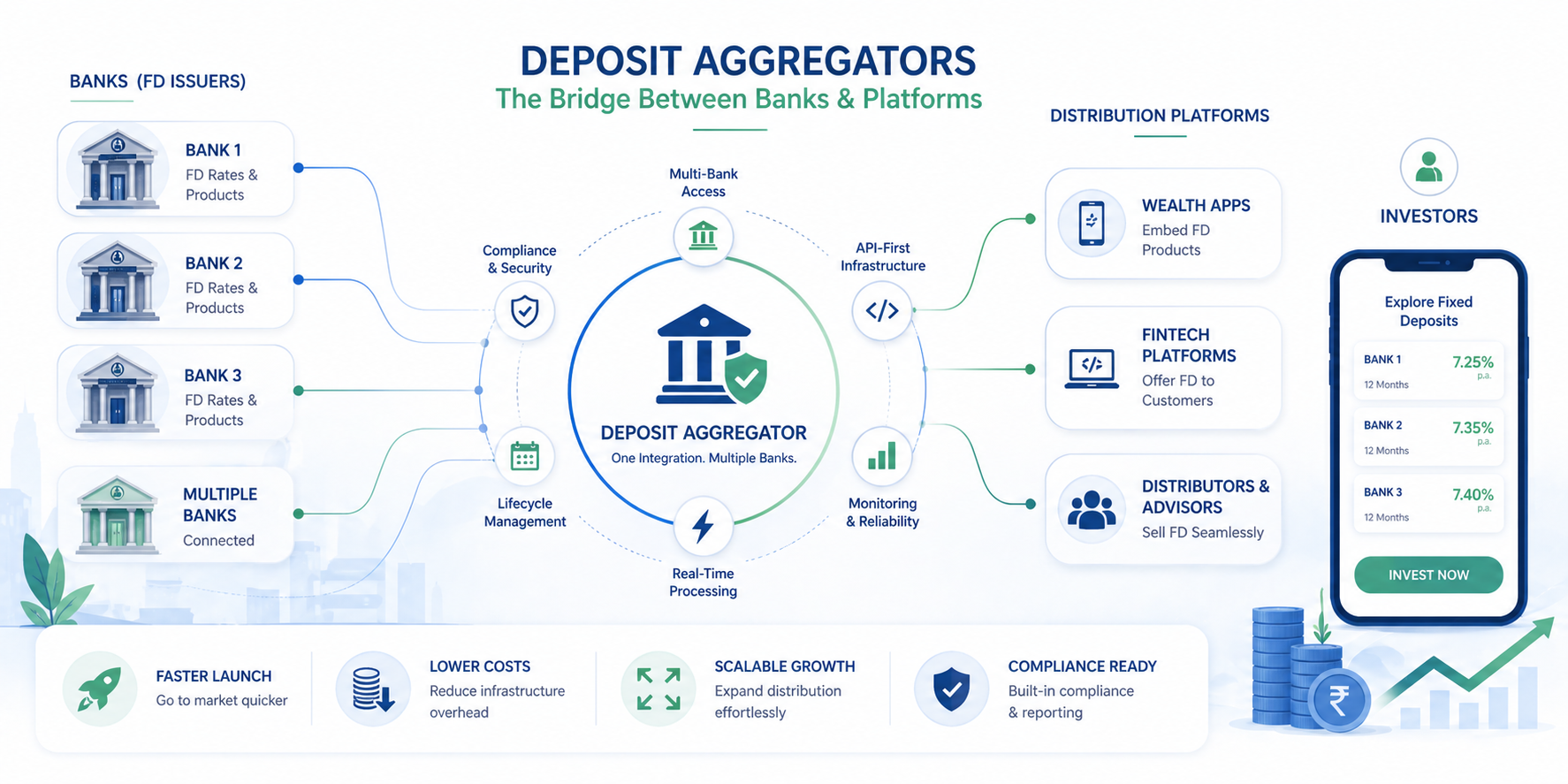
Deposit aggregators are quietly becoming a critical layer in the financial infrastructure stack—enabling banks, fintechs, and wealth platforms to distribute fixed deposits (FDs) at scale without building everything from scratch.
This article breaks down the deposit aggregator landscape in India, including how they work, key players, and the trends shaping their future.
What is a Deposit Aggregator?
A deposit aggregator is a platform or infrastructure provider that connects:
- Banks (FD issuers)
- Fintechs / wealth platforms (distributors)
- End users (investors)
It enables fintech platforms to offer FDs from multiple banks through a single integration, without directly managing:
- Bank partnerships
- Compliance workflows
- Operational complexity
In simple terms, a deposit aggregator acts as a bridge between supply (banks) and distribution (platforms).
Why Deposit Aggregators Are Growing in India
Several structural shifts are driving the growth of deposit aggregators:
1. Rising Demand for Stable Investment Options
With increasing market volatility, users are actively allocating capital toward low-risk, predictable instruments like FDs.
2. Shift Toward Digital Distribution
Users are no longer relying solely on bank branches. They prefer:
- Investment apps
- Wealth platforms
- Digital ecosystems
This creates a need for embedded FD access within existing platforms.
3. Faster Go-To-Market Requirements
Launching FD products traditionally involves:
- Bank integrations
- Compliance approvals
- Operational setup
Deposit aggregators reduce this complexity, enabling platforms to launch faster.
4. API-First Financial Infrastructure
Modern fintech is built on APIs. Deposit aggregators align perfectly with this shift by offering:
- Plug-and-play integrations
- Modular infrastructure
- Scalable distribution
How Deposit Aggregators Work
A typical deposit aggregator ecosystem operates through the following flow:
- Bank Integration
The aggregator integrates with multiple banks offering FD products. - API Layer Creation
It standardizes FD offerings into a unified API layer. - Platform Integration
Fintech or wealth platforms integrate once with the aggregator. - User Access
End users can browse, compare, and book FDs directly within the platform. - Lifecycle Management
The aggregator manages:
- Booking confirmations
- Status updates
- Maturity handling
- Reporting and reconciliation
This removes the need for platforms to manage multiple bank integrations individually.
Types of Deposit Aggregators in India
The Indian market currently has different types of players operating in the deposit aggregation space:
1. Consumer-Focused FD Marketplaces
These platforms focus on end-user discovery and comparison.
They typically:
- Offer FD listings across banks
- Enable comparison of rates and tenures
- Provide direct booking interfaces
However, they are often closed ecosystems and not designed for other platforms to integrate into.
2. Distribution Platforms for Agents & Advisors
These platforms cater to:
- Financial advisors
- Distribution networks
- Offline-to-online transitions
They provide tools for:
- Managing client portfolios
- Selling FD products
- Tracking commissions
Their focus is more on distribution enablement than infrastructure.
3. API-First Deposit Infrastructure Providers
This is the most important and emerging category.
These platforms:
- Offer FD distribution via APIs, SDKs, or plugins
- Enable fintechs and banks to embed FD journeys
- Handle compliance, reporting, and lifecycle management
This category represents the shift toward infrastructure-led aggregation, where the goal is not just listing FDs—but enabling them across ecosystems.
Key Capabilities of Modern Deposit Aggregators
As the market evolves, deposit aggregators are no longer just connectors. They are becoming full-stack infrastructure providers.
Key capabilities include:
1. Multi-Bank Access
Access to multiple FD issuers through a single integration.
2. Real-Time Processing
Instant booking, confirmations, and status updates.
3. Compliance Handling
Built-in workflows for:
- KYC
- Documentation
- Regulatory reporting
4. Lifecycle Management
Handling renewals, withdrawals, and maturity events.
5. Monitoring & Reliability
Tracking:
- SLAs
- Alerts
- Production issues
This ensures consistent performance at scale.
Challenges in the Deposit Aggregator Ecosystem
Despite its growth, the space comes with challenges:
1. Regulatory Complexity
FDs are regulated products, requiring strict compliance and reporting.
2. Bank Integration Variability
Different banks have different systems, making standardization difficult.
3. Operational Dependencies
Delays or failures at the bank level can impact user experience.
4. Trust & Transparency
Users need clear, reliable communication when dealing with deposits.
These challenges make infrastructure quality a key differentiator.
Emerging Trends in Deposit Aggregation
The deposit aggregator space in India is evolving rapidly. Here are the key trends shaping its future:
1. Shift from Marketplaces to Infrastructure
Earlier, aggregation meant listing products.
Now, it means:
- Enabling distribution
- Supporting integrations
- Powering ecosystems
Infrastructure-led players are gaining more relevance than marketplaces.
2. Embedded Finance Adoption
FDs are being embedded into:
- Wealth apps
- Payment platforms
- Super apps
Users no longer “go” to FDs.
FDs come to where users already are.
3. Real-Time Infrastructure Expectations
Platforms now expect:
- Instant confirmations
- Real-time tracking
- Reliable uptime
This is pushing aggregators to invest heavily in:
- Monitoring systems
- SLA tracking
- Production reliability
4. Focus on Lifecycle Management
The focus is shifting from:
- Just booking FDs
to - Managing the entire FD lifecycle seamlessly
This includes renewals, reporting, and user communication.
5. Compliance-First Architecture
With increasing regulatory scrutiny, aggregators are moving toward:
- Built-in compliance systems
- Automated reporting
- Audit-ready infrastructure
Compliance is becoming a core feature, not an afterthought.
Why Deposit Aggregators Are Strategic for Platforms
For fintechs, wealth platforms, and banks, deposit aggregators are no longer optional.
They enable:
- Faster product launches
- Reduced operational overhead
- Access to multiple banks
- Scalable distribution
More importantly, they allow platforms to:
👉 Respond quickly to changing user demand
In volatile markets, this agility becomes a major advantage.
The Role of Finspring in the Ecosystem
Finspring operates in the API-first deposit infrastructure layer, enabling platforms to:
- Integrate FD products quickly
- Launch without complex backend builds
- Manage lifecycle and compliance seamlessly
With plug-and-play SDKs and real-time infrastructure, Finspring helps platforms move from:
👉 Idea → Integration → Launch
in significantly shorter timelines.
Conclusion
Deposit aggregators are redefining how fixed deposits are distributed in India.
What started as a simple aggregation layer is now evolving into a core financial infrastructure category—powering:
- Faster launches
- Better user experiences
- Scalable distribution
As the ecosystem matures, the winners will not be those who list the most products—but those who enable the fastest, most reliable access to them.
Because in the new financial landscape,
distribution is infrastructure—and infrastructure defines growth.