In modern fintech, the difference between a product that launches in weeks and one that takes months often comes down to one thing: developer experience. While features, pricing, and partnerships matter, the real engine behind rapid innovation is the quality of the infrastructure developers build on. This is where developer-friendly API platforms come into play. More specifically, platforms that offer developer-friendly SDKs across the payment lifecycle are becoming the backbone of scalable fintech systems. These platforms don’t just expose APIs—they provide structured, intuitive, and production-ready tools that make integration, execution, and scaling significantly easier.
For companies like Finspring, which operate in the FD (Fixed Deposit) and financial infrastructure layer, this becomes even more critical. Because in regulated financial systems, complexity is unavoidable—but it should never reach the developer.
What Are Developer-Friendly API Platforms?
A developer-friendly API platform is an infrastructure system designed with ease of integration, clarity, and scalability in mind. Instead of requiring developers to navigate complex documentation, fragmented endpoints, and unclear workflows, these platforms provide:
- Clean, well-structured APIs
- Comprehensive SDKs
- Clear documentation and examples
- Predictable behavior across environments
When combined, these elements create an experience where developers can integrate, test, and deploy quickly without unnecessary friction.
Why Developer Experience Matters in Fintech
Fintech systems are inherently complex. They involve:
- Multiple integrations (banks, payment networks, compliance systems)
- Regulatory requirements
- Real-time transaction handling
- High reliability expectations
Without developer-friendly infrastructure, this complexity translates into:
- Longer development cycles
- Higher error rates
- Increased operational overhead
On the other hand, when platforms offer developer-friendly SDKs for the payment lifecycle, they abstract this complexity, allowing teams to focus on building user-facing value rather than backend plumbing.
Understanding the Payment Lifecycle
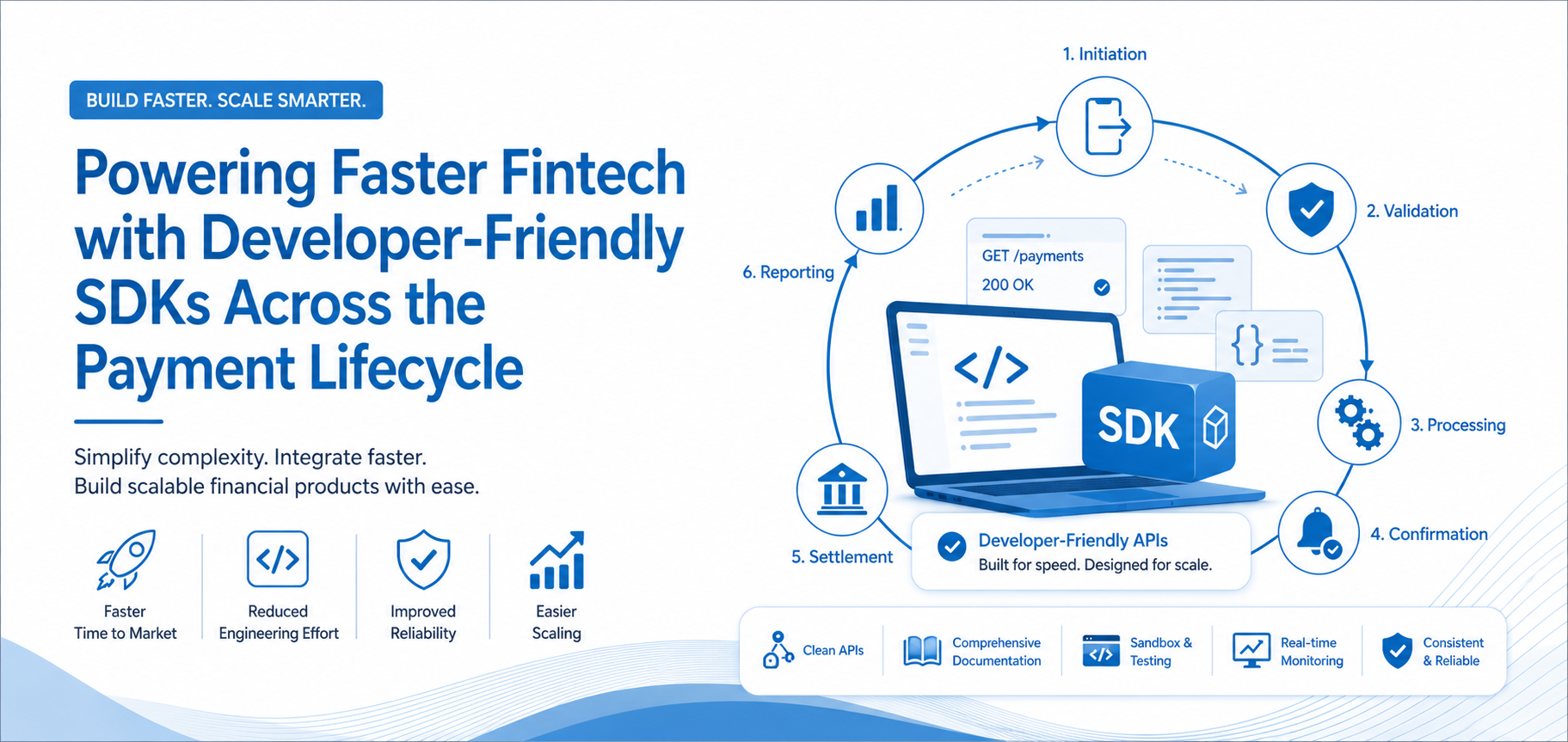
To appreciate the importance of SDKs, it’s essential to understand the payment lifecycle—the sequence of events that occur from the moment a user initiates a transaction to its final settlement.
Key stages in the payment lifecycle:
- Initiation – User triggers a transaction
- Validation – System checks data and compliance requirements
- Processing – Transaction is executed
- Confirmation – User receives status update
- Settlement – Funds are transferred and reconciled
- Reporting – Data is logged for compliance and analysis
Each stage involves multiple systems and potential failure points. Without proper tooling, managing this lifecycle becomes complex and error-prone.
The Role of Developer-Friendly SDKs in the Payment Lifecycle
Developer-friendly SDKs simplify the entire lifecycle by providing pre-built functions, structured workflows, and reusable components.
Instead of manually handling each stage, developers can rely on SDKs to:
- Standardize interactions
- Automate validations
- Handle edge cases
- Ensure consistency
Payment Lifecycle with Developer-Friendly SDKs
| Stage | Without SDKs | With Developer-Friendly SDKs |
|---|---|---|
| Initiation | Custom API calls | Pre-built functions |
| Validation | Manual checks | Automated validation |
| Processing | Complex logic | Simplified workflows |
| Confirmation | Custom handling | Standardized responses |
| Settlement | Manual reconciliation | Built-in handling |
| Reporting | Separate systems | Integrated logging |
Key Features of Developer-Friendly API Platforms
1. Clear and Structured SDKs
SDKs should provide:
- Pre-defined methods
- Consistent naming conventions
- Minimal configuration
This reduces the learning curve and speeds up integration.
2. Comprehensive Documentation
Good documentation includes:
- Step-by-step guides
- Code examples
- Error handling instructions
This ensures developers can move from understanding to implementation quickly.
3. Sandbox and Testing Environments
Developers need safe environments to:
- Test integrations
- Simulate transactions
- Debug issues
Sandbox environments make this possible without affecting production systems.
4. Real-Time Feedback and Monitoring
Developer-friendly platforms provide:
- Instant API responses
- Detailed error messages
- Monitoring dashboards
This helps developers identify and fix issues quickly.
5. Consistent API Behavior
Predictability is critical. APIs should behave consistently across:
- Different environments
- Edge cases
- High-load scenarios
This builds confidence and reduces debugging time.
Why Developer-Friendly SDKs Matter for Payments
Payments are time-sensitive and high-risk. Even small errors can lead to:
- Failed transactions
- Revenue loss
- User dissatisfaction
Developer-friendly SDKs reduce these risks by:
- Standardizing workflows
- Automating validations
- Ensuring reliability
This is especially important in high-volume systems, where manual handling is not scalable.
Finspring’s Approach to Developer-Friendly Infrastructure
Finspring focuses on delivering developer-friendly SDKs across the FD and financial lifecycle, ensuring that platforms can integrate deposit products as easily as they integrate payments.
Key capabilities include:
- Plug-and-play SDKs for quick integration
- Pre-built FD workflows covering booking, confirmation, and lifecycle events
- Embedded compliance logic, reducing the need for manual checks
- Real-time monitoring and SLA tracking, ensuring reliability
- Unified APIs for multi-bank access, simplifying integrations
This allows developers to:
- Integrate once
- Launch quickly
- Scale without rebuilding systems
Benefits for Fintech Platforms
1. Faster Time to Market
Developer-friendly SDKs reduce integration time, allowing platforms to:
- Launch products faster
- Capture market opportunities
- Stay competitive
2. Reduced Engineering Effort
Pre-built workflows eliminate the need for:
- Custom development
- Repetitive coding
- Complex debugging
This frees up resources for innovation.
3. Improved Reliability
Standardized SDKs ensure:
- Consistent behavior
- Fewer errors
- Better system stability
4. Easier Scaling
As transaction volumes grow, SDK-based systems can:
- Handle increased load
- Maintain performance
- Reduce operational complexity
Challenges Without Developer-Friendly SDKs
Platforms that lack developer-friendly infrastructure often face:
- Long integration timelines
- High dependency on internal teams
- Increased error rates
- Difficulty scaling systems
Over time, these challenges slow down growth and increase costs.
The Future of Developer-Friendly API Platforms
As fintech evolves, developer experience will become even more critical. Future platforms will focus on:
- AI-assisted integration
- Auto-generated SDKs
- Predictive error handling
- Real-time optimization
The goal is to make infrastructure:
- Invisible to developers
- Powerful under the hood
- Scalable by design
Conclusion
Developer-friendly API platforms are not just a convenience—they are a necessity in modern fintech. By providing developer-friendly SDKs across the payment lifecycle, these platforms enable faster launches, better reliability, and scalable growth.
For platforms integrating financial products like FDs, the complexity is unavoidable. But with the right infrastructure—like Finspring’s SDK-driven approach—that complexity can be managed seamlessly.
Because in fintech, the speed of your product is only as fast as the systems your developers build on.