Digital FD launch product may appear straightforward on the surface. The product itself is simple, regulated, and widely understood. However, when distributed through digital channels — especially via SDKs, aggregators, APIs, or embedded finance models — the operational complexity increases significantly.
Before going live, financial institutions, NBFCs, fintech platforms, and neobanks must conduct a structured operational risk assessment. Overlooking hidden dependencies can lead to transaction failures, reconciliation mismatches, compliance exposure, or reputational damage.
Here are the key operational risks that must be evaluated before launching an FD product digitally.
Technology Infrastructure Risk
The first operational layer to assess is technology stability. Digital FD journeys involve multiple system interactions — frontend UI, API gateways, KYC services, payment processing, core banking systems, ledger entries, and notification engines.
If any of these components are poorly integrated or lack redundancy, failure at one node can cascade across the entire journey.
Key questions to evaluate include:
- Is infrastructure built for 99.9%+ uptime?
- Is there auto-scaling during high inflow periods?
- Are failover mechanisms tested?
- Is real-time monitoring in place?
Cloud deployment environments such as Amazon Web Services or Microsoft Azure may provide scalability, but architecture design still determines resilience.
A weak infrastructure foundation can turn a marketing success into an operational crisis.
Third-Party Dependency Risk
Most digital FD models rely on external partners:
- FD aggregators or SDK providers
- Payment gateways
- KYC vendors
- Core banking API providers
Every external dependency introduces risk.
If the aggregator’s API goes down, your booking flow fails. If the payment gateway faces downtime, funds may be debited without confirmation. If KYC validation services slow down, onboarding friction increases.
Operational assessment must include:
- SLA review
- Escalation matrices
- Backup vendors where possible
- Defined reconciliation processes
Dependency mapping should clearly identify single points of failure.
Regulatory and Compliance Risk
FDs are regulated financial products. Digital distribution must comply with guidelines set by the Reserve Bank of India and other applicable authorities.
Operational risks arise when:
- Disclosure language is unclear
- Rate changes are not updated in real time
- TDS deductions are miscalculated
- KYC processes are improperly executed
- Customer consent logs are not stored
Digital journeys must ensure proper documentation, transparent interest rate communication, and accurate reporting.
Compliance lapses are not minor operational errors — they can result in regulatory scrutiny, penalties, or suspension of product distribution.
Transaction Failure and Reconciliation Risk
One of the most significant operational risks is transaction mismatch.
Consider this scenario: a customer completes payment, but the FD booking confirmation fails due to API timeout. Funds are debited, but no FD reference number is generated.
Without robust reconciliation systems, such cases create:
- Customer anxiety
- Support escalation
- Financial liability
- Manual intervention workload
Before launch, organizations must assess:
- Automated reconciliation timelines
- Retry logic for failed API calls
- Clear transaction status tracking
- T+0 or T+1 settlement clarity
Ambiguous transaction states are among the most damaging operational failures in financial services.
Lifecycle Management Risk
Many platforms focus heavily on onboarding but underestimate lifecycle management complexity.
Digital FD launch products must handle:
- Maturity alerts
- Auto-renewal execution
- Premature withdrawals
- Interest payout schedules
- Nominee updates
If lifecycle flows are not automated and tested thoroughly, operational load increases significantly after launch.
For example, delayed maturity credits can generate high volumes of support tickets and erode trust instantly.
Operational readiness must include end-to-end lifecycle simulation — not just booking validation.
Data Security and Privacy Risk
Digital FD launch products involve sensitive personal and financial information:
- PAN details
- Aadhaar-linked KYC
- Bank account information
- Transaction histories
Data breaches expose institutions to legal, regulatory, and reputational consequences.
Operational risk assessment should evaluate:
- Encryption standards
- Access control mechanisms
- Data storage locations
- Audit logging systems
- Incident response protocols
Security frameworks must align with industry standards and internal governance policies.
Data risk is often invisible — until it becomes catastrophic.
Capacity and Scalability Risk
High interest rate campaigns or market shifts can cause sudden FD inflows.
If systems are not stress-tested before launch, traffic spikes may result in:
- Server crashes
- API throttling
- Booking failures
- Delayed confirmations
Operational readiness requires:
- Load testing beyond expected peak volumes
- Auto-scaling configuration validation
- Performance benchmarking
- Monitoring dashboards
Scalability risk is especially critical for fintech platforms embedding FD offerings into super apps or high-traffic ecosystems.
Customer Support Readiness Risk
Digital launch often triggers a surge in queries:
- “When will my FD confirmation arrive?”
- “How do I download my receipt?”
- “Why is my maturity amount different?”
- “How do I withdraw early?”
If support teams are not trained and prepared, response delays increase.
Operational assessment should cover:
- Support training documentation
- Escalation workflows
- Defined turnaround times
- Ticket tracking tools
- FAQs aligned with real scenarios
Poor post-launch support can damage a brand more than technical glitches.
Settlement and Treasury Risk
digital FD launch distribution affects treasury management and settlement flows.
Operational risks include:
- Delayed fund settlement with partner institutions
- Liquidity mismatches
- Incorrect interest accrual posting
- Manual ledger reconciliation
Finance and operations teams must align on settlement cycles, reporting formats, and audit readiness.
Treasury risk is often overlooked by product teams but has direct financial implications.
Brand and Reputation Risk
In financial services, trust is the ultimate currency.
A single operational failure — such as delayed maturity credit or unclear transaction confirmation — can create viral backlash on social media.
Reputation risk assessment must include:
- Communication strategy during downtime
- Incident transparency policies
- Customer notification templates
- Defined PR response protocol
Operational resilience protects not just systems, but brand equity.
Governance and Audit Risk
digital FD launch operations must maintain:
- Detailed audit logs
- Version control documentation
- Approval workflows
- Periodic internal reviews
Without governance frameworks, even minor operational inconsistencies can escalate during audits.
Risk assessment must involve compliance, IT, operations, and finance stakeholders — not just product teams.
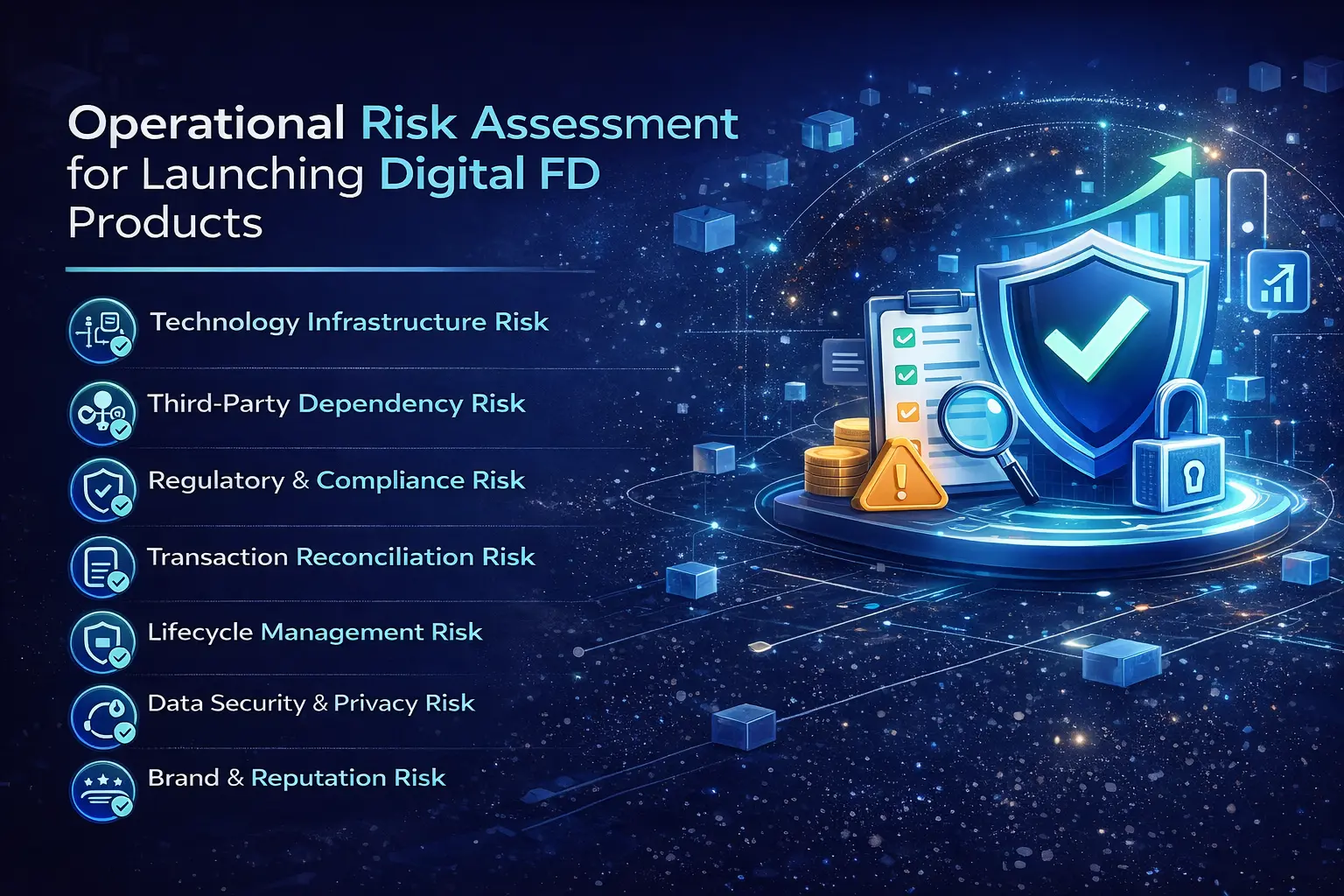
Building a Structured Operational Risk Framework
Before launching an FD product digitally, institutions should conduct a structured risk assessment covering:
- Technology resilience
- Third-party dependencies
- Regulatory compliance
- Transaction reconciliation
- Lifecycle automation
- Data security
- Scalability readiness
- Support preparedness
- Treasury alignment
- Governance controls
Digital distribution amplifies both opportunity and exposure. While the product itself may be stable and regulated, the operational ecosystem around it determines success.
The goal is not to eliminate all risk — that is impossible. The goal is to identify, mitigate, and monitor risks proactively.
A well-executed digital FD launch is not defined by how smoothly day one runs — it is defined by how well the system performs under stress, scrutiny, and scale.
Operational discipline before launch determines stability after launch.