High Fixed Deposit (FD) inflow periods are both an opportunity and a stress test. Whether triggered by festive rate campaigns, quarter-end treasury allocations, regulatory changes, or sudden interest rate hikes, these spikes can multiply transaction volumes overnight. For digital FD platforms, the challenge is not attracting inflows — it is handling them without system slowdowns, booking failures, reconciliation mismatches, or customer frustration.
Ensuring uptime, scalability, and performance during high FD inflow periods requires architectural discipline, operational foresight, and continuous monitoring. It is not a last-minute infrastructure upgrade; it is a deliberate engineering strategy built long before the traffic surge begins.
Designing for High Availability from Day One
High availability cannot be retrofitted into a platform that was designed for normal load conditions. Digital FD platforms must adopt a distributed architecture where services are decoupled and independently scalable. A monolithic system may function under steady traffic but often collapses under peak transactional bursts.
Modern infrastructure strategies leverage cloud-native environments such as Amazon Web Services, Microsoft Azure, and Google Cloud Platform to create redundancy across multiple availability zones. This ensures that if one server cluster experiences failure, traffic automatically reroutes without disrupting customer journeys.
The uptime benchmark for financial platforms today is 99.9% to 99.99%. During high FD inflow periods, anything less creates revenue leakage and reputational damage. True uptime resilience depends on load balancers, failover configurations, container orchestration, and infrastructure monitoring working in synchrony.
Auto-Scaling to Handle Traffic Surges
High FD inflow periods often follow predictable patterns — festive seasons, financial year-end, special rate campaigns, or regulatory announcements. However, the magnitude of traffic can still exceed projections.
Auto-scaling mechanisms ensure that infrastructure expands dynamically when CPU usage, memory utilization, or API request rates exceed defined thresholds. Instead of provisioning static capacity (which is expensive and inefficient), auto-scaling allows the system to respond in real time.
Container orchestration systems like Kubernetes are frequently used to spin up additional application pods during peak loads and scale them down once demand normalizes. This elasticity ensures that booking journeys remain smooth even when concurrent users spike dramatically.
Without auto-scaling, digital FD platforms risk slow page loads, API timeouts, and incomplete transaction states — all of which directly impact conversion rates.
Decoupling Critical Services to Prevent Bottlenecks
One of the most common reasons platforms fail during high inflow periods is service interdependency. If FD booking, KYC validation, payment confirmation, ledger posting, and notification services operate within tightly coupled systems, a slowdown in one component cascades across the entire ecosystem.
To prevent this, platforms should adopt microservices architecture where each function operates independently. For example, KYC verification should not block the booking confirmation API. Instead, event-driven architecture using asynchronous message queues allows booking confirmation to proceed while secondary validations occur in parallel.
Message brokers like Apache Kafka or similar event streaming systems ensure that transactional data flows reliably between services even under heavy load. By decoupling services, platforms reduce the risk of systemic failure.
Optimizing Database Performance Under Heavy Transactional Load
During high FD inflow periods, database performance becomes a critical bottleneck. Every FD booking involves writing customer data, tenure details, rate information, payment confirmation status, and ledger entries into structured databases. If the database layer is not optimized, it becomes the single point of failure.
Platforms must use read replicas to distribute query loads and implement indexing strategies for frequently accessed fields. Write-heavy systems benefit from database partitioning, ensuring that transactional entries are distributed across segments rather than centralized in a single table.
Financial platforms often rely on managed database services offered by cloud providers to maintain high availability and automated backups. Database health monitoring must include metrics such as query latency, lock contention, and replication lag to prevent performance degradation.
When inflow volumes surge, even a few milliseconds of delay per transaction can compound into major slowdowns.
Payment Gateway Resilience and Redundancy
FD booking is inseparable from payment processing. During peak inflow periods, payment gateway APIs experience high traffic volumes as customers complete transactions.
Platforms must integrate with multiple payment gateways rather than relying on a single provider. If one gateway experiences downtime or latency issues, traffic should automatically route to an alternative provider.
Payment confirmation mechanisms must include retry logic and reconciliation workflows to ensure that no transaction remains in an ambiguous state. A payment debited without FD confirmation creates customer anxiety and increases support tickets dramatically.
Ensuring redundancy at the payment layer is as critical as server scalability.
Real-Time Monitoring and Incident Response
High inflow periods demand real-time visibility into system health. Monitoring tools should track:
-
API latency
-
Error rates
-
Server CPU and memory usage
-
Database performance
-
Payment success ratios
-
Queue backlogs
If anomalies appear, automated alerts must notify engineering teams immediately. Proactive monitoring enables corrective action before customers notice disruption.
A mature platform maintains a dedicated war-room strategy during known peak periods, where engineering, DevOps, and support teams monitor dashboards continuously. Quick response reduces downtime from minutes to seconds.
Uptime during high FD inflow periods is not just technical; it is operational discipline.
Stress Testing Before Peak Events
Load testing and stress testing simulate high concurrency scenarios before actual inflow spikes occur. Platforms should simulate traffic 2x or even 5x higher than expected volumes to identify weak points.
Tools that generate concurrent booking requests, payment flows, and dashboard queries help teams understand how the system behaves under pressure. Bottlenecks often appear in unexpected layers — caching systems, logging services, or third-party API integrations.
Stress testing should not be a one-time event. It must occur before every major campaign or rate revision period.
Caching and Performance Optimization
To reduce backend load, platforms should cache static or semi-static data such as interest rate tables, tenure lists, FAQs, and eligibility criteria. This reduces database hits and speeds up page loads.
Content delivery networks (CDNs) distribute static assets across geographies, improving load times for users accessing the platform from different regions.
During high inflow periods, even minor performance improvements can significantly enhance booking completion rates.
Ensuring Partner Bank and NBFC Coordination
Digital FD platforms often operate in partnership with regulated institutions. During high inflow periods, backend systems at partner banks or NBFCs must also scale accordingly.
If the distribution layer scales but the core banking system cannot process high volumes, transaction delays occur.
Close coordination with partner institutions is essential. Pre-peak readiness checks should confirm that downstream APIs, reconciliation systems, and settlement workflows are prepared for increased load.
Scalability must extend beyond the platform itself.
Disaster Recovery and Business Continuity Planning
Even with robust infrastructure, unexpected disruptions can occur. A disaster recovery (DR) strategy ensures business continuity in case of catastrophic system failure.
This includes:
-
Secondary region deployment
-
Real-time data replication
-
Automated failover systems
-
Periodic DR drills
Recovery Time Objective (RTO) and Recovery Point Objective (RPO) must align with financial industry standards. During high FD inflow periods, downtime translates directly into lost revenue and trust erosion.
Resilience planning is as important as performance optimization.
Performance Benchmarks for Digital FD Platforms
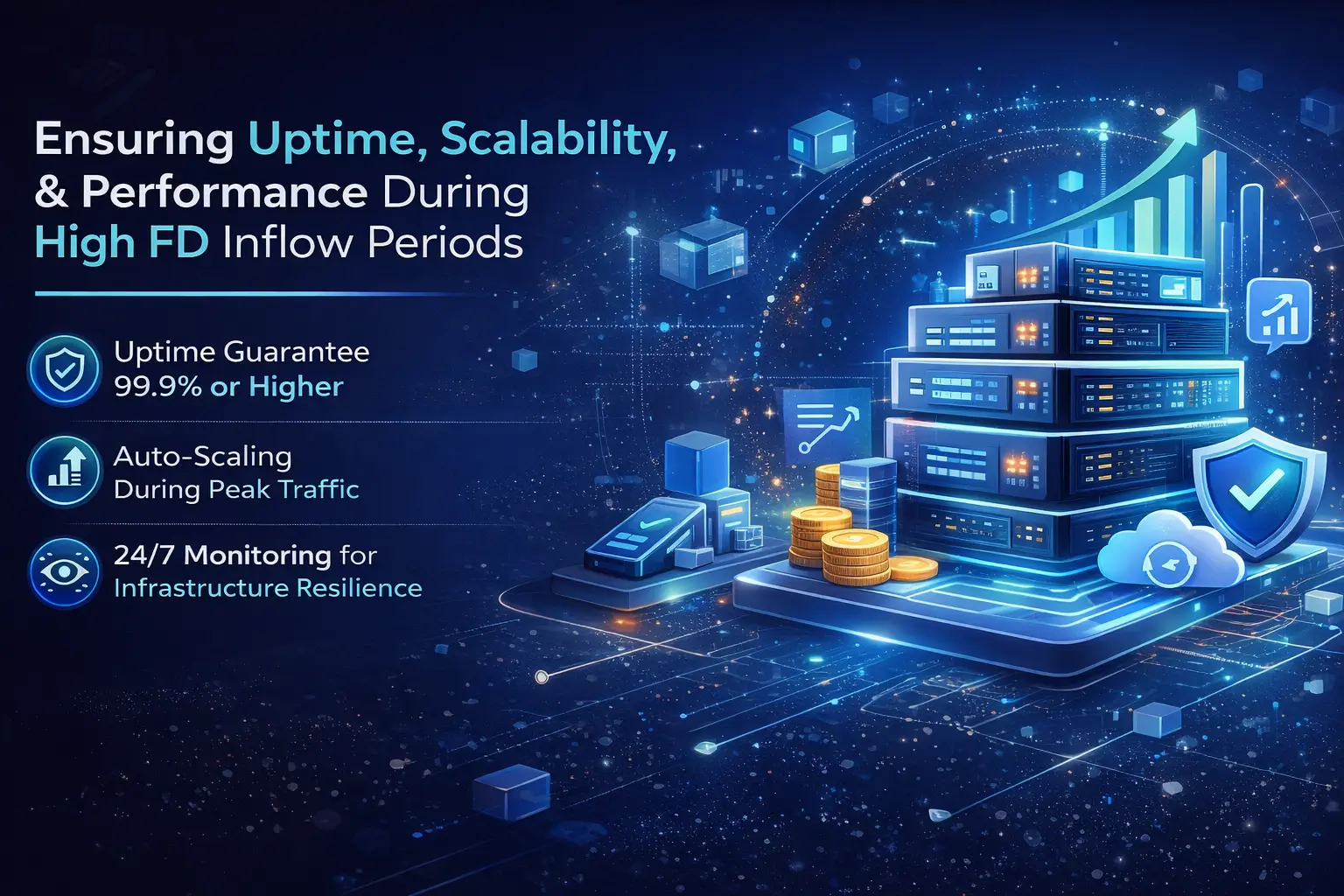
To ensure uptime and scalability during high FD inflow periods, platforms should target measurable benchmarks:
-
99.9% or higher uptime
-
Sub-3-second page load times
-
API response time under 500 milliseconds
-
Zero transaction data loss
-
Automated failover within seconds
-
Real-time monitoring with instant alerting
Meeting these benchmarks builds institutional confidence and positions the platform as enterprise-grade infrastructure rather than a fragile frontend wrapper.
The Strategic Advantage of Scalability
High FD inflow periods are moments of revenue acceleration. But they also expose weaknesses in architecture, operations, and integration layers.
Platforms that invest early in distributed systems, auto-scaling, database optimization, payment redundancy, and proactive monitoring convert these peak moments into growth opportunities. Those that neglect infrastructure discipline risk transaction failures, customer dissatisfaction, and reputational harm.
In today’s competitive landscape, uptime is not just a technical metric — it is a trust signal. Scalability is not just about handling traffic — it is about protecting customer capital. Performance is not just about speed — it is about delivering certainty during moments of high financial activity.
Ensuring uptime, scalability, and performance during high FD inflow periods is therefore not optional. It is the foundation upon which sustainable digital FD ecosystems are built.