For cooperative banks, the first interaction with a customer has traditionally happened at a branch. Forms, document verification, and manual approvals have defined onboarding for decades. While this model built trust locally, it is no longer aligned with how users expect to access financial services today. Customers now expect instant, seamless, and digital onboarding experiences, regardless of the type of bank. This is why digital onboarding solutions for cooperative banks are becoming a critical part of transformation strategies. Onboarding is no longer just an operational step—it is a growth lever that directly impacts acquisition, conversion, and long-term engagement.
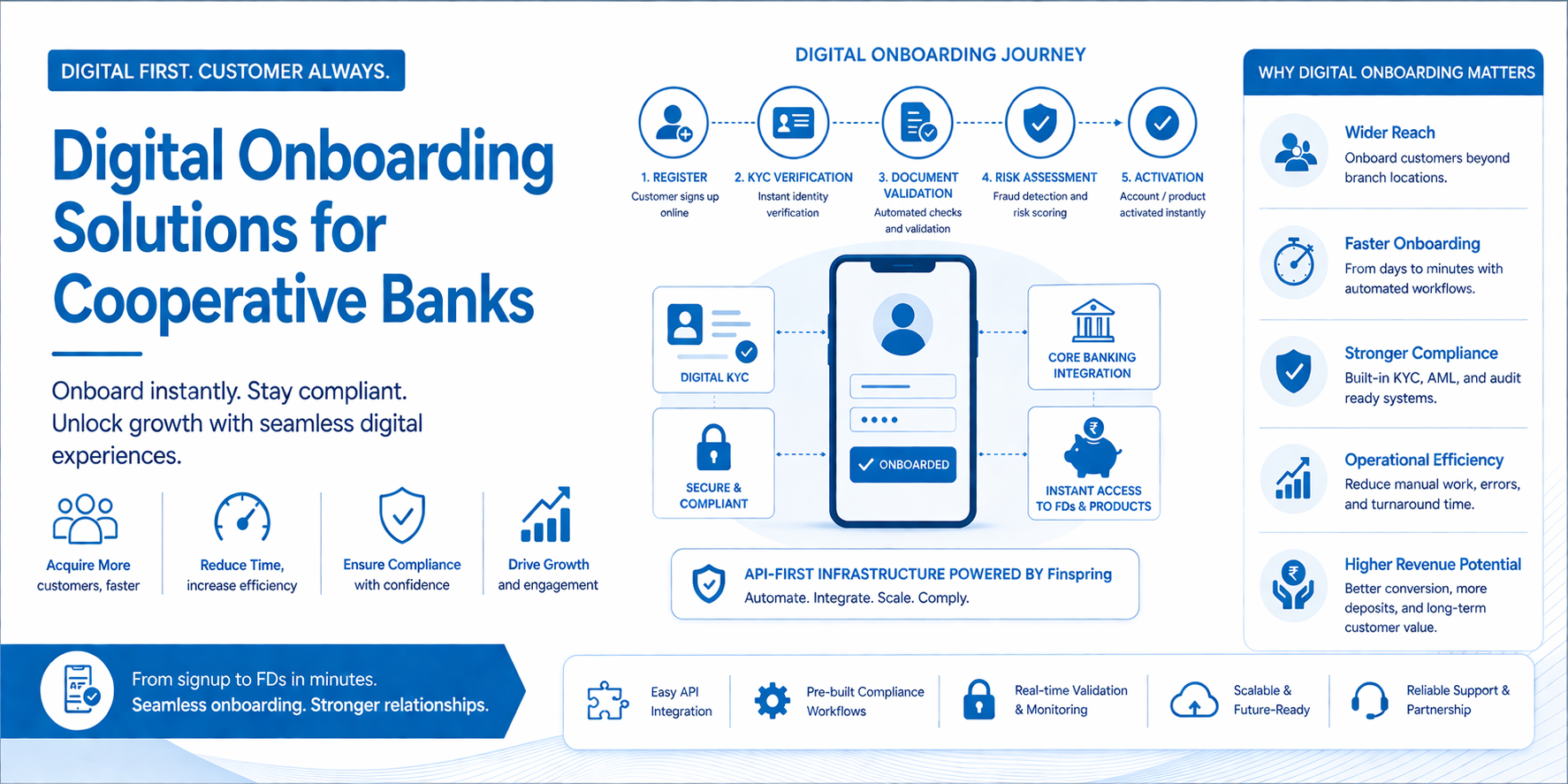
In this article, we explore how digital onboarding works, why it matters for cooperative banks, and how infrastructure platforms like Finspring enable compliant and scalable onboarding systems.
What is Digital Onboarding for Cooperative Banks?
Digital onboarding refers to the process of acquiring, verifying, and activating customers entirely through digital channels, without requiring physical branch visits. It replaces manual workflows with automated systems that handle:
- Identity verification (KYC)
- Document submission and validation
- Risk assessment
- Account or product activation
For cooperative banks, digital onboarding solutions enable them to extend their reach beyond physical locations, allowing customers to access services through mobile apps, websites, or partner platforms.
Why Digital Onboarding is Critical Today
The shift toward digital onboarding is not just a trend—it is a necessity driven by structural changes in the financial ecosystem.
1. Changing User Expectations
Today’s users expect:
- Instant account creation
- Minimal paperwork
- Real-time confirmations
If onboarding takes days instead of minutes, users drop off.
2. Competition from Fintech Platforms
Fintech companies have set new standards for onboarding:
- Fully digital journeys
- Simple interfaces
- Fast processing
Cooperative banks must match this experience to remain competitive.
3. Expansion Beyond Local Markets
Digital onboarding allows cooperative banks to:
- Acquire customers outside their immediate geography
- Scale without opening new branches
- Reach younger, tech-savvy users
4. Regulatory Alignment
Regulators are increasingly supporting digital KYC and verification methods, making it easier for banks to adopt digital onboarding while remaining compliant.
Traditional vs Digital Onboarding
| Aspect | Traditional Onboarding | Digital Onboarding |
|---|---|---|
| Process | Manual and paper-based | Automated and digital |
| Time | Days to weeks | Minutes |
| Reach | Limited to branch location | Nationwide |
| Error Rate | High | Low |
| User Experience | Friction-heavy | Seamless |
Key Components of Digital Onboarding Solutions
To build effective digital onboarding solutions for cooperative banks, several components must work together seamlessly.
1. Digital KYC (Know Your Customer)
Digital KYC enables identity verification using:
- Aadhaar-based verification
- PAN validation
- Document uploads
This replaces manual verification and ensures compliance with regulatory requirements.
2. Document Processing & Validation
Automated systems handle:
- Document uploads
- Data extraction
- Validation checks
This reduces errors and speeds up processing.
3. Risk and Fraud Detection
Onboarding systems must include:
- Risk scoring
- Fraud detection mechanisms
- Transaction monitoring
This ensures that only legitimate users are onboarded.
4. Workflow Automation
Automation handles:
- Approval processes
- Data validation
- Status updates
This eliminates manual bottlenecks.
5. Integration with Core Systems
Onboarding systems must connect with:
- Core banking systems
- Compliance platforms
- Product modules (like FDs)
This ensures a smooth transition from onboarding to usage.
Challenges in Implementing Digital Onboarding
While the benefits are clear, cooperative banks face several challenges in adopting digital onboarding solutions.
1. Legacy Systems
Existing infrastructure may not support:
- API integrations
- Real-time processing
- Automation
2. Compliance Complexity
Onboarding must meet strict regulatory standards, including:
- KYC requirements
- Data security norms
- Audit readiness
3. Limited Technical Resources
Many cooperative banks lack:
- Large engineering teams
- Advanced technical expertise
4. User Trust and Adoption
Customers accustomed to branch interactions may:
- Hesitate to adopt digital processes
- Require additional support
How API Infrastructure Enables Digital Onboarding
API-first infrastructure simplifies onboarding by providing pre-built, reusable components that handle key processes.
Benefits include:
- Faster integration with KYC providers
- Automated compliance workflows
- Real-time validation and monitoring
- Scalable systems that handle increasing volumes
Instead of building onboarding systems from scratch, cooperative banks can use APIs to assemble digital onboarding capabilities quickly and efficiently.
The Role of Finspring in Digital Onboarding
Finspring plays a critical role in enabling digital onboarding within the context of FD and deposit infrastructure. While onboarding itself involves identity verification and compliance, the real value comes from what happens after onboarding—product access and activation.
Finspring enables:
1. Seamless Transition from Onboarding to FD Booking
Once a user is onboarded:
- They can instantly access FD products
- Booking can happen within the same flow
2. Embedded Compliance Workflows
Finspring integrates:
- KYC validation
- Documentation checks
- Audit-ready systems
ensuring that onboarding remains compliant.
3. Multi-Platform Integration
Cooperative banks can onboard users through:
- Their own apps
- Fintech platforms
- Partner ecosystems
4. Real-Time Infrastructure
Finspring ensures:
- Instant confirmations
- Reliable transaction processing
- Continuous monitoring
Example: Digital Onboarding Flow with Finspring
| Stage | Traditional Process | Digital Process |
|---|---|---|
| User Registration | Branch visit | Online signup |
| KYC Verification | Manual | Instant API-based |
| Approval | Delayed | Automated |
| Product Access | Separate process | Immediate FD access |
Benefits of Digital Onboarding for Cooperative Banks
1. Higher Conversion Rates
Faster onboarding reduces drop-offs and increases:
- Customer acquisition
- Product adoption
2. Operational Efficiency
Automation reduces:
- Manual workload
- Errors
- Processing time
3. Scalable Growth
Digital systems allow banks to:
- Handle more users
- Expand reach
- Scale without additional infrastructure
4. Improved Customer Experience
Seamless onboarding leads to:
- Higher satisfaction
- Increased trust
- Better retention
Best Practices for Implementing Digital Onboarding
1. Start with Core Use Cases
Focus on:
- Account opening
- FD onboarding
- Basic transactions
2. Use API-First Solutions
Adopt platforms that:
- Simplify integration
- Provide pre-built workflows
- Ensure compliance
3. Ensure Compliance from Day One
Build systems that:
- Meet regulatory requirements
- Maintain audit trails
- Protect user data
4. Educate Customers
Help users:
- Understand digital processes
- Build trust in the system
- Transition smoothly
The Future of Digital Onboarding
Digital onboarding will continue to evolve with:
- AI-driven identity verification
- Biometric authentication
- Real-time risk assessment
- Fully automated onboarding journeys
These advancements will make onboarding:
- Faster
- More secure
- More user-friendly
Conclusion
Digital onboarding solutions for cooperative banks are no longer optional—they are essential for growth in a digital-first financial ecosystem. By replacing manual processes with automated, API-driven systems, cooperative banks can deliver faster, more reliable, and scalable onboarding experiences.
Platforms like Finspring play a key role by ensuring that onboarding seamlessly connects to product access, compliance, and lifecycle management. This allows cooperative banks to not only acquire customers digitally but also activate and retain them effectively.
Because in modern banking, onboarding is not just the first step.
It is the foundation of everything that follows.