Cooperative banks have long played a vital role in India’s financial ecosystem, especially in serving Tier 2, Tier 3, and rural communities. Built on trust, relationships, and local reach, these institutions have historically focused on stability over speed. However, the rapid shift toward digital financial services is reshaping expectations. Today, customers expect instant access, seamless transactions, and transparent experiences—even from cooperative banks. This is where digital transformation for cooperative banks becomes essential. It is no longer about incremental upgrades or isolated technology projects. It is about rebuilding systems, processes, and distribution models to operate effectively in a digital-first world.
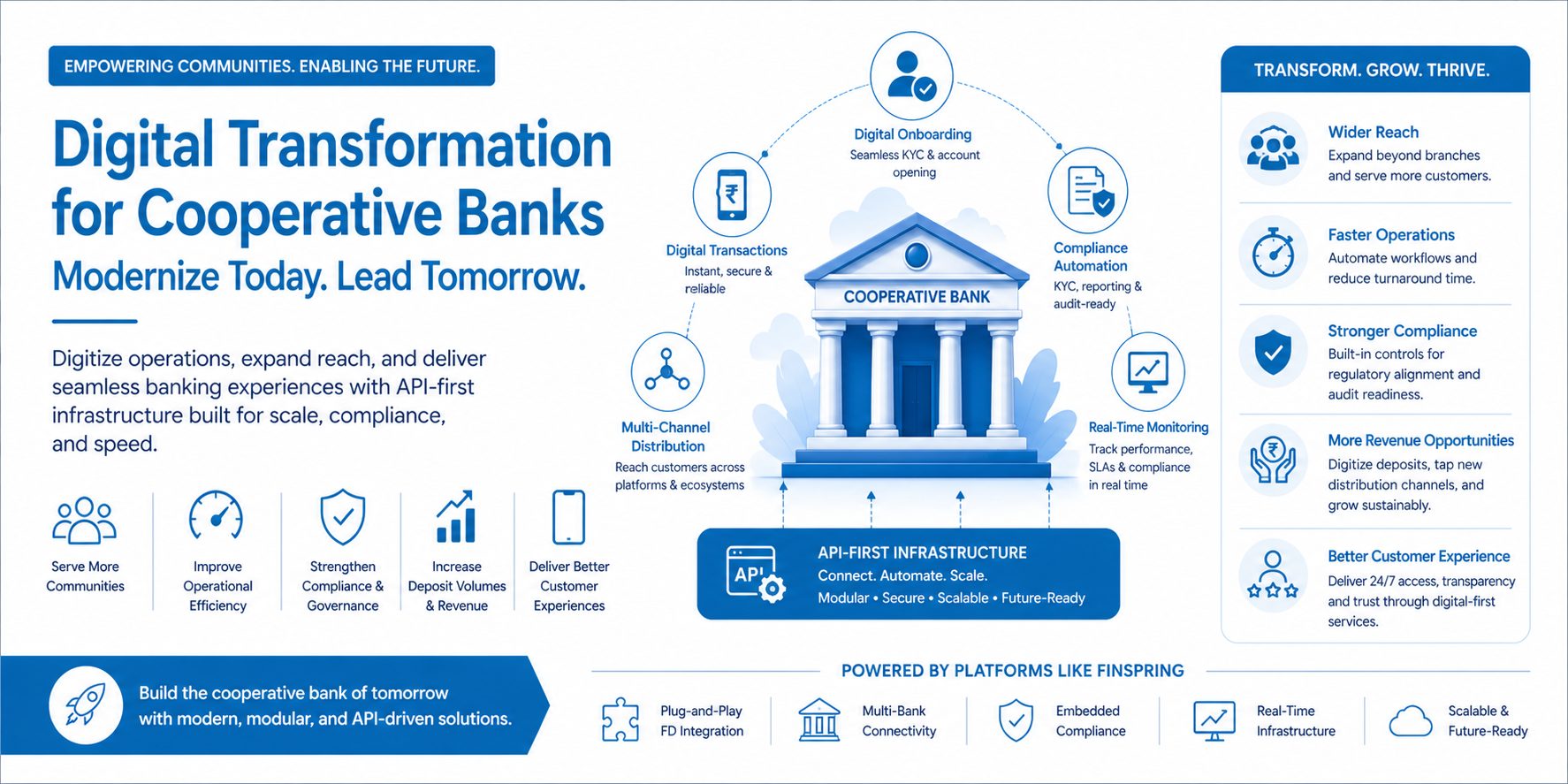
In this article, we break down what digital transformation means for cooperative banks, the challenges involved, and how API infrastructure platforms like Finspring enable this shift.
What is Digital Transformation for Cooperative Banks?
Digital transformation for cooperative banks refers to the process of modernizing core systems, customer interfaces, and operational workflows to deliver financial services digitally, efficiently, and at scale.
This includes:
- Moving from manual to automated processes
- Enabling online onboarding and transactions
- Integrating with fintech platforms
- Ensuring compliance through digital systems
- Expanding distribution beyond physical branches
The goal is not just to digitize existing processes, but to reimagine how banking services are delivered.
Why Cooperative Banks Need Digital Transformation Now
The urgency for digital transformation is driven by multiple factors:
1. Changing Customer Expectations
Customers today expect:
- Mobile-first experiences
- Instant confirmations
- 24/7 access
Traditional branch-based models cannot meet these expectations.
2. Increasing Competition
Fintech platforms and private banks are:
- Offering faster services
- Providing better user experiences
- Expanding into rural markets
Without digital capabilities, cooperative banks risk losing relevance.
3. Regulatory Requirements
Regulators are emphasizing:
- Transparency
- Real-time reporting
- Strong compliance frameworks
Digital systems are essential to meet these standards efficiently.
4. Operational Efficiency
Manual processes lead to:
- Delays
- Errors
- High operational costs
Digital transformation reduces these inefficiencies.
Key Challenges in Digital Transformation
Despite the need, cooperative banks face several challenges when attempting to modernize.
1. Legacy Infrastructure
Many cooperative banks rely on:
- Outdated core banking systems
- Limited integration capabilities
This makes modernization complex and time-consuming.
2. Limited Technical Resources
Unlike large banks, cooperative banks often have:
- Smaller IT teams
- Limited budgets
This restricts their ability to build advanced systems internally.
3. Compliance Complexity
Meeting regulatory requirements involves:
- KYC processes
- Reporting standards
- Audit readiness
Managing this manually slows down transformation.
4. Integration Challenges
Connecting with:
- Fintech platforms
- Payment systems
- External services
requires standardized infrastructure, which is often missing.
The Role of API Infrastructure in Digital Transformation
API infrastructure is the backbone of modern digital systems. It allows cooperative banks to:
- Connect with external platforms
- Automate workflows
- Scale operations
- Deliver real-time services
Instead of rebuilding entire systems, banks can use APIs to add capabilities incrementally, making transformation faster and more manageable.
Core Components of Digital Transformation
1. Digital Onboarding
Enable customers to:
- Open accounts online
- Complete KYC digitally
- Access services instantly
This reduces dependency on physical branches.
2. Transaction Automation
Automate:
- Payments
- Deposits
- Transfers
to ensure faster and more reliable processing.
3. Compliance Automation
Use API-driven systems to handle:
- KYC validation
- Reporting
- Audit trails
This ensures regulatory alignment without manual effort.
4. Multi-Channel Distribution
Expand beyond branches by integrating with:
- Mobile apps
- Fintech platforms
- Wealth platforms
This increases reach and accessibility.
5. Real-Time Monitoring
Track:
- Transactions
- System performance
- Compliance metrics
to ensure reliability and transparency.
Traditional vs Digitally Transformed Cooperative Banks
| Aspect | Traditional Model | Digital Model |
|---|---|---|
| Customer Access | Branch-based | Multi-channel |
| Processing Speed | Slow | Real-time |
| Compliance | Manual | Automated |
| Scalability | Limited | High |
| User Experience | Basic | Seamless |
The Role of Finspring in Digital Transformation
Finspring enables cooperative banks to accelerate digital transformation by providing API-first infrastructure for FD and deposit distribution.
Key capabilities include:
1. FD Digitization
Finspring allows banks to:
- Offer FDs digitally
- Integrate with fintech platforms
- Reach new customer segments
2. Multi-Platform Distribution
Banks can distribute FD products across:
- Wealth apps
- Investment platforms
- Digital ecosystems
without building new channels.
3. Embedded Compliance
Finspring integrates:
- KYC workflows
- Reporting systems
- Audit trails
ensuring compliance at scale.
4. Real-Time Infrastructure
Banks gain access to:
- Instant booking confirmations
- SLA tracking
- Monitoring systems
improving reliability and trust.
Example: Digital FD Transformation
| Stage | Traditional Process | Digital Process with Finspring |
|---|---|---|
| Onboarding | Manual KYC | Instant digital verification |
| Booking | Branch visit | Online booking |
| Confirmation | Delayed | Real-time |
| Reporting | Manual | Automated |
Benefits of Digital Transformation for Cooperative Banks
1. Increased Customer Reach
Digital channels allow banks to:
- Serve more users
- Expand beyond local geographies
2. Improved Efficiency
Automation reduces:
- Processing time
- Errors
- Operational costs
3. Enhanced Compliance
Digital systems ensure:
- Accurate reporting
- Audit readiness
- Regulatory alignment
4. Higher Revenue Potential
By integrating with platforms, banks can:
- Increase deposit volumes
- Monetize distribution
- Expand product offerings
Best Practices for Implementation
1. Start with High-Impact Areas
Focus on:
- Onboarding
- Deposits (FDs)
- Payments
to see immediate benefits.
2. Use API-First Infrastructure
Adopt modular systems that:
- Are easy to integrate
- Scale efficiently
- Reduce development effort
3. Partner with Infrastructure Providers
Work with platforms like Finspring to:
- Accelerate implementation
- Reduce complexity
- Ensure compliance
4. Train Internal Teams
Ensure staff can:
- Use digital systems
- Manage workflows
- Support customers
The Future of Cooperative Banking
Digital transformation will redefine cooperative banks as:
- Digitally enabled institutions
- Integrated ecosystem players
- Scalable financial platforms
Banks that embrace this shift will:
- Compete effectively with fintechs
- Retain customer trust
- Grow sustainably
Conclusion
Digital transformation for cooperative banks is no longer optional—it is essential for survival and growth in a digital-first financial ecosystem. By adopting API-driven infrastructure and modern systems, cooperative banks can overcome legacy limitations and deliver seamless, scalable services.
Platforms like Finspring play a crucial role in this journey by enabling banks to digitize FD products, automate compliance, and expand distribution without heavy infrastructure investments.
Because the future of cooperative banking is not just about serving communities.
It is about serving them faster, better, and at scale through digital systems.