Digital wealth management has evolved from a niche financial service into a core offering for fintechs, digital banks, insurance companies, payroll platforms, and consumer apps. As businesses race to launch investment products, one challenge consistently stands out: building the technology behind them.
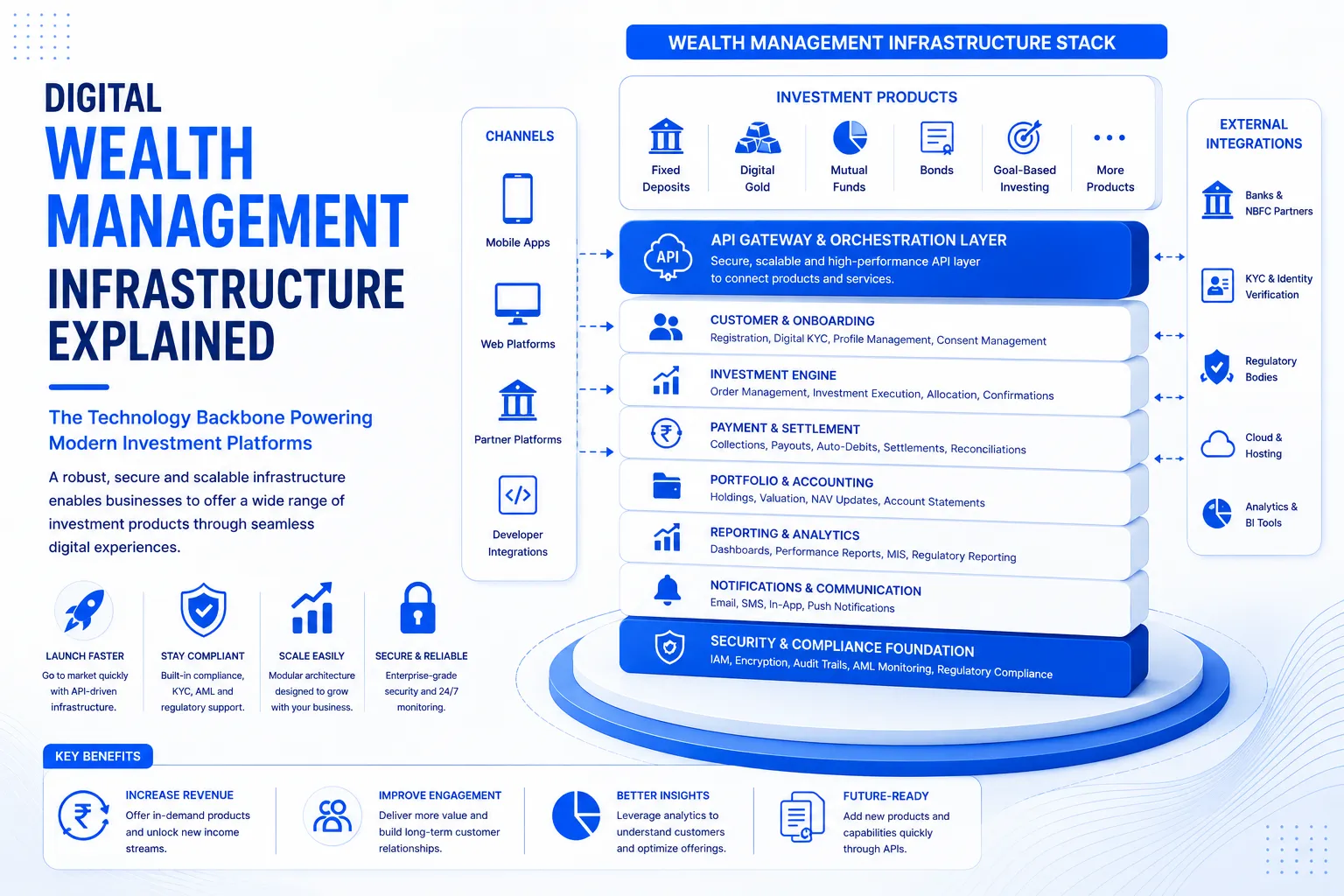
Offering products like Fixed Deposits, Digital Gold, Mutual Funds, and Bonds requires much more than an attractive user interface. Behind every successful investment platform is a sophisticated digital wealth management infrastructure that handles customer onboarding, investment execution, compliance, payments, portfolio management, and security.
The good news is that businesses no longer need to build this infrastructure themselves. API-driven platforms have made it possible to launch modern wealth management products faster while reducing operational complexity.
In this guide, we’ll explain what digital wealth management infrastructure is, the key components involved, and how businesses can leverage it to bring investment products to market.
What Is Digital Wealth Management Infrastructure?
Digital wealth management infrastructure is the technology foundation that enables businesses to offer investment products through websites, mobile applications, and digital platforms.
Instead of building every financial system internally, businesses use infrastructure providers that connect them to regulated investment products and automate backend operations.
A modern infrastructure typically supports:
- Customer onboarding
- Investment product integration
- Digital KYC
- Payment processing
- Portfolio management
- Compliance workflows
- Transaction reporting
- Security and authentication
- Analytics and notifications
This allows businesses to focus on delivering exceptional customer experiences while relying on robust backend systems.
Why Infrastructure Matters
Launching investment products involves far more than displaying financial information.
Behind every investment transaction, multiple systems must work together.
For example, when a customer invests in a Fixed Deposit, the infrastructure may:
- Verify customer identity
- Process payment
- Validate eligibility
- Execute the investment
- Generate confirmations
- Update the portfolio
- Record compliance data
- Notify the customer
Without reliable infrastructure, delivering this experience consistently becomes difficult.
Core Components of Wealth Management Infrastructure
Modern digital investment platforms consist of several interconnected layers.
1. Product Integration Layer
This layer connects businesses with financial products.
Through APIs, businesses can integrate offerings such as:
- Fixed Deposits
- Digital Gold
- Mutual Funds
- Bonds
- Goal-based investment solutions
Instead of creating individual integrations for every product, businesses can often access multiple investment options through a unified infrastructure platform.
2. Customer Onboarding
Before customers can begin investing, they must complete onboarding requirements.
Infrastructure platforms typically provide:
- Digital registration
- Identity verification
- Document collection
- Consent management
- Account creation
Efficient onboarding reduces friction and improves conversion rates.
3. Digital KYC and Compliance
Compliance is a critical component of wealth management infrastructure.
Common capabilities include:
- Digital KYC
- AML screening
- Identity verification
- Regulatory reporting
- Audit trails
- Customer consent management
Embedding these workflows into infrastructure simplifies regulatory compliance while improving operational efficiency.
4. Payment Infrastructure
Investment products require secure movement of funds.
Payment infrastructure manages:
- Deposits
- Withdrawals
- Investment funding
- SIP collections
- Refunds
- Settlement workflows
Reliable payment systems ensure seamless customer experiences throughout the investment lifecycle.
5. Investment Execution Engine
Once a customer submits an investment request, the execution engine processes the transaction.
Responsibilities include:
- Order validation
- Product allocation
- Investment confirmation
- Transaction recording
- Portfolio updates
Automation significantly reduces processing time and operational errors.
6. Portfolio Management System
Customers expect real-time visibility into their investments.
Portfolio infrastructure enables users to:
- View holdings
- Track returns
- Monitor diversification
- Review historical performance
- Analyze asset allocation
Comprehensive portfolio dashboards improve engagement and encourage repeat investment activity.
7. Reporting and Analytics
Businesses require operational visibility to manage investment products effectively.
Reporting systems provide:
- Transaction reports
- Customer activity
- Product performance
- Investment trends
- Operational insights
- Compliance documentation
Analytics help businesses optimize customer experiences while supporting strategic decision-making.
8. Security Infrastructure
Financial services demand enterprise-grade security.
Essential security capabilities include:
- Data encryption
- Multi-factor authentication
- Secure API gateways
- Fraud monitoring
- Access controls
- Audit logging
Robust security builds customer trust while protecting sensitive financial information.
Why APIs Have Become the Foundation
APIs connect frontend applications with backend financial infrastructure.
Instead of developing individual systems, businesses integrate standardized APIs that expose investment functionality securely.
Common API categories include:
Investment APIs
Enable customers to invest in products such as Fixed Deposits, Digital Gold, Mutual Funds, and Bonds.
KYC APIs
Support digital identity verification and regulatory compliance.
Portfolio APIs
Provide real-time investment information and performance tracking.
Payment APIs
Handle deposits, withdrawals, and recurring investments.
Reporting APIs
Generate operational and compliance reports.
Together, these APIs simplify development while enabling scalable financial services.
Building for Scalability
Digital wealth management platforms should support future expansion.
Businesses often begin with one investment product before gradually adding more.
A scalable architecture allows organizations to:
- Launch Fixed Deposits first
- Add Digital Gold
- Expand into Mutual Funds
- Introduce Bonds
- Offer goal-based investing
- Build recurring investment plans
API-driven infrastructure makes this modular growth possible without requiring significant redevelopment.
Industries Using Digital Wealth Infrastructure
Modern wealth management infrastructure supports businesses across multiple industries.
Fintech Companies
Expand beyond payments into investments.
Digital Banks
Offer broader wealth management capabilities.
Insurance Platforms
Integrate investment products alongside protection solutions.
Payroll Providers
Enable salary-linked investing.
Employee Benefits Platforms
Support long-term financial wellness.
Consumer Apps
Increase engagement through embedded investment products.
Benefits of API-Driven Infrastructure
Businesses adopting modern infrastructure gain several advantages.
Faster Product Launches
Reduce development timelines through pre-built integrations.
Lower Operational Complexity
Avoid building financial systems internally.
Improved Customer Experience
Deliver seamless investment journeys.
Better Scalability
Expand product offerings without redesigning infrastructure.
Enhanced Security
Leverage enterprise-grade financial systems.
Regulatory Support
Simplify compliance with integrated workflows.
How Finspring Simplifies Wealth Management Infrastructure
Building digital wealth infrastructure independently can require years of development and complex regulatory coordination.
Finspring simplifies this process by providing API-driven infrastructure that enables businesses to launch investment products through a single integration.
Using Finspring’s platform, businesses can integrate:
- Fixed Deposits
- Digital Gold
- Mutual Funds
- Bonds
- Other embedded investment products
Instead of managing backend financial operations, organizations can focus on customer experience, product innovation, and business growth while relying on secure, scalable infrastructure.
The Future of Wealth Management Infrastructure
As embedded finance continues to reshape financial services, digital wealth management infrastructure will become increasingly important.
Businesses that invest in scalable, API-driven architecture can launch products faster, respond to changing customer expectations, and expand into new financial services with confidence.
Rather than building every component internally, organizations can leverage modern infrastructure platforms to deliver secure, compliant, and engaging investment experiences that keep customers coming back.
For businesses looking to enter wealth management, the question is no longer whether infrastructure is necessary—it is how quickly they can adopt the right one.
Frequently Asked Questions (FAQs)
What is digital wealth management infrastructure?
Digital wealth management infrastructure is the backend technology that enables businesses to offer investment products such as Fixed Deposits, Digital Gold, Mutual Funds, and Bonds through secure APIs and automated financial systems.
Why is API-driven infrastructure important?
API-driven infrastructure simplifies integration, reduces development time, supports scalability, and enables businesses to launch wealth management products without building complex financial systems from scratch.
What are the main components of wealth management infrastructure?
Key components include investment APIs, customer onboarding, digital KYC, payment processing, portfolio management, reporting, compliance, analytics, and enterprise-grade security.
Which businesses need digital wealth management infrastructure?
Fintech companies, digital banks, insurance providers, payroll platforms, employee benefits platforms, and consumer apps can all benefit from digital wealth management infrastructure.
How does Finspring support digital wealth management?
Finspring provides API-driven infrastructure that enables businesses to integrate investment products such as Fixed Deposits, Digital Gold, Mutual Funds, and Bonds through a single, scalable platform, reducing operational complexity and accelerating time to market.