Fixed Deposits (FDs) remain one of the most trusted financial products in India’s savings ecosystem. For NBFCs, fintech platforms, and digital wealth providers, offering fixed deposits can help diversify funding sources, strengthen customer relationships, and improve product portfolios. However, launching and managing FD products involves much more than simply enabling users to make deposits. Financial institutions must manage the entire FD lifecycle, which includes customer onboarding, deposit booking, payment processing, interest tracking, maturity management, reporting, and regulatory compliance. Each stage requires accurate data handling, secure transactions, and seamless coordination between systems. Finspring simplifies this complexity by offering a comprehensive platform designed for end-to-end FD lifecycle management. Through its SDK-driven infrastructure, Finspring allows institutions to integrate and manage the full deposit journey—from the moment a user discovers an FD product to its maturity and final payout.
This article explains how Finspring manages the entire FD lifecycle management process while ensuring operational efficiency, regulatory readiness, and a smooth customer experience.
Understanding the Fixed Deposit Lifecycle
Before exploring how Finspring manages deposits, it is important to understand the key stages involved in the lifecycle of a fixed deposit.
A typical FD journey includes the following steps:
- Customer onboarding and identity verification
- Product discovery and deposit selection
- Deposit booking and payment confirmation
- Deposit lifecycle tracking and interest accrual
- Maturity management and payout processing
- Renewal or reinvestment options
- Reporting and compliance monitoring
Each stage must function accurately and reliably because even small operational errors can impact financial records, regulatory compliance, and customer trust.
Finspring’s infrastructure is designed to manage every step of this lifecycle automatically and securely.
Stage 1: Customer Onboarding and Verification
The first step in FD lifecycle management is ensuring that customers are verified and compliant with regulatory requirements. Financial institutions must conduct identity checks and KYC verification before allowing users to book deposits.
Finspring integrates onboarding workflows into its platform, allowing institutions to manage customer verification seamlessly.
Key onboarding capabilities include:
- identity verification and KYC integration
- document validation and compliance checks
- customer profile creation
- secure user authentication
By integrating these processes into the platform, Finspring ensures that every deposit begins with a verified customer profile. This reduces fraud risks and helps institutions maintain regulatory compliance.
Stage 2: FD Product Discovery
Once onboarding is completed, customers must be able to discover available FD products easily. Product discovery plays a critical role in improving user engagement and conversion rates.
Finspring enables financial platforms to present FD options dynamically within their applications. Users can view deposit offerings with details such as:
- interest rates
- deposit tenure options
- minimum investment requirements
- payout structures
Because these product listings are powered through the SDK infrastructure, institutions can update FD offerings without rebuilding their application interfaces.
This flexibility ensures that users always see accurate product information.
Stage 3: Deposit Booking and Payment Processing
After selecting an FD product, the customer proceeds to the deposit booking stage. This is one of the most critical parts of the FD lifecycle because it involves financial transactions and deposit record creation.
Finspring manages this process through its deposit booking engine.
Key functions include:
- validating deposit parameters
- processing payment confirmation
- generating deposit records
- initiating lifecycle tracking
The platform also coordinates with payment systems to ensure that deposit bookings are confirmed only after successful payment completion. This eliminates discrepancies between payment transactions and deposit records.
Once a deposit is successfully booked, it becomes part of the active FD portfolio managed by the system.
Stage 4: Deposit Lifecycle Tracking
After booking, the deposit enters its active lifecycle phase. During this period, the system must track interest accrual, maintain deposit records, and ensure accurate financial reporting.
Finspring’s lifecycle management engine continuously monitors each deposit and records important events such as:
- interest accumulation
- tenure progression
- maturity date tracking
- account status updates
These processes run automatically within the platform, reducing manual operational work for financial institutions.
The lifecycle engine ensures that deposits remain accurately tracked from creation to maturity.
Stage 5: Portfolio Monitoring and Customer Visibility
Transparency is essential for maintaining customer trust in financial products. Users need to see their deposits clearly and track performance over time.
Finspring provides portfolio management tools that allow users and institutions to monitor deposit activity.
Key portfolio features include:
- active FD summaries
- maturity timelines
- interest earnings projections
- historical transaction records
These dashboards can be embedded within mobile apps, wealth platforms, or financial dashboards.
For institutions, the portfolio layer provides operational visibility into all deposits managed through the platform.
Stage 6: Maturity and Payout Management
As deposits approach maturity, the system must handle payout processing accurately. This stage involves calculating final interest earnings, updating financial records, and initiating payment transfers.
Finspring’s maturity management engine automates these processes.
Key functions include:
- calculating final payout values
- triggering maturity events
- initiating payout transactions
- updating deposit status
Automation ensures that deposits are processed correctly without requiring manual intervention from operations teams.
This capability becomes particularly valuable for institutions managing thousands of deposits simultaneously.
Stage 7: Renewal and Reinvestment Options
Many customers choose to reinvest their deposits after maturity. Offering seamless renewal options can help institutions retain deposit capital and maintain long-term customer relationships.
Finspring supports renewal workflows within its FD lifecycle management system.
Customers can choose to:
- renew their existing deposit for another tenure
- reinvest funds into new FD products
- withdraw funds at maturity
These options can be presented through automated notifications or integrated user interface components.
Providing reinvestment options directly within the platform improves user convenience and increases retention rates.
Stage 8: Reporting, Reconciliation, and Compliance
Financial institutions must maintain detailed records of deposit transactions to meet regulatory and operational requirements.
Finspring includes a comprehensive reporting and reconciliation layer that ensures all FD activities are documented accurately.
Reporting capabilities include:
- transaction logs
- deposit activity reports
- reconciliation summaries
- audit-ready records
These records help institutions monitor financial operations and prepare regulatory submissions when required.
By embedding reporting infrastructure into the lifecycle management system, Finspring reduces the administrative burden associated with deposit operations.
Operational Benefits of End-to-End FD Lifecycle Management
Managing the entire FD lifecycle through a unified platform offers several operational advantages.
Reduced Operational Complexity
Instead of managing multiple disconnected systems, institutions can oversee deposit operations from a single platform.
Improved Accuracy
Automated lifecycle tracking reduces manual errors and ensures accurate financial records.
Faster Product Launch
Because lifecycle infrastructure is already built into the platform, institutions can launch FD products without developing complex backend systems.
Enhanced Customer Experience
Customers benefit from seamless onboarding, transparent deposit tracking, and automated maturity workflows.
The Importance of Integrated FD Lifecycle Infrastructure
As financial institutions continue to digitize their services, infrastructure capable of managing long-term financial products becomes increasingly important.
Fixed deposits involve complex operational requirements that extend far beyond simple transactions. Managing these requirements efficiently requires robust lifecycle infrastructure.
Finspring’s platform provides a comprehensive solution by integrating every stage of FD lifecycle management into a single technology framework.
Conclusion
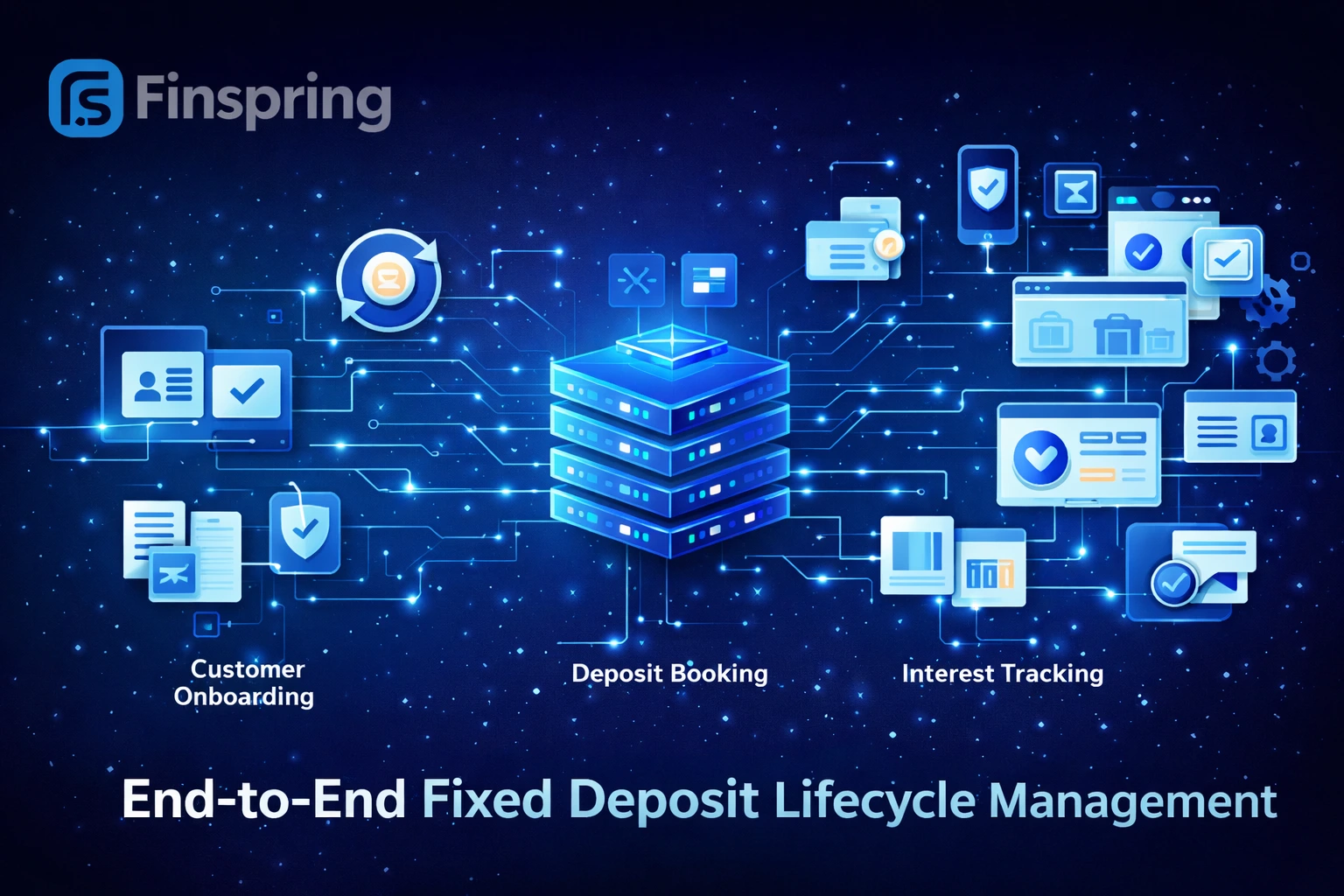
Managing fixed deposits involves a complex operational journey that begins with customer onboarding and continues through deposit booking, lifecycle monitoring, maturity processing, and reporting.
Finspring simplifies this process by providing a unified platform designed for end-to-end FD lifecycle management. Through integrated onboarding systems, automated booking engines, lifecycle tracking modules, portfolio dashboards, and reporting tools, the platform enables financial institutions to manage deposit operations efficiently and securely.
By automating key processes and providing a structured infrastructure for deposit management, Finspring allows institutions to focus on delivering better financial products while reducing operational complexity.
In a rapidly evolving digital finance ecosystem, robust FD lifecycle management systems like Finspring’s play a critical role in enabling scalable and reliable deposit services.