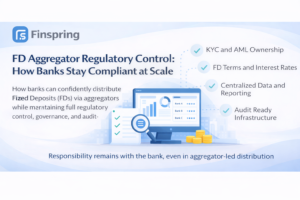
As digital distribution becomes central to how financial products reach customers, banks are increasingly partnering with fintech platforms and aggregators to distribute Fixed Deposits (FDs) at scale. This shift often raises an important question inside banks and NBFCs: If FDs are sold through aggregators, how does the bank retain FD Aggregator Regulatory Control ?
The answer lies in understanding the difference between distribution and ownership, and in designing the right infrastructure, governance, and controls at the outset.
This article explores how banks can confidently distribute FDs via aggregators while remaining fully compliant, accountable, and in control.
The FD Aggregator Regulatory Control Reality: Control Cannot Be Delegated
From a regulatory standpoint, one principle is non-negotiable:
The bank remains fully responsible for the FD, regardless of the distribution channel.
This includes responsibility for:
-
KYC and AML compliance
-
Product terms and disclosures
-
Interest rate setting
-
Customer communication
-
Reporting and audits
Aggregators do not replace the bank’s regulatory obligations. They operate strictly as distribution and technology partners, not as issuers or custodians of the deposit.
The challenge, therefore, is not whether banks can retain control — it is how that control is operationalized at scale.
Distribution vs Ownership: The Core Distinction
When banks sell FDs through aggregators, roles must be clearly defined.
The Bank Owns:
-
The FD product
-
Regulatory accountability
-
Customer funds
-
Compliance interpretation
-
Reporting to regulators
The Aggregator Enables:
-
Digital discovery and reach
-
User interfaces and journeys
-
API-driven onboarding
-
Operational efficiency
Problems arise only when this distinction becomes blurred — typically due to fragmented systems or loosely governed integrations.
Where Banks Typically Fear Loss of Control
Banks exploring aggregator-led distribution often worry about:
-
Loss of visibility into end customers
-
Inconsistent KYC or onboarding standards
-
Data fragmentation across partners
-
Difficulty in audit and reporting
-
Over-dependence on third-party systems
These are valid concerns — but they are infrastructure problems, not distribution problems.
The Infrastructure-First Approach to Retaining FD Aggregator Regulatory Control
Banks that successfully scale FD distribution through aggregators adopt a compliance-first infrastructure model, where governance is embedded into the system itself.
Key principles include:
1. Bank-Led Product Definition
Even when FDs are sold via aggregators:
-
Product terms are defined by the bank
-
Interest rates are controlled by the bank
-
Eligibility rules are set by the bank
Aggregators consume these rules via APIs.
They do not interpret or modify them.
This ensures that product governance remains centralized, regardless of how many platforms distribute the FD.
2. Controlled Digital Onboarding
Modern FD distribution relies on digital onboarding, but control does not mean manual intervention.
Banks retain control by:
-
Defining KYC and AML workflows centrally
-
Approving onboarding logic once, at the infrastructure level
-
Enforcing uniform checks across all distribution partners
When onboarding flows are standardized and API-driven, every aggregator follows the same regulatory logic — eliminating variability.
3. Single Source of Truth for Data
One of the biggest risks in aggregator-led distribution is data fragmentation.
Banks mitigate this by ensuring:
-
All FD data flows back to a central system
-
Customer, transaction, and maturity data are unified
-
Aggregators never become the system of record
In this model:
-
Aggregators are interfaces
-
The bank (or its designated infrastructure layer) remains the system of truth
This is critical for audits, reconciliations, and regulatory reporting.
4. Centralized Reporting and Audit Readiness
Regulators do not audit aggregators — they audit banks.
Banks that retain control ensure that:
-
Reporting formats are standardized
-
Data is available in regulator-ready formats
-
Aggregator activity is fully traceable
This is achieved when reporting is designed at the infrastructure layer, not assembled manually across partners.
The result: audits become predictable, repeatable, and defensible.
5. Governance Through Architecture, Not Oversight
Traditional oversight relies heavily on:
-
Manual checks
-
Partner reviews
-
Operational controls
At scale, this becomes unsustainable.
Modern banks retain control by embedding governance directly into the architecture:
-
Rule-based validations
-
Permissioned access
-
Automated alerts and controls
When governance is architectural, control does not weaken as distribution expands — it strengthens.
Why Aggregators Do Not Dilute FD Aggregator Regulatory Control
Contrary to common belief, well-structured aggregator partnerships can increase regulatory discipline.
Why?
Because they force banks to:
-
Standardize processes
-
Eliminate ad-hoc exceptions
-
Formalize onboarding and reporting logic
-
Reduce manual interventions
In many cases, banks achieve better compliance outcomes through digital distribution than through fragmented offline channels.
The Role of Multi-Aggregator Distribution
As banks scale, they often work with multiple aggregators.
This is where infrastructure design becomes critical.
Without a unified integration layer:
-
Each aggregator introduces variation
-
Compliance becomes partner-dependent
-
Reporting becomes complex
With a single, expansion-ready integration:
-
Aggregators plug into the same governed system
-
Compliance logic scales uniformly
-
Control remains centralized
The bank’s regulatory posture stays consistent — regardless of how many platforms distribute its FDs.
From Channel Risk to Strategic Advantage
Banks that approach aggregator distribution defensively often limit scale.
Banks that approach it architecturally unlock:
-
Wider reach without compliance dilution
-
Faster go-to-market
-
Better data visibility
-
Stronger governance
The key shift is this:
FD Aggregator Regulatory Control is not preserved by restricting channels, but by designing the right infrastructure.
Closing Thoughts
Selling Fixed Deposits via aggregators does not require banks to give up control.
It requires them to:
-
Clearly separate ownership from distribution
-
Embed compliance into infrastructure
-
Centralize data and reporting
-
Govern through architecture, not manual oversight
When these principles are applied, aggregators become a controlled extension of the bank’s distribution strategy, not a regulatory risk.
In a digital-first financial ecosystem, this is not just a safe approach — it is a necessary one.
Read more about choosing the right FD aggregator platform for your business, here.