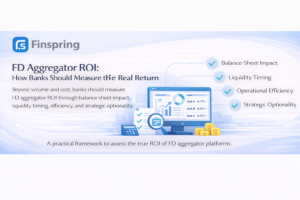
Fixed Deposit (FD) aggregator platforms are often evaluated through a narrow lens: How many FDs did we sell, and what did it cost? While volume and cost matter, they are insufficient to measure the true return on FD aggregation. For banks and regulated institutions, FD Aggregator ROI ROI must account for speed, control, predictability, and balance-sheet impact—not just distribution metrics.
This article outlines a practical framework for measuring ROI from FD aggregator platforms, grounded in how banks actually operate.
Why Traditional ROI Metrics Fall Short
Many teams default to metrics like:
-
Cost per FD booking
-
Commission paid vs branch acquisition cost
-
Gross deposit inflows
These are useful—but incomplete.
They ignore:
-
Liquidity timing benefits
-
Tenure mix improvements
-
Operational cost reductions
-
Governance and compliance efficiency
-
Opportunity cost of slower channels
As a result, FD aggregators may appear expensive on paper while quietly delivering net-positive outcomes across the system.
A Better Way to Think About FD Aggregator ROIROI
FD Aggregator ROI should be measured across four layers:
-
Distribution Efficiency
-
Balance Sheet Impact
-
Operational Leverage
-
Strategic Optionality
Each layer answers a different question—and together, they reflect the full return.
1) Distribution Efficiency ROI
This is the most visible layer—and the one most teams start with.
Key Metrics
-
Time to market for FD campaigns
-
Incremental deposit volumes (net new, not cannibalised)
-
Conversion rates by tenure
-
Campaign responsiveness to rate changes
What to Look For
-
Speed advantage: How quickly can the bank mobilise deposits when needed?
-
Incrementality: Are these deposits additive, or would they have arrived anyway?
-
Precision: Can specific tenures be promoted selectively?
ROI Insight:
If an aggregator enables faster, more targeted deposit mobilisation than branches or static channels, it delivers ROI even if per-booking costs are higher.
2) Balance Sheet ROI (Often Missed)
For treasury and ALM teams, this is where ROI becomes tangible.
Key Metrics
-
Alignment of inflows to liquidity gaps
-
Tenure-wise deposit composition improvement
-
Reduction in short-term funding reliance
-
Predictability of inflows during campaigns
What to Look For
-
Did aggregator-led inflows reduce reliance on bulk deposits or interbank borrowing?
-
Did they improve duration matching?
-
Were inflows timed to actual liquidity needs?
ROI Insight:
Deposits mobilised at the right time and tenure can be more valuable than cheaper deposits mobilised late.
3) Operational ROI
Aggregator platforms often replace or simplify multiple manual processes.
Key Metrics
-
Reduction in manual processing per FD
-
Lower servicing and reconciliation effort
-
Fewer exceptions and rework cases
-
Audit readiness and reporting efficiency
What to Look For
-
Are teams spending less time on coordination and fixes?
-
Has documentation standardisation reduced friction?
-
Are audits easier to prepare for?
ROI Insight:
Operational efficiency compounds. Small per-transaction savings add up significantly at scale—and reduce hidden costs that traditional ROI models miss.
4) Strategic Optionality ROI
This is the least quantified—but most important—layer.
Key Metrics
-
Ability to launch short-term campaigns without system changes
-
Flexibility to pause or cap inflows quickly
-
Ease of onboarding additional aggregators
-
Readiness to expand into adjacent products
What to Look For
-
Does the bank gain more control levers?
-
Can strategies be executed without long lead times?
-
Is the institution less dependent on any single channel?
ROI Insight:
Optionality is value. Infrastructure that increases strategic choices delivers ROI even when not exercised continuously.
Separating Gross FD Aggregator ROI from Net ROI
A common mistake is to measure gross inflows instead of net impact.
To calculate net ROI, banks should:
-
Exclude cannibalised branch volumes
-
Account for tenure and stability differences
-
Factor in cost of alternative funding sources
-
Include operational and treasury offsets
Only then does the real return become visible.
Short-Term vs Long-Term ROI
FD aggregators often look different depending on the timeframe.
Short-Term
-
Higher visibility of commissions
-
Faster inflows
-
Immediate reporting improvements
Long-Term
-
Better predictability
-
Improved liquidity planning
-
Reduced dependency on reactive funding
-
Stronger governance through standardisation
ROI improves over time as patterns stabilise and teams learn how to use the channel intentionally.
The Role of Governance in FD Aggregator ROI Outcomes
Poor ROI outcomes are rarely caused by aggregators themselves.
They usually result from:
-
Lack of inflow caps
-
Unclear campaign objectives
-
Weak coordination between treasury and distribution
-
Overuse instead of targeted use
When governance is embedded into the infrastructure—rate controls, tenure rules, caps—ROI becomes predictable.
Aggregators as ROI Multipliers, Not Cost Centres
The most mature institutions stop viewing FD aggregators as “another channel.”
They treat them as:
-
Execution layers for treasury strategy
-
Acceleration layers for distribution
-
Standardisation layers for operations
In this model, ROI is not a single number.
It is a system-wide improvement.
A Practical FD Aggregator ROI Checklist
Before concluding whether an FD aggregator “works,” ask:
-
Did it improve timing, not just volume?
-
Did it reduce reliance on emergency liquidity?
-
Did it simplify operations?
-
Did it give treasury more control?
-
Did it increase optionality?
If the answer to several of these is yes, the ROI is real—even if it doesn’t show up cleanly in a single metric.
Closing Thoughts
Measuring ROI for FD aggregator platforms requires moving beyond transactional thinking.
The real returns lie in:
-
Faster execution
-
Better balance-sheet outcomes
-
Lower operational friction
-
Greater strategic control
Banks that evaluate aggregators purely on cost risk underestimating their value.
Banks that evaluate them as infrastructure understand where the true ROI lives.
Read the impact on on-boarding FD Aggregator platforms on the treasury teams of banks, here.