As digital distribution reshapes deposit markets, more banks, fintech platforms, and wealth management firms are exploring Fixed Deposit (FD) launches through aggregator SDKs rather than building infrastructure in-house. One of the first questions decision-makers ask is straightforward: How much do FD aggregator SDK cost?
The answer is more nuanced than a single fee line item. The cost structure typically spans integration, compliance alignment, platform usage, revenue sharing, and ongoing operational considerations.
This article breaks down the typical cost components and explains how institutions should evaluate total cost of ownership rather than just upfront pricing.
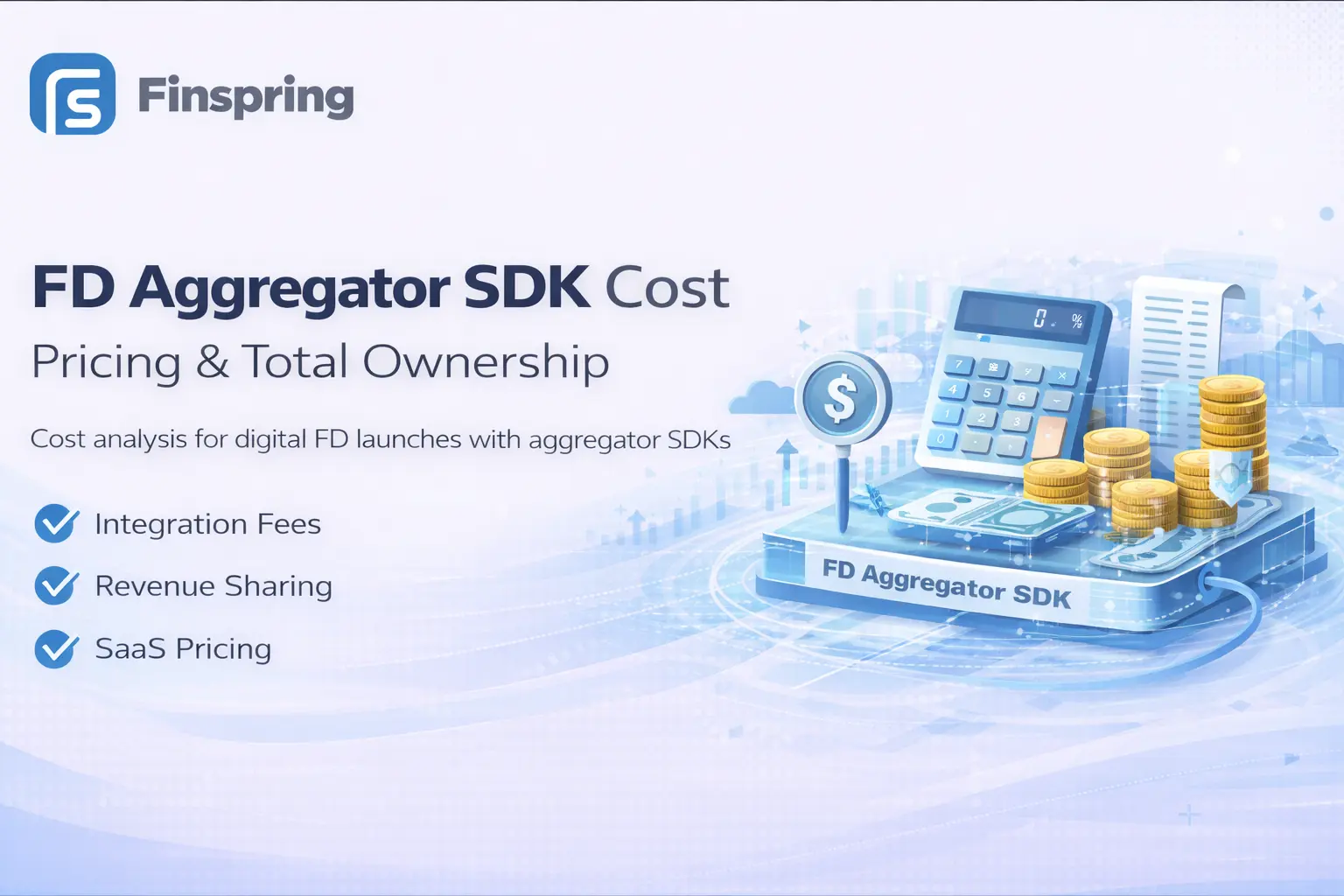
1. One-Time Integration FD aggregator SDK cost
The first layer of cost is technical integration.
Most FD aggregator SDKs require:
- API integration into the institution’s website or app
- Front-end embedding of booking workflows
- Configuration of rate display
- Testing and user acceptance validation
Some SDK providers charge a one-time setup or onboarding fee to cover:
- Technical support
- Sandbox access
- Initial configuration
- Compliance alignment workshops
Compared to building full FD infrastructure internally, integration costs are usually modest. However, institutions should clarify whether setup fees are fixed or variable based on customization needs.
Key consideration: Integration costs are typically a fraction of in-house development expenditure.
2. Platform Access or SaaS Fees
Some FD aggregator SDK providers operate on a Software-as-a-Service (SaaS) model.
This may include:
- Monthly or annual platform access fees
- Tiered pricing based on volume
- Minimum usage commitments
These fees generally cover:
- Ongoing system maintenance
- API uptime and monitoring
- Compliance updates
- Product enhancements
- Reporting tools
Institutions should evaluate whether the fee structure scales proportionately with growth or introduces fixed overhead regardless of volume.
For cost-sensitive markets, predictable and scalable fee models are critical.
3. Revenue Share or Commission-Based Model
Many FD aggregator SDKs operate primarily on a revenue-sharing structure.
Under this model:
- The bank pays distribution commission
- The aggregator receives a share of that commission
- The platform integrating the SDK may receive a share as well
This aligns incentives because costs scale with actual FD bookings rather than being fixed upfront.
Key elements to review:
- Commission percentage
- Whether revenue share applies to fresh bookings only
- Whether renewals are included
- Whether tenure length affects economics
Revenue share models often reduce upfront financial risk while tying cost to performance.
4. Compliance and Legal Review FD aggregator SDK cost
Although infrastructure reduces engineering burden, compliance review remains mandatory.
Before launch, institutions may incur:
- Legal contract drafting and negotiation expenses
- Vendor risk assessment reviews
- Information security audits
- Internal compliance approval cycles
These are not direct FD aggregator SDK cost but are real costs in the launch process.
Institutions should factor internal compliance resource allocation into the total cost structure.
The advantage of established SDK providers is that much of the regulatory workflow is pre-aligned, reducing repeated compliance interpretation work.
5. Security and Audit FD aggregator SDK cost
Even when using a third-party SDK, institutions remain accountable for:
- Data protection
- Regulatory reporting
- Audit readiness
Some costs may include:
- Third-party security audit verification
- Periodic penetration testing
- Audit review of integration processes
However, mature FD aggregator SDKs typically maintain:
- Encryption standards
- Audit logging
- Role-based access control
- Recognized security certifications
This reduces duplication of infrastructure-level security investment.
6. Operational Cost Savings
When evaluating cost structure, it is essential to account for avoided costs.
Using an FD aggregator SDK eliminates the need to:
- Hire dedicated backend engineers for deposit systems
- Maintain in-house API orchestration
- Build reporting engines from scratch
- Develop maturity tracking logic
- Design renewal workflows
The opportunity cost of building in-house infrastructure can include:
- Engineering salaries
- DevOps resources
- Ongoing maintenance
- Compliance testing cycles
- Upgrade management
The SDK model shifts these from capital expenditure to operational expenditure.
7. Time-to-Market Value
Time also has cost.
Building in-house FD infrastructure can take:
- 6 to 12 months
- Multiple internal approval cycles
- Vendor coordination
Using an FD aggregator SDK can significantly compress timelines.
Earlier launch enables:
- Faster deposit mobilisation
- Earlier revenue realisation
- Competitive positioning
The cost structure must therefore include time-to-market value, not just direct expenses.
Delayed launches often carry hidden financial consequences.
8. Scalability FD aggregator SDK cost Implications
An often-overlooked cost element is scalability.
In-house builds often incur:
- Performance scaling costs
- Infrastructure expansion
- Server capacity upgrades
- Additional compliance adaptations
FD aggregator SDKs typically operate on scalable infrastructure models.
This means:
- Higher transaction volume does not proportionally increase internal technology costs
- Expansion across banks is simpler
- Multi-asset addition does not require architectural rebuild
Institutions should assess whether the cost model supports long-term growth rather than short-term savings.
9. Multi-Bank and Multi-Asset Expansion Costs
If an institution intends to:
- Add more banks
- Expand into Recurring Deposits
- Introduce Bonds or other instruments
The cost advantage of an SDK becomes clearer.
Without modular infrastructure, each new product may trigger:
- Fresh integrations
- New compliance reviews
- Additional development cycles
With an aggregator SDK, expansion often leverages existing integration frameworks.
This significantly lowers incremental cost per product.
10. Hidden FD aggregator SDK cost Risks to Watch
While SDK models reduce build costs, institutions should watch for:
- Unclear revenue share terms
- High minimum commitments
- Hidden customization fees
- Long lock-in periods
- Renewal commission disputes
Transparency in commercial agreements is critical.
Cost structure should align incentives without introducing dependency risk.
Build vs SDK: Comparative Cost Perspective
In-house build:
- High upfront engineering investment
- Long development timeline
- Ongoing maintenance cost
- Internal compliance and security overhead
- Higher fixed cost structure
FD aggregator SDK cost:
- Lower upfront cost
- Revenue-linked variable cost
- Faster go-live
- Reduced engineering overhead
- Infrastructure maintenance handled externally
For most mid-sized fintech and wealth platforms, the SDK model is capital-efficient.
Closing Thoughts
The cost structure of launching FDs using an FD aggregator SDK typically includes:
- One-time integration fees
- SaaS or access charges (if applicable)
- Revenue share on bookings
- Internal compliance review costs
- Security oversight alignment
However, cost should not be evaluated in isolation.
Institutions must compare:
- Total cost of ownership
- Opportunity cost of delay
- Engineering overhead avoided
- Scalability flexibility gained
In regulated financial infrastructure, efficiency is not achieved by minimizing fees alone. It is achieved by optimizing capital allocation, reducing complexity, and accelerating responsible growth.
For many institutions, launching FDs using an FD aggregator SDK offers a balanced cost structure—one that supports compliance, speed, and scale without requiring heavy in-house technology buildout.