When launching a digital Fixed Deposit (FD) offering, institutions face a fundamental infrastructure decision:
Do we integrate directly with banks? Or do we use an FD aggregator?
This is not just a technical choice. It is a strategic decision that affects speed to market, operational complexity, scalability, compliance ownership, revenue structure, and long-term control.
Let’s break this down clearly and structurally.
What Is an FD Aggregator?
An FD aggregator is a platform that connects multiple banks and NBFCs into a single unified API layer. Instead of integrating separately with each issuing institution, you integrate once with the aggregator, and they handle the orchestration behind the scenes.
From your perspective, you get:
- A single API endpoint
- Access to multiple FD issuers
- Standardized KYC and AML workflows
- Unified booking, renewal, and closure flows
- Centralized reconciliation
The aggregator acts as an infrastructure intermediary between distribution platforms and regulated deposit-taking institutions.
What Is Direct Bank Integration?
Direct integration means building individual technical connections with each bank or NBFC offering FDs. You connect your systems directly to their core banking system or deposit management APIs.
Banks typically operate on core systems such as:
- Finacle
- TCS BaNCS
- Flexcube
Each bank may have its own:
- API standards
- Compliance documentation
- Settlement processes
- Reporting formats
- SLA expectations
Direct integration gives deeper control but significantly increases complexity.
Core Differences: Aggregator vs Direct Integration
Let’s examine this across key dimensions.
1. Speed to Market
An FD aggregator dramatically reduces deployment time. Instead of negotiating and integrating with each bank separately, you plug into one infrastructure provider that already maintains these relationships.
Direct integration, on the other hand, requires individual legal agreements, compliance reviews, API documentation alignment, and testing cycles for every bank. This can extend deployment timelines from weeks to several months.
If speed is your priority, the aggregator model wins decisively.
2. Operational Complexity
Aggregators standardize deposit workflows. They normalize rate structures, booking flows, renewal logic, and reporting formats across multiple issuers.
Direct integration requires you to handle:
- Different interest calculation methods
- Separate reconciliation formats
- Individual KYC validation rules
- Bank-specific exception handling
Over time, maintaining multiple integrations becomes operationally heavy unless you have a dedicated infrastructure team.
3. Control and Customization
Direct bank integration offers deeper customization. You can negotiate specific rate structures, create custom tenure products, or integrate treasury-level configurations directly with the issuer.
Aggregators typically offer standardized product configurations. While flexible to an extent, you may not get full control over rate experimentation or product structuring.
If FD strategy is central to your long-term financial architecture, direct integration may offer strategic leverage.
4. Revenue Structure
Aggregators often operate on revenue-sharing or commission models. You earn a portion of the deposit spread or a per-booking fee.
With direct integration, you may negotiate better margins directly with banks, especially if you bring significant deposit volumes. However, you must also invest more in infrastructure and relationship management.
Higher potential margin usually comes with higher operational burden.
5. Risk and Dependency
Using an aggregator introduces vendor dependency. If the aggregator experiences downtime, compliance issues, or operational bottlenecks, your FD offering is impacted.
With direct integrations, risk is distributed across individual bank relationships. However, system reliability depends entirely on how robust your internal infrastructure is.
Aggregator dependency risk must be weighed against the complexity risk of managing multiple integrations internally.
6. Regulatory and Compliance Layer
Aggregators often provide built-in orchestration for KYC, CKYC, AML screening, and reporting. They standardize compliance processes across issuers, reducing duplication.
With direct integration, you must ensure compliance alignment separately with each bank’s internal policies and audit frameworks. This increases documentation and audit coordination effort.
However, direct integration may give you more visibility into compliance data and risk assessment processes.
When Does an FD Aggregator Make Strategic Sense?
An FD aggregator model works best when:
- You want rapid deployment
- FD is an add-on product, not your core balance sheet focus
- You operate as a distribution-first fintech
- You lack deep internal banking infrastructure
- You prefer standardized product structures
For wealth apps, super apps, and digital investment platforms, aggregators provide scalability with minimal engineering overhead.
When Does Direct Bank Integration Make More Sense?
Direct integration is better suited when:
- FD products are central to your financial strategy
- You want to build proprietary deposit infrastructure
- You need high customization flexibility
- You expect large deposit volumes and margin negotiation leverage
- You have strong technical and compliance teams
Institutions building long-term deposit platforms with treasury alignment often prefer direct relationships.
Hybrid Approach: The Emerging Model
Some institutions begin with an aggregator to enter the market quickly. Once deposit volumes grow and operational maturity improves, they gradually build selective direct integrations with key banks.
This hybrid approach balances speed and long-term control.
You get:
- Fast initial deployment
- Early revenue generation
- Gradual transition toward deeper issuer relationships
This staged strategy reduces early capital expenditure while preserving future flexibility.
Strategic Perspective: Infrastructure vs Distribution
The real decision comes down to identity.
Are you an infrastructure-led financial institution?
Or a distribution-led digital platform?
If you are focused on customer acquisition, user experience, and cross-selling, an FD aggregator allows you to focus on growth rather than plumbing.
If you see deposits as a strategic balance sheet driver, direct integration offers greater architectural control.
Final Answer
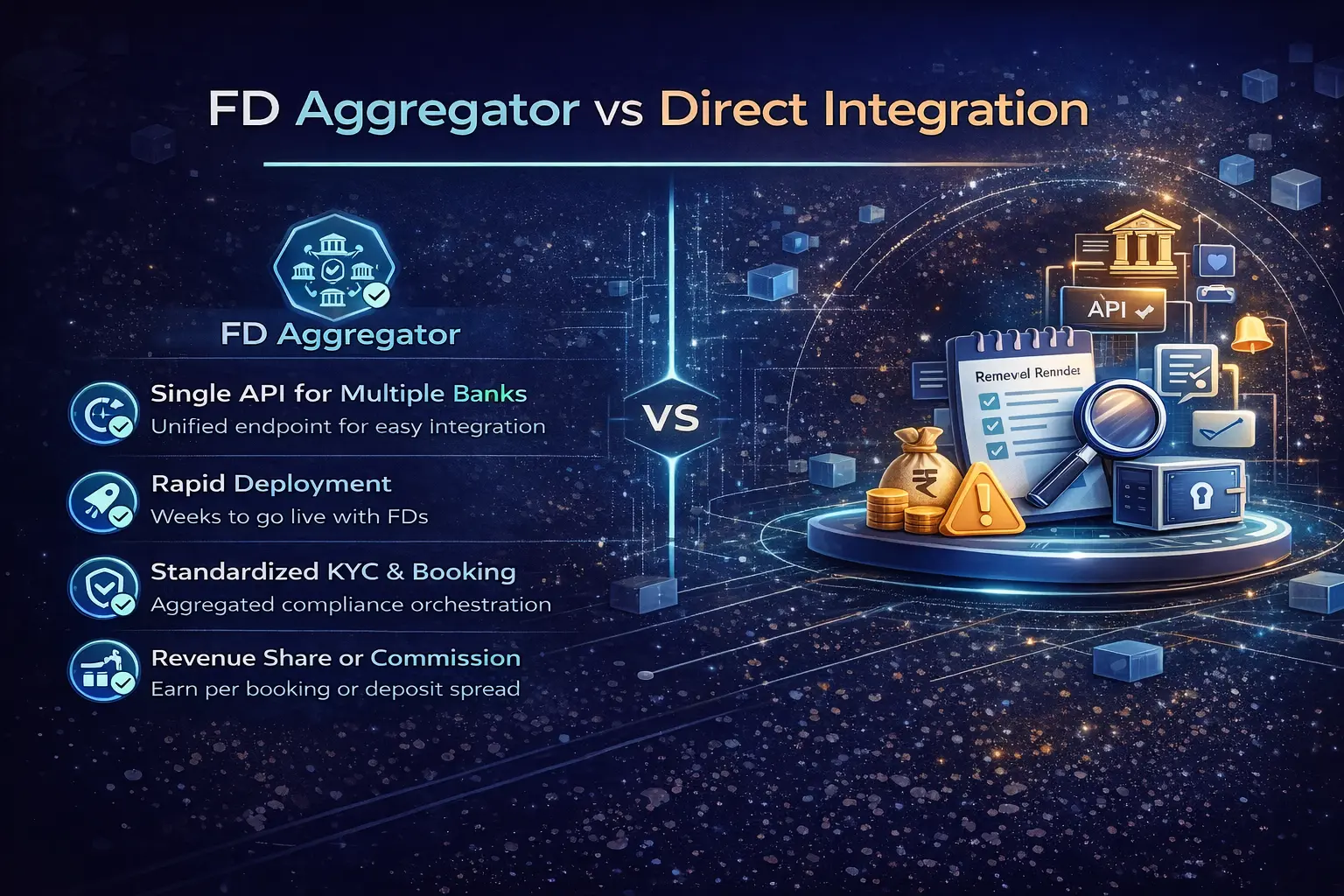
An FD aggregator acts as a centralized infrastructure layer that connects you to multiple banks through a single standardized API, reducing deployment time and operational complexity.
Direct bank integration involves building individual technical and legal relationships with each issuer, offering deeper customization and potential margin advantages but requiring significantly higher operational effort.
Choosing between them depends on your strategic priorities: speed versus control, standardization versus customization, scalability versus ownership.
The most successful institutions evaluate not just the technical integration path — but the long-term role FD plays in their business architecture.