In fintech, every transaction tells a story. But without a reliable way to record, trace, and verify that story, even the most advanced systems become fragile. This is where FD audit trails become essential. Particularly in fixed deposit (FD) infrastructure, audit trails are not just compliance artifacts—they are the foundation of trust, accountability, and operational clarity. As financial systems scale and regulatory scrutiny increases, fintech platforms must move beyond basic logging and adopt structured, real-time, and audit-ready systems. This article explores what audit trails mean in fintech, why they are critical for FD systems, and how to implement them effectively.
What is an Audit Trail in Fintech?
An audit trail is a chronological, immutable record of all activities, transactions, and system events that occur within a financial platform. It captures not only what happened, but also:
- Who performed the action
- When it occurred
- What data was involved
- What changes were made
- What the system response was
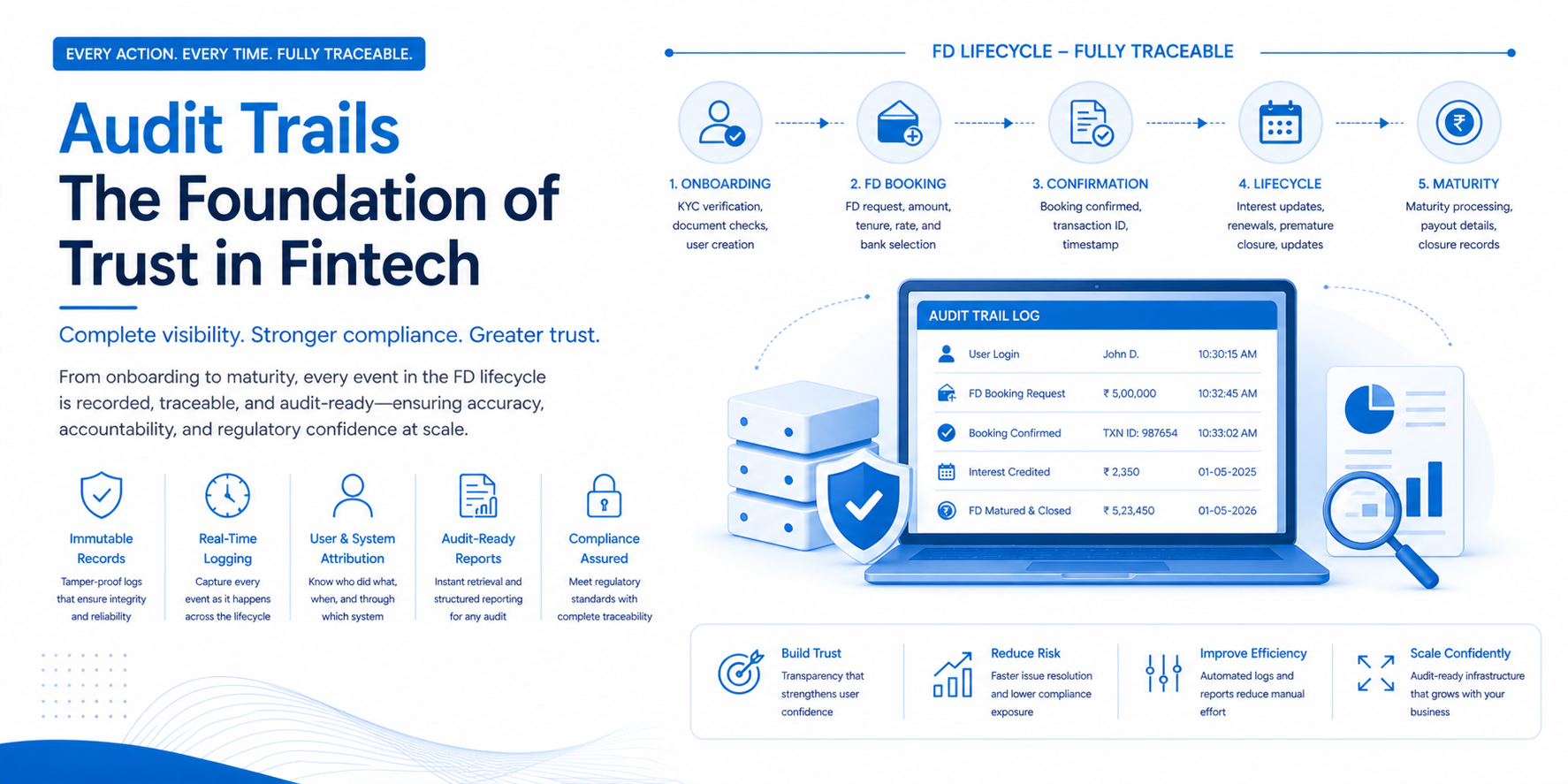
In the context of FD systems, audit trails track the entire lifecycle of a deposit—from onboarding and booking to maturity and closure—ensuring that every step is traceable and verifiable.
Why Audit Trails Are Critical in FD Infrastructure
Fixed Deposits are inherently trust-driven products. Users expect:
- Accurate records
- Timely updates
- Transparent communication
At the same time, regulators require:
- Complete transaction visibility
- Accurate reporting
- Verifiable compliance
Audit trails bridge these expectations by ensuring that every action within the FD lifecycle is documented and accessible.
Without strong audit trails, platforms face:
- Disputes without evidence
- Compliance gaps
- Delayed audits
- Increased operational risk
Regulatory Expectations for Audit Trails
In regulated environments like India, audit trails must meet strict standards. While exact requirements vary, the following principles are universally expected:
Key Requirements:
- Immutability: Records cannot be altered or deleted once created
- Completeness: Every critical action must be logged
- Timestamp Accuracy: Events must be recorded with precise timestamps
- User Attribution: Each action must be linked to a specific user or system
- Data Integrity: Logs must remain consistent and tamper-proof
- Accessibility: Records must be retrievable for audits and investigations
Core Components of an Effective Audit Trail System
1. Event Logging Layer
At the foundation is a system that captures every relevant event, including:
- User onboarding actions
- FD booking requests
- Transaction confirmations
- Status updates
- Lifecycle events (renewals, withdrawals)
This layer ensures that no critical activity goes unrecorded.
2. Immutable Data Storage
Audit logs must be stored in a way that prevents modification. This can include:
- Write-once storage systems
- Blockchain-inspired append-only logs
- Encrypted databases with restricted access
Immutability ensures that audit trails remain trustworthy and legally defensible.
3. Timestamping and Sequencing
Every event must include:
- Accurate timestamps
- Sequential ordering
This allows auditors and internal teams to reconstruct the exact sequence of events, which is critical for:
- Dispute resolution
- Compliance verification
- Incident analysis
4. User and System Attribution
Audit trails must clearly indicate:
- Which user initiated an action
- Which system processed it
This creates accountability and ensures that every action can be traced back to its source.
5. Retrieval and Reporting Layer
Audit data is only useful if it can be accessed easily. Systems must provide:
- Searchable logs
- Structured reporting
- Export capabilities
This ensures that audits can be conducted efficiently without manual data compilation.
FD Lifecycle Audit Trail Example
| Stage | Event Logged | Key Data Captured |
|---|---|---|
| Onboarding | KYC submission | User details, timestamp, verification status |
| Booking | FD creation request | Amount, tenure, bank, request ID |
| Confirmation | FD booked | Confirmation ID, processing time |
| Lifecycle | Interest accrual updates | Periodic updates, calculated values |
| Maturity | FD closure | Final amount, payout details |
This structured logging ensures that every stage of the FD journey is fully traceable.
Common Challenges in Audit Trail Implementation
1. Incomplete Logging
Many systems log only major events, missing critical intermediate steps. This creates gaps that make audits difficult and unreliable.
2. Data Silos
Audit data is often stored across multiple systems, making it difficult to:
- Consolidate information
- Maintain consistency
- Generate unified reports
3. Performance Trade-Offs
Extensive logging can impact system performance if not designed correctly. Platforms must balance:
- Data capture requirements
- System efficiency
4. Manual Retrieval Processes
In some systems, retrieving audit data requires:
- Manual queries
- Cross-team coordination
This slows down audits and increases operational overhead.
Best Practices for Implementing Audit Trails
1. Log Everything That Matters
Focus on capturing:
- User actions
- System responses
- Data changes
Avoid selective logging that creates blind spots.
2. Design for Immutability
Ensure that once data is written:
- It cannot be altered
- It remains tamper-proof
This is critical for regulatory compliance.
3. Standardize Across Systems
Use consistent formats and structures for:
- Event logs
- Data fields
- Reporting templates
This simplifies integration and analysis.
4. Enable Real-Time Logging
Logs should be captured:
- Instantly
- Continuously
This ensures that no events are missed and data remains accurate.
5. Build Audit-Ready Reporting
Design systems that can:
- Generate reports instantly
- Provide structured data outputs
This reduces audit preparation time significantly.
Traditional vs Modern Audit Trail Systems
| Aspect | Traditional Systems | Modern Audit Trail Systems |
|---|---|---|
| Logging | Partial and manual | Comprehensive and automated |
| Storage | Editable databases | Immutable storage systems |
| Retrieval | Manual and slow | Real-time and searchable |
| Scalability | Limited | High and system-driven |
| Audit Readiness | Reactive | Continuous |
The Role of Audit Trails in Building Trust
Audit trails are not just for regulators—they directly impact user trust. When systems are transparent and reliable:
- Users feel confident about their investments
- Disputes can be resolved quickly
- Platforms demonstrate accountability
In FD systems, where trust is paramount, audit trails become a core product capability, not just a backend requirement.
How Finspring Enables Audit-Ready FD Infrastructure
Finspring integrates audit trail capabilities directly into its FD infrastructure, ensuring that:
- Every transaction is logged in real time
- Data is stored securely and immutably
- Reports can be generated instantly
- Systems remain audit-ready at all times
This allows platforms to:
- Launch with confidence
- Scale without compliance concerns
- Maintain transparency across operations
The Future of FD Audit Trails in Fintech
As fintech systems evolve, audit trails will become more advanced, incorporating:
- AI-driven anomaly detection
- Real-time compliance monitoring
- Predictive risk analysis
- Cross-platform audit integration
The goal is not just to record what happened, but to anticipate and prevent issues before they occur.
Conclusion
Audit trails are a foundational element of fintech infrastructure, especially for FD systems where trust, accuracy, and compliance are critical. By implementing robust, real-time, and immutable audit systems, platforms can ensure operational clarity, regulatory alignment, and long-term credibility.
In modern financial ecosystems, transparency is not optional.
It is the system itself.