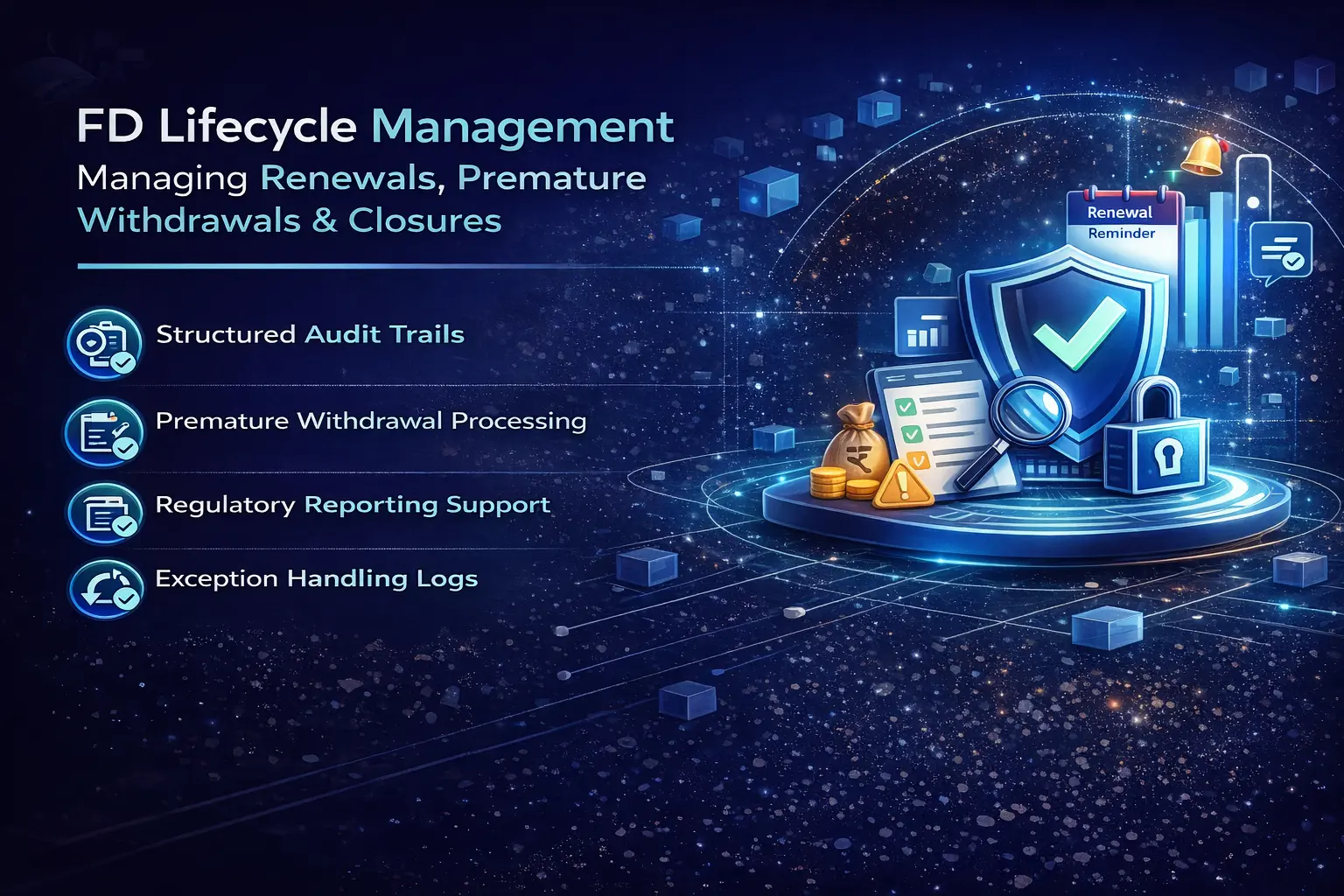
FD Lifecycle Management events is where operational maturity truly shows. Booking an FD is relatively straightforward. However, handling renewals, premature withdrawals, and closures requires precise orchestration across compliance systems, core banking infrastructure, accounting ledgers, and customer communication layers. If these processes are not structured correctly, institutions risk reconciliation errors, regulatory exposure, and customer dissatisfaction.
A well-designed FD system treats lifecycle events as automated, event-driven workflows rather than manual interventions. Each event must trigger predefined system logic, accounting updates, compliance checks, and customer notifications in real time.
Understanding the FD Lifecycle Management Framework
An FD typically moves through five structured stages: booking, accrual period, pre-maturity notification, maturity action (renewal or payout), and closure. Every stage requires synchronization between customer-facing systems and backend core infrastructure.
Most institutions rely on core banking systems such as Finacle, TCS BaNCS, or Flexcube, where deposit ledgers and interest engines operate. Lifecycle management systems must remain perfectly aligned with these cores to avoid ledger mismatches or reporting discrepancies.
Lifecycle management is not just about changing status labels; it involves interest recalculation, regulatory compliance, tax adjustments, payout execution, and audit logging.
Managing FD Renewals
Renewals are strategically important because they determine deposit retention. A mature FD presents either a churn risk or a reinvestment opportunity.
The renewal process should begin before maturity through automated reminders. Institutions typically trigger notifications 7 to 30 days prior to maturity. These alerts inform customers of the upcoming maturity date and provide renewal options such as renewing principal and interest, renewing only principal, modifying tenure, or closing the FD.
From a system design perspective, renewal management must include dynamic interest rate logic. The system should determine whether renewal occurs at the prevailing rate on maturity day or under a promotional rate policy. This decision must align with treasury guidelines and regulatory norms.
If customers do not provide explicit instructions, default rules apply. These rules might include automatic renewal for the same tenure at the prevailing rate or crediting funds to a linked savings account. These default policies must be clearly disclosed at booking to prevent future disputes.
Technically, renewal triggers the creation of a new FD instance or updates the existing one depending on policy. The system recalculates interest schedules, generates updated certificates, and updates ledger entries. All actions must be timestamped and logged for compliance.
Well-managed renewals increase retention rates and reduce cost of acquisition by converting maturing deposits into fresh investments seamlessly.
Managing Premature Withdrawals
Premature withdrawals introduce financial recalculations and compliance sensitivity. Customers may request early closure due to liquidity needs, and the system must respond instantly while applying correct penalty logic.
Premature withdrawal handling begins with a customer request initiated digitally. The system calculates revised interest based on the actual duration completed rather than the original tenure. Additionally, a penalty rate reduction is applied as per institutional policy. This could involve reducing the applicable interest rate by a fixed percentage.
The system must automatically recompute interest accrual, adjust any tax deductions such as TDS if applicable, and display the final payout amount transparently before customer confirmation. Transparency here reduces customer disputes significantly.
After confirmation, the backend must update the FD status to prematurely closed, trigger payout to the linked account, adjust accounting ledgers, and generate a closure confirmation document. Every action must be recorded in audit logs for regulatory review.
Operationally, premature withdrawal systems must also handle edge cases such as partial withdrawals (if allowed), high-value deposits requiring approval workflows, or flagged accounts under AML monitoring.
Automation with structured controls ensures speed without compromising regulatory compliance.
Managing Maturity Payouts and Final Closures
If an FD reaches maturity without renewal, closure becomes the next lifecycle event. Closure involves final interest computation up to the maturity timestamp, payout execution, ledger updates, and regulatory reporting adjustments.
On the maturity date, the system should automatically calculate total accrued interest. If auto-credit to a savings account is pre-selected, the payout must trigger instantly. If manual action is required, reminders should continue until the customer selects an option.
Once payout is processed, the FD status changes to closed. A final digital certificate or closure confirmation is generated. Reporting systems must reflect the removal of that deposit from active balances.
Closure workflows must synchronize with accounting systems to ensure liquidity ratios, deposit reporting, and internal dashboards update correctly. Any mismatch between customer-facing records and backend ledgers can create audit concerns.
Effective closure handling ensures operational cleanliness and preserves institutional credibility.
Communication and Notification Layer
Lifecycle management is incomplete without proactive communication. Customers should never feel uncertain about maturity dates, penalty deductions, or payout amounts.
Each lifecycle event should trigger structured notifications including maturity reminders, renewal confirmations, premature withdrawal summaries, payout acknowledgments, and final closure statements. Communication systems must be integrated with lifecycle triggers rather than handled manually.
Real-time notifications reduce confusion and minimize support requests.
Reconciliation and Compliance Control
Every lifecycle event affects financial reporting and regulatory compliance. Renewals generate new deposit entries. Premature withdrawals adjust interest revenue. Closures alter liquidity positions.
Institutions must implement automated reconciliation mechanisms that match lifecycle actions with payment confirmations and ledger updates. Audit logs should capture user actions, timestamps, transaction IDs, and recalculation logic.
Regulatory frameworks require deposit records to be stored for extended retention periods. Therefore, lifecycle events must be fully traceable and reproducible.
Without automated reconciliation and audit controls, scaling FD operations becomes risky and inefficient.
Automation vs Manual Oversight
While automation drives efficiency, certain high-risk cases may require manual oversight. High-value premature withdrawals, AML-flagged accounts, or system discrepancies may trigger review workflows before final execution.
The ideal system design enables automation by default while allowing structured manual intervention with complete logging. This balance ensures scalability without sacrificing compliance rigor.
Strategic Perspective
FD lifecycle management is not a secondary process. It directly impacts retention, customer satisfaction, regulatory standing, and operational scalability.
Institutions that treat lifecycle management as a core infrastructure layer rather than an afterthought achieve smoother renewals, fewer disputes, and stronger deposit stickiness.
The difference between a functional FD platform and a scalable one lies in how intelligently lifecycle events are orchestrated.
Final Answer
FD Lifecycle Management events such as renewals, premature withdrawals, and closures requires automated workflows, accurate interest recalculation engines, synchronized ledger updates, proactive customer communication, and strong reconciliation controls.
Renewals must be notification-driven and rate-policy aligned. Premature withdrawals must apply transparent penalty logic and adjust tax implications accurately. Closures must trigger precise payout execution and compliance reporting updates.
When lifecycle events are managed through structured, event-driven systems integrated with core banking infrastructure, institutions achieve operational accuracy, regulatory confidence, and long-term deposit retention.
The real test of an FD platform is not how deposits are booked.
It is how they are managed until the very end.