In today’s competitive digital banking landscape, speed-to-market is no longer optional. For banks, NBFCs, and fintech platforms, launching a Fixed Deposit (FD) product quickly can unlock new revenue streams, improve customer retention, and strengthen digital presence. But one question consistently arises in boardrooms and product meetings: How long does end-to-end FD product deployment timeline actually take?
The answer depends on your infrastructure, regulatory readiness, and integration approach. In this detailed guide, we break down timelines, phases, bottlenecks, and how modern plug-and-play FD infrastructure can dramatically accelerate deployment.
What Is “End-to-End FD Product Deployment”?
End-to-end FD deployment refers to the complete process of launching a Fixed Deposit product digitally—from planning and compliance setup to API integration, user experience design, and go-live execution.
This includes:
- Regulatory alignment
- Core banking integration
- KYC and onboarding flows
- Payment gateway integration
- Partner bank or NBFC onboarding
- UI/UX implementation
- Testing and compliance checks
- Live deployment and monitoring
Let’s explore how long this typically takes.
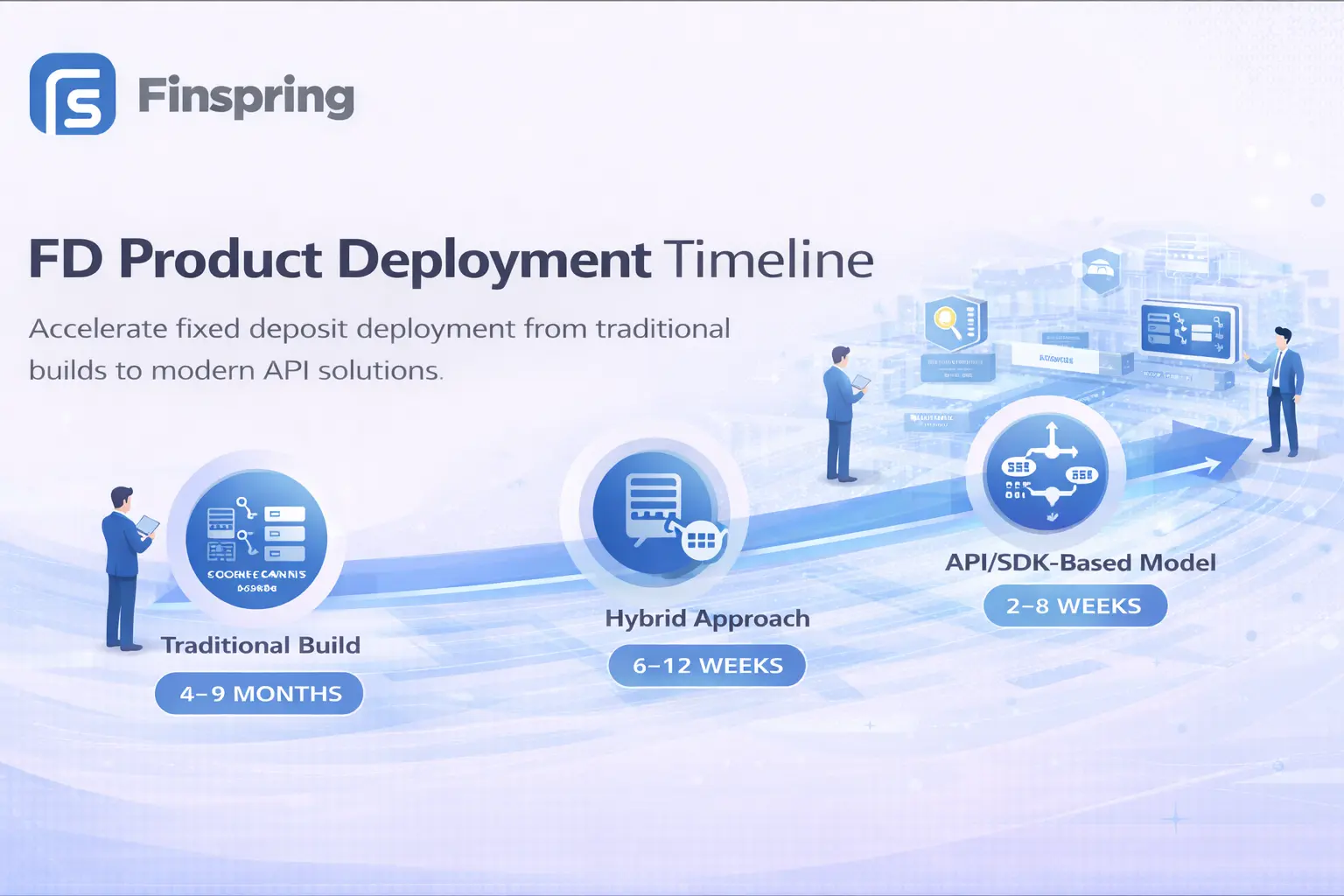
Traditional FD Product Deployment Timeline (4–9 Months)
Historically, deploying an FD product required deep backend integrations and multiple stakeholders. Below is a breakdown of a conventional timeline.
1. Regulatory & Compliance Planning (4–6 Weeks)
Banks and NBFCs must align with RBI guidelines, internal compliance teams, and risk frameworks. Documentation, approval cycles, and legal sign-offs often create early delays.
Key activities:
- FD product structuring
- Interest rate configuration
- TDS rules
- AML/KYC alignment
- Legal documentation drafting
2. Core Banking System Integration (6–10 Weeks)
Integration with Core Banking Systems (CBS) such as:
- Finacle
- TCS BaNCS
- Flexcube
This phase often becomes the biggest bottleneck. Legacy systems require custom APIs, data mapping, and multiple testing cycles.
3. Partner & Payment Infrastructure Setup (3–6 Weeks)
To enable digital FD booking:
- Payment gateway integration
- UPI/net banking rails
- Escrow or settlement account setup
- Partner bank configuration (if marketplace model)
Delays often arise due to dependency on third-party approvals.
4. Frontend Development & User Journey Design (4–8 Weeks)
This includes:
- FD calculator
- Tenure selection UI
- Interest payout options
- Nominee addition
- Auto-renewal features
- FD certificate generation
- Each UX element must be tested across web and mobile.
5. Testing, UAT & Compliance Audit (3–5 Weeks)
Before go-live:
- User Acceptance Testing (UAT)
- Security audits
- Load testing
- RBI compliance verification
- Internal sign-offs
Total Traditional Timeline:
4 to 9 months
For institutions dependent on legacy banking systems, the process can extend beyond 9 months.
Modern API-Based FD Deployment Timeline (2–8 Weeks)
With the rise of FD infrastructure providers offering SDKs and APIs, the timeline has significantly reduced.
Instead of building everything from scratch, institutions can plug into ready-made FD rails.
Here’s what changes:
1. Pre-Built Compliance Framework (1 Week)
Regulatory templates, TDS logic, KYC flows, and reporting are already structured.
Minimal documentation effort.
2. API/SDK Integration (1–3 Weeks)
Modern FD platforms provide:
- REST APIs
- Plug-and-play SDKs
- Sandbox environments
- Clear API documentation
Instead of CBS-level integration complexity, you connect via standardized endpoints.
3. White-Labeled UI or Embedded Widget (1–2 Weeks)
Instead of custom designing:
- Use pre-built FD booking modules
- Embed directly within app
- Customize branding
This drastically cuts frontend development time.
4. Testing & Go-Live (1–2 Weeks)
Since infrastructure is pre-validated:
- Reduced compliance friction
- Faster UAT cycles
- Faster partner approvals
Total API-Based Timeline:
2 to 8 weeks
That’s up to 80% faster compared to traditional deployment.
Key Factors That Influence FD Deployment Timeline
Not every organization experiences the same timeline. Here are the biggest variables:
1. Legacy vs Modern Core Infrastructure
If your core banking system lacks API readiness, integration time increases significantly.
2. Regulatory Preparedness
Clear documentation and proactive compliance teams reduce weeks of delay.
3. Internal Decision-Making Speed
Board approvals and risk committee reviews often slow down deployment.
4. Marketplace vs Single-Issuer Model
If you’re aggregating multiple banks/NBFCs, additional partner onboarding adds time.
5. Customization Requirements
Highly customized interest slabs, premature withdrawal logic, or auto-sweep features require additional development.
Breakdown: Realistic FD product deployment timeline Scenarios
Scenario 1: Traditional Bank Launching Digital FD
- Heavy CBS integration
- Manual reconciliation
- Custom UI
- Internal compliance cycle
Timeline: 6–9 months
Scenario 2: NBFC Using FD SDK Provider
- API integration
- Pre-built compliance
- Embedded booking flow
Timeline: 3–6 weeks
Scenario 3: Fintech Marketplace Adding FD as Investment Option
- Partner onboarding
- White-labeled integration
- Minimal backend changes
Timeline: 2–4 weeks
Why Deployment Speed Matters
In digital finance, opportunity cost is real.
Delays can mean:
- Missed festive deposit inflows
- Competitors capturing rate-sensitive customers
- Loss of digital trust positioning
- Slower revenue realization
FDs may be considered a “stable” product—but deployment speed determines strategic advantage.
Cost vs Time Trade-Off
Traditional Build:
- Higher upfront engineering cost
- Longer time to revenue
- Heavy dependency on CBS vendor
API-Based Model:
- Faster monetization
- Lower integration cost
- Reduced operational complexity
While traditional models offer deep customization, most modern institutions prioritize speed, scalability, and modular architecture.
The Future of FD product deployment timeline
The evolution of digital banking is shifting from product ownership to infrastructure orchestration.
Institutions no longer need to reinvent FD rails. Instead, they can:
- Focus on distribution
- Improve customer acquisition
- Enhance cross-sell
- Offer FD as a stable yield product in volatile markets
- The deployment timeline is no longer a technical limitation—it’s a strategic choice.
Final Answer: So How Long Does FD product deployment timeline Take?
| Deployment Model | Typical Timeline |
|---|---|
| Traditional CBS Integration | 4–9 months |
| Hybrid Approach | 6–12 weeks |
| API/SDK-Based Model | 2–8 weeks |
If your goal is rapid go-live with minimal technical complexity, modern FD infrastructure can reduce deployment time from months to weeks.
The real question isn’t how long it takes.
It’s whether you want to build infrastructure — or leverage it.
FAQ: FD Product Deployment Timeline
1. What is the fastest way to launch an FD product?
Using an API-based FD SDK provider can reduce deployment to 2–4 weeks.
2. Why does traditional FD deployment take so long?
Legacy core banking integration and compliance approvals create extended timelines.
3. Can fintech platforms offer FDs without a banking license?
Yes, via regulated partner banks or NBFCs under marketplace models.
4. Is regulatory approval the biggest bottleneck?
In traditional setups, yes. In API-based models, much of the compliance framework is pre-built.
Conclusion
End-to-end FD product deployment timelineraditionally took up to 9 months. Today, with modern infrastructure solutions, it can be executed in as little as 2–8 weeks.
Speed is no longer a constraint. Architecture is.
And the institutions that understand this are launching smarter, faster, and more efficiently than ever before.