When financial institutions or fintech platforms launch Fixed Deposit (FD) products digitally through an SDK model, the focus is often on speed to market and customer experience. However, beyond onboarding journeys and booking flows lies a far more critical dimension: audit integrity, reconciliation accuracy, and regulatory reporting compliance.
An FD SDK is not merely a technical integration layer. It becomes part of the financial control environment. Therefore, its ability to support audit trails, ensure transaction-level reconciliation, and align with regulatory reporting standards is central to long-term sustainability.
Understanding how an FD SDK supports these functions helps institutions assess operational robustness before entering a distribution partnership.
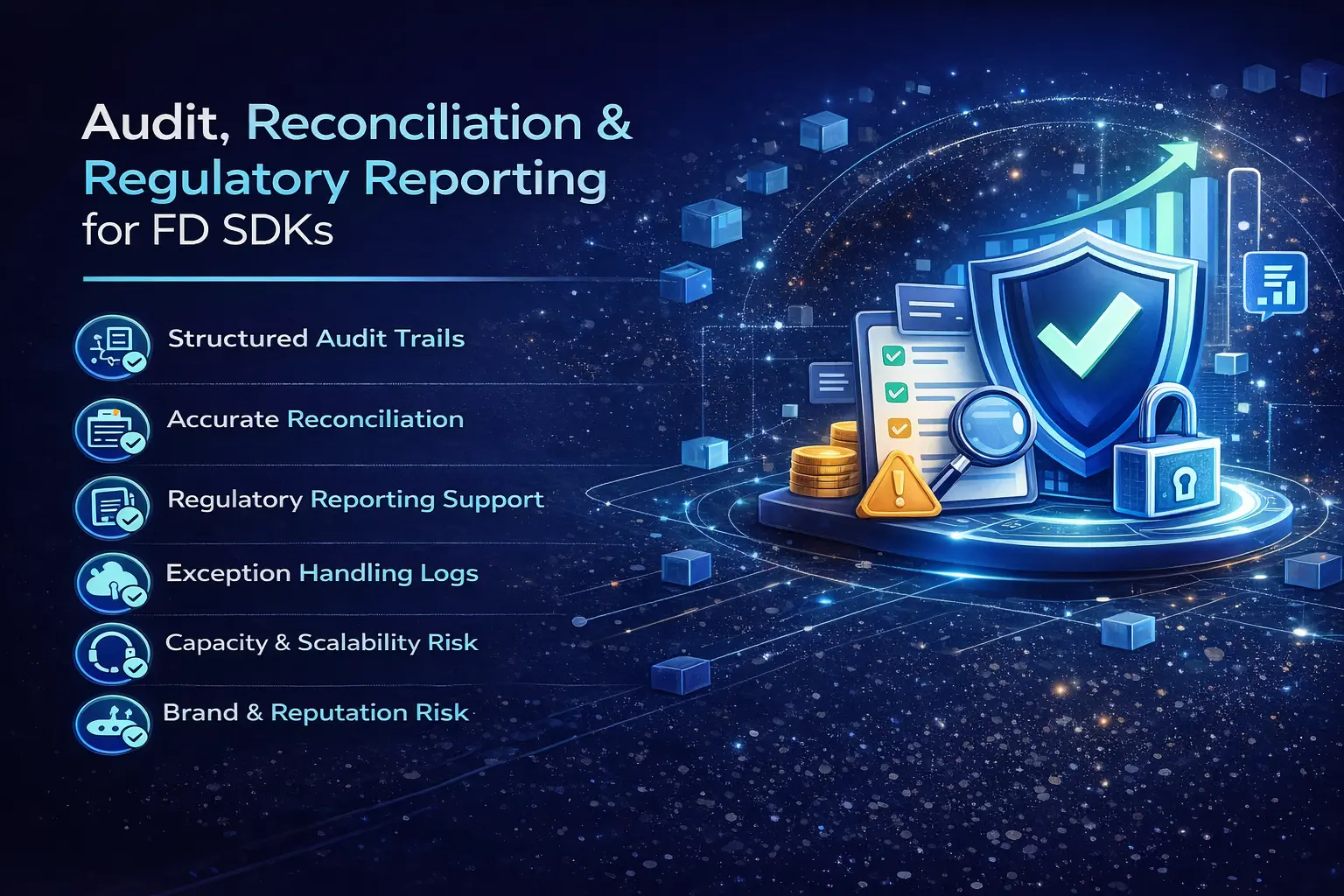
Structured Audit Trails Across the Entire FD Lifecycle
Audit readiness begins with traceability. Every FD transaction — from rate display to final maturity payout — must be fully traceable through structured logs and system records.
A well-designed FD SDK captures time-stamped records of:
- Customer consent and disclosures
- Rate selection and tenure confirmation
- KYC validation events
- Payment initiation and confirmation
- FD creation reference numbers
- Maturity instructions or renewal selections
- Premature withdrawal requests
These logs must be immutable and securely stored. Financial audits often require transaction reconstruction, meaning institutions must be able to replay the sequence of events that led to an FD booking or closure.
The SDK should maintain standardized logging formats with unique transaction IDs, allowing internal audit teams to map frontend user actions to backend ledger entries without ambiguity.
Without structured logs, even minor discrepancies become difficult to investigate.
Real-Time and Periodic Reconciliation Mechanisms
Reconciliation ensures that what the customer sees, what the platform records, and what the partner bank or NBFC reflects are perfectly aligned.
An FD SDK supports reconciliation by acting as an orchestration layer between:
- The distribution platform
- The payment gateway
- The partner institution’s core system
- The internal ledger or reporting system
Reconciliation workflows typically operate on multiple layers.
At the transaction level, the SDK verifies that payment confirmation matches FD booking confirmation. If a payment is successful but FD creation fails, the system should trigger automated reconciliation logic to retry booking or initiate refunds.
At the end-of-day level, batch reconciliation compares all transactions processed during the day against partner institution confirmations. Any mismatches must be flagged immediately for review.
A mature SDK should provide reconciliation dashboards showing:
- Successful bookings
- Failed transactions
- Pending confirmations
- Settlement status
- Exception logs
Timely reconciliation reduces financial exposure and minimizes manual intervention.
Alignment with Core Banking and Ledger Systems
Since FDs ultimately reside on regulated institutions’ balance sheets, data synchronization between the SDK and the partner’s core system is critical.
An FD SDK must ensure:
- Accurate interest rate mapping
- Tenure alignment
- Compounding logic consistency
- Ledger entry accuracy
- Settlement confirmation
Even a minor discrepancy in rate calculation or maturity amount can create financial liability.
The SDK should perform validation checks before final booking confirmation, ensuring that the frontend rate displayed matches the rate configured at the partner institution level.
Ledger mapping is particularly important for audit purposes. Every booking must generate structured entries that align with the accounting system’s standards.
Without this alignment, financial reporting becomes fragmented and audit complexity increases significantly.
Regulatory Reporting Support
Fixed Deposits are regulated financial instruments. In India, institutions distributing or originating FDs must comply with reporting standards governed by the Reserve Bank of India.
Regulatory reporting may require structured data related to:
- Aggregate FD volumes
- Interest payout commitments
- Customer categorization (retail vs institutional)
- Maturity bucket distribution
- Premature withdrawal trends
An FD SDK supports regulatory reporting by standardizing data capture at the transaction level. Each booking must store structured fields that can later be aggregated into compliance reports.
This includes maintaining:
- Timestamped booking data
- Rate version history
- Tenure categorization
- Geographic distribution (if applicable)
- Tax deduction indicators
The SDK should enable exportable reports in predefined formats, allowing compliance teams to generate regulatory submissions without manual data compilation.
Automation reduces reporting errors and improves regulatory confidence.
TDS and Tax Reporting Integration
Interest income from FDs often attracts Tax Deducted at Source (TDS). Accurate calculation and reporting of TDS are operationally critical.
An FD SDK must ensure:
- Correct TDS threshold checks
- PAN validation
- Senior citizen rate mapping
- TDS deduction logic based on tenure
- Annual interest certificate generation
From an audit perspective, institutions must demonstrate how TDS was calculated and deducted. Therefore, the SDK should store tax computation logic transparently and maintain calculation records for review.
Mismatch in TDS reporting can result in customer disputes and compliance exposure.
Exception Handling and Escalation Logs
No system operates without exceptions. What matters is how exceptions are tracked and resolved.
An enterprise-grade FD SDK maintains detailed exception logs that capture:
- API failures
- Payment mismatches
- Booking confirmation delays
- Rate version conflicts
- Settlement discrepancies
Each exception should have a defined resolution workflow and timestamped resolution status.
Audit teams often examine not just successful transactions but how failures were handled. Therefore, exception transparency strengthens control confidence.
Version Control and Change Documentation
Interest rates change. Regulatory guidelines evolve. API versions are updated.
An FD SDK must maintain version control documentation showing:
- When rate tables were updated
- When API endpoints were modified
- When new compliance disclosures were added
This documentation becomes critical during audits. Institutions must demonstrate that customers received accurate rate information at the time of booking.
Version logs allow reconstruction of historical conditions even years later.
Without version traceability, historical disputes become difficult to resolve.
Data Security and Access Audit Trails
Audit integrity also extends to data access.
The SDK should implement:
- Role-based access control
- Admin activity logging
- Data modification tracking
- Secure storage encryption
Access logs must record who viewed, modified, or exported sensitive data.
Financial institutions are expected to demonstrate that customer information is protected and that internal misuse risk is mitigated.
Audit readiness is incomplete without access governance transparency.
Independent Audit Support and Certification
Some FD SDK providers undergo third-party security and compliance audits to demonstrate operational maturity.
Certifications related to information security management and cloud security practices provide additional confidence.
Although certification does not eliminate risk, it strengthens the control framework and simplifies due diligence.
Institutions integrating with an SDK should request documentation on audit reports, penetration testing summaries, and compliance certifications before go-live.
The Strategic Importance of Control Infrastructure
In digital FD distribution, customer experience attracts deposits — but control infrastructure sustains the business.
Audit trails protect institutional credibility. Reconciliation safeguards financial accuracy. Regulatory reporting ensures compliance continuity.
An FD SDK that lacks structured logging, automated reconciliation, and reporting capabilities exposes institutions to operational strain and regulatory scrutiny.
Conversely, a well-architected SDK becomes an enabler of governance, transparency, and scalability.
When evaluating an FD SDK, institutions should not only assess onboarding flows and API speed. They must examine whether the system can withstand audit inspection, reconcile transactions at scale, and generate regulator-ready reports consistently.
In financial services, operational excellence is invisible when everything works — but highly visible when it fails.
A strong FD SDK ensures that audit, reconciliation, and regulatory reporting are not reactive tasks performed after problems arise, but embedded capabilities built into the system from the start.