As financial institutions, fintech platforms, NBFCs, and neobanks expand into digital Fixed Deposit (FD) distribution, many rely on SDK or aggregator partners to power the underlying infrastructure. While this approach accelerates go-to-market timelines, it also introduces dependency risk. That is why Service Level Agreements (SLAs) are not a formality — they are foundational to risk management, customer experience, and regulatory compliance. If you are evaluating or working with an FD SDK SLA or aggregator partner, here are the SLAs you should expect — and why each one matters.
1. Uptime and Availability SLAs
The first and most critical SLA is uptime.
Since FD booking is transactional and time-sensitive, your SDK partner must commit to at least 99.9% uptime, with clearly defined measurement windows (monthly or quarterly). For enterprise-grade deployments, 99.95% or higher should be the expectation.
The SLA must specify:
- API availability percentage
- Scheduled maintenance windows
- Advance notice requirements
- Penalties for breaches
Financial platforms cannot afford unexplained outages during rate campaigns or quarter-end inflow periods. If your aggregator’s API is down, your revenue pipeline is instantly affected.
Additionally, uptime must apply to all critical endpoints, not just the booking API. This includes KYC validation, FD status checks, renewal flows, premature withdrawal endpoints, and reconciliation services.
2. API Response Time and Latency Benchmarks
Availability alone is insufficient. Performance must be measurable.
A reliable FD SDK should guarantee:
- Average API response time under 500 milliseconds
- Peak latency thresholds clearly defined
- Real-time monitoring transparency
Slow APIs increase abandonment rates, especially during payment confirmation or maturity calculation stages. If your platform promises a seamless digital experience but the aggregator introduces latency, customer trust erodes quickly.
Your SLA should include defined performance thresholds and escalation triggers if response times exceed agreed levels.
3. Transaction Success Rate Commitments
FD booking flows involve multiple steps: KYC validation, rate confirmation, payment processing, ledger posting, and receipt generation.
Your aggregator partner should provide a defined transaction success rate SLA, typically above 99%.
This SLA must clarify:
- How failed transactions are categorized
- Retry logic responsibilities
- Time to reconcile ambiguous transactions
- Automatic refund timelines in case of booking failure
No customer should experience a scenario where funds are debited but FD confirmation is unclear. The SLA must specify strict reconciliation timelines, ideally within T+0 or T+1 working day.
4. Data Security and Compliance SLAs
Since FDs are regulated financial products, your aggregator must operate within the compliance framework defined by the Reserve Bank of India.
Your SLA must confirm:
- Encryption standards (AES-256 or equivalent)
- Secure API communication (TLS 1.2 or higher)
- Data storage location compliance
- Access control and audit logging mechanisms
- Incident response timelines for data breaches
Additionally, there must be clarity on data ownership. Your customer data should remain your asset, with explicit contractual protection against misuse.
Compliance failure is not just technical risk — it is regulatory exposure.
5. Disaster Recovery and Business Continuity Guarantees
A serious FD SDK partner should maintain a documented Disaster Recovery (DR) framework.
The SLA must clearly state:
- Recovery Time Objective (RTO)
- Recovery Point Objective (RPO)
- Data replication strategy
- Secondary region failover
For financial services infrastructure, RTO should ideally be under a few hours, with minimal data loss tolerance.
You must also verify whether periodic DR drills are conducted and whether summary reports are shared with partners.
Business continuity is not optional in regulated financial ecosystems.
6. Scalability and Peak Load Handling Commitments
High FD inflow periods — especially during rate hikes or festive campaigns — can cause transaction volumes to surge dramatically.
Your SLA should confirm:
- Maximum concurrent request capacity
- Auto-scaling capabilities
- Load testing benchmarks
- Historical peak performance data
If the aggregator cannot handle volume spikes, your frontend platform suffers reputational damage.
A credible partner should be able to demonstrate infrastructure scaling across platforms like Amazon Web Services or equivalent cloud environments.
Scalability commitments must be documented — not assumed.
7. Lifecycle Event Processing SLAs
Many platforms focus on booking SLAs but ignore lifecycle management.
Your aggregator must define SLAs for:
- Maturity processing timelines
- Renewal execution
- Premature withdrawal settlement
- Interest payout credit timelines
- Nominee updates
For example, if a customer requests premature withdrawal, the SLA should define whether funds are credited T+0, T+1, or later.
Lifecycle inefficiencies generate the highest volume of support escalations. Therefore, SLAs must extend beyond onboarding.
8. Reconciliation and Settlement SLAs
Financial accuracy is non-negotiable.
The SLA must clarify:
- Daily reconciliation timelines
- Mismatch resolution process
- Settlement cycles with partner banks/NBFCs
- Audit report sharing frequency
Reconciliation delays can create financial exposure and regulatory complications. A robust aggregator partner must provide transparent reporting dashboards for real-time tracking.
Settlement clarity protects both your organization and end customers.
9. Support and Escalation SLAs
Even the best systems encounter occasional issues. The difference lies in response quality.
Your SLA should define:
- First response time (for critical issues)
- Escalation matrix
- 24/7 availability for high-severity incidents
- Dedicated relationship manager (for enterprise partners)
For severity level 1 incidents — such as API downtime or transaction failures — response time should ideally be under 30 minutes.
Support SLAs should include measurable turnaround times, not generic assurances.
10. Change Management and Update Notifications
SDK-based integrations often evolve. API versions update, new features are introduced, and compliance changes occur.
Your aggregator must commit to:
- Advance notice of API changes
- Backward compatibility support
- Sandbox testing environment
- Detailed integration documentation
Unexpected changes can break production systems. Therefore, structured change management processes are essential.
11. Reporting and Analytics Transparency
To optimize business performance, you need data visibility.
Your FD SDK SLA should guarantee:
- Access to booking analytics
- Renewal conversion metrics
- Drop-off analysis
- Error logs
- Audit trails
Without transparent reporting, it becomes difficult to optimize user journeys or identify operational bottlenecks.
Data transparency strengthens the partnership.
12. Financial Penalty Clauses for FD SDK SLA Breaches
An FD SDK SLA without consequences is merely a guideline.
Contracts should include:
- Service credits for uptime breaches
- Financial penalties for repeated violations
- Termination rights for chronic underperformance
This ensures alignment of incentives and accountability.
Defining Enterprise-Grade Expectations
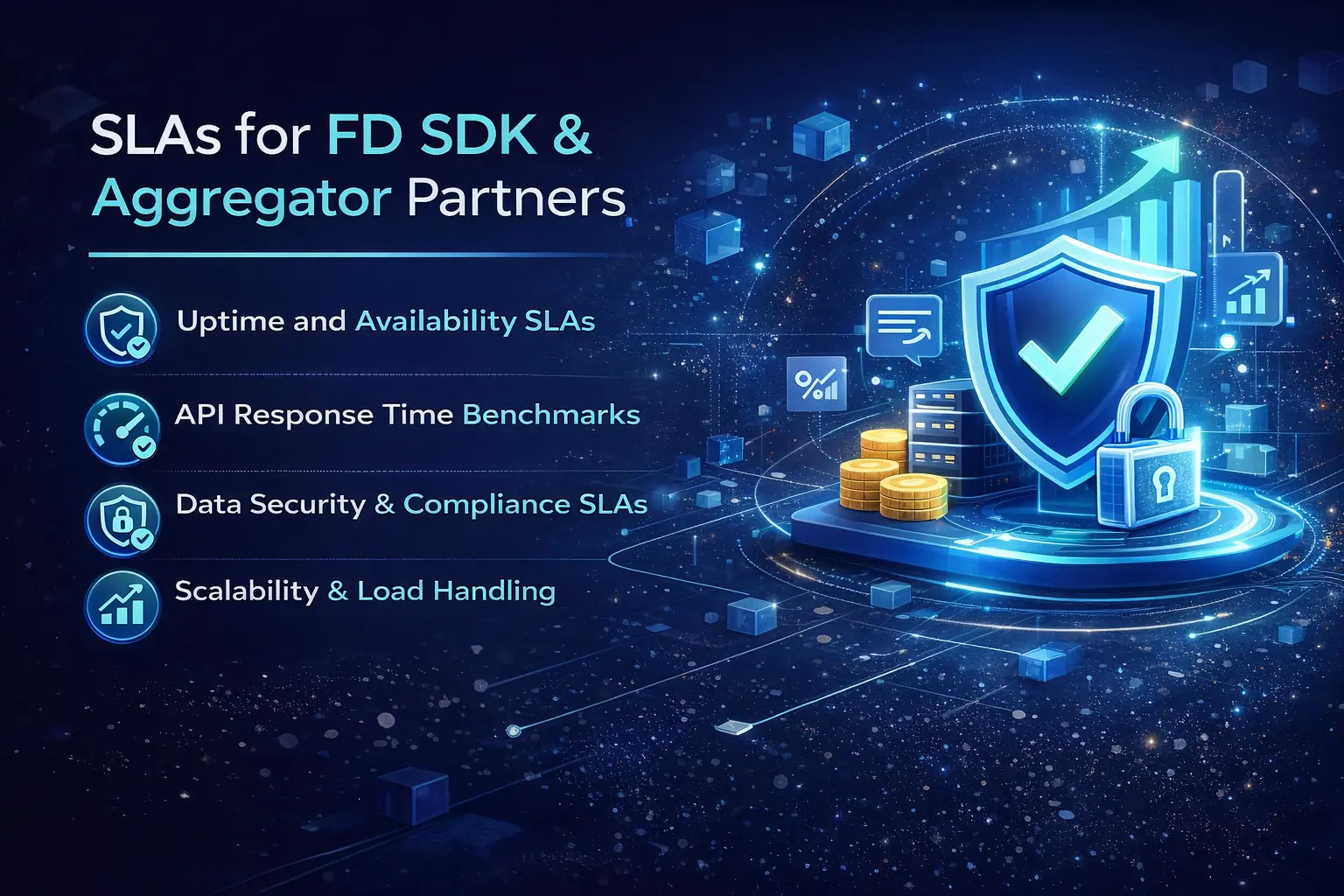
Choosing an FD SDK or aggregator partner is not just a technical decision — it is a strategic one. Your partner becomes the backbone of your FD offering, directly influencing customer experience, regulatory compliance, and revenue performance.
The right FD SDK SLA framework should cover:
- Availability
- Performance
- Security
- Scalability
- Lifecycle management
- Support responsiveness
- Financial accountability
If any of these elements are missing or vaguely defined, risk exposure increases significantly.
In today’s digital financial ecosystem, customers expect seamless booking, instant confirmations, transparent maturity handling, and secure data protection. Your aggregator partner must meet these standards consistently — not occasionally.
Ultimately, a strong SLA transforms your partnership from vendor dependency into infrastructure confidence. And in financial services, confidence is everything.