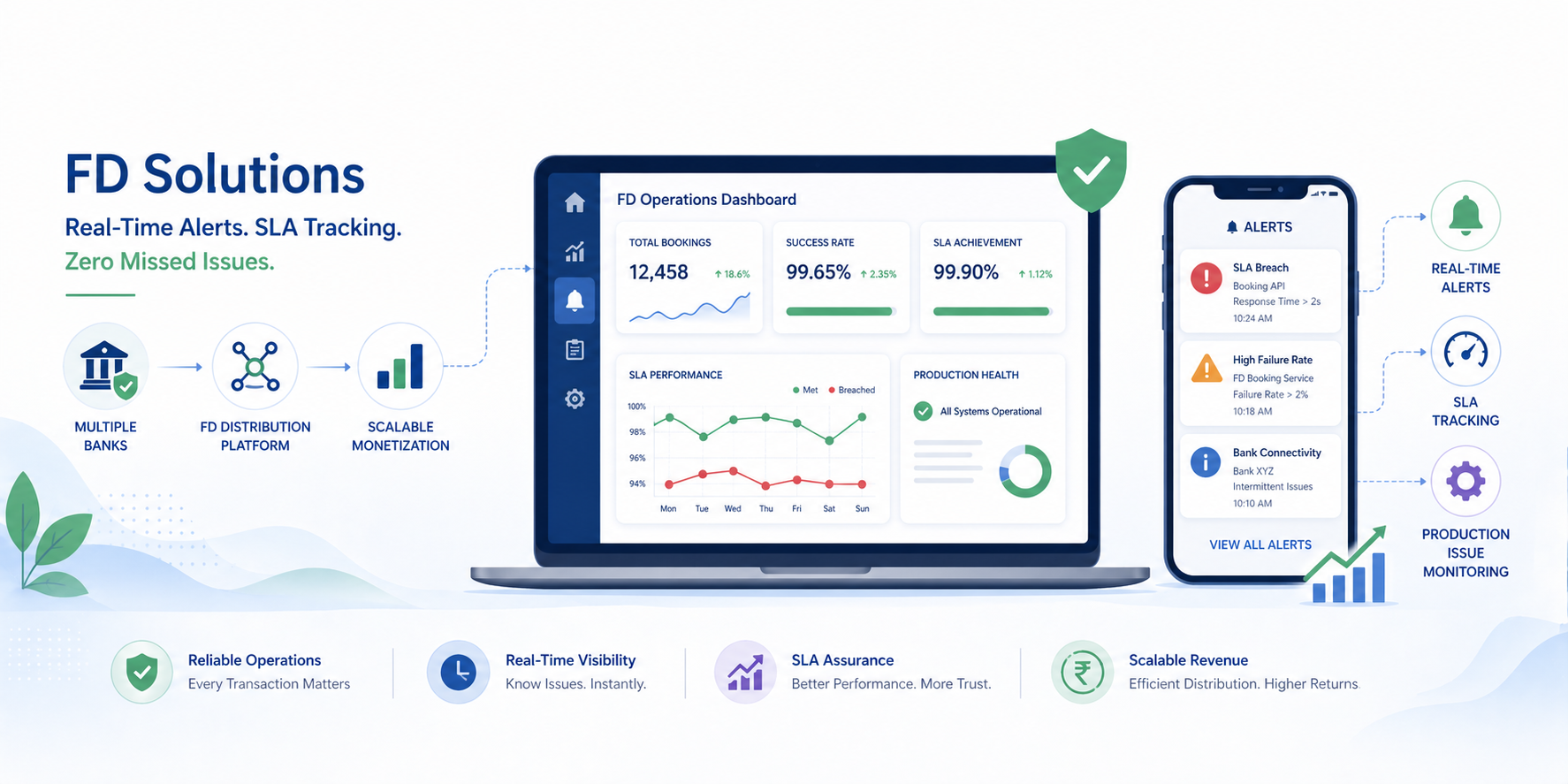
Fixed Deposits (FDs) are often viewed as low-excitement, low-engagement products. But behind that perception lies a powerful opportunity—FD distribution is one of the most predictable and scalable revenue streams in financial services today. As digital platforms expand and user acquisition costs rise, fintechs and banks are actively looking for stable monetization layers. FD distribution offers exactly that: consistent revenue, high trust, and long-term user value. This article explores how FD platforms generate revenue, the different monetization models available, FD solutions real-time alerts sla tracking issues, and how modern infrastructure makes scaling this revenue easier than ever.
Why FD Distribution is a Strong Monetization Layer
Unlike high-risk investment products, FDs are:
- Trust-driven
- Widely understood
- Low-friction to adopt
- High in user intent during uncertain markets
This creates a unique advantage:
👉 You don’t need to convince users to buy FDs—you need to make them accessible
That shift—from persuasion to access—makes FD distribution highly efficient from a monetization standpoint.
The Core FD Distribution Model
At its simplest, FD monetization works like this:
- A bank offers an FD product
- A platform distributes it to users
- The bank pays the platform for distribution
This payment typically comes in the form of:
- Commissions
- Revenue share
- Referral fees
The more efficiently a platform can distribute FDs, the more it can monetize.
Key Revenue Models in FD Distribution
1. Commission-Based Model
This is the most common model.
Platforms earn a commission from banks for every FD booked through their interface.
How it works:
- Bank sets commission structure (fixed or percentage-based)
- Platform earns per successful FD booking
- Revenue scales with volume
Why it works:
- Simple to implement
- Directly tied to performance
- Predictable revenue stream
2. Revenue Share Model
In this model, platforms earn a share of the interest spread or lifetime value of the FD.
How it works:
- Bank shares a portion of earnings generated from the deposit
- Platform benefits over the lifecycle of the FD
Why it works:
- Aligns incentives between bank and platform
- Encourages long-term user retention
- Creates recurring revenue potential
3. Platform Fee Model
Some platforms charge users a small service fee for:
- Facilitating FD booking
- Providing better discovery or comparison
- Offering additional features
Why it works:
- Direct monetization from users
- Less dependency on banks
Limitation:
- Works only when strong user trust is already established
4. Cross-Sell & Upsell Monetization
FDs often act as an entry product.
Once users trust the platform, they are more likely to:
- Explore mutual funds
- Invest in equities
- Opt for premium services
Why it works:
- FDs build trust
- Trust increases lifetime value (LTV)
- Higher-margin products can be layered on top
5. Float-Based Monetization (Advanced)
In certain models, platforms can earn from:
- Temporary holding of funds
- Settlement timing advantages
This is more complex and depends on:
- Regulatory permissions
- Operational setup
Monetization for Banks: Why Distribution Matters
FD distribution is not just valuable for fintechs—banks benefit significantly as well.
Banks use FD distribution to:
1. Acquire Deposits at Scale
Instead of relying only on branches, banks can:
- Access users across multiple platforms
- Expand reach without physical expansion
2. Optimize Cost of Acquisition
Digital distribution often lowers:
- Marketing costs
- Operational overhead
3. Improve Product Visibility
Banks can position their FD offerings across:
- Wealth apps
- Fintech platforms
- Digital ecosystems
This increases:
- Discoverability
- Conversion rates
The Role of Infrastructure in Monetization
While the revenue models are clear, execution is where most platforms struggle.
Monetizing FD distribution requires:
- Fast product launches
- Reliable booking flows
- Accurate tracking and reconciliation
- Real-time reporting
Without strong infrastructure, monetization breaks down.
Key Infrastructure Requirements for Monetization
1. Multi-Bank Integration
Access to multiple FD issuers increases:
- Product variety
- User choice
- Conversion rates
2. Real-Time Tracking
Platforms need visibility into:
- Bookings
- Commissions
- Performance metrics
This ensures accurate revenue calculation.
3. Reliable Execution
Failures in booking or confirmation directly impact:
- Revenue
- User trust
4. Scalable Operations
As volume increases, systems must handle:
- Higher transaction loads
- More complex reporting
5. Compliance & Audit Readiness
Revenue flows must be:
- Transparent
- Traceable
- Audit-friendly
Challenges in Monetizing FD Distribution
Despite its potential, platforms face several challenges:
1. Fragmented Bank Integrations
Managing multiple integrations increases complexity.
2. Delayed Launch Timelines
Slow go-to-market reduces revenue opportunity.
3. Operational Overhead
Manual reconciliation and tracking reduce efficiency.
4. Limited Visibility
Without real-time data, revenue tracking becomes unreliable.
How Modern FD Platforms Solve This
Modern FD infrastructure platforms simplify monetization by providing:
- Unified API integration for multiple banks
- Automated commission tracking
- Real-time dashboards for performance monitoring
- Built-in compliance workflows
This allows platforms to:
- Launch faster
- Scale distribution
- Monetize more efficiently
FDs as a Long-Term Revenue Strategy
FD monetization is not about short-term gains.
It is about:
- Building a stable revenue layer
- Increasing user trust
- Expanding product ecosystems
Platforms that integrate FDs effectively can:
- Reduce dependency on volatile revenue streams
- Improve user retention
- Increase lifetime value
The Finspring Advantage
Finspring enables fintechs and banks to monetize FD distribution seamlessly through:
- Plug-and-play FD SDKs
- Multi-bank access via a single integration
- Real-time infrastructure for tracking and reliability
- Scalable systems designed for high-volume distribution
This ensures that platforms can move from:
👉 Integration → Distribution → Monetization
without operational bottlenecks.
Conclusion
FD distribution is evolving from a simple product offering into a strategic revenue engine.
With the right infrastructure, platforms can:
- Unlock consistent revenue
- Scale efficiently
- Build long-term user trust
- Provide FD solutions for real-time alerts & SLA tracking issues
The opportunity is not just in offering FDs.
It is in monetizing them effectively.
Because in modern fintech,
distribution is not just access—it is revenue.