As financial institutions increasingly move toward digital-first product distribution, the ability to launch fixed deposit (FD) offerings through scalable technology has become essential. NBFCs, fintech platforms, wealth management apps, and digital banks are actively seeking infrastructure solutions that allow them to integrate FD products without building complex systems from scratch. This is where Finspring’s FD SDK architecture plays a critical role. Designed as a modular and developer-friendly infrastructure layer, the SDK allows financial platforms to seamlessly integrate fixed deposit products into their applications. Instead of building individual systems for onboarding, booking, reconciliation, reporting, and portfolio management, organizations can deploy Finspring’s architecture as a plug-and-play solution.
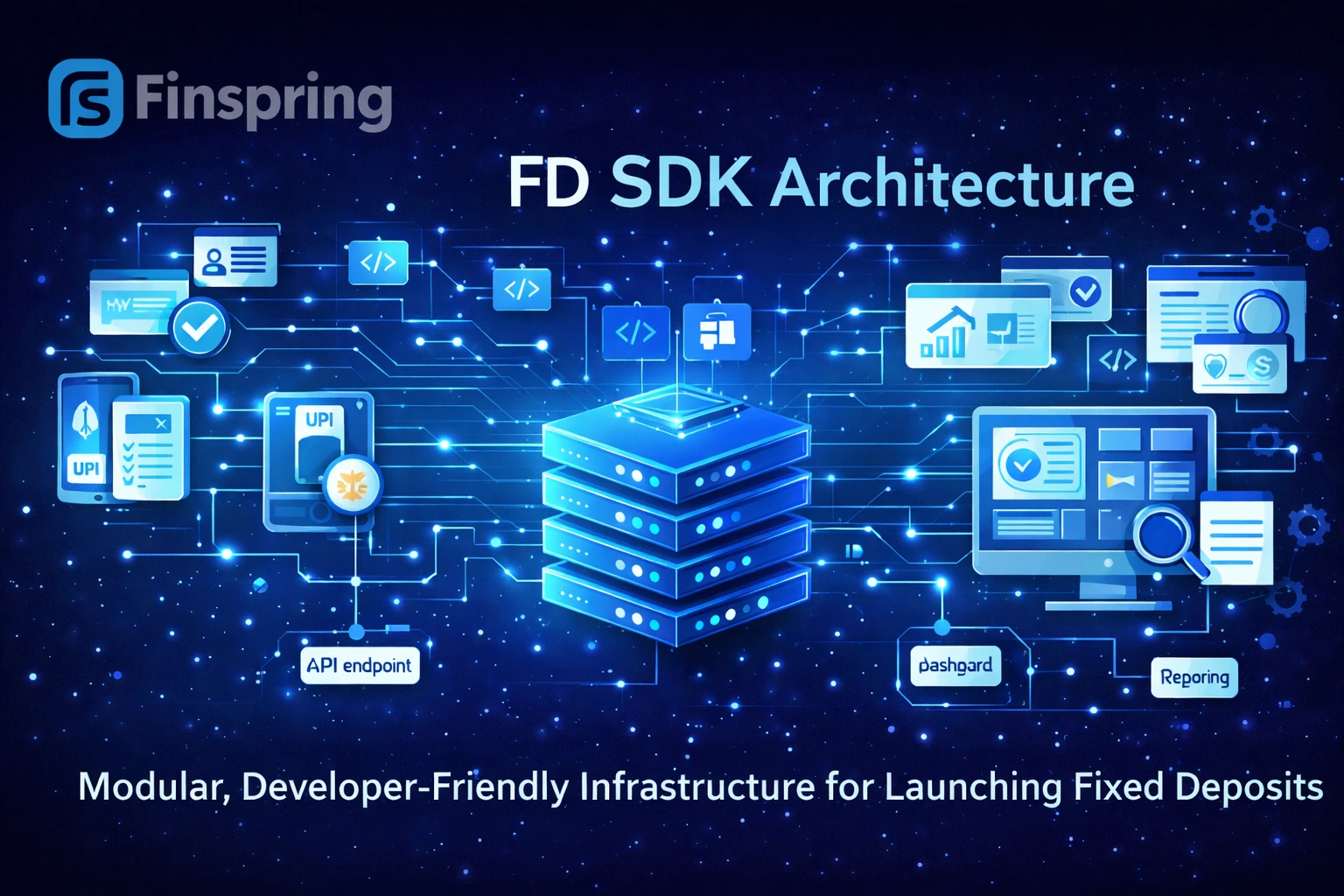
Understanding the technical architecture behind the SDK provides valuable insight into how it delivers reliability, scalability, and security while significantly reducing implementation complexity. This article offers a deep dive into the FD SDK architecture powering Finspring’s platform.
Why FD Infrastructure Requires Specialized Architecture
Unlike many financial products, fixed deposits involve a long lifecycle with multiple operational checkpoints. From the moment a deposit is booked to its maturity and eventual payout, systems must track interest accruals, maintain accurate ledgers, handle renewals, and generate regulatory reports.
A typical FD lifecycle includes several key stages:
- Customer onboarding and KYC verification
- Product discovery and rate selection
- Deposit booking and payment confirmation
- Deposit lifecycle management
- Interest calculation and maturity tracking
- Closure, renewal, or withdrawal
- Reporting and compliance monitoring
Each of these stages requires reliable system coordination between multiple entities such as payment gateways, banking partners, compliance systems, and customer-facing applications.
Finspring’s FD SDK architecture is designed specifically to manage these interactions while maintaining performance and operational transparency.
Core Design Principles of Finspring’s FD SDK Architecture
The architecture of the SDK is built around several guiding principles that ensure both technical efficiency and operational resilience.
Modular Design
The SDK follows a modular architecture that separates major system functions into independent components. Each module is responsible for a specific aspect of the FD lifecycle.
Key modules include:
- onboarding and customer verification
- FD booking engine
- payment orchestration
- deposit lifecycle management
- portfolio and reporting services
This modular structure allows institutions to integrate only the components they need while maintaining flexibility for future expansion.
API-First Infrastructure
Finspring’s platform follows an API-first architecture, meaning every system interaction is exposed through secure APIs. This approach ensures seamless integration with web platforms, mobile apps, internal dashboards, and partner ecosystems.
Developers can interact with the SDK through clearly documented API endpoints for actions such as:
- retrieving available FD products
- creating deposit bookings
- tracking deposit status
- accessing maturity schedules
- managing customer portfolios
An API-first design ensures that institutions can embed FD capabilities into existing digital products without disrupting their existing infrastructure.
Event-Driven System Architecture
To support real-time updates and system coordination, the FD SDK uses an event-driven architecture. This means that important actions within the system trigger events that automatically update other components.
For example, when a deposit is successfully booked:
- A booking confirmation event is generated.
- The customer portfolio is updated.
- Transaction records are logged for reconciliation.
- Notification services can trigger alerts or confirmations.
This event-driven workflow ensures that system components remain synchronized without relying on slow or inefficient polling mechanisms.
Key Components of the FD SDK Architecture
The SDK consists of multiple interconnected components designed to support the full deposit lifecycle.
1. Onboarding and Identity Layer
The onboarding layer handles customer verification and identity management. This component integrates with KYC providers and identity verification systems to ensure compliance with financial regulations.
Key capabilities include:
- customer identity verification
- document validation
- risk checks and compliance monitoring
- user account creation
By integrating onboarding into the SDK architecture, financial institutions avoid building separate verification workflows for FD products.
2. FD Product Discovery Engine
The product discovery engine allows platforms to display available FD offerings dynamically. This module retrieves real-time deposit information such as interest rates, tenure options, and minimum deposit amounts.
Applications using the SDK can present these options within their user interfaces while maintaining synchronization with backend systems.
This layer ensures that users always see the most accurate and up-to-date FD product information.
3. Deposit Booking Engine
The deposit booking engine is the core transactional component of the FD SDK architecture. It manages the creation and confirmation of fixed deposits.
Key responsibilities include:
- validating deposit parameters
- confirming payment completion
- generating deposit records
- initiating lifecycle tracking
Once a deposit is booked, the system creates a unique deposit record that remains active throughout the lifecycle of the FD.
4. Payment Orchestration Layer
Deposits require seamless coordination with multiple payment methods and financial systems. The payment orchestration layer manages interactions with payment rails such as UPI, net banking, or bank transfers.
This component ensures that deposit bookings are confirmed only after successful payment completion.
The payment layer also records transaction details for reconciliation and audit purposes.
5. Deposit Lifecycle Management System
After a deposit is booked, it enters a lifecycle that may last several months or years. The lifecycle management system tracks the deposit from creation to maturity.
Key functions include:
- interest calculation
- maturity tracking
- renewal workflows
- closure processing
The system automatically updates deposit status and records lifecycle events to maintain accurate financial records.
6. Portfolio and Dashboard Services
The portfolio management layer allows institutions and end users to monitor deposits in real time. This component aggregates deposit data into structured dashboards.
Portfolio services support features such as:
- active FD summaries
- maturity timelines
- interest earnings
- deposit history
These dashboards can be embedded into consumer apps, wealth management platforms, or administrative portals.
7. Reporting and Reconciliation Engine
Financial systems require reliable reporting infrastructure for operational monitoring and regulatory compliance.
Finspring’s architecture includes a dedicated reporting engine that generates:
- transaction logs
- reconciliation reports
- deposit activity summaries
- audit-ready records
This module ensures transparency across all deposit operations and simplifies regulatory reporting requirements.
Security and Compliance in the Architecture
Security is a critical consideration in financial technology systems. Finspring’s FD SDK architecture incorporates multiple security layers to protect sensitive financial data.
Key security mechanisms include:
- encrypted API communication
- role-based access controls
- secure authentication protocols
- transaction-level audit trails
These safeguards ensure that financial institutions can integrate FD capabilities while maintaining strict security and compliance standards.
Scalability and Performance Optimization
One of the biggest challenges in financial infrastructure is managing large transaction volumes during peak activity periods. The FD SDK architecture is designed to scale efficiently as user demand grows.
The system uses distributed infrastructure capable of handling:
- high booking volumes
- concurrent user interactions
- large-scale portfolio updates
By supporting scalable deployments, the architecture ensures reliable performance even during periods of heavy deposit inflows.
Developer Experience and Integration Workflow
A major advantage of Finspring’s architecture is its developer-friendly integration process. The SDK includes documentation, API references, and development resources that simplify implementation.
Typical integration steps include:
- Connecting the platform to the SDK APIs
- Configuring onboarding and payment workflows
- Embedding FD discovery and booking modules
- Testing deposit lifecycle interactions
- Deploying the integration to production
Because the SDK handles most backend infrastructure, development teams can focus primarily on user interface design and customer experience.
Conclusion
Digital fixed deposit distribution requires sophisticated infrastructure capable of managing complex financial workflows. Building this infrastructure internally can take months of development and extensive operational planning.
Finspring’s FD SDK architecture addresses this challenge by offering a modular, API-driven system that supports the entire FD lifecycle. Through components such as onboarding systems, booking engines, lifecycle management modules, and reporting services, the architecture simplifies the integration of FD products into digital platforms.
With its event-driven design, scalable infrastructure, and built-in compliance capabilities, Finspring’s architecture enables financial institutions to launch and manage FD offerings efficiently while maintaining reliability and security.
For fintech platforms and NBFCs seeking to expand their financial product offerings, adopting a robust FD SDK architecture provides a faster, more efficient path to delivering fixed deposit services in the digital economy.