Launching a fintech product in India is no longer just a technology challenge—it is a regulatory engineering problem. Startups often focus on user experience, growth loops, and product-market fit, but overlook the structural reality that every financial product must operate within the frameworks defined by the Reserve Bank of India (RBI). Without the right infrastructure, even the strongest product ideas fail to go live or scale sustainably.
This is where RBI-ready infrastructure becomes critical. It is not just about passing compliance checks; it is about building systems that are designed from the ground up to operate within regulatory boundaries, while still enabling speed, flexibility, and scalability. Modular API-based infrastructure is emerging as the most effective way to achieve this balance.
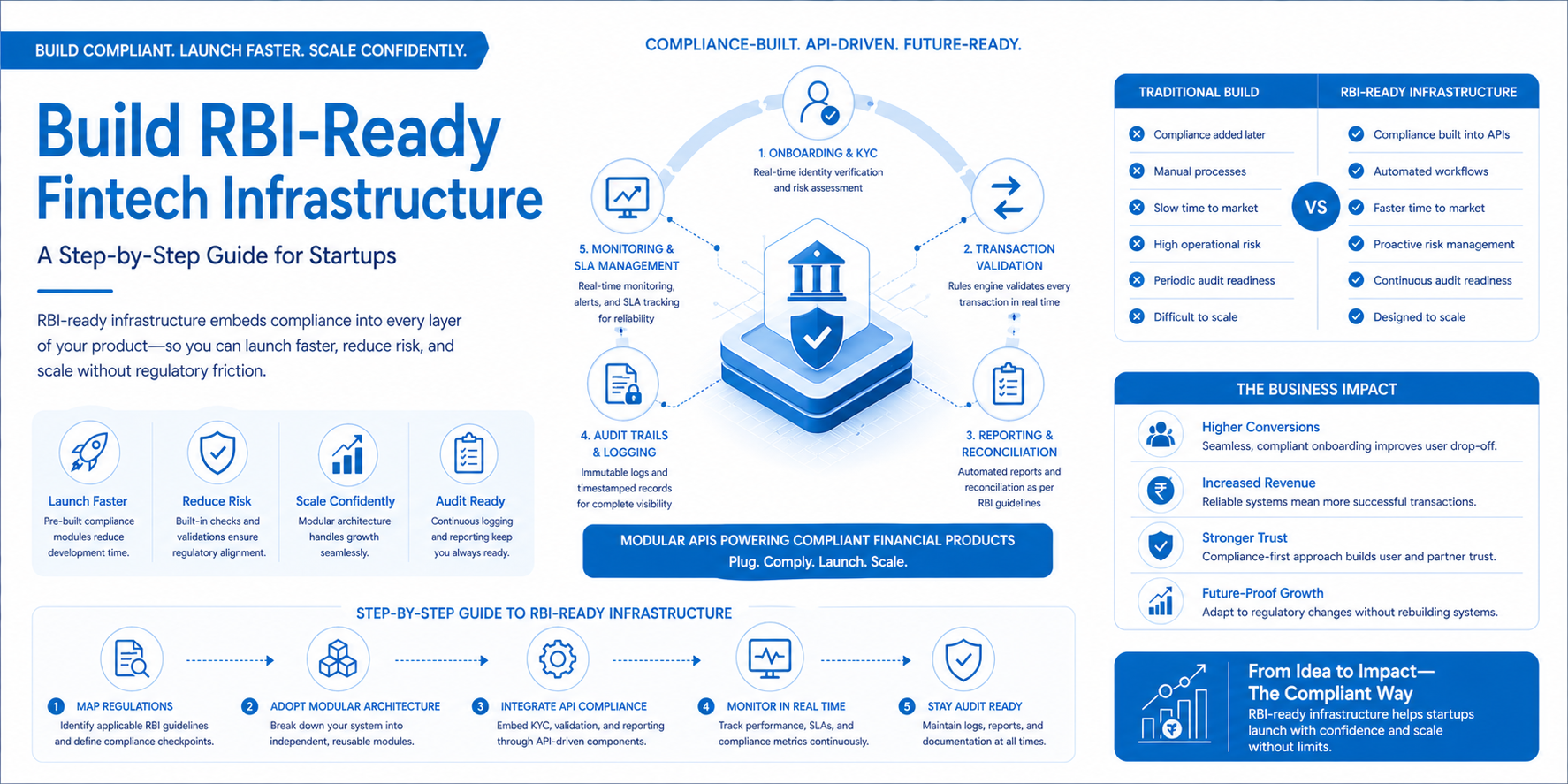
What is RBI-Ready Infrastructure?
RBI-ready infrastructure refers to a system architecture where compliance, reporting, transaction handling, and user flows are inherently aligned with RBI guidelines, ensuring that products can be launched, operated, and scaled without regulatory friction.
Unlike traditional builds where compliance is layered on after development, RBI-ready systems:
- Embed regulatory logic into APIs
- Standardize workflows across products
- Automate reporting and audit readiness
- Ensure consistent adherence to guidelines
This approach transforms compliance from a reactive requirement into a proactive capability.
Why Startups Struggle with RBI Compliance
For most startups, regulatory complexity becomes visible only after product development has already begun. This leads to delays, rework, and operational inefficiencies that slow down growth.
Common challenges include:
- Unclear regulatory mapping, where teams are unsure how RBI guidelines translate into technical requirements
- Fragmented systems, with compliance handled separately from core product flows
- Manual processes, leading to delays in onboarding, verification, and reporting
- Dependency on multiple partners, each with different compliance standards
These challenges create a situation where product readiness does not equal launch readiness, delaying time-to-market significantly.
The Role of Modular APIs in RBI-Ready Infrastructure
Modular APIs allow startups to build fintech systems in independent, reusable components, each responsible for a specific function such as onboarding, transaction processing, compliance validation, or reporting.
This modular approach provides two key advantages:
- Flexibility: Teams can update or replace individual components without rebuilding the entire system
- Speed: Pre-built modules reduce development time and simplify integration
When compliance is embedded within these modules, startups gain access to ready-to-use regulatory capabilities, eliminating the need to build them from scratch.
Core Components of RBI-Ready Infrastructure
1. Compliance-Embedded Onboarding
User onboarding must align with RBI requirements for KYC and identity verification. A robust system integrates:
- Real-time KYC APIs
- Document validation workflows
- Risk scoring mechanisms
This ensures that onboarding is both fast and compliant, reducing drop-offs while maintaining regulatory integrity.
2. Transaction Validation Layer
Every financial transaction must be validated against regulatory rules, including:
- Transaction limits
- Source and destination checks
- Fraud detection
By embedding these checks into APIs, platforms can ensure that non-compliant transactions are blocked before execution, rather than flagged afterward.
3. Audit Trails and Logging
RBI mandates detailed record-keeping for financial activities. Infrastructure must include:
- Immutable logs
- Timestamped event tracking
- User and system attribution
This ensures that platforms remain audit-ready at all times, reducing the burden during regulatory reviews.
4. Reporting and Reconciliation Systems
Accurate and timely reporting is a core requirement. RBI-ready systems automate:
- Transaction reporting
- Compliance documentation
- Reconciliation workflows
Automation ensures that reporting is consistent, accurate, and scalable, even as transaction volumes increase.
5. Monitoring and SLA Management
Real-time monitoring is essential to ensure system reliability and compliance. This includes:
- Performance tracking
- SLA adherence
- Alert systems for anomalies
Monitoring ensures that issues are detected and resolved before they impact users or regulatory standing.
Traditional vs RBI-Ready Infrastructure
| Aspect | Traditional Fintech Build | RBI-Ready Modular Infrastructure |
|---|---|---|
| Compliance Integration | Added later | Built into APIs |
| Time to Market | Slow | Fast |
| Scalability | Limited | High |
| Risk Management | Reactive | Proactive |
| Audit Readiness | Periodic | Continuous |
Step-by-Step Guide to Building RBI-Ready Infrastructure
Step 1: Map Regulatory Requirements Early
Before building any product, startups must:
- Identify applicable RBI guidelines
- Translate them into technical requirements
- Define compliance checkpoints across the user journey
This ensures that compliance is designed into the system, not added later.
Step 2: Adopt Modular Architecture
Break down the system into:
- Onboarding modules
- Transaction modules
- Compliance modules
- Reporting modules
This modularity allows teams to build and scale efficiently, while maintaining flexibility.
Step 3: Integrate API-Driven Compliance
Use APIs to handle:
- KYC verification
- Transaction validation
- Reporting
This reduces manual effort and ensures real-time compliance enforcement.
Step 4: Implement Real-Time Monitoring
Set up systems to track:
- Transactions
- Performance metrics
- Compliance deviations
Real-time visibility ensures that issues are addressed proactively.
Step 5: Ensure Audit Readiness
Design systems that:
- Log every action
- Store data securely
- Generate reports instantly
This ensures that audits can be handled without disruption.
Key Benefits for Startups
1. Faster Launch Cycles
With compliance built into infrastructure, startups can go live faster, capturing market opportunities without delays.
2. Reduced Operational Burden
Automation eliminates the need for:
- Manual checks
- Repetitive workflows
- Cross-team coordination
This allows teams to focus on growth.
3. Lower Risk Exposure
Proactive compliance reduces the risk of:
- Regulatory penalties
- Operational failures
- Reputational damage
4. Scalable Growth
Modular systems can handle increasing volumes without requiring major changes, enabling sustainable scaling.
Example: FD Platform with RBI-Ready Infrastructure
| Stage | Without RBI-Ready Infra | With RBI-Ready Infra |
|---|---|---|
| Onboarding | Manual KYC delays | Instant API-based verification |
| Booking | Multiple approvals | Pre-compliant workflows |
| Reporting | Manual compilation | Automated real-time reporting |
| Audit | Time-consuming | Instant readiness |
The Role of Finspring
Finspring enables startups to build RBI-ready FD infrastructure through:
- Modular APIs and SDKs
- Built-in compliance workflows
- Real-time monitoring and reporting
- Scalable architecture designed for growth
This allows startups to move from:
Idea → Integration → Launch → Scale
without being slowed down by regulatory complexity.
The Future of RBI-Ready Infrastructure
As fintech continues to evolve, RBI-ready systems will become more advanced, incorporating:
- AI-driven compliance automation
- Predictive risk detection
- Real-time regulatory updates
- Deeper ecosystem integrations
Startups that adopt this approach early will be better positioned to:
- Navigate regulatory changes
- Scale across markets
- Build long-term trust
Conclusion
Building fintech products in India requires more than innovation—it requires alignment with regulation at every level. RBI-ready infrastructure, powered by modular APIs, provides a clear path for startups to achieve this balance.
By embedding compliance into the core system, startups can:
- Launch faster
- Operate efficiently
- Scale confidently
In today’s fintech landscape, success is not just about building quickly.
It is about building in a way that allows you to move without friction while staying fully compliant.