Fixed deposits have long been one of the most stable pillars of banking. They offer predictable returns, capital protection, and broad appeal across retail, HNI, and institutional customers. For decades, however, the way fixed deposits were distributed remained largely unchanged.
That is no longer the case.
As financial distribution becomes more digital, network-driven, and platform-centric, fixed deposits are entering a new phase of evolution. The future of fixed deposit growth will not be driven solely by branches or proprietary bank channels. It will be shaped by aggregators, agents, and bank platforms working together in a connected ecosystem.
This article explores how that future is unfolding, why traditional models are being rethought, and what role each stakeholder plays in the next phase of fixed deposit distribution.
Why Fixed Deposit Distribution Is Changing
The fundamentals of fixed deposits have not changed. The environment around them has.
Banks today face several structural pressures:
-
Rising cost of distribution
-
Slower branch-led growth
-
Increasing competition on fixed deposit rates
-
Digitally savvy customers expecting faster experiences
-
Agents and advisors demanding better tools
At the same time, customers are no longer confined to a single bank relationship. They compare rates, seek advice from independent advisors, and expect seamless digital journeys.
These forces are pushing fixed deposits away from siloed, bank-centric distribution toward platform-driven networks.
The Traditional Fixed Deposit Model and Its Limits
Historically, banks controlled fixed deposit distribution end to end.
How the Old Model Worked
-
Banks acquired customers through branches or internal sales teams
-
Agents were tied to specific institutions
-
Technology systems were bank-specific
-
Rate comparison was manual or opaque
This model offered control, but it came with clear constraints.
Structural Limitations
| Dimension | Traditional Model |
|---|---|
| Cost structure | High fixed costs |
| Speed | Slow to scale |
| Geographic reach | Limited |
| Agent productivity | Constrained |
| Rate responsiveness | Delayed |
As competition intensified, these limitations became more visible.
The Emergence of Aggregator-Led Fixed Deposits Distribution
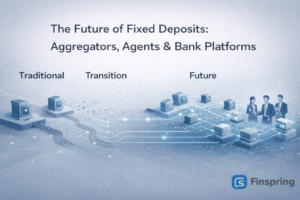
Aggregator platforms emerged to address these inefficiencies.
An FD aggregator acts as a neutral digital layer connecting:
-
Multiple banks
-
Multiple agents and advisors
-
Wealth and fintech platforms
Instead of building and managing every distribution node, banks plug into an existing ecosystem.
This shift does not remove banks from the equation. It repositions them.
The New Roles in the Fixed Deposit Ecosystem
The future of fixed deposits is defined by clearer role separation.
1. Banks: Product, Risk, and Governance Owners
In the platform-driven model, banks focus on what they do best:
-
Structuring fixed deposit products
-
Managing balance sheet and liquidity
-
Pricing and risk discipline
-
Regulatory compliance
Distribution becomes a scalable interface, not a fixed asset.
2. Aggregators: Distribution Infrastructure Providers
Aggregators provide the connective tissue.
They enable:
-
Single-platform multi-bank access
-
Standardized onboarding and workflows
-
Real-time fixed deposit rate visibility
-
Centralized reporting and auditability
Aggregators turn fragmented distribution into reusable infrastructure.
3. Agents and Advisors: Trust and Relationship Engines
Agents remain central to fixed deposit growth.
Their value lies in:
-
Trusted customer relationships
-
Local and segment-specific reach
-
Advisory-driven conversions
Aggregator platforms enhance agent productivity instead of replacing it.
Why Agents Will Remain Critical in the Future
Despite digital growth, fixed deposits remain trust-heavy products.
Customers still prefer:
-
Known advisors
-
Relationship-driven recommendations
-
Human reassurance for capital protection products
What changes is how agents operate.
With aggregator platforms, agents gain:
-
Access to multiple banks through one system
-
Faster onboarding and execution
-
Transparent rate comparison
-
Centralized commission tracking
This allows agents to scale without operational overload.
Why Aggregators Will Become Core Infrastructure
FD aggregators are no longer just intermediaries.
They are becoming infrastructure layers for the deposit ecosystem.
Key Reasons
-
Distribution Is Now a Network Problem
Scale comes from connecting networks, not expanding branches. -
Speed and Flexibility Matter
Aggregators allow banks to respond quickly to changes in fixed deposit rates and demand. -
Cost Efficiency Is Structural
One integration unlocks many channels, keeping customer acquisition costs under control. -
Governance Can Be Embedded Digitally
Modern platforms enforce rules, disclosures, and audit trails programmatically.
Bank Platforms vs Aggregator Platforms
Some banks attempt to build proprietary platforms. While effective for owned channels, these often struggle to scale externally.
| Dimension | Bank-Owned Platform | Aggregator Platform |
|---|---|---|
| Bank coverage | Single bank | Multiple banks |
| Agent adoption | Limited | High |
| Scalability | Linear | Network-driven |
| Integration effort | High | Low |
| Neutrality | No | Yes |
In practice, the future lies in interoperability, not exclusivity.
How Fixed Deposits Benefit from Platform-Led Distribution
Platform-led models improve fixed deposit outcomes across the board.
For Banks
-
Lower cost of liability acquisition
-
Faster market expansion
-
Better rate competitiveness
-
Improved data visibility
For Agents
-
Higher productivity
-
Better client outcomes
-
Faster closures
-
More predictable earnings
For Customers
-
Transparent comparison of fixed deposit rates
-
Faster booking
-
Reduced documentation friction
-
Access to multiple banks without complexity
Technology as the Foundation of the Future
The future fixed deposit ecosystem is API-driven.
Key capabilities include:
-
Real-time product and rate APIs
-
Digital KYC and onboarding
-
Automated compliance checks
-
Secure transaction execution
-
Unified analytics and reporting
Without this foundation, aggregation does not scale.
How Finspring Fits Into the Future
Finspring.ai is designed to support this evolving ecosystem.
It enables:
-
Banks to expand FD distribution without expanding operational complexity
-
Agents to access multiple banks through a single platform
-
Wealth and fintech platforms to add fixed deposits seamlessly
-
Centralized governance, reporting, and control
Finspring acts as infrastructure, not a competing channel.
The Long-Term Direction of Fixed Deposit Growth
Fixed deposits are not becoming obsolete. They are becoming platform-native.
The future will be defined by:
-
Network-led distribution
-
Agent-empowered workflows
-
Aggregator-driven infrastructure
-
Bank-controlled product and risk layers
Banks that embrace this model gain flexibility, speed, and cost advantages. Those that resist it face rising costs and shrinking reach.
Conclusion
The future of fixed deposits will not be built by banks alone, agents alone, or platforms alone.
It will be built at the intersection of all three.
Aggregators provide the infrastructure, agents provide trust, and banks provide the products and governance. Together, they form a scalable, resilient distribution model suited to modern financial markets.
Fixed deposits may be a traditional product, but their future is unmistakably platform-driven.