Fixed Deposits (FDs) have remained one of the most trusted financial products for decades because they offer something users consistently value: predictability. However, for the banks and fintech platforms distributing FDs, predictability is becoming harder to maintain. This raises an important question for banks, fintechs, and infrastructure providers: How do you future-proof FD offerings against regulatory or rate changes?
The answer lies in infrastructure, flexibility, and compliance-first design.
Why FD Products Face Increasing Volatility
FDs are considered stable investments, but the ecosystem around them is not static. Institutions distributing FDs must respond to multiple external forces simultaneously.
These include:
- Changes in RBI guidelines and reporting requirements
- Interest rate fluctuations driven by inflation or monetary policy
- Shifts in customer demand during economic uncertainty
- New digital compliance expectations
- Competition from newer financial products
Without adaptive systems, every change creates friction.
The Two Biggest Risks to FD Offerings
1. Regulatory Risk
Financial products operate in regulated environments. Even small changes in:
- Documentation requirements
- KYC norms
- Reporting obligations
- Audit expectations
can require significant operational updates.
If infrastructure is rigid, adapting becomes slow and expensive.
2. Interest Rate Risk
FD attractiveness depends heavily on prevailing rates.
When rates rise:
- Demand often increases
When rates fall:
- Customers may move toward alternative products
Platforms need the ability to:
- Update offerings quickly
- Communicate changes clearly
- Reposition products dynamically
What Future-Proofing Actually Means
Future-proofing does not mean predicting every regulatory update or market shift.
It means building systems capable of adapting quickly when change happens.
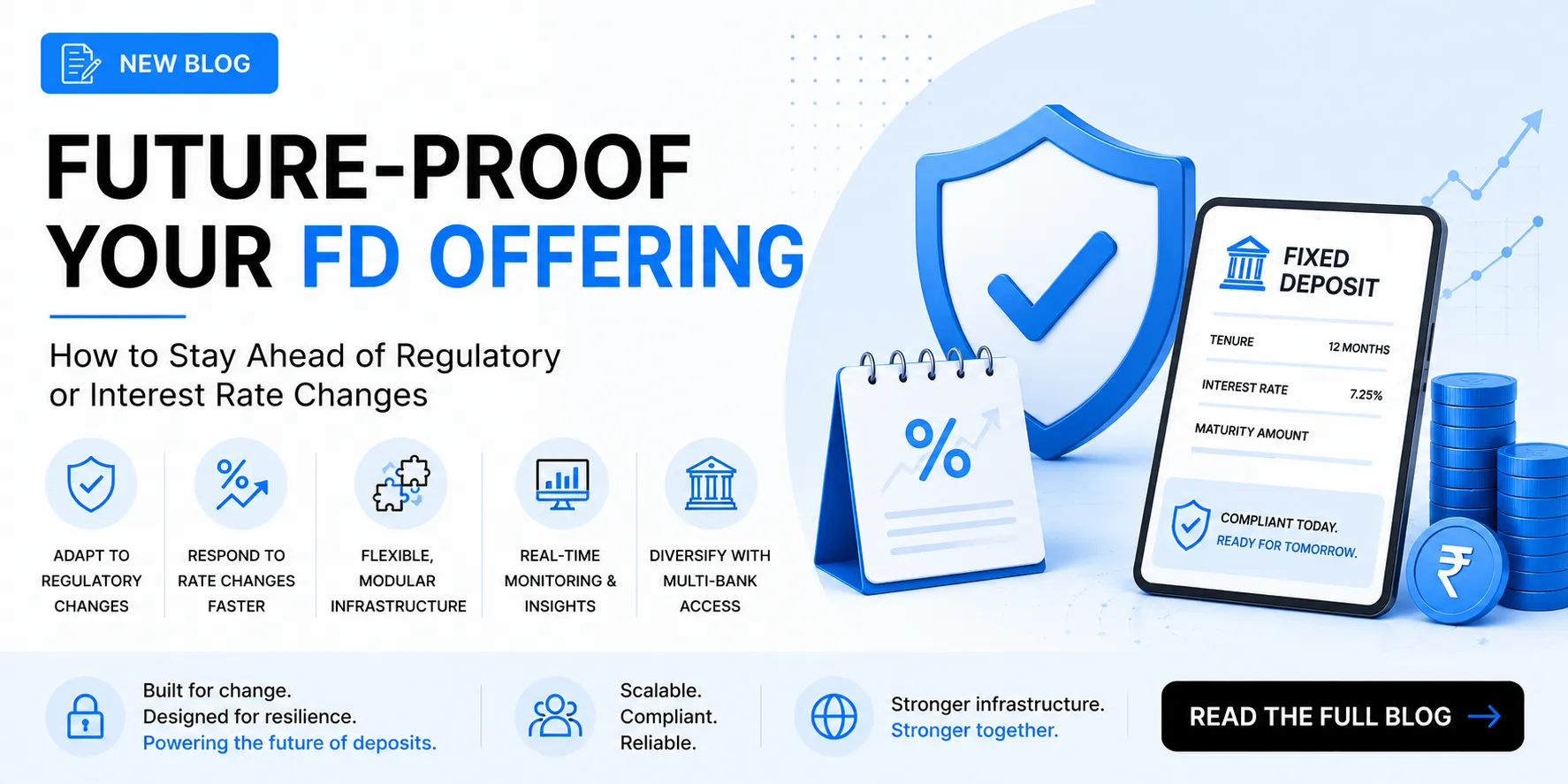
A future-proof FD infrastructure should enable:
✓ Rapid compliance updates
✓ Flexible product configurations
✓ Multi-bank diversification
✓ Real-time monitoring
✓ Scalable distribution
Traditional FD Systems vs Future-Proof Infrastructure
| Area | Traditional FD Systems | Future-Proof FD Infrastructure |
|---|---|---|
| Compliance Updates | Manual | Embedded & automated |
| Rate Changes | Slow updates | Real-time adjustments |
| Product Flexibility | Limited | Modular |
| Scaling | Difficult | High |
| Monitoring | Reactive | Continuous |
Strategy 1: Build Compliance into Infrastructure, Not Operations
Many institutions treat compliance as a separate team or workflow.
This creates bottlenecks.
Instead, compliance should be embedded directly into infrastructure, allowing systems to automatically align with changing requirements.
Examples include:
- Automated KYC workflows
- Audit-ready logging
- Built-in reporting systems
- API-driven compliance checks
When regulations change, updates occur at the infrastructure layer instead of requiring operational overhauls.
This dramatically reduces adaptation time.
Strategy 2: Use Modular, API-Driven Architecture
Rigid systems struggle during change because everything is interconnected.
Modular systems isolate functions:
- Onboarding
- FD booking
- Reporting
- Compliance
- Notifications
This means updates can happen to one component without disrupting the entire system.
API-driven infrastructure becomes critical here.
A modular architecture allows institutions to:
- Introduce new rules faster
- Add new banks
- Update workflows quickly
Strategy 3: Diversify Across Multiple Banks
Dependence on a single institution increases vulnerability.
Future-proof FD ecosystems often rely on multi-bank access, enabling platforms to:
- Offer different rates
- Reduce concentration risk
- Maintain competitiveness during market shifts
If one bank changes offerings, distribution remains intact.
Diversification increases resilience.
Strategy 4: Implement Real-Time Monitoring
Many institutions discover problems after users do.
Future-proof infrastructure includes:
- SLA tracking
- Alert systems
- Transaction monitoring
- Compliance monitoring
Real-time visibility enables proactive action.
Example Monitoring Metrics
| Metric | Why It Matters |
|---|---|
| FD booking success rate | Detect friction quickly |
| API latency | Maintain reliability |
| Compliance alerts | Reduce regulatory risk |
| Rate update frequency | Ensure accuracy |
Strategy 5: Make Product Configuration Dynamic
Traditional FD systems often require manual updates whenever rates or terms change.
Future-proof platforms enable:
- Dynamic rate updates
- Flexible tenure configurations
- Instant product modifications
This improves responsiveness and reduces operational burden.
Strategy 6: Prepare for Audit Requirements Continuously
Audit preparation should not begin before an audit.
Future-ready infrastructure maintains:
- Immutable logs
- Automated records
- Continuous reporting
Audit readiness becomes a byproduct of operations rather than a separate effort.
Why Infrastructure Matters More Than Predictions
Organizations often focus on forecasting:
“What will RBI change next?”
“Will rates increase?”
These questions matter—but infrastructure matters more.
Because institutions rarely win by predicting perfectly.
They win by adapting quickly.
How Finspring Helps Future-Proof FD Offerings
Finspring is designed around compliance-first, API-driven FD infrastructure, helping banks and fintechs respond faster to change.
Key capabilities include:
1. Multi-Bank FD Infrastructure
Allows platforms to diversify offerings and reduce dependency.
2. Embedded Compliance Systems
Supports:
- KYC workflows
- Reporting
- Audit readiness
making regulatory adaptation easier.
3. Real-Time Monitoring
Tracks:
- Performance
- Reliability
- SLA metrics
to maintain operational resilience.
4. Plug-and-Play APIs
Enable rapid updates without rebuilding systems.
Example: Responding to an RBI Update
Imagine new reporting requirements are introduced.
Legacy setup:
- Manual review
- Process redesign
- Team coordination
- Delayed implementation
API-first infrastructure:
- Compliance layer updated
- Workflows adjusted automatically
- Reporting standardized
Response time shrinks dramatically.
The Future of FD Distribution
The next generation of FD infrastructure will likely include:
- AI-driven compliance monitoring
- Predictive risk detection
- Dynamic product optimization
- Automated regulatory adaptation
The institutions that succeed will not necessarily have the highest rates.
They will have the most adaptable infrastructure.
Conclusion
Future-proofing FD offerings is no longer optional. Regulatory expectations will continue evolving, and market conditions will continue shifting.
The question is not whether change will happen.
The question is whether your infrastructure is designed to absorb it.
Banks and fintechs that invest in:
- Compliance-first systems
- API-driven architecture
- Real-time monitoring
- Modular infrastructure
will be better positioned to maintain trust, scale distribution, and adapt without disruption.
Because in financial services, long-term success does not come from avoiding change.
It comes from building systems that evolve with it.