Accelerating Fixed Deposit Distribution Through Single-Platform Access
For agents and wealth distributors, speed and reach define success. The ability to engage more customers, close more applications, and manage portfolios efficiently has become far more important than simply having access to a single bank’s products.
As fixed deposit distribution becomes increasingly competitive, agents are turning to FD aggregators to overcome the limitations of traditional bank-by-bank models. Aggregator platforms enable agents to reach more customers faster by simplifying access, improving conversion rates, and removing operational bottlenecks.
This article explains how FD aggregators transform agent productivity and why they are becoming a critical layer in modern fixed deposit distribution.
The Traditional Agent Bottleneck
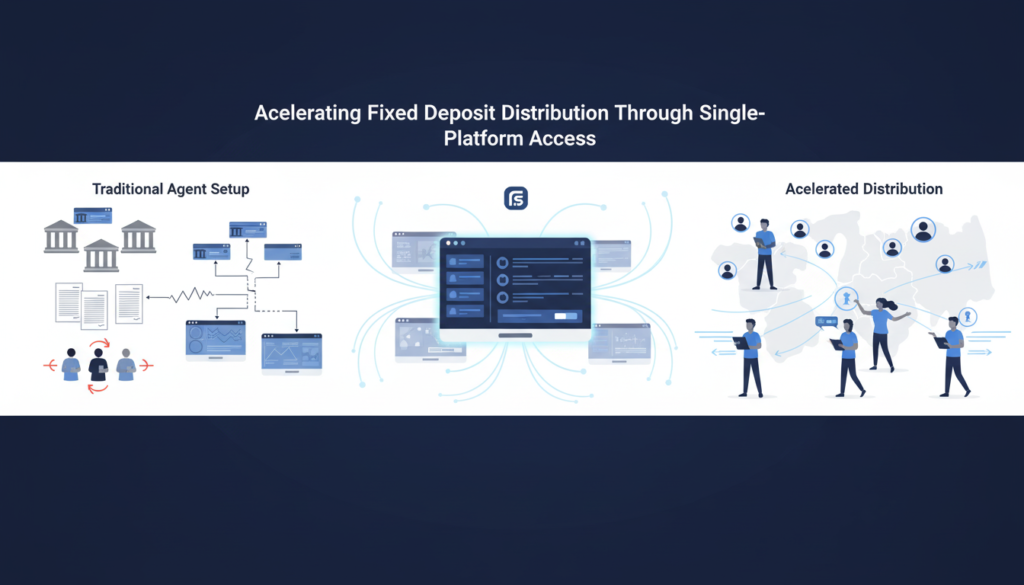
Historically, agents distributed fixed deposits through direct bank relationships. While familiar, this approach introduced structural friction that limited scale.
Common Challenges Agents Faced
- Separate onboarding for each bank
- Multiple systems and dashboards
- Manual comparison of fixed deposit rates
- Slower turnaround times
- Limited product choice for clients
As customer expectations evolved toward faster, digital-first experiences, these constraints became increasingly visible.
What Is an FD Aggregator?
An FD aggregator is a neutral platform that connects multiple banks, multiple agents, and digital workflows into a single system.
From an agent’s perspective, it replaces fragmented bank portals with:
- One login
- One onboarding process
- One reporting dashboard
- Access to multiple fixed deposit products
This unified structure fundamentally changes how agents operate.
How FD Aggregators Help Agents Reach More Customers
1. Faster Client Onboarding
Speed is the first advantage.
FD aggregators standardize onboarding processes across banks, allowing agents to submit applications digitally without repeating documentation for each institution.
Result:
- Reduced onboarding time per customer
- Faster application submission
- Higher daily customer throughput
This allows agents to serve more customers using the same time and resources.
2. Real-Time Access to Fixed Deposit Products
Agents using aggregators can instantly view:
- Available fixed deposit tenures
- Minimum investment thresholds
- Current fixed deposit rates
This eliminates the need for manual checks across multiple bank systems.
| Distribution Model | Time to Compare Rates |
|---|---|
| Direct bank portals | High |
| Manual coordination | Very high |
| FD aggregator | Near-instant |
Faster comparisons lead to faster decisions and quicker closures.
3. Broader Customer Coverage Without Geographic Limits
Traditional agent distribution is often tied to physical branches or regional bank partnerships.
FD aggregators remove this dependency by:
- Enabling digital submissions
- Supporting remote onboarding
- Allowing agents to serve clients beyond local geographies
Agents can now reach customers across cities and regions without expanding physical presence.
Why Single-Platform Access Improves Conversion
Reduced Customer Drop-Off
Every additional step in a process increases the risk of abandonment.
Aggregator platforms reduce:
- Repeated data entry
- Delays caused by manual verification
- Follow-ups due to inconsistent formats
This streamlined experience keeps customers engaged until completion.
Better Client Confidence
Clients are more likely to proceed when agents can:
- Show multiple fixed deposit options
- Explain differences clearly
- Recommend suitable tenures transparently
Access to multiple banks through one platform improves advisory credibility.
Aggregators vs Traditional Distribution: Agent Impact
| Factor | Traditional Model | Aggregator Model |
|---|---|---|
| Banks accessible | One or few | Multiple |
| Systems used | Many | One |
| Rate comparison | Manual | Real-time |
| Customer reach | Limited | Expanded |
| Scalability | Low | High |
This difference directly affects how many customers an agent can serve in a given period.
How Aggregators Increase Agent Productivity
Higher Output Per Agent
By reducing non-selling activities such as:
- System switching
- Manual reconciliation
- Documentation follow-ups
FD aggregators allow agents to focus on:
- Client acquisition
- Advisory conversations
- Portfolio expansion
One agent can now manage a larger customer base without compromising service quality.
Centralized Reporting and Tracking
Agents benefit from:
- Unified dashboards
- Clear visibility into application status
- Centralized commission tracking
| Metric | Aggregator View |
|---|---|
| Submitted applications | ✓ |
| Confirmed fixed deposits | ✓ |
| Pending actions | ✓ |
| Earnings summary | ✓ |
This clarity enables better planning and follow-ups.
Impact on Customer Experience
From the customer’s perspective, aggregator-led distribution feels:
- Faster
- More transparent
- Less bureaucratic
Customers benefit from:
- Quick comparison of fixed deposit rates
- Digital documentation
- Reduced dependency on opening a new bank account solely for investment
This improves satisfaction and increases referral potential.
Why Banks Support Agent-Led Aggregator Distribution
FD aggregators do not only benefit agents. Banks gain access to:
- Larger agent networks
- Wider customer reach
- Faster deposit mobilization
- Lower acquisition costs
Importantly, banks can scale distribution without expanding internal sales teams or branches.
Where FD Aggregators Deliver the Most Value
FD aggregator platforms are particularly effective when:
- Agents serve multiple client segments
- Customers are rate-sensitive
- Fixed deposit volumes are high
- Digital onboarding is preferred
- Speed to market matters
In such environments, aggregators outperform traditional distribution models.
How Finspring Enables Faster Customer Reach for Agents
Finspring.ai is designed as a bank-first, agent-friendly FD aggregation platform.
It enables:
- Single-platform access to multiple banks
- Standardized workflows for faster execution
- Transparent reporting and analytics
- Compliance-aligned distribution
By removing operational friction, Finspring allows agents to scale customer outreach efficiently while helping banks grow fixed deposit volumes.
The Bigger Shift in FD Distribution
Agents today are no longer limited by physical reach or institutional silos. The combination of:
- Digital onboarding
- Multi-bank access
- Unified platforms
is redefining how fixed deposits are sold.
FD aggregators are not just tools for convenience. They are infrastructure for scale.
Conclusion
FD aggregators help agents reach more customers faster by eliminating fragmentation, improving access to fixed deposit products, and streamlining the entire distribution journey.
With a single platform, agents can:
- Serve more clients
- Close more deposits
- Deliver better outcomes
For banks and agents alike, aggregator-led distribution represents the future of scalable fixed deposit growth.
Read how to scale FD Sales without increasing the headcount, here.