In a fully digital Fixed Deposit (FD) journey, compliance is not a back-office function—it is a real-time experience layer. Customers expect to book an FD in minutes. Regulators expect airtight compliance. Institutions must deliver both. So How to handle KYC and AML in digital FD?
This guide breaks down the architecture, process flows, regulatory checkpoints, and best practices to build a compliant, seamless system.
Why KYC, CKYC, and AML Matter in FD Products
FDs are regulated financial instruments. Even though they’re considered low-risk products, they fall under strict guidelines defined by the Reserve Bank of India (RBI) and Prevention of Money Laundering Act (PMLA).
In a digital FD system, you must ensure:
- Customer identity verification
- Central registry checks
- Anti-money laundering screening
- Record-keeping and audit readiness
If not handled properly, institutions face regulatory penalties and operational risk.
Let’s break each component down.
1. KYC in a Digital FD Setup
KYC (Know Your Customer) verifies the identity of a depositor before allowing financial transactions.
What Digital KYC Typically Includes
- PAN verification
- Aadhaar-based eKYC
- OTP authentication
- Video KYC (if required)
- Address validation
- Face match & liveness detection
Types of KYC Flows in FD Booking
A. Existing Customer Flow
If the customer already has a savings account or prior relationship:
- Fetch KYC status from Core Banking System
- Validate KYC completeness
- Skip redundant steps
- Proceed directly to FD booking
This reduces friction dramatically.
Core banking systems often used include:
- Finacle
- TCS BaNCS
- Flexcube
B. New-to-Institution Customer Flow
If the customer is new:
- PAN API verification
- Aadhaar eKYC API
- CKYC search
- AML screening
- Risk categorization
- Customer ID creation
Only after this is complete should the FD Booking API activate.
2. CKYC Handling in Digital FD Infrastructure
CKYC (Central Know Your Customer) allows institutions to fetch pre-verified KYC records.
Instead of collecting documents again, you:
- Search CKYC registry using PAN/Aadhaar
- Retrieve KYC identifier (KIN)
- Validate data match
- Store CKYC reference ID
This reduces onboarding time significantly.
Best Practice: CKYC First Strategy
Before initiating fresh KYC, always:
- Run CKYC search API
- If found → fetch and validate
- If not found → trigger fresh KYC
This prevents duplicate registry entries and speeds up onboarding.
3. AML Flow in a Digital FD Setup
AML (Anti-Money Laundering) ensures funds are not linked to illegal activity.
In digital FD systems, AML checks must happen in real-time or near-real-time.
AML Screening Typically Includes:
- Sanctions list screening
- Politically Exposed Person (PEP) check
- Watchlist database scan
- Adverse media search
- Risk scoring
If flagged:
- Mark as high-risk
- Trigger manual review workflow
- Temporarily restrict booking
Automation is critical here.
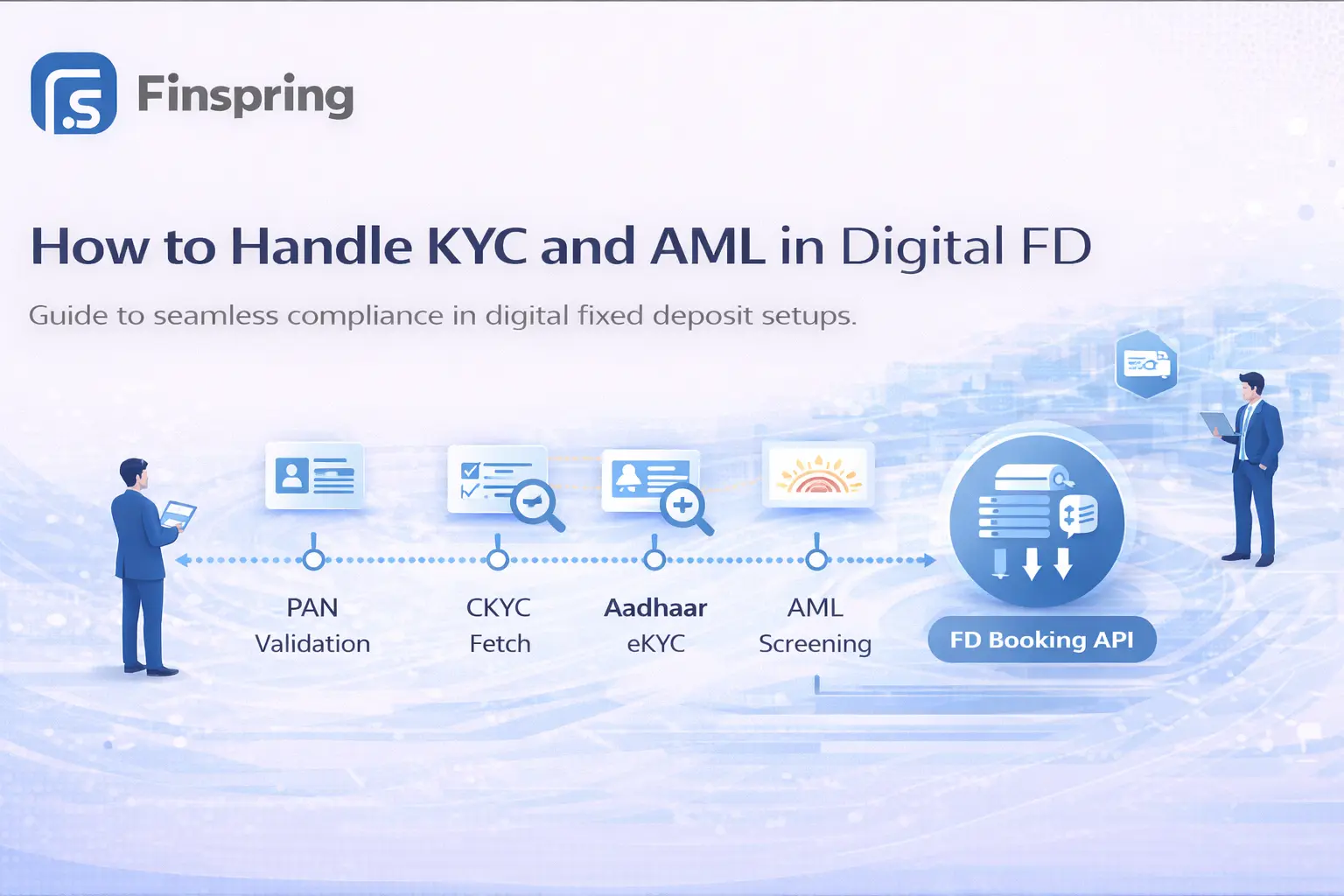
Ideal KYC-AML Flow Architecture for FD
Let’s visualize the proper flow.
Step 1: Customer Initiates FD Booking
→ Enter PAN & mobile number
Step 2: PAN Validation API
→ Verify format & identity
Step 3: CKYC Search API
→ If KIN exists → fetch
→ If not → initiate fresh KYC
Step 4: Aadhaar eKYC / Video KYC
→ Validate identity
Step 5: AML Screening API
→ Sanctions, PEP, risk scoring
Step 6: Risk Categorization
→ Low risk → proceed
→ High risk → manual review
Step 7: Customer ID Creation
→ Generate unique CIF
Step 8: Activate FD Booking API
All of this should ideally happen within minutes.
Handling Edge Cases
1. Name Mismatch Between PAN & CKYC
- Trigger validation screen
- Allow document upload
- Send for manual review
2. High-Risk AML Flag
- Escalate internally
- Temporarily restrict transaction
- Maintain audit logs
3. Incomplete CKYC Record
- Prompt additional fields
- Trigger re-verification
Edge-case management defines operational strength.
Regulatory Considerations in India
Digital FD platforms must comply with:
- RBI KYC Master Directions
- PMLA guidelines
- Data localization rules
- Secure audit trail storage
- Minimum 5-year record retention
Every API call must be logged.
How to handle KYC and AML in digital FD
Here’s how modern digital FD platforms balance speed and regulation:
1. Progressive KYC Model
Collect only mandatory fields upfront.
Defer non-critical fields post-booking if allowed.
2. Reusable KYC Tokens
For returning customers, store KYC verification tokens securely to avoid repeat verification.
3. Real-Time Webhooks
Trigger AML check instantly post-KYC rather than batch processing.
4. API Orchestration Layer
Instead of sequential long waits, run:
- CKYC search
- AML screening
- PAN verification
Simultaneously when possible.
Security & Data Protection Requirements
KYC and AML flows involve sensitive data.
Ensure:
- End-to-end encryption
- Tokenized storage
- Role-based access control
- Encrypted document vault
- Secure API gateways
Data breach in KYC systems is catastrophic for brand trust.
Timeline: How to handle KYC and AML in digital FD?
In an optimized FD setup:
- PAN verification → Seconds
- CKYC fetch → 30–60 seconds
- Aadhaar eKYC → 1–2 minutes
- AML screening → Real-time API
- Full onboarding → Under 5 minutes
If your KYC takes 15–20 minutes, friction is too high.
Manual vs Fully Automated Model
| Model | Speed | Risk | Scalability |
|---|---|---|---|
| Manual review heavy | Slow | Low automation risk | Poor |
| Hybrid (auto + review) | Moderate | Balanced | Good |
| Fully automated | Fast | Requires strong API reliability | Excellent |
Most institutions adopt a hybrid approach for risk mitigation.
Common Mistakes in Digital FD Compliance Setup
- Running AML after fund receipt
- Not checking CKYC before fresh KYC
- Poor audit logging
- No retry mechanism for failed APIs
- Manual certificate issuance before compliance clearance
These create regulatory and operational vulnerabilities.
The Strategic Perspective: How to handle KYC and AML in digital FD
In digital FD ecosystems, compliance is not a cost center.
It is an infrastructure moat.
Institutions that design intelligent KYC, CKYC, and AML API orchestration achieve:
- Faster onboarding
- Lower drop-offs
- Stronger regulatory standing
- Scalable FD growth
Final Answer
Handling KYC, CKYC, and AML in a digital FD setup requires:
- Real-time PAN and Aadhaar verification
- CKYC-first retrieval logic
- Automated AML screening
- Risk scoring and escalation workflows
- Secure data storage and audit logging
- Seamless integration with FD booking APIs
When built correctly, the entire compliance flow can complete within 3–5 minutes—without compromising regulatory standards.
The goal isn’t just compliance.
It’s compliant speed.
And in digital FD deployment, speed defines competitive advantage.