Cooperative banks have traditionally relied on localized operations, branch-led interactions, and manual processes to serve their communities. While this model built strong relationships, it is increasingly misaligned with today’s expectations of instant, digital, and seamless financial services. Payments sit at the center of this shift. To stay relevant and competitive, cooperative banks must adopt integrated payment systems for cooperative banks—systems that unify multiple payment channels, automate processes, and connect seamlessly with modern financial ecosystems.
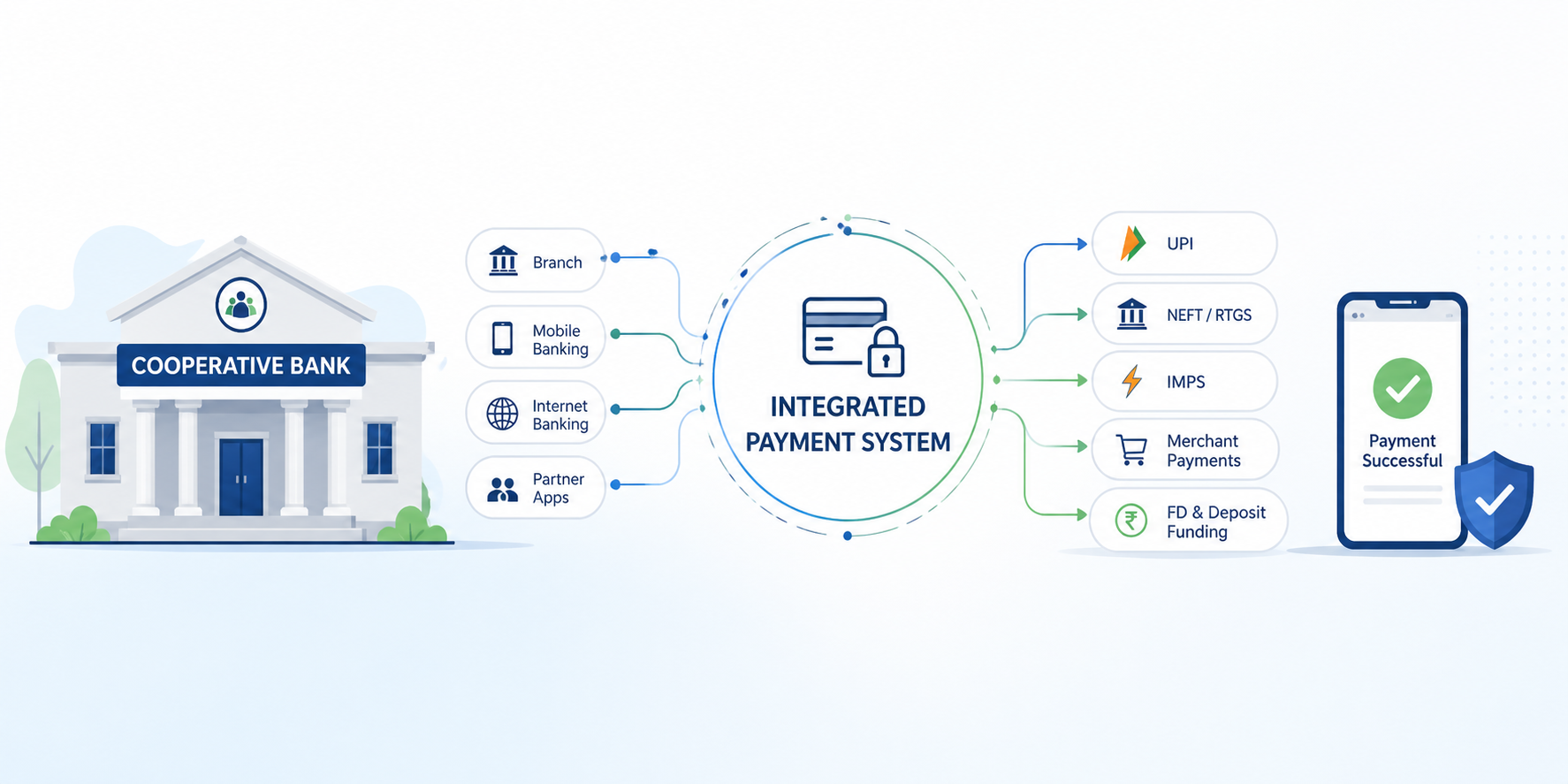
In this article, we explore what integrated payment systems are, why they matter, and how infrastructure platforms like Finspring enable cooperative banks to modernize their payment capabilities.
What Are Integrated Payment Systems for Cooperative Banks?
Integrated payment systems refer to unified platforms that connect multiple payment methods, channels, and backend processes into a single, cohesive infrastructure. Instead of operating separate systems for different payment types, banks can manage everything through one integrated layer.
These systems typically include:
- Digital payments (UPI, NEFT, RTGS, IMPS)
- Internal fund transfers
- Merchant payments
- Deposit-related transactions (such as FD funding)
- Reconciliation and reporting systems
The goal is to create a centralized yet flexible system that enables seamless transaction processing across all channels.
Why Cooperative Banks Need Integrated Payment Systems
The need for integrated payment systems is driven by several structural changes in the financial ecosystem.
1. Rising Digital Payment Adoption
Customers increasingly prefer:
- Mobile payments
- Instant transfers
- Cashless transactions
Without integrated systems, cooperative banks struggle to meet these expectations.
2. Fragmented Legacy Systems
Many cooperative banks operate with:
- Separate systems for each payment type
- Limited integration capabilities
- Manual reconciliation processes
This fragmentation leads to inefficiencies and errors.
3. Regulatory Requirements
Payment systems must comply with:
- Reporting standards
- Transaction monitoring
- Audit requirements
Integrated systems simplify compliance by standardizing processes.
4. Need for Scalability
As transaction volumes grow, banks require systems that can:
- Handle increased load
- Maintain performance
- Scale efficiently
Traditional vs Integrated Payment Systems
| Aspect | Traditional Systems | Integrated Payment Systems |
|---|---|---|
| Architecture | Fragmented | Unified |
| Processing Speed | Slow | Real-time |
| Reconciliation | Manual | Automated |
| Scalability | Limited | High |
| User Experience | Inconsistent | Seamless |
Core Components of Integrated Payment Systems
To build effective integrated payment systems for cooperative banks, several components must work together.
1. Unified Payment Gateway
A central gateway handles:
- Payment initiation
- Routing
- Processing
This ensures consistent handling of all transactions.
2. API Integration Layer
APIs connect the payment system with:
- Core banking systems
- External networks
- Fintech platforms
This enables seamless communication between systems.
3. Transaction Processing Engine
This layer:
- Executes transactions
- Validates data
- Ensures accuracy
It is the backbone of payment operations.
4. Reconciliation and Settlement Systems
These systems ensure:
- Accurate fund transfers
- Proper accounting
- Error resolution
Automation reduces manual effort.
5. Compliance and Monitoring Layer
This layer handles:
- Transaction monitoring
- Fraud detection
- Regulatory reporting
It ensures that all payments are compliant.
Challenges in Implementing Integrated Payment Systems
Cooperative banks often face several challenges when adopting integrated payment systems.
1. Legacy Infrastructure
Existing systems may not support:
- Real-time processing
- API integration
- Automation
2. Limited Technical Expertise
Banks may lack:
- Skilled development teams
- Experience with modern infrastructure
3. High Implementation Costs
Building systems from scratch can be:
- Expensive
- Time-consuming
4. Compliance Complexity
Payment systems must adhere to strict regulations, increasing implementation complexity.
The Role of API Infrastructure
API infrastructure simplifies the adoption of integrated payment systems by providing:
- Pre-built integration layers
- Standardized communication protocols
- Scalable architectures
- Real-time processing capabilities
Instead of building everything internally, cooperative banks can use APIs to assemble modern payment systems quickly and efficiently.
How Finspring Enables Integrated Payment Systems
While Finspring primarily focuses on FD and deposit infrastructure, it plays a crucial role in enabling integrated payment systems—especially in the context of deposit-linked transactions and financial product flows.
1. Seamless FD Funding via Payment Systems
Finspring enables:
- Integration of payment flows with FD booking
- Smooth fund transfer from user accounts to deposits
- Real-time confirmation
This connects payment systems directly with investment products.
2. Unified API Layer
Finspring provides:
- Standardized APIs
- Multi-bank integration
- Simplified workflows
This reduces the complexity of managing multiple payment and deposit systems.
3. Embedded Compliance
Finspring integrates:
- KYC validation
- Transaction monitoring
- Reporting systems
ensuring compliance across payment and deposit flows.
4. Real-Time Monitoring and SLA Tracking
Banks can track:
- Transaction performance
- Payment success rates
- System reliability
This ensures consistent service quality.
Example: Integrated Payment Flow with Finspring
| Stage | Traditional Process | Integrated Process |
|---|---|---|
| Payment Initiation | Separate system | Unified interface |
| Processing | Manual routing | Automated API routing |
| FD Funding | Manual transfer | Integrated flow |
| Confirmation | Delayed | Real-time |
| Reporting | Manual | Automated |
Benefits of Integrated Payment Systems
1. Improved Efficiency
Automation reduces:
- Processing time
- Errors
- Operational costs
2. Better User Experience
Seamless payment flows provide:
- Faster transactions
- Instant confirmations
- Consistent experience
3. Enhanced Compliance
Integrated systems ensure:
- Accurate reporting
- Real-time monitoring
- Audit readiness
4. Scalability
Banks can:
- Handle higher transaction volumes
- Expand services
- Integrate new partners
5. Increased Revenue Opportunities
By enabling digital payments, banks can:
- Increase transaction volumes
- Offer new services
- Improve customer engagement
Best Practices for Implementation
1. Start with Core Payment Flows
Focus on:
- UPI and digital payments
- Internal transfers
- FD funding
2. Use API-First Infrastructure
Adopt platforms that:
- Simplify integration
- Provide scalability
- Ensure compliance
3. Automate Reconciliation
Reduce manual work by:
- Implementing automated systems
- Standardizing processes
4. Monitor Performance
Track:
- SLAs
- Transaction success rates
- System health
The Future of Payment Systems for Cooperative Banks
Payment systems will continue to evolve with:
- Real-time processing across all channels
- AI-driven fraud detection
- Deeper integration with financial products
- Fully digital ecosystems
Cooperative banks that adopt integrated systems will be able to:
- Compete with fintech platforms
- Serve customers better
- Scale sustainably
Conclusion
Integrated payment systems for cooperative banks are essential for modernizing operations and meeting the demands of a digital-first financial ecosystem. By unifying payment channels, automating processes, and enabling real-time transactions, these systems provide the foundation for scalable growth.
Platforms like Finspring enhance this transformation by connecting payment flows with deposit infrastructure, ensuring seamless, compliant, and reliable financial operations.
Because in today’s banking landscape, payments are not just transactions.
They are the foundation of every financial interaction.