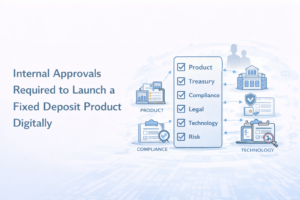
As Fixed Deposits move increasingly into digital channels, banks and financial platforms are discovering that demand is rarely the constraint. The real gating factor is internal readiness. Launching a Fixed Deposit product digitally is not a single approval exercise. It is a coordinated governance process that spans product design, compliance, treasury, technology, operations, and risk. Understanding these internal approvals for digital FD launch—not only to avoid delays, but to design a launch process that is predictable, auditable, and scalable.
This article breaks down the key internal approvals typically required before launching an FD product digitally, and why each exists.
Why Digital FD Launches Require Structured Internal Approvals
Fixed Deposits may be a familiar product, but digital distribution changes the risk surface.
Unlike branch-led distribution, digital FD launches introduce:
-
Faster inflow velocity
-
Wider and more immediate customer reach
-
Automated onboarding and servicing
-
Platform-level dependency instead of relationship-led control
Regulators expect banks to demonstrate that these changes are governed systematically, not managed informally.
Internal approvals ensure that speed does not come at the cost of accountability.
1. Product Approval: Defining What Is Being Offered
The first layer of approval sits with the product team, often in coordination with business leadership.
This approval typically covers:
-
FD tenures and minimum deposit amounts
-
Interest rate structures and payout options
-
Eligibility criteria (retail, senior citizen, corporate, etc.)
-
Renewal and premature withdrawal rules
For digital launches, product teams must also validate that:
-
Product rules are unambiguous and system-enforceable
-
Edge cases (partial failures, retries, reversals) are handled cleanly
-
No manual interpretation is required during execution
This approval ensures that the FD product can exist as a deterministic system, not a loosely defined offering.
2. Treasury and ALM Approval: Balance Sheet Alignment
Treasury approval is one of the most critical—and often underestimated—steps.
From a treasury perspective, digital FD distribution affects:
-
Liquidity inflow timing
-
Tenure mix and duration matching
-
Cost of funds
-
Concentration and sourcing risk
Treasury teams typically review:
-
Expected inflow velocity through digital channels
-
Tenure-wise exposure limits
-
Rate boundaries and campaign flexibility
-
Caps on volumes or issuer participation
This approval ensures that digital FD launches support balance-sheet strategy rather than disrupt it.
Importantly, treasury sign-off is not a one-time event. It often includes guardrails that are enforced continuously post-launch.
3. Compliance Approval: KYC, AML, and Regulatory Alignment
Compliance approval is non-negotiable in any FD launch, but digital distribution raises additional scrutiny.
Compliance teams validate that:
-
KYC and AML workflows meet regulatory requirements
-
Customer onboarding is consistent across channels
-
Disclosures are accurate, complete, and clearly presented
-
No regulatory obligations are delegated improperly
For aggregator-led or SDK-based launches, compliance teams also review:
-
Role clarity between issuer and distributor
-
Data handling and storage responsibilities
-
Audit trail completeness
The goal is not to slow down the launch, but to ensure that regulatory accountability remains clearly anchored to the bank.
4. Legal Approval: Contracts and Issuer Responsibility
Legal approval ensures that documentation matches operational reality.
This includes:
-
Product terms and conditions
-
Customer agreements and disclosures
-
Partner or platform contracts (if applicable)
-
Liability and responsibility clauses
For digital launches, legal teams pay particular attention to:
-
How issuer responsibility is communicated
-
Whether customer consent is captured correctly
-
How disputes and escalations are handled
Legal approval ensures that what is executed digitally aligns with what is defensible legally.
5. Technology and Information Security Approval
Digital FD products are technology-led by definition.
Technology and infosec approvals typically cover:
-
System architecture and integration points
-
Data flow mapping and storage locations
-
Access controls and role-based permissions
-
Encryption, logging, and monitoring standards
For SDK-based launches, this approval is faster when:
-
The SDK follows standard security practices
-
Integrations are modular and well-documented
-
Data ownership and system-of-record are clearly defined
Infosec approval ensures that operational efficiency does not introduce systemic risk.
6. Operations Approval: Servicing and Exception Handling
Operations teams are responsible for what happens after go-live.
Their approval validates:
-
Booking confirmation flows
-
Exception handling and failed transaction resolution
-
Customer support escalation paths
-
Maturity, renewal, and closure processes
Digital FD launches often fail not at booking, but during servicing.
Operations approval ensures that automation is backed by clear human processes when exceptions occur.
7. Risk Management Approval: Controls and Oversight
Risk teams review digital FD launches through a broader lens.
They assess:
-
Process risk introduced by automation
-
Dependency risk on platforms or partners
-
Operational concentration risk
-
Scenario handling for failures or surges
Risk approval often results in:
-
Volume caps
-
Rate boundaries
-
Monitoring thresholds
These controls allow innovation while maintaining institutional discipline.
8. Management and Committee-Level Sign-Off
For many banks, final approval sits with:
-
Product committees
-
Risk management committees
-
Executive leadership
This sign-off consolidates all prior approvals and confirms that the institution is comfortable with:
-
The scale of launch
-
The pace of distribution
-
The governance framework
Digital FD launches are not just product decisions—they are institutional decisions.
Why These Approvals Often Delay Digital Launches
Delays usually occur when approvals are treated as sequential and siloed.
Common causes include:
-
Late involvement of treasury or compliance
-
Ambiguity around roles in digital distribution
-
Over-customisation of workflows
-
Manual approval processes instead of rule-based ones
When approvals are designed into infrastructure early, these delays reduce significantly.
How Plug-and-Play FD Infrastructure Simplifies Approvals
Modern FD SDKs help accelerate approvals by:
-
Embedding compliance workflows
-
Standardising reporting and audit trails
-
Clarifying issuer and distributor roles
-
Reusing pre-approved system logic
This shifts approvals from ad-hoc reviews to configuration validation.
Approvals become faster because teams are reviewing known structures, not reinventing them.
Closing Thoughts
Launching a Fixed Deposit product digitally is not blocked by regulation. It is governed by internal readiness.
The approvals required—product, treasury, compliance, legal, technology, operations, risk, and leadership—exist for valid reasons. They protect customers, institutions, and balance sheets.
The platforms that launch fastest are not those that bypass approvals, but those that design for them early.
In digital FD distribution, speed is not about fewer approvals.
It is about better-designed approval systems.