NBFC funding structure is not just a balance sheet component — it is the foundation of profitability, risk management, and long-term sustainability. Many NBFCs rely heavily on bank borrowings, market-linked instruments, securitization, or external commercial borrowings to fund their lending operations. While these channels provide scale, they also introduce concentration risk, refinancing pressure, and cost volatility.
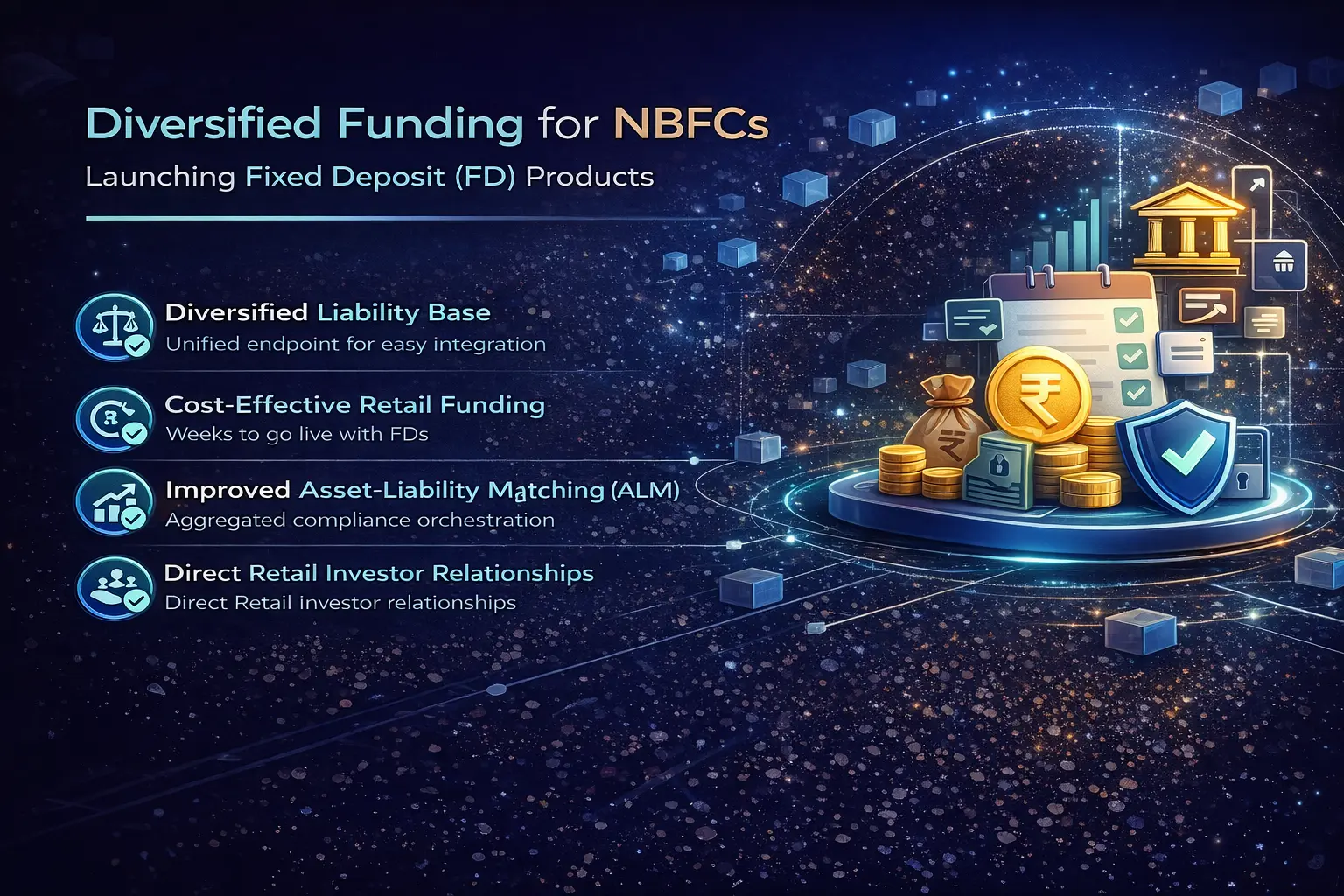
Launching Fixed Deposit (FD) products offers NBFCs a powerful opportunity to diversify funding sources, improve cost predictability, and build direct retail investor relationships. When executed strategically, deposit mobilization strengthens liability stability and enhances long-term resilience.
Let’s explore how.
Understanding the Funding Challenge for NBFCs
NBFCs traditionally depend on wholesale borrowing. This includes term loans from banks, issuance of Non-Convertible Debentures (NCDs), and structured finance instruments. While effective in growth phases, wholesale funding can become expensive or constrained during liquidity tightening cycles.
In periods of market stress, refinancing risk increases and cost of funds can spike. Overdependence on a limited set of funding channels exposes NBFCs to systemic shocks and rating pressure. Diversification is therefore not optional — it is essential.
Retail fixed deposits introduce a more granular, diversified liability base that reduces reliance on concentrated institutional lenders.
Why Fixed Deposits Are Strategic for NBFCs
Retail FDs provide NBFCs with access to a broad base of individual investors seeking stable returns. Unlike wholesale funding, which may involve large-ticket lenders, retail deposits distribute liability across thousands of small investors.
This distribution reduces concentration risk and strengthens liquidity buffers. Retail deposits also tend to be relatively stable compared to market-linked instruments. Investors holding FDs typically commit funds for defined tenures, offering predictable maturity schedules and better asset-liability matching.
Moreover, FDs can improve cost optimization if structured correctly. NBFCs with strong credit ratings can often raise deposits at competitive rates while maintaining healthy spreads between borrowing cost and lending yield.
Regulatory Framework and Eligibility
NBFCs cannot accept public deposits unless specifically authorized. Only deposit-taking NBFCs that meet Reserve Bank of India (RBI) criteria can launch fixed deposit schemes. These NBFCs must adhere to strict prudential norms, including capital adequacy requirements, credit rating thresholds, and deposit caps linked to net owned funds.
Compliance includes maintaining liquidity buffers, transparent disclosure norms, and adherence to deposit acceptance guidelines. While the regulatory bar is high, meeting it enhances credibility in the eyes of retail investors.
Deposit-taking NBFCs that satisfy these standards gain the strategic advantage of diversified liability access.
Building a Retail Deposit Franchise
Launching an FD product is not merely about publishing interest rates. It requires building trust and distribution channels.
Digital infrastructure now enables NBFCs to offer fully online FD booking journeys with integrated KYC, CKYC, and AML compliance. Instead of relying solely on branch-based models, NBFCs can distribute deposits through:
-
Their own digital platforms
-
Wealth management apps
-
Investment marketplaces
-
FD aggregators
-
Strategic fintech partnerships
By leveraging technology, NBFCs can scale retail deposit acquisition without proportional physical infrastructure expansion.
Digital distribution reduces acquisition cost while expanding geographic reach.
Improving Asset-Liability Matching (ALM)
One of the core benefits of launching FDs is improved asset-liability management. NBFCs lend across various tenures — from short-term consumer loans to longer-term housing or SME financing. Without stable liabilities, mismatch risk increases.
Fixed deposits provide defined tenure structures, allowing NBFCs to align borrowing duration with lending maturity profiles. For example, if an NBFC specializes in 24-month loans, it can structure FD products with similar tenure brackets to reduce mismatch.
A well-balanced ALM structure improves credit ratings, lowers refinancing pressure, and enhances regulatory comfort.
Enhancing Cost Stability
Wholesale borrowing costs fluctuate based on liquidity conditions, policy rates, and credit market sentiment. Retail FDs, however, can provide more stable funding costs over fixed tenures.
Even if deposit rates are slightly higher than short-term wholesale rates during favorable cycles, they offer insulation during tightening phases. This stability enables better interest margin planning and predictable earnings.
Over time, a strong deposit franchise can reduce overall weighted average cost of funds.
Strengthening Brand and Investor Trust
Launching fixed deposits creates direct relationships with retail investors. Unlike institutional lenders, retail depositors engage with the brand personally. Transparent communication, timely interest payouts, and smooth maturity handling build credibility.
This trust can translate into cross-selling opportunities, including recurring deposits, NCDs, or other investment products.
A successful deposit program elevates the NBFC from a wholesale borrower to a recognized retail financial brand.
Risk Considerations
Diversification does not eliminate risk; it redistributes it.
Deposit-taking NBFCs must manage:
-
Liquidity buffers
-
Regulatory reporting obligations
-
Interest rate sensitivity
-
Reputation risk
Failure to honor maturity payments or delays in renewal handling can damage public trust rapidly. Therefore, lifecycle management systems for renewals, premature withdrawals, and closures must be robust and automated.
Additionally, interest rate competition in the deposit market requires strategic pricing discipline. Offering unsustainably high rates to attract deposits may distort cost structures and compress margins.
Strategic balance is essential.
Technology as a Diversification Enabler
Modern API-driven infrastructure enables NBFCs to launch digital FDs faster than ever. Instead of building complex systems from scratch, they can integrate deposit booking, compliance checks, payment systems, and reconciliation modules through standardized platforms.
Digital onboarding reduces friction and expands reach beyond traditional geographic limits. Automated lifecycle management improves operational efficiency while maintaining compliance integrity.
Technology lowers the barrier to entry while supporting scalable deposit mobilization.
Strategic Impact on Long-Term Sustainability
Diversifying funding sources through fixed deposits reduces reliance on cyclical wholesale markets. It improves resilience during liquidity crunches and strengthens creditworthiness.
A diversified funding mix enhances negotiating power with banks and institutional lenders. When an NBFC is not solely dependent on wholesale funding, it gains strategic flexibility.
Over time, a balanced mix of retail deposits and institutional borrowings creates a more stable liability structure that supports sustainable growth.
Final Answer
NBFCs can diversify funding sources by launching fixed deposit products that build a stable, retail-driven liability base. By mobilizing deposits from individual investors, NBFCs reduce concentration risk, improve asset-liability matching, stabilize funding costs, and enhance long-term financial resilience.
Successful implementation requires regulatory compliance, digital infrastructure, disciplined pricing strategy, and strong lifecycle management systems. When executed thoughtfully, fixed deposits transform the funding structure from dependence-driven to diversified and strategically balanced.
For NBFCs seeking stability in a volatile funding environment, fixed deposits are not just a product — they are a structural advantage.