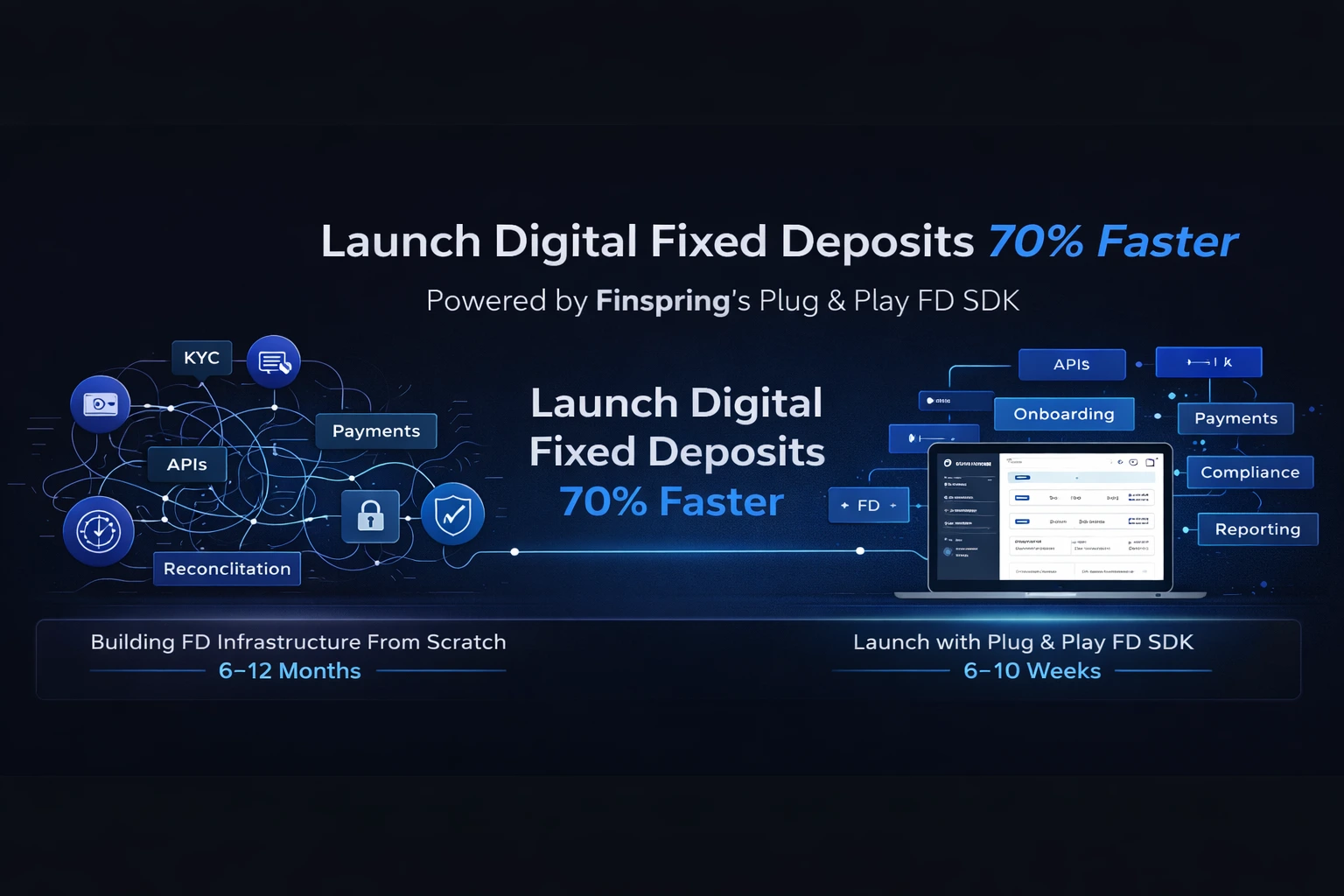
Launching Fixed Deposit (FD) products digitally has become a strategic priority for NBFCs, fintech platforms, and wealth management companies. Fixed deposits provide a stable funding source, strengthen customer trust, and enable institutions to diversify their financial offerings. However, building a fully functional digital FD infrastructure from scratch is complex, time-consuming, and operationally intensive. Institutions must develop multiple components including onboarding flows, KYC integrations, payment systems, reconciliation engines, reporting modules, compliance frameworks, and customer interfaces. Each of these layers involves regulatory considerations, security standards, and extensive testing. As a result, many financial institutions take 6–12 months or longer to launch a digital FD product. This is where Finspring’s Plug & Play FD SDK becomes transformative. By providing a ready-to-integrate software development kit designed specifically for FD distribution and management, Finspring enables institutions to reduce development complexity and launch FD products significantly faster. In many cases, organizations can reduce time-to-market by up to 70% compared to building an FD infrastructure internally.
This article explains how the Plug & Play FD SDK accelerates FD launches while maintaining security, scalability, and regulatory compliance.
Why Time-to-Market Matters for Digital FD Products
In the financial services industry, speed of product deployment directly impacts competitive advantage. Institutions that launch new financial products faster can capture market demand earlier, attract new customers, and generate revenue sooner.
However, delays in product development often arise due to multiple operational challenges.
Common Barriers to Launching Digital FD Products
Financial institutions frequently face the following challenges when building FD platforms internally:
- Complex technology architecture: Developing backend infrastructure for deposit lifecycle management.
- Regulatory compliance requirements: Ensuring adherence to RBI guidelines and audit requirements.
- Integration with payment systems: Supporting multiple payment rails such as UPI, net banking, and bank transfers.
- Customer onboarding flows: Implementing KYC, verification, and account creation processes.
- Operational monitoring: Building dashboards for reconciliation, reporting, and customer management.
These elements must work seamlessly together before a product can go live. Coordinating multiple vendors, internal teams, and regulatory requirements significantly extends development timelines.
A purpose-built FD SDK removes much of this friction.
What Is a Plug & Play FD SDK?
A Plug & Play FD SDK is a pre-built technology framework that allows financial institutions to integrate fixed deposit functionality directly into their digital platforms. Instead of developing FD infrastructure from scratch, developers can embed ready-made modules into their applications.
The SDK typically includes APIs, UI components, documentation, and backend integrations necessary to support the entire FD lifecycle.
Finspring’s FD SDK enables institutions to quickly integrate:
- FD product listing and discovery
- Customer onboarding and KYC
- Deposit booking workflows
- Payment processing
- Portfolio management dashboards
- Reporting and reconciliation tools
Because these components are already designed, tested, and optimized, institutions can focus on integrating them into their existing platforms rather than building them from the ground up.
How Finspring’s Plug & Play FD SDK Accelerates Time-to-Market
Finspring’s architecture is specifically designed to simplify and streamline the process of launching digital FD products. Several key factors contribute to the dramatic reduction in time-to-market.
1. Pre-Built FD Infrastructure
The most significant time savings come from eliminating the need to build deposit infrastructure internally.
Finspring’s SDK provides ready-made modules for:
- FD booking workflows
- interest calculation
- maturity tracking
- customer portfolio management
- renewal and closure processes
These components are already optimized for performance and reliability. As a result, development teams do not need to spend months designing the underlying system architecture.
Instead, they can simply integrate the SDK into their application environment and configure it according to their product requirements.
2. Simplified API Integrations
Integrating multiple financial services APIs is typically one of the most time-consuming parts of building a fintech product.
Finspring’s SDK simplifies this process by offering unified APIs that manage key interactions across the FD lifecycle. Developers can integrate these APIs into web platforms, mobile apps, or internal dashboards without complex engineering overhead.
For example, APIs support functions such as:
- creating FD bookings
- retrieving deposit details
- tracking maturity timelines
- updating customer portfolios
Because these APIs are standardized and documented, development teams can implement them quickly and confidently.
3. Built-In Compliance and Reporting
Compliance requirements are a major reason why financial product launches are delayed. Financial institutions must ensure that their systems support regulatory reporting, audit trails, and accurate record-keeping.
Finspring’s FD SDK includes built-in capabilities for:
- transaction logs
- reconciliation records
- regulatory reporting formats
- audit-ready documentation
These features allow institutions to launch FD products while maintaining operational transparency and regulatory readiness.
By embedding compliance infrastructure within the SDK, Finspring removes the need for institutions to build separate reporting and monitoring systems.
4. Scalable Infrastructure from Day One
When financial products gain traction, systems must be capable of handling increased user activity and deposit volumes. Building scalable infrastructure internally requires careful planning and testing.
Finspring’s SDK is designed to support high transaction volumes and rapid user growth. The infrastructure is optimized for performance during periods of high FD inflows.
This scalability ensures that institutions can launch quickly without worrying about rebuilding their systems later as demand increases.
5. Reduced Development and Testing Cycles
Traditional fintech product launches involve multiple stages of development, testing, debugging, and iteration. Each component must be validated individually before being integrated into the full system.
Because Finspring’s SDK is pre-tested and production-ready, development teams can dramatically shorten their testing cycles. Instead of validating every backend component individually, teams primarily focus on:
- integration testing
- UI customization
- workflow optimization
This streamlined process significantly accelerates the journey from development to production deployment.
Comparing Traditional Development vs SDK-Based Deployment
The difference in launch timelines becomes clear when comparing the two approaches.
| Development Approach | Typical Launch Timeline | Complexity |
|---|---|---|
| Building FD infrastructure internally | 6–12 months | Very High |
| Integrating Finspring Plug & Play FD SDK | 6–10 weeks | Moderate |
By reducing infrastructure development, compliance setup, and testing requirements, the SDK can shorten the product launch timeline by approximately 70%.
This speed advantage allows institutions to respond quickly to market opportunities and evolving customer demand.
Strategic Benefits Beyond Faster Launches
While faster time-to-market is the primary advantage, Finspring’s SDK also provides several long-term strategic benefits.
Lower Development Costs
Building financial infrastructure internally requires large engineering teams and extended development cycles. By using a ready-made SDK, institutions significantly reduce development expenses.
Faster Iteration
With the core infrastructure already in place, organizations can focus on improving customer experience, introducing new FD products, and optimizing distribution strategies.
Improved Reliability
Pre-built infrastructure that has already been tested across multiple use cases reduces the likelihood of system failures, operational errors, or integration issues.
The Future of Financial Product Deployment
As fintech ecosystems continue to evolve, financial institutions are increasingly adopting modular technology solutions instead of building every system internally.
SDK-based infrastructure allows companies to launch new financial products quickly while maintaining operational flexibility and compliance. This approach aligns with modern fintech architecture, where speed, scalability, and integration capabilities are critical.
Finspring’s Plug & Play FD SDK reflects this shift by enabling institutions to deploy FD products faster while maintaining the reliability expected in financial services.
Conclusion
Launching digital fixed deposit products traditionally requires months of engineering, integration, and regulatory preparation. For many institutions, these complexities delay product rollouts and slow down innovation.
Finspring’s Plug & Play FD SDK eliminates many of these barriers by providing ready-to-integrate infrastructure for the entire FD lifecycle. Through pre-built modules, unified APIs, built-in compliance features, and scalable architecture, the SDK allows institutions to dramatically reduce development timelines.
By cutting time-to-market by up to 70%, financial institutions can launch FD products faster, capture market opportunities earlier, and deliver secure savings options to customers without the operational burden of building infrastructure from scratch.
In a competitive financial landscape where speed and reliability matter, adopting a Plug & Play FD SDK can be the difference between delayed launches and rapid market entry.