In financial infrastructure, performance is not just a technical metric—it is a direct driver of trust, revenue, and compliance. Unlike other industries where occasional downtime may be tolerated, even minor disruptions in financial systems can lead to failed transactions, user dissatisfaction, and regulatory risk. This is why SLA tracking (Service Level Agreement tracking) has become a foundational component of modern fintech infrastructure and it is important to resolve SLA tracking production issues.
For products like Fixed Deposits (FDs), where users expect certainty and accuracy, infrastructure reliability must be measurable, enforceable, and continuously monitored. SLA tracking ensures that every system component—from APIs to partner integrations—operates within defined performance standards.
What is SLA Tracking in Financial Infrastructure?
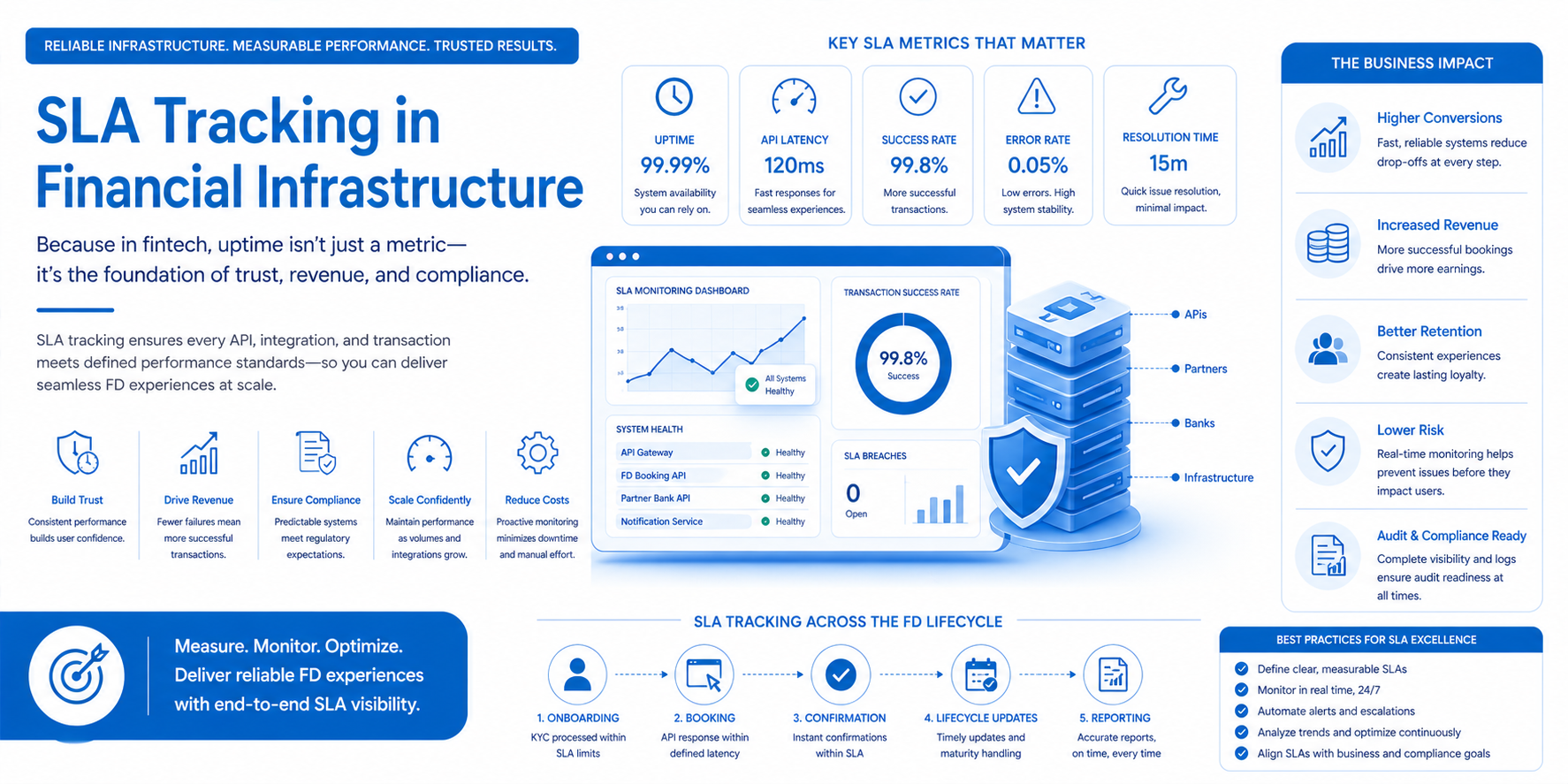
SLA tracking refers to the process of defining, monitoring, and enforcing performance benchmarks for system components, services, and integrations. These benchmarks typically include:
- Uptime guarantees
- API response times
- Transaction processing speed
- Error rates
- Resolution times for issues
In financial systems, SLA tracking ensures that these metrics are not just observed but actively managed in real time, allowing platforms to detect and resolve issues before they impact users or compliance obligations.
Why SLA Tracking Matters in Fintech
In fintech, infrastructure is the product. Users may interact with a simple interface, but their experience depends entirely on how reliably the backend performs. SLA tracking ensures that this reliability is consistent, measurable, and scalable.
Key reasons SLA tracking is critical:
- Trust is time-sensitive: Delays in confirmations or updates reduce user confidence instantly
- Revenue depends on uptime: Failed transactions directly impact monetization
- Compliance requires consistency: Regulatory frameworks expect predictable system behavior
- Scale increases complexity: As volumes grow, so does the risk of performance degradation
Without SLA tracking, platforms operate without visibility, making it difficult to maintain high performance standards.
Core SLA Metrics in Financial Infrastructure
| Metric | Description | Why It Matters |
|---|---|---|
| Uptime | Percentage of system availability | Ensures continuous access for users |
| API Latency | Time taken for API responses | Impacts user experience and transaction speed |
| Transaction Success Rate | Percentage of successful transactions | Directly affects revenue and trust |
| Error Rate | Frequency of system errors | Indicates system stability |
| Resolution Time | Time taken to fix issues | Determines recovery speed |
The Role of SLA Tracking in FD Systems
Fixed Deposit systems require high reliability across multiple stages, including onboarding, booking, confirmation, and lifecycle management. Any delay or failure in these stages can disrupt user experience and create operational challenges.
Example: FD Booking Flow with SLA Tracking
| Stage | SLA Metric | Impact of Failure |
|---|---|---|
| Onboarding | KYC processing time | Delays reduce conversion rates |
| Booking | API response time | Slow booking leads to drop-offs |
| Confirmation | Processing time | Delayed confirmation reduces trust |
| Lifecycle Updates | Update frequency | Inconsistent updates create confusion |
SLA tracking ensures that each stage operates within defined limits, maintaining consistency and reliability throughout the user journey.
Common Causes of SLA Breaches
Even well-designed systems can experience SLA breaches due to:
1. Partner Dependencies
Financial platforms often rely on banks and third-party services. Delays or failures at the partner level can impact overall performance.
2. Infrastructure Bottlenecks
High transaction volumes can strain systems that are not designed for scale, leading to latency and downtime.
3. Lack of Real-Time Monitoring
Without continuous monitoring, issues go undetected until they impact users.
4. Manual Incident Management
Slow response times increase the duration and impact of outages.
How SLA Tracking Solves These Challenges
1. Real-Time Monitoring
SLA tracking systems continuously monitor:
- API performance
- Transaction flows
- System health
This ensures that issues are detected as they occur, not after they escalate.
2. Automated Alerts
When performance deviates from defined SLAs, alerts are triggered instantly. This allows teams to:
- Identify root causes quickly
- Initiate corrective actions
- Minimize downtime
3. Performance Analytics
SLA tracking provides insights into:
- System performance trends
- Bottlenecks
- Partner reliability
This helps platforms optimize infrastructure proactively.
4. Accountability Across Systems
By defining SLAs for each component, platforms can:
- Hold internal teams accountable
- Evaluate partner performance
- Ensure consistent service delivery
Traditional Monitoring vs SLA-Driven Infrastructure
| Aspect | Traditional Monitoring | SLA-Driven Infrastructure |
|---|---|---|
| Approach | Reactive | Proactive |
| Visibility | Limited | Real-time |
| Issue Detection | Delayed | Instant |
| Scalability | Limited | High |
| Reliability | Inconsistent | Predictable |
Best Practices for Implementing SLA Tracking
1. Define Clear SLAs
Set measurable benchmarks for:
- Uptime
- Latency
- Transaction success
Clarity ensures accountability.
2. Monitor Continuously
Use real-time systems to track performance across:
- APIs
- Databases
- Integrations
3. Automate Alerts
Ensure that any deviation from SLAs triggers:
- Immediate notifications
- Escalation workflows
4. Analyze and Optimize
Regularly review performance data to:
- Identify patterns
- Improve systems
- Prevent future issues
5. Align SLAs with Business Goals
SLA metrics should reflect:
- User expectations
- Revenue impact
- Compliance requirements
The Business Impact of SLA Tracking
SLA tracking is not just a technical requirement—it has direct business implications:
1. Higher Conversion Rates
Reliable systems reduce drop-offs during onboarding and transactions.
2. Increased Revenue
Fewer failed transactions mean more completed bookings and higher earnings.
3. Improved User Retention
Consistent performance builds trust, leading to repeat usage.
4. Reduced Operational Costs
Proactive issue resolution reduces the need for manual intervention.
The Role of Finspring
Finspring integrates SLA tracking into its FD infrastructure, enabling platforms to:
- Monitor performance in real time
- Track API and transaction-level SLAs
- Receive automated alerts for production issues
- Maintain high uptime and reliability
This ensures that platforms can scale FD distribution without compromising performance or trust.
The Future of SLA Tracking in Financial Infrastructure
As fintech systems evolve, SLA tracking will become more advanced, incorporating:
- AI-driven performance prediction
- Automated incident resolution
- Cross-platform SLA orchestration
- Real-time optimization
These advancements will make infrastructure more resilient, adaptive, and self-correcting.
Conclusion
In financial infrastructure, uptime is not just a technical metric—it is a core product feature. SLA tracking ensures that systems operate reliably, consistently, and at scale, enabling platforms to deliver seamless user experiences and maintain regulatory compliance.
For FD systems and beyond, the ability to monitor and enforce performance standards is what separates fragile systems from scalable platforms.
Because in fintech, reliability is not optional.
It is the foundation of growth.