The wealth management industry has evolved beyond traditional banks and investment firms. Today, digital businesses—including fintechs, neobanks, payroll platforms, insurance companies, e-commerce marketplaces, and consumer apps—are integrating investment products directly into their customer journeys.
This shift is powered by embedded finance, allowing businesses to offer wealth-building opportunities without becoming financial institutions themselves.
However, choosing the right wealth management instruments is essential. The right mix of products helps businesses attract different customer segments while creating recurring engagement and new revenue opportunities.
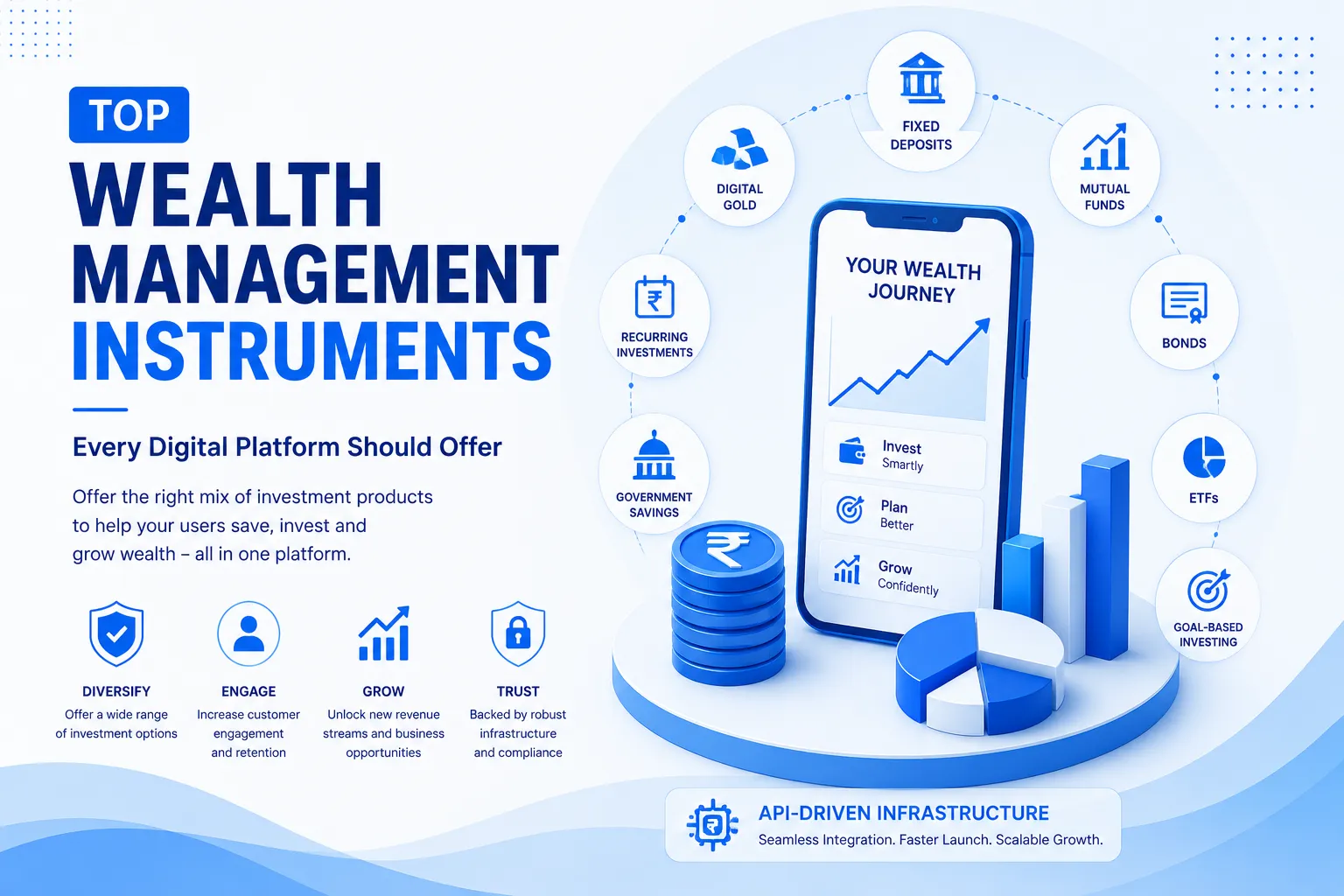
Here are the top wealth management instruments every digital platform should consider offering.
1. Fixed Deposits (FDs)
Fixed Deposits remain one of the most trusted investment products worldwide. They appeal to users seeking stable, predictable returns with relatively low risk.
Unlike market-linked investments, Fixed Deposits offer guaranteed interest over a predefined tenure, making them ideal for conservative investors and first-time savers.
Key Benefits
- Guaranteed returns
- Capital preservation
- Flexible investment tenures
- Low investment risk
- Suitable for emergency and goal-based savings
Why Digital Platforms Should Offer FDs
Many customers already trust their banking, payroll, or financial apps. Adding Fixed Deposits allows users to grow savings without leaving the platform, increasing engagement and customer retention.
2. Digital Gold
Digital Gold has become one of the fastest-growing investment products due to its accessibility and convenience.
Instead of purchasing physical gold, users can buy fractional amounts online with secure storage provided by regulated partners.
Digital Gold is especially attractive to younger investors because they can begin investing with relatively small amounts.
Benefits
- Fractional investments
- High liquidity
- Safe digital storage
- Easy gifting
- Inflation hedge
Digital Gold is commonly integrated into:
- Savings apps
- Reward programs
- E-commerce platforms
- Employee benefit applications
Its flexibility makes it an excellent addition to modern digital wealth platforms.
3. Mutual Funds
Mutual Funds allow investors to participate in professionally managed portfolios across equities, debt instruments, hybrid funds, and index funds.
Rather than selecting individual securities, customers invest in diversified portfolios managed by experienced fund managers.
Advantages
- Diversification
- Professional management
- Multiple risk categories
- SIP (Systematic Investment Plan) support
- Long-term wealth creation
Mutual Funds are particularly valuable for users seeking long-term financial growth while minimizing the complexity of portfolio management.
4. Bonds
Bonds are fixed-income securities that provide predictable returns over a defined period.
Governments, corporations, and financial institutions issue bonds to raise capital, while investors earn regular interest payments.
Benefits
- Stable income
- Lower volatility than equities
- Portfolio diversification
- Long-term financial planning
- Capital preservation
Businesses serving conservative investors often include bonds as part of balanced investment portfolios.
5. Exchange Traded Funds (ETFs)
Exchange Traded Funds combine diversification with the flexibility of stock market trading.
Unlike Mutual Funds, ETFs can be bought and sold throughout market hours.
Key Advantages
- Lower management costs
- Broad market exposure
- High liquidity
- Diversification
- Passive investment strategy
As financial literacy grows, ETFs are becoming increasingly popular among younger investors seeking cost-effective portfolio diversification.
6. Recurring Investment Plans
Recurring investment products encourage disciplined saving through automated monthly investments.
Rather than requiring large one-time investments, users contribute fixed amounts regularly toward financial goals.
Examples include:
- Monthly Digital Gold purchases
- Systematic Investment Plans (SIPs)
- Automated Fixed Deposit ladders
- Goal-based investment plans
Automation significantly improves customer retention while helping users build wealth consistently over time.
7. Government Savings Products
Government-backed investment schemes remain attractive due to their stability and sovereign backing.
These instruments often appeal to:
- First-time investors
- Retirement planners
- Risk-averse individuals
- Long-term savers
Depending on the market, businesses may integrate government savings products into their digital investment offerings to provide diversified options for users.
8. Goal-Based Investment Portfolios
Modern investors rarely invest without purpose.
Instead of choosing products individually, customers increasingly prefer investment journeys built around goals such as:
- Buying a home
- Retirement planning
- Children’s education
- Emergency funds
- Vacation savings
Goal-based investing combines multiple wealth management instruments into personalized portfolios tailored to each user’s financial objectives.
This approach improves user engagement by making investing more meaningful and outcome-focused.
9. Managed Investment Portfolios
Many customers want investment opportunities without actively managing portfolios.
Managed portfolios automatically allocate funds across multiple investment instruments based on:
- Risk profile
- Investment horizon
- Financial goals
- Market conditions
These products simplify wealth management for users while offering digital platforms higher-value financial services.
10. Digital Cash Management Products
Cash management has become an important part of modern wealth management.
Customers increasingly expect their idle balances to generate returns instead of remaining unused.
Digital platforms are responding by offering:
- Interest-bearing accounts
- Automated savings
- Sweep accounts
- Short-term investment options
These products improve customer satisfaction while encouraging users to keep funds within the platform ecosystem.
Choosing the Right Wealth Management Mix
Not every platform needs to offer every investment product immediately.
Businesses should select wealth management instruments based on:
Customer Demographics
Young professionals may prefer Digital Gold and Mutual Funds, while retirees often prioritize Fixed Deposits and Bonds.
Risk Appetite
Different customers have different investment preferences.
Offering multiple risk categories allows businesses to serve broader audiences.
Business Model
A payroll platform may focus on recurring investments, while an e-commerce marketplace could emphasize Digital Gold and reward-based investing.
User Experience
Investment products should integrate seamlessly into the existing customer journey rather than feeling like standalone financial services.
Why APIs Are Making Wealth Management More Accessible
Launching investment products once required extensive regulatory approvals, complex infrastructure, and years of development.
Today, API-driven financial infrastructure enables businesses to integrate wealth management instruments much faster.
Using modern APIs, digital platforms can offer products such as:
- Fixed Deposits
- Digital Gold
- Mutual Funds
- Bonds
- Goal-based investing
- Portfolio management
without building the entire financial ecosystem themselves.
This allows businesses to focus on customer experience while relying on secure backend infrastructure for investment operations.
The Future of Digital Wealth Management
As embedded finance continues to expand, customers will increasingly expect investment opportunities wherever they manage their finances.
Rather than visiting multiple financial institutions, users will invest directly through the digital platforms they already trust.
Businesses that offer a diversified portfolio of wealth management instruments can improve customer engagement, strengthen loyalty, and unlock new revenue opportunities.
Platforms like Finspring make this possible by providing API-driven infrastructure that enables businesses to launch investment products such as Fixed Deposits, Digital Gold, Mutual Funds, and other wealth management solutions quickly and securely. By simplifying integration, companies can bring modern investment experiences to market faster while focusing on delivering exceptional value to their customers.
Frequently Asked Questions (FAQs)
What are wealth management instruments?
Wealth management instruments are financial products designed to help individuals save, invest, and grow their wealth. Common examples include Fixed Deposits, Digital Gold, Mutual Funds, Bonds, ETFs, and managed investment portfolios.
Which wealth management instrument is best for beginners?
Fixed Deposits and Digital Gold are often considered beginner-friendly because they are simple to understand, require relatively low initial investments, and involve lower risk compared to market-linked investments.
Why should digital platforms offer investment products?
Offering investment products increases customer engagement, creates additional revenue opportunities, improves customer retention, and enables businesses to become comprehensive financial platforms through embedded finance.
How do APIs help businesses launch wealth management products?
APIs provide the infrastructure needed to integrate investment products like Fixed Deposits, Mutual Funds, and Digital Gold without requiring businesses to build complex financial systems from scratch.
Which investment products are growing the fastest?
Digital Gold, Mutual Funds, recurring investment plans, and embedded wealth management solutions are among the fastest-growing investment categories as consumers increasingly prefer digital-first financial experiences.