The way businesses offer financial products is changing rapidly. In the past, launching investment services required years of development, multiple banking partnerships, regulatory expertise, and significant operational resources. Today, wealth management APIs have simplified this process, making it possible for digital businesses to integrate investment products quickly and securely.
Whether you’re a fintech startup, digital bank, insurance company, payroll platform, employee benefits provider, or consumer app, wealth management APIs enable you to offer investment products without building complex financial infrastructure from scratch.
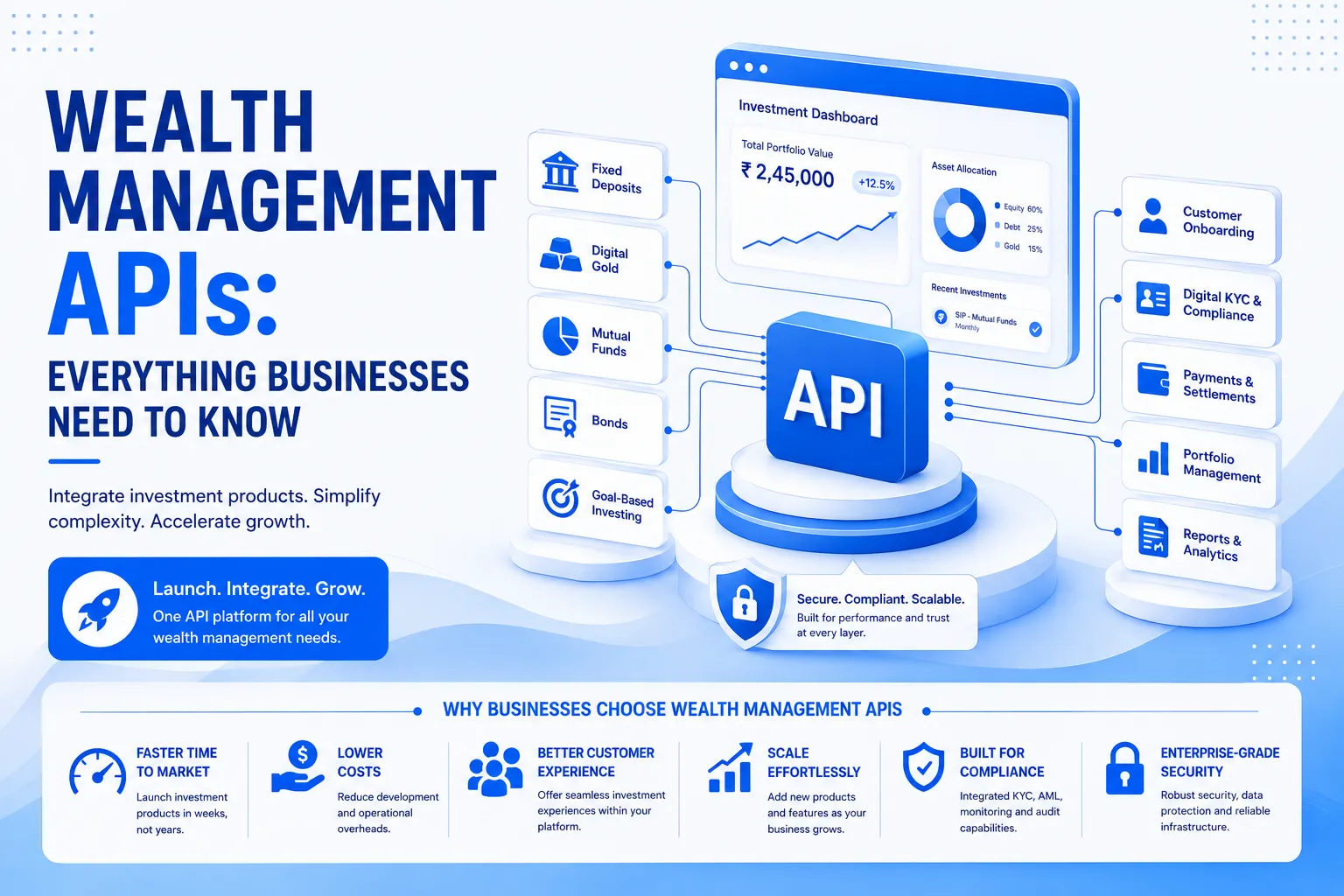
By integrating a single API platform, businesses can provide customers with investment opportunities such as Fixed Deposits, Digital Gold, Mutual Funds, and Bonds—all within their existing digital experience.
This guide explains what wealth management APIs are, how they work, and why they are becoming the foundation of modern embedded finance.
What Are Wealth Management APIs?
A wealth management API is a set of application programming interfaces that allows businesses to integrate investment products and wealth-building services into their websites, mobile apps, or digital platforms.
Instead of building proprietary investment systems, businesses connect to APIs that manage the backend infrastructure.
These APIs enable features such as:
- Investment product integration
- Customer onboarding
- Digital KYC
- Portfolio management
- Payment processing
- Transaction reporting
- Compliance workflows
- Notifications and alerts
As a result, businesses can deliver investment experiences while relying on secure infrastructure providers to handle much of the operational complexity.
Why Businesses Are Using Wealth Management APIs
Digital businesses increasingly recognize that investment products improve customer engagement and create new revenue opportunities.
However, building financial infrastructure independently presents several challenges:
- Long development cycles
- Regulatory complexity
- Banking partnerships
- Compliance management
- Operational overhead
- Security requirements
Wealth management APIs eliminate many of these barriers by providing ready-to-integrate infrastructure.
This allows businesses to focus on user experience and customer acquisition rather than backend financial systems.
Investment Products Supported by Wealth Management APIs
Modern API platforms support multiple investment products.
Fixed Deposits
Businesses can integrate Fixed Deposits that allow customers to earn predictable returns over flexible investment tenures.
FD APIs typically support:
- Investment creation
- Interest calculations
- Maturity tracking
- Portfolio updates
Digital Gold
Digital Gold APIs allow customers to purchase, sell, and hold gold digitally.
Capabilities often include:
- Fractional purchases
- Live pricing
- Secure storage
- Redemption
- Portfolio visibility
Mutual Funds
Mutual Fund APIs simplify access to professionally managed investment portfolios.
Businesses can offer:
- SIP creation
- One-time investments
- Fund discovery
- Portfolio tracking
- Performance reporting
Bonds
Bond APIs allow businesses to provide fixed-income investment opportunities while helping customers diversify portfolios.
Common features include:
- Bond listings
- Investment execution
- Interest tracking
- Maturity management
Goal-Based Investing
Many API platforms support investment journeys organized around customer goals such as:
- Retirement
- Education
- Home ownership
- Emergency funds
- Vacation savings
Goal-based investing improves personalization while encouraging long-term engagement.
Core Components of Wealth Management APIs
A complete wealth management API platform typically consists of several services.
Customer Onboarding API
Supports:
- Registration
- Profile creation
- Consent management
- Customer verification
Fast onboarding improves conversion rates while reducing operational friction.
Digital KYC API
Digital KYC APIs simplify customer identity verification and regulatory compliance.
Typical capabilities include:
- Identity verification
- Document validation
- AML checks
- Customer screening
Investment API
This is the core API responsible for investment execution.
Functions include:
- Product discovery
- Investment creation
- Portfolio updates
- Order confirmation
- Transaction history
Portfolio API
Portfolio APIs provide customers with complete visibility into investments.
Users can:
- View holdings
- Track returns
- Monitor asset allocation
- Review historical performance
Real-time portfolio tracking significantly improves customer engagement.
Payment API
Investment journeys require seamless movement of funds.
Payment APIs manage:
- Deposits
- Withdrawals
- Recurring investments
- SIP collections
- Refunds
Secure payment infrastructure is essential for delivering frictionless investment experiences.
Reporting API
Businesses require analytics to monitor operations.
Reporting APIs provide:
- Customer activity
- Investment reports
- Compliance documentation
- Transaction summaries
- Operational insights
Benefits of Wealth Management APIs
Businesses adopting API-driven investment infrastructure gain several advantages.
Faster Time to Market
Launch wealth management products in weeks instead of years.
Lower Development Costs
Avoid building financial systems from scratch.
Better Customer Experience
Deliver seamless investment journeys within existing applications.
Easier Scalability
Add new investment products without redesigning infrastructure.
Improved Security
Leverage enterprise-grade infrastructure built specifically for financial services.
Regulatory Support
Simplify compliance with integrated KYC, reporting, and security workflows.
Industries Using Wealth Management APIs
Wealth management APIs are no longer limited to banks.
Organizations across industries are adopting embedded investment solutions.
Fintech Companies
Expand beyond payments into long-term investing.
Digital Banks
Offer diversified wealth management products.
Insurance Companies
Combine protection with wealth-building services.
Payroll Platforms
Enable salary-linked investment experiences.
Employee Benefits Platforms
Support financial wellness initiatives.
Consumer Apps
Increase engagement through embedded financial products.
Choosing the Right Wealth Management API Platform
Not all API providers offer the same capabilities.
Businesses should evaluate providers based on:
Product Coverage
Can the platform support Fixed Deposits, Digital Gold, Mutual Funds, Bonds, and future investment products?
Scalability
Will the infrastructure support future business growth?
Security
Does the provider offer enterprise-grade security, encryption, and access controls?
Compliance
Are KYC, AML, reporting, and regulatory workflows included?
Developer Experience
Comprehensive documentation, SDKs, testing environments, and technical support reduce integration time.
Reliability
High availability and performance are essential for financial applications.
How Finspring Simplifies Wealth Management APIs
Building wealth management infrastructure internally is expensive, time-consuming, and operationally complex.
Finspring provides API-driven financial infrastructure that enables businesses to integrate multiple investment products through a single platform.
Using Finspring’s APIs, businesses can launch:
- Fixed Deposits
- Digital Gold
- Mutual Funds
- Bonds
- Additional embedded investment solutions
Instead of managing backend infrastructure, organizations can focus on building exceptional customer experiences while accelerating product launches.
The Future of Wealth Management APIs
As embedded finance continues to transform digital businesses, wealth management APIs will become increasingly important.
Customers expect investment products to be available wherever they already manage their finances.
Businesses that adopt API-driven wealth management can increase engagement, improve customer retention, diversify revenue streams, and create stronger competitive advantages.
Rather than building financial infrastructure from scratch, organizations can leverage modern APIs to launch secure, scalable, and compliant investment products that meet evolving customer expectations.
Frequently Asked Questions (FAQs)
What is a wealth management API?
A wealth management API enables businesses to integrate investment products such as Fixed Deposits, Digital Gold, Mutual Funds, and Bonds into digital platforms without building financial infrastructure from scratch.
Which products can be offered through wealth management APIs?
Businesses can offer Fixed Deposits, Digital Gold, Mutual Funds, Bonds, recurring investment plans, portfolio management, and goal-based investing using API-driven infrastructure.
Why are wealth management APIs important?
They reduce development time, simplify integration, improve scalability, support compliance, and allow businesses to launch investment products much faster.
Which industries use wealth management APIs?
Fintech companies, digital banks, insurance providers, payroll platforms, employee benefits platforms, and consumer applications commonly use wealth management APIs.
How does Finspring help businesses launch wealth management products?
Finspring provides API-driven infrastructure that enables businesses to integrate investment products such as Fixed Deposits, Digital Gold, Mutual Funds, and Bonds through a single, scalable API platform, helping organizations launch wealth management services faster and more efficiently.