The demand for embedded wealth management is growing rapidly. Fintech companies, digital banks, insurance providers, payroll platforms, employee benefits solutions, and consumer apps are all looking to integrate investment products into their digital experiences. However, launching wealth management products isn’t just about choosing what to offer—it’s about selecting the right technology partner.
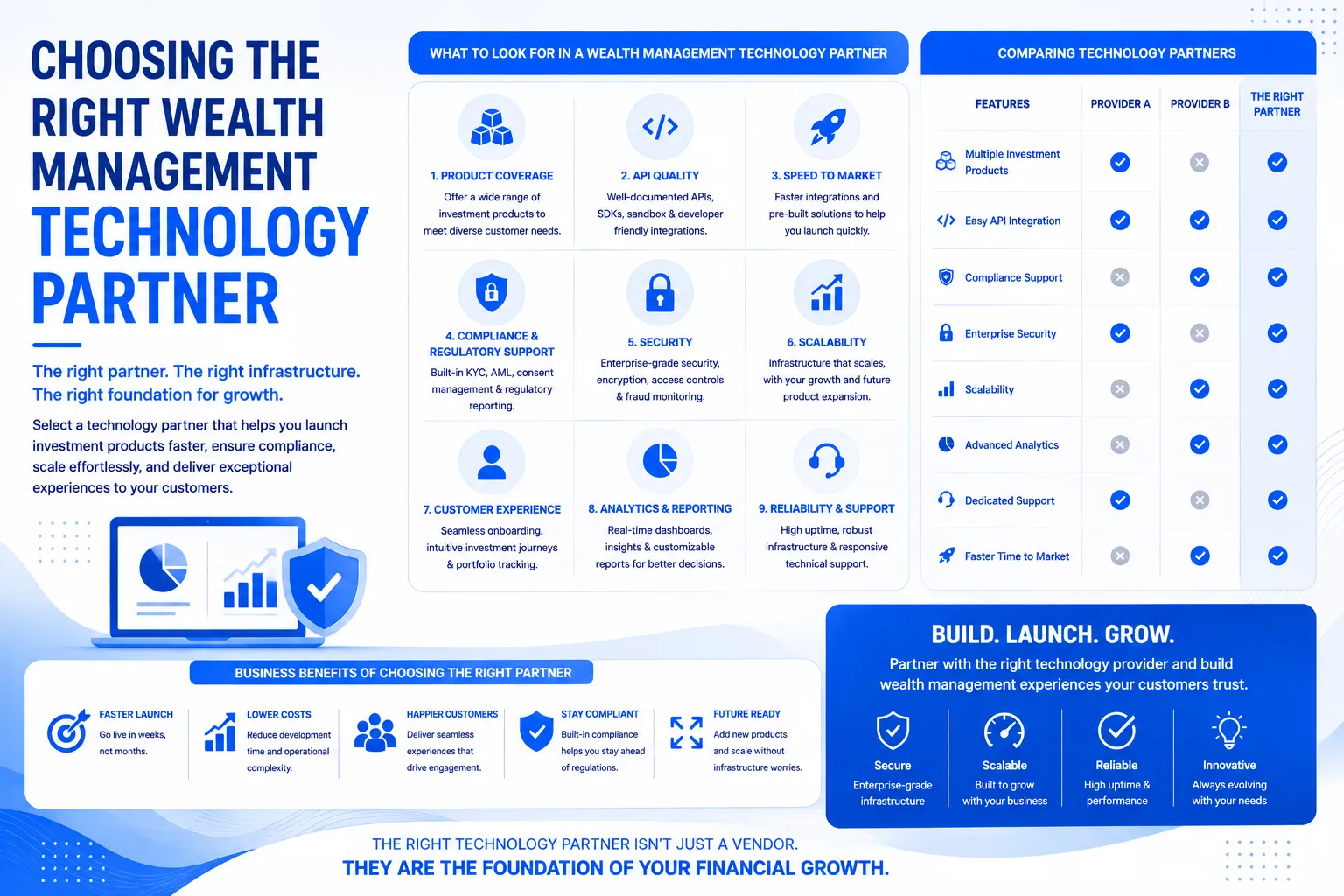
Your technology partner determines how quickly you can launch, how easily you can scale, how secure your platform remains, and how smoothly your customers experience investing.
Choosing the wrong provider can lead to long development cycles, operational complexity, limited scalability, and poor customer experiences. The right partner, on the other hand, allows you to launch investment products efficiently while focusing on growing your business.
This guide explores the factors businesses should evaluate when selecting a wealth management platform provider.
Why Your Technology Partner Matters
Building financial infrastructure from scratch is a complex undertaking.
Businesses must manage:
- Product integrations
- Banking partnerships
- Regulatory compliance
- Digital onboarding
- Payment infrastructure
- Portfolio management
- Security
- Reporting
Rather than building each component independently, many organizations partner with API-driven infrastructure providers that offer these capabilities through a single platform.
A strong technology partner reduces operational complexity while accelerating product launches.
What Is a Wealth Management Technology Partner?
A wealth management technology partner provides the infrastructure businesses need to launch investment products digitally.
Instead of developing financial systems internally, businesses integrate APIs that support wealth management operations.
Typical capabilities include:
- Investment product APIs
- Digital KYC
- Customer onboarding
- Payment infrastructure
- Portfolio management
- Reporting
- Compliance support
- Security
- Analytics
This allows businesses to focus on customer experience while the infrastructure provider manages backend operations.
Key Factors to Evaluate
Not every wealth management platform provider offers the same capabilities.
Here are the most important criteria to consider.
1. Product Coverage
One of the first questions to ask is:
Which investment products does the platform support?
A comprehensive provider should enable businesses to launch multiple products through a single integration.
Examples include:
- Fixed Deposits
- Digital Gold
- Mutual Funds
- Bonds
- Goal-based investing
- Future embedded investment products
Choosing a provider with broad product coverage allows businesses to expand without switching infrastructure later.
2. API Quality
The API experience directly affects development speed.
Evaluate:
- RESTful APIs
- Documentation quality
- SDK availability
- Sandbox environments
- Sample code
- Error handling
- API versioning
Developer-friendly APIs reduce integration effort while improving implementation quality.
3. Speed to Market
Launching investment products quickly creates competitive advantages.
Ask providers:
- How long does implementation typically take?
- What onboarding support is available?
- Are integrations pre-built?
- Is technical assistance included?
The faster your platform goes live, the sooner you begin delivering value to customers.
4. Compliance and Regulatory Support
Financial services require strict regulatory compliance.
Look for providers offering:
- Digital KYC
- AML workflows
- Identity verification
- Audit trails
- Consent management
- Regulatory reporting
Built-in compliance reduces operational overhead while helping businesses remain aligned with applicable regulations.
5. Security
Customer trust depends on strong security.
Essential security capabilities include:
- Data encryption
- Secure API gateways
- Multi-factor authentication
- Access controls
- Fraud monitoring
- Continuous security monitoring
Enterprise-grade security protects both customer information and business operations.
6. Scalability
Your business will evolve.
Choose infrastructure that supports future growth.
Ask questions like:
- Can new products be added later?
- Does the platform support higher transaction volumes?
- Can APIs handle increased customer activity?
- Is the architecture cloud-native?
Scalable infrastructure prevents expensive migrations as your business expands.
7. Customer Experience
Technology should enhance—not complicate—the customer journey.
Evaluate whether the provider supports:
- Fast onboarding
- Seamless investment journeys
- Mobile-first experiences
- Portfolio tracking
- Notifications
- Goal-based investing
The smoother the customer experience, the higher the adoption rates.
8. Reporting and Analytics
Operational visibility is essential for growth.
A strong platform should provide:
- Investment reports
- Customer insights
- Product performance
- Portfolio analytics
- Operational dashboards
- Compliance reporting
Analytics help businesses make better strategic decisions.
9. Reliability and Performance
Investment platforms must operate consistently.
Look for providers offering:
- High uptime
- Fast API response times
- Infrastructure redundancy
- Disaster recovery
- Monitoring systems
Reliable infrastructure ensures uninterrupted customer experiences.
Questions to Ask Before Choosing a Partner
Before making a decision, consider asking:
- Which investment products are supported?
- How long does integration take?
- What compliance features are included?
- How scalable is the infrastructure?
- What security certifications are available?
- Is developer documentation comprehensive?
- What support is available during implementation?
- Can additional products be added later?
Clear answers help reduce implementation risks.
Common Mistakes Businesses Make
When selecting a provider, businesses often focus only on immediate requirements.
Common mistakes include:
Choosing Based Only on Price
Lower costs may lead to limited functionality or higher long-term operational expenses.
Ignoring Scalability
Businesses frequently underestimate future product expansion.
Selecting flexible infrastructure avoids expensive migrations.
Overlooking Developer Experience
Poor documentation slows integration and increases engineering effort.
Underestimating Compliance
Compliance should be built into the platform—not added later.
Selecting Single-Product Platforms
Choosing providers that only support one investment product limits future growth.
A unified platform provides greater flexibility.
Why API-Driven Infrastructure Is Becoming the Standard
Modern businesses increasingly prefer API-first platforms because they offer:
- Faster implementation
- Lower operational complexity
- Better scalability
- Improved customer experiences
- Easier maintenance
- Continuous product innovation
Rather than managing financial infrastructure internally, businesses can focus on customer acquisition, product strategy, and growth.
Why Businesses Choose Finspring
Businesses looking to launch wealth management products need infrastructure that is secure, scalable, and easy to integrate.
Finspring provides API-driven financial infrastructure that enables organizations to launch investment products through a single integration.
With Finspring, businesses can offer:
- Fixed Deposits
- Digital Gold
- Mutual Funds
- Bonds
- Additional embedded investment products
The platform simplifies integration while helping businesses reduce development time, improve scalability, and deliver modern investment experiences without building financial infrastructure from scratch.
The Right Partner Accelerates Growth
Choosing a wealth management technology partner is one of the most important decisions a business can make when entering embedded finance.
The ideal provider should offer more than APIs—it should provide the infrastructure, security, compliance, scalability, and product flexibility needed to support long-term growth.
Businesses that choose a scalable, API-driven platform today will be better positioned to launch investment products quickly, respond to evolving customer expectations, and expand into new financial services over time.
As embedded wealth management continues to grow, selecting the right technology partner will become a key competitive advantage.
Frequently Asked Questions (FAQs)
What is a wealth management technology partner?
A wealth management technology partner provides the backend infrastructure, APIs, compliance capabilities, and operational systems required to help businesses launch investment products digitally.
What should businesses look for in a wealth management platform provider?
Key factors include product coverage, API quality, scalability, compliance support, security, reporting, developer experience, reliability, and customer onboarding capabilities.
Why are API-driven wealth management platforms important?
They simplify integration, reduce development time, support regulatory compliance, and enable businesses to launch investment products without building financial infrastructure internally.
Which investment products should a technology platform support?
A comprehensive platform should support Fixed Deposits, Digital Gold, Mutual Funds, Bonds, and the flexibility to add future embedded investment products.
How does Finspring help businesses launch wealth management products?
Finspring provides API-driven financial infrastructure that enables businesses to integrate products such as Fixed Deposits, Digital Gold, Mutual Funds, and Bonds through a single platform, helping them launch faster while reducing operational complexity and supporting long-term scalability.