Short answer: Yes — and in most modern digital finance models, that’s exactly how it’s done.
But the real question isn’t whether you can.
It’s how much control, compliance ownership, and revenue leverage you retain while doing it.
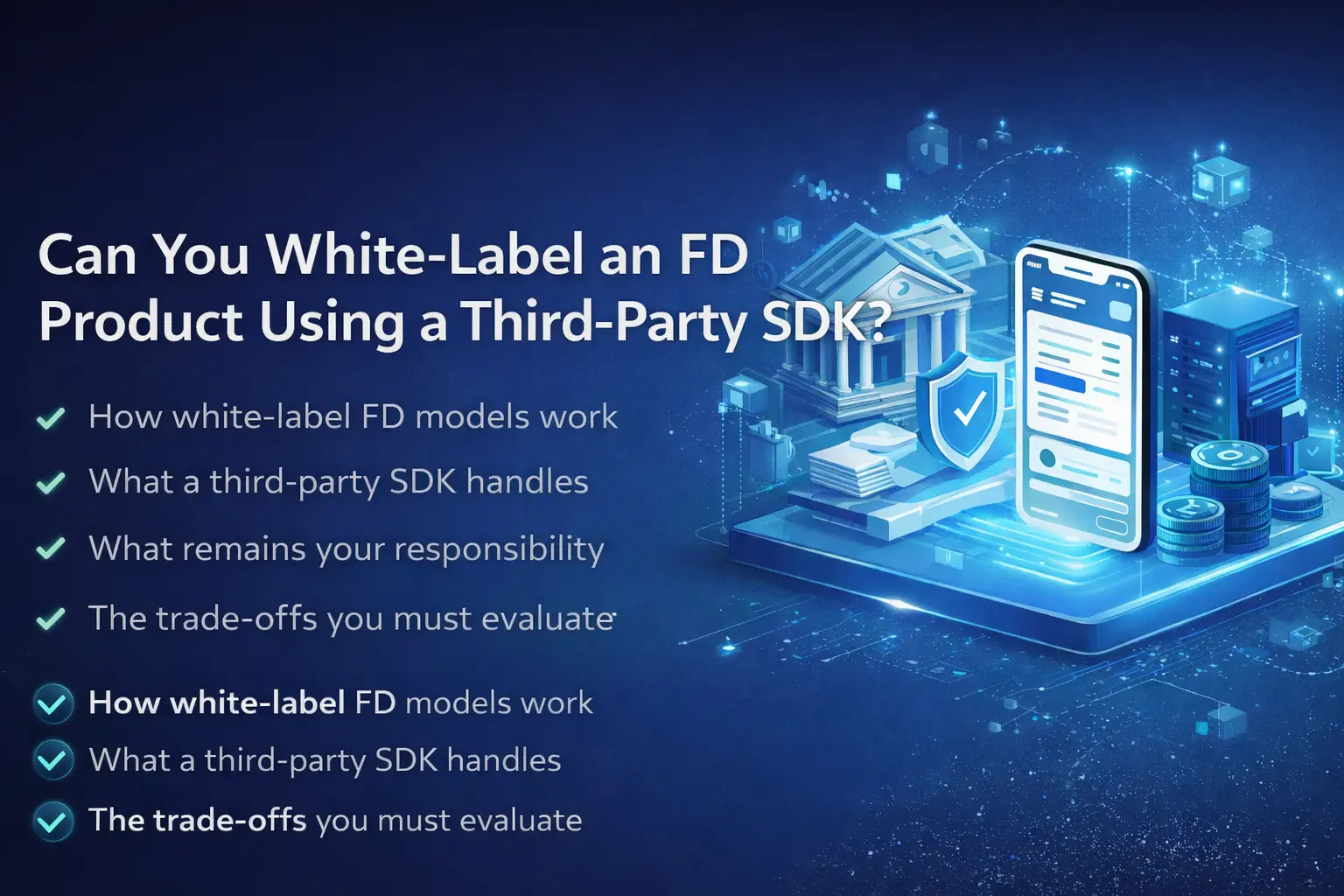
If you’re a bank, NBFC, fintech, wealth platform, or super app evaluating Fixed Deposit (FD) infrastructure, this guide explains:
- How white-label FD models work
- What a third-party SDK actually handles
- What remains your responsibility
- The trade-offs you must evaluate
Let’s break it down properly.
What Does “White-Label FD” Actually Mean?
A white-label FD product means:
- The FD is issued by a regulated bank/NBFC
- The infrastructure may be powered by a third-party SDK
- The customer sees your brand, not the infrastructure provider
From the customer’s perspective:
It looks like your FD product.
Behind the scenes:
APIs, compliance logic, booking systems, and reporting may be powered externally.
What Is a Third-Party FD SDK?
An FD SDK (Software Development Kit) is a pre-built infrastructure layer that provides:
- FD rate configuration
- Booking APIs
- KYC & AML orchestration
- Payment integrations
- Certificate generation
- Reconciliation & reporting
Instead of building everything from scratch or deeply integrating into core banking systems like:
- Finacle
- TCS BaNCS
- Flexcube
- You integrate via standardized APIs.
That dramatically reduces deployment time.
How White-Label + SDK Model Works
Let’s map the structure.
Layer 1: Issuer Layer
- Regulated bank or NBFC
- Holds deposits
- Manages compliance & balance sheet
Layer 2: Infrastructure Layer (SDK Provider)
- Provides APIs
- Handles orchestration
- Ensures compliance workflows
- Generates FD accounts
Layer 3: Distribution Layer (You)
- Own the customer interface
- Control branding
- Manage acquisition
- Own user experience
Customers interact with your app or website, but the deposit sits with the issuing institution.
What Can Be Fully White-Labeled?
Most modern FD SDK providers allow branding customization across:
- FD rate display
- Booking interface
- Nominee flow
- Confirmation screens
- Email & SMS templates
- FD certificates (co-branded or fully branded)
Some providers even allow:
- Custom UI embedding
- Native mobile SDK integration
- White-labeled web modules
To customers, it feels like your proprietary product.
What You Still Don’t Control
Here’s where founders must think strategically.
When using a third-party SDK:
You typically do NOT control:
- Core deposit ledger
- Interest computation engine
- Regulatory reporting backend
- Settlement banking rails
- Risk categorization rules (fully)
You rely on the infrastructure provider’s robustness.
This is the main trade-off.
Regulatory Responsibility in White-Label FD
This is critical.
Even if infrastructure is third-party:
- The issuing bank/NBFC carries regulatory responsibility
- You may carry distribution responsibility
- KYC and AML flows must align with RBI guidelines
White-label does NOT mean regulatory outsourcing.
Your agreements must clearly define:
- Data ownership
- Customer grievance redressal
- Liability in case of disputes
- Audit access
This is where legal clarity matters.
Revenue Model in White-Label FD Setup
Common monetization structures include:
1. Revenue Share Model
You earn commission per FD booking.
2. Spread-Based Model
Margin between issuer rate and customer rate.
3. Fixed Fee Per Account
Flat payout for every deposit booked.
4. Platform Fee Model
Infrastructure provider charges you per API usage.
Understanding the margin stack is crucial before committing.
Benefits of White-Label + SDK Model
1. Speed to Market
Launch in 2–6 weeks instead of 6–9 months.
2. Lower Engineering Cost
No deep CBS integration required.
3. Scalable Infrastructure
Handles spikes during festive campaigns.
4. Reduced Compliance Friction
Pre-built KYC, CKYC, AML logic.
5. Focus on Distribution
You concentrate on growth, not plumbing.
For digital-first platforms, this is often ideal.
Risks to Evaluate Before Choosing This Model
Let’s be strategic.
1. Vendor Lock-In
Switching providers later can be complex.
2. Limited Customization
Interest slab experimentation may be restricted.
3. Dependency Risk
Downtime or API failure affects your brand.
4. Margin Compression
Revenue share models reduce long-term profit potential.
5. Data Ownership Concerns
Ensure customer data portability.
White-label works best when agreements are clear and infrastructure is stable.
Who Should Use White-Label FD SDK?
Ideal for:
- Fintech platforms adding fixed-income products
- Wealth apps expanding into deposits
- Super apps monetizing idle balances
- NBFCs launching digital FDs quickly
- Neo-banks without deposit license
Not ideal if:
- You want deep core banking customization
- You plan to build proprietary FD ledger infra
- You need complex treasury-level configurations
Deployment Timeline in White-Label Model
| Stage | Typical Duration |
|---|---|
| Agreement & Compliance Setup | 1–2 weeks |
| API/SDK Integration | 1–3 weeks |
| Branding Customization | 1–2 weeks |
| UAT & Go-Live | 1–2 weeks |
Total: 2–8 weeks
Compare that with traditional CBS build: 4–9 months.
Strategic Question: Build or Orchestrate?
This is not just a technical decision.
It’s a business architecture decision.
Ask yourself:
- Is FD core to my balance sheet strategy?
- Or is FD a distribution-led product?
- Do I want infrastructure ownership?
- Or capital-light scalability?
White-label + SDK is essentially an orchestration model.
You own the experience.
The issuer owns the balance sheet.
The SDK provider owns the plumbing.
The Future: Embedded Finance & Modular Banking
Digital finance is moving toward modular infrastructure.
Instead of owning everything, platforms orchestrate:
- Lending APIs
- Insurance APIs
- FD APIs
- Wealth APIs
White-label FD is part of this larger embedded finance shift.
Speed and distribution advantage often outweigh infrastructure ownership.
Final Answer
Yes, you can absolutely white-label an FD product while using a third-party SDK.
In fact, this is now one of the most efficient ways to:
- Launch quickly
- Stay compliant
- Minimize engineering overhead
- Scale deposit distribution
However, success depends on:
- Clear regulatory alignment
- Strong SLA agreements
- Transparent revenue structures
- Reliable API performance
- Defined data ownership
White-labeling an FD is not about outsourcing responsibility.
It’s about strategically choosing where to build — and where to leverage.
And in modern digital finance, leverage often wins.