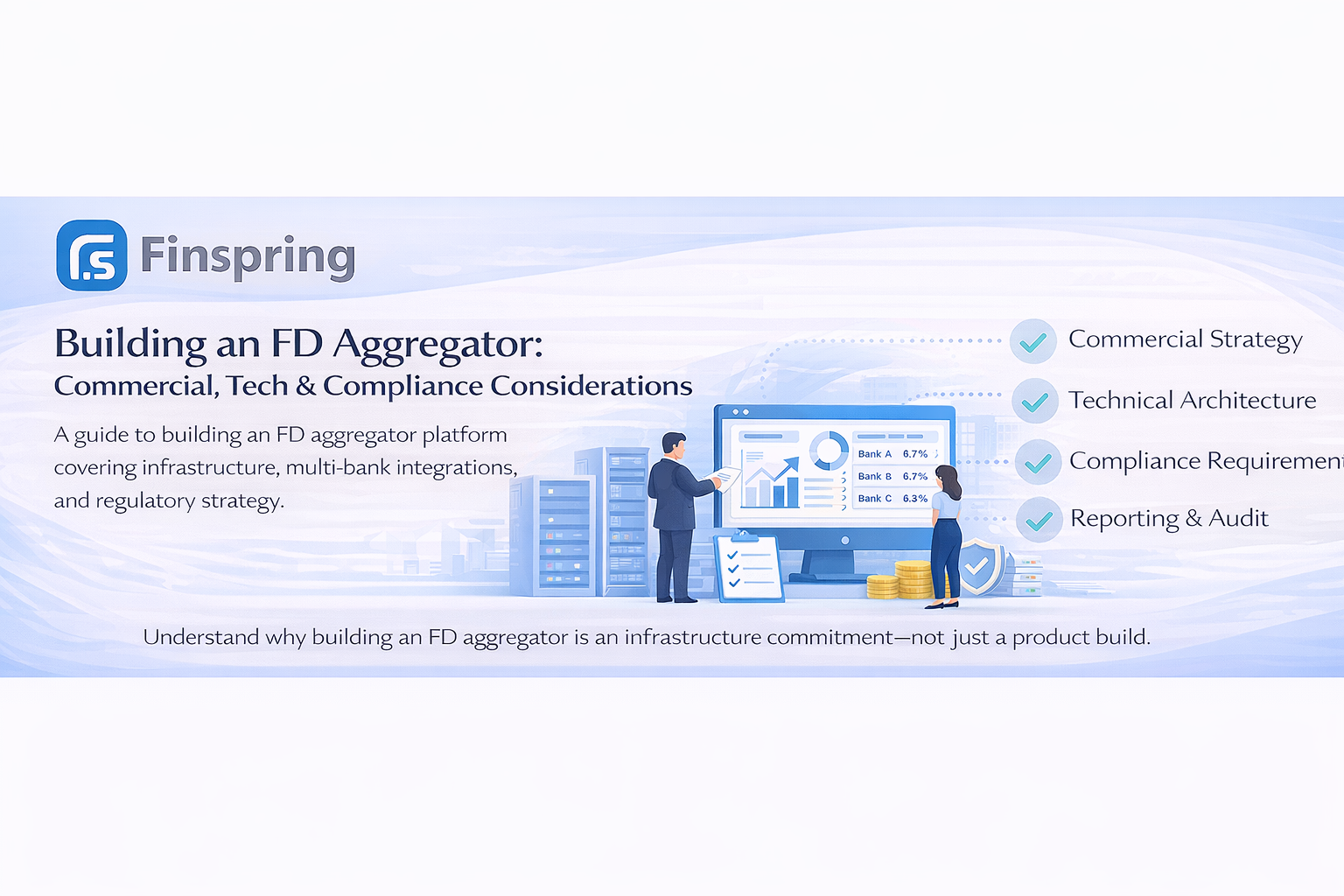
Fixed Deposit (FD) aggregation has emerged as a powerful distribution and infrastructure layer in the digital financial ecosystem. For fintechs and platforms, building an FD aggregator can unlock scale, diversification, and recurring revenue. For banks and NBFCs, it offers structured digital distribution without losing regulatory control.
However, building an FD aggregator is not simply a product or UI exercise.
It is an infrastructure decision—with deep commercial, technical, and compliance implications.
This article breaks down what it actually takes to build an FD aggregator, and where teams often underestimate complexity.
1. The Commercial Layer: More Than Commissions
Most teams start with a simple commercial assumption:
“We’ll earn a commission per FD booking.”
In reality, the commercial model is more nuanced.
Key Commercial Considerations
a. Revenue Structure
- Commission-based revenue (per booking or AUM-linked)
- Platform or access fees (for B2B distribution)
- Hybrid models combining both
Each model has different implications for:
- Cash flow predictability
- Partner incentives
-
Long-term scalability
b. Bank Participation Economics
Banks evaluate aggregators on:
- Cost of funds impact
- Incrementality of deposits
-
Operational efficiency gains
An aggregator must clearly demonstrate that it is not merely shifting deposits from one channel to another.
c. Scale vs Margin Trade-offs
Early-stage aggregators often over-optimize for margin.
At scale, volume consistency and partner retention matter more than per-transaction margins.
Commercial success depends on alignment, not extraction.
2. The Tech Layer: Where Complexity Actually Lives
Technology is often assumed to be the hardest part—but most complexity does not sit in the UI.
It sits in orchestration.
Core Technical Building Blocks
a. Multi-Bank Integration
Each bank has:
- Different core systems
- Different API maturity
- Different data formats
Building point-to-point integrations does not scale.
Successful aggregators design:
- A normalized internal data model
- Bank-specific adapters at the edge
- A stable internal contract that does not change per partner
b. Workflow Orchestration
FD journeys include:
- Discovery
- Eligibility
- Booking
- Payment
- Confirmation
-
Post-booking servicing
These steps vary subtly across banks.
The aggregator’s job is not to hide differences—but to absorb them at the system level, not push them to users or agents.
c. State Management
FDs are long-lived products.
The system must handle:
- Pending states
- Partial failures
- Delayed confirmations
- Renewals and maturities
This requires careful state design, not just APIs.
3. Compliance Layer: The Non-Negotiable Foundation
Compliance is not a feature you add later.
In FD aggregation, it is the foundation.
Core Compliance Responsibilities
a. Clear Role Definition
Regulators care deeply about:
- Who is the issuer (the bank)
- Who is the distributor (the aggregator)
-
Who owns the customer relationship
These roles must be explicit in:
- Contracts
- System flows
-
Customer communication
Ambiguity creates regulatory risk.
b. KYC & AML Alignment
While banks retain ultimate responsibility, aggregators often:
- Facilitate onboarding
- Collect documents
-
Initiate checks
This requires:
- Bank-approved workflows
- Consistent execution
-
Clear audit trails
Any deviation across partners becomes a compliance liability.
c. Data Governance
Aggregators must answer:
- Where does customer data reside?
- Who can access it?
-
How is it logged and audited?
Being “just a platform” does not exempt you from data accountability.
4. Reporting & Audit: Often Underestimated
One of the fastest ways to lose bank trust is poor reporting.
Banks require:
- Transaction-level visibility
- Reconciliation-ready data
-
Regulator-aligned formats
An aggregator must build:
- Centralized reporting pipelines
- Bank-specific reporting outputs
-
Immutable logs for audits
This is not glamorous work—but it is decisive for long-term partnerships.
5. Operational Design: Humans Still Exist
Even the best systems require operations.
Key questions:
- How are exceptions handled?
- Who resolves failed transactions?
-
How are customer escalations routed?
Early aggregators often rely on manual workarounds.
At scale, this becomes unmanageable.
Operational processes must be:
- Clearly defined
- Tool-supported
-
Exception-focused, not transaction-focused
6. Trust Is the Real Product
FD aggregation sits at the intersection of:
- Customer money
- Bank balance sheets
-
Regulatory oversight
Trust is built through:
- Predictable behaviour
- Transparent communication
- Consistent compliance
-
Stable systems
A single failure may not kill an aggregator.
Repeated inconsistency will.
7. Build vs Partner: A Strategic Choice
Many teams underestimate the cost and time of building everything in-house.
Key trade-offs include:
-
Speed to market vs control
-
Capital expenditure vs operating leverage
-
Maintenance burden vs focus
Some platforms choose to:
-
Build a thin layer
-
Partner for deeper infrastructure
-
Retain ownership of experience and distribution
This hybrid approach is increasingly common.
8. Scaling Beyond FDs: Design Early or Pay Later
FD aggregation rarely stays limited to FDs.
Natural extensions include:
-
Recurring Deposits
-
Bonds
-
Mutual Funds
If the system is not designed with multi-asset expansion in mind:
-
Each new product becomes a rewrite
-
Compliance complexity multiplies
-
Reporting fragments
The cost of redesign later is far higher than designing modularly upfront.
9. Common Pitfalls to Avoid
-
Treating FD aggregation as a UI problem
-
Underestimating reporting and audits
-
Over-customizing for early partners
-
Blurring issuer and distributor roles
-
Ignoring treasury and compliance stakeholders
Most failures are structural, not market-driven.
Closing Thoughts
Building an FD aggregator is not about launching faster.
It is about designing responsibly.
The platforms that succeed are those that:
-
Respect regulatory boundaries
-
Invest early in infrastructure
-
Align commercial incentives
-
Design for scale, not demos
In a regulated financial ecosystem, aggregation is not a shortcut.
It is an architectural commitment.
Read how banks measure FD Aggregator ROI, here.