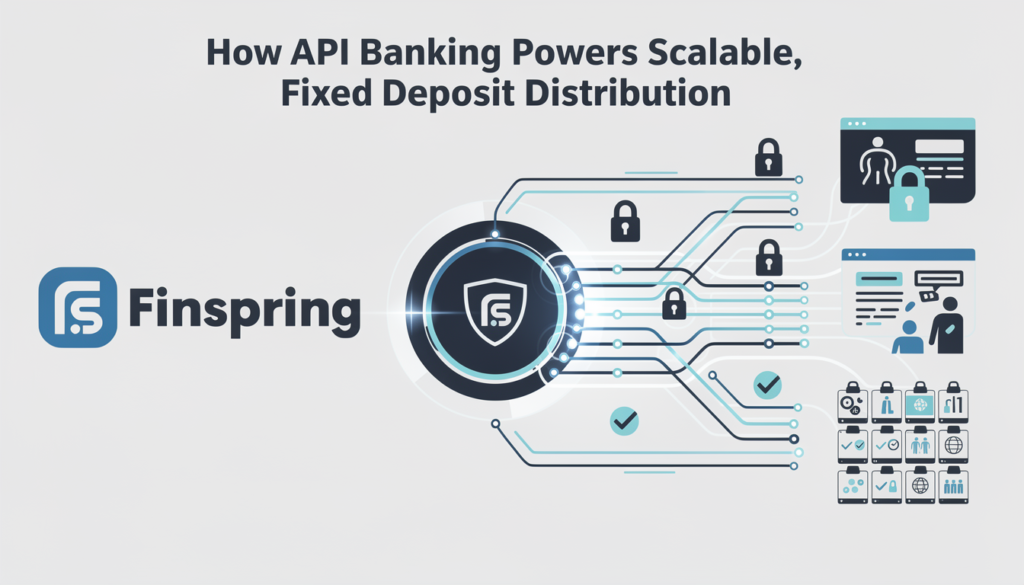
How API Banking Powers Scalable, Secure Fixed Deposit Distribution
FD aggregator platforms have emerged as a critical distribution layer between banks, agents, and customers. While the user-facing experience often looks simple, the real engine behind this scalability is invisible.
That engine is API banking.
APIs enable FD aggregator platforms to connect with multiple banks, standardize workflows, surface real-time fixed deposit data, and execute transactions securely at scale. Without APIs, aggregator-led distribution would not be operationally viable.
This article explains the role APIs play in FD aggregator platforms, why they matter for banks and agents, and how they enable faster, more reliable fixed deposit distribution.
What Is API Banking in the Context of FD Aggregators?
API banking refers to the use of secure, programmatic interfaces that allow systems to communicate with each other in real time.
In FD aggregation, APIs connect:
- Bank core systems
- FD product engines
- KYC and verification services
- Agent and partner platforms
Instead of manual uploads or file-based integrations, APIs allow data and actions to move instantly between systems.
Why FD Aggregator Platforms Are API-First by Design
FD aggregators operate in a multi-bank environment. Each bank has:
- Different core systems
- Different fixed deposit configurations
- Different compliance requirements
APIs act as the translation layer that normalizes these differences into a single, consistent workflow.
Without APIs:
- Integrations would be slow
- Updates would be manual
- Scale would be limited
With APIs:
- Everything becomes real time
- Systems remain decoupled
- Growth is linear, not operationally exponential
Core API Functions in FD Aggregator Platforms
1. Fixed Deposit Product and Rate APIs
One of the most critical API functions is fetching live product data.
APIs allow aggregator platforms to:
- Pull fixed deposit rates in real time
- Display tenure-wise options
- Reflect minimum and maximum deposit limits
- Update changes instantly across channels
| Without APIs | With APIs |
|---|---|
| Manual rate updates | Real-time rate sync |
| Risk of outdated data | Always current |
| Delayed campaigns | Instant launches |
This is essential in a market where fixed deposit rates change frequently.
2. Customer and Agent Onboarding APIs
Onboarding is often the biggest friction point in deposit distribution.
APIs integrate:
- KYC verification services
- Identity checks
- Document validation
- Bank account verification
This allows FD aggregators to offer:
- Digital onboarding
- Faster approvals
- Lower rejection rates
For agents, this means more customers onboarded per day. For banks, it means cleaner, compliant data intake.
3. FD Booking and Transaction APIs
Once a customer selects a fixed deposit, APIs handle:
- Application submission
- Validation against bank rules
- Deposit booking confirmation
- Acknowledgement and receipt generation
This removes the need for:
- Manual uploads
- Email-based coordination
- Branch intervention
| Step | API Role |
|---|---|
| Application submission | Secure data push |
| Validation | Rule-based checks |
| Booking | Real-time execution |
| Confirmation | Instant response |
How APIs Enable Single-Platform Multi-Bank Access
From an agent’s perspective, an FD aggregator feels like one platform.
Under the hood, APIs are:
- Routing requests to different banks
- Handling different response formats
- Managing retries and failures
- Ensuring transaction integrity
This abstraction is what allows agents to access multiple banks without learning multiple systems.
APIs and Compliance Control
A common concern with aggregator platforms is governance.
APIs help banks maintain control by enabling:
- Pre-defined validation rules
- Mandatory disclosures
- Audit logs
- Role-based access
Every API call can be:
- Logged
- Time-stamped
- Traced back to a user or agent
This makes aggregator-led distribution auditable and regulator-friendly.
Reporting and Analytics Through APIs
Beyond transactions, APIs also power reporting.
Aggregator platforms use APIs to:
- Pull transaction status
- Track conversions
- Monitor drop-offs
- Generate performance dashboards
| Reporting Dimension | API Contribution |
|---|---|
| Application funnel | Status APIs |
| Rate performance | Product APIs |
| Agent productivity | Activity APIs |
| Revenue tracking | Settlement APIs |
This data is critical for banks optimizing fixed deposit distribution strategies.
Why APIs Improve Speed to Market
Launching a new fixed deposit product traditionally requires:
- Frontend changes
- Manual coordination
- Long testing cycles
With APIs:
- Products can be configured centrally
- Updates propagate instantly
- Campaigns go live faster
This agility allows banks to respond quickly to market changes in fixed deposit rates without operational delays.
Scalability Without Operational Complexity
APIs allow FD aggregators to scale in three directions simultaneously:
- More banks
- More agents
- More customers
And they do so without:
- Proportional increases in support staff
- Manual reconciliation
- Custom integrations for each new partner
This is why aggregator platforms can grow rapidly while maintaining stability.
Security and Reliability of API-Led FD Platforms
Modern API banking follows strict security standards:
- Encrypted data transmission
- Token-based authentication
- Rate limiting
- Monitoring and alerts
For FD aggregators, this ensures:
- Customer data protection
- Transaction integrity
- Platform reliability at scale
Security is not a feature add-on. It is built into the API layer.
What Banks Should Look for in API-Driven FD Aggregators
Banks evaluating aggregator platforms should assess:
- API coverage across the FD lifecycle
- Real-time rate and product sync
- Compliance-ready validation layers
- Robust error handling and retries
- Scalable architecture
Strong API design is a predictor of long-term platform viability.
How Finspring Uses APIs to Power FD Aggregation
Finspring.ai is built as an API-first FD aggregation platform.
Its architecture enables:
- Seamless integration with bank systems
- Real-time fixed deposit product and rate updates
- Secure onboarding and booking workflows
- Transparent reporting and analytics
By using APIs as core infrastructure, Finspring allows banks to scale fixed deposit distribution without compromising control or reliability.
The Bigger Picture
FD aggregation is not just a distribution shift. It is an infrastructure shift.
At the center of this shift is API banking, enabling:
- Faster execution
- Better visibility
- Lower operational risk
- Scalable growth
As fixed deposits continue to be a core liability product, the platforms distributing them will increasingly be judged by the strength of their API foundations.
Conclusion
APIs are the backbone of FD aggregator platforms. They make multi-bank access possible, ensure real-time fixed deposit data, and enable scalable, compliant distribution.
For banks, agents, and platforms alike, API banking is not optional infrastructure. It is the foundation that allows fixed deposit ecosystems to function at speed and scale.
Read how FD Aggregators help Agents reach more customers faster, here.