Finspring

Fixed Deposit

developer-friendly SDKs across the payment lifecycle
Fixed Deposit

Developer-Friendly API Platforms: Why SDKs Define the Payment Lifecycle

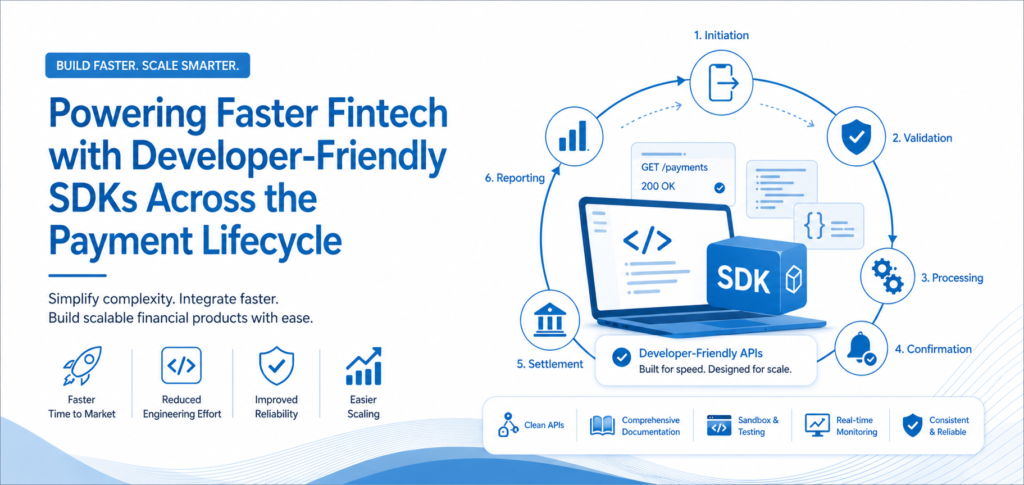
In modern fintech, the difference between a product that launches in weeks and one that takes months often comes down to one thing: developer experience. While features, pricing, and partnerships matter, the real engine behind rapid innovation is the quality of the infrastructure developers build on. This is where developer-friendly API platforms come into play. More specifically, platforms that offer developer-friendly SDKs across the payment lifecycle are becoming the backbone of scalable fintech systems. These platforms don’t just expose APIs—they provide structured, intuitive, and production-ready tools that make integration, execution, and scaling significantly easier. For companies like Finspring, which operate in the FD (Fixed Deposit) and financial infrastructure layer, this becomes even more critical. Because in regulated financial systems, complexity is unavoidable—but it should never reach the developer. What Are Developer-Friendly API Platforms? A developer-friendly API platform is an infrastructure system designed with ease of integration, clarity, and scalability in mind. Instead of requiring developers to navigate complex documentation, fragmented endpoints, and unclear workflows, these platforms provide: Clean, well-structured APIs Comprehensive SDKs Clear documentation and examples Predictable behavior across environments When combined, these elements create an experience where developers can integrate, test, and deploy quickly without unnecessary friction. Why Developer Experience Matters in Fintech Fintech systems are inherently complex. They involve: Multiple integrations (banks, payment networks, compliance systems) Regulatory requirements Real-time transaction handling High reliability expectations Without developer-friendly infrastructure, this complexity translates into: Longer development cycles Higher error rates Increased operational overhead On the other hand, when platforms offer developer-friendly SDKs for the payment lifecycle, they abstract this complexity, allowing teams to focus on building user-facing value rather than backend plumbing. Understanding the Payment Lifecycle To appreciate the importance of SDKs, it’s essential to understand the payment lifecycle—the sequence of events that occur from the moment a user initiates a transaction to its final settlement. Key stages in the payment lifecycle: Initiation – User triggers a transaction Validation – System checks data and compliance requirements Processing – Transaction is executed Confirmation – User receives status update Settlement – Funds are transferred and reconciled Reporting – Data is logged for compliance and analysis Each stage involves multiple systems and potential failure points. Without proper tooling, managing this lifecycle becomes complex and error-prone. The Role of Developer-Friendly SDKs in the Payment Lifecycle Developer-friendly SDKs simplify the entire lifecycle by providing pre-built functions, structured workflows, and reusable components. Instead of manually handling each stage, developers can rely on SDKs to: Standardize interactions Automate validations Handle edge cases Ensure consistency Payment Lifecycle with Developer-Friendly SDKs Stage Without SDKs With Developer-Friendly SDKs Initiation Custom API calls Pre-built functions Validation Manual checks Automated validation Processing Complex logic Simplified workflows Confirmation Custom handling Standardized responses Settlement Manual reconciliation Built-in handling Reporting Separate systems Integrated logging Key Features of Developer-Friendly API Platforms 1. Clear and Structured SDKs SDKs should provide: Pre-defined methods Consistent naming conventions Minimal configuration This reduces the learning curve and speeds up integration. 2. Comprehensive Documentation Good documentation includes: Step-by-step guides Code examples Error handling instructions This ensures developers can move from understanding to implementation quickly. 3. Sandbox and Testing Environments Developers need safe environments to: Test integrations Simulate transactions Debug issues Sandbox environments make this possible without affecting production systems. 4. Real-Time Feedback and Monitoring Developer-friendly platforms provide: Instant API responses Detailed error messages Monitoring dashboards This helps developers identify and fix issues quickly. 5. Consistent API Behavior Predictability is critical. APIs should behave consistently across: Different environments Edge cases High-load scenarios This builds confidence and reduces debugging time. Why Developer-Friendly SDKs Matter for Payments Payments are time-sensitive and high-risk. Even small errors can lead to: Failed transactions Revenue loss User dissatisfaction Developer-friendly SDKs reduce these risks by: Standardizing workflows Automating validations Ensuring reliability This is especially important in high-volume systems, where manual handling is not scalable. Finspring’s Approach to Developer-Friendly Infrastructure Finspring focuses on delivering developer-friendly SDKs across the FD and financial lifecycle, ensuring that platforms can integrate deposit products as easily as they integrate payments. Key capabilities include: Plug-and-play SDKs for quick integration Pre-built FD workflows covering booking, confirmation, and lifecycle events Embedded compliance logic, reducing the need for manual checks Real-time monitoring and SLA tracking, ensuring reliability Unified APIs for multi-bank access, simplifying integrations This allows developers to: Integrate once Launch quickly Scale without rebuilding systems Benefits for Fintech Platforms 1. Faster Time to Market Developer-friendly SDKs reduce integration time, allowing platforms to: Launch products faster Capture market opportunities Stay competitive 2. Reduced Engineering Effort Pre-built workflows eliminate the need for: Custom development Repetitive coding Complex debugging This frees up resources for innovation. 3. Improved Reliability Standardized SDKs ensure: Consistent behavior Fewer errors Better system stability 4. Easier Scaling As transaction volumes grow, SDK-based systems can: Handle increased load Maintain performance Reduce operational complexity Challenges Without Developer-Friendly SDKs Platforms that lack developer-friendly infrastructure often face: Long integration timelines High dependency on internal teams Increased error rates Difficulty scaling systems Over time, these challenges slow down growth and increase costs. The Future of Developer-Friendly API Platforms As fintech evolves, developer experience will become even more critical. Future platforms will focus on: AI-assisted integration Auto-generated SDKs Predictive error handling Real-time optimization The goal is to make infrastructure: Invisible to developers Powerful under the hood Scalable by design Conclusion Developer-friendly API platforms are not just a convenience—they are a necessity in modern fintech. By providing developer-friendly SDKs across the payment lifecycle, these platforms enable faster launches, better reliability, and scalable growth. For platforms integrating financial products like FDs, the complexity is unavoidable. But with the right infrastructure—like Finspring’s SDK-driven approach—that complexity can be managed seamlessly. Because in fintech, the speed of your product is only as fast as the systems your developers build on.

api banking infrastructure companies
Fixed Deposit

BaaS vs API Infrastructure: What Fintechs Need to Know About API Banking Infrastructure Companies

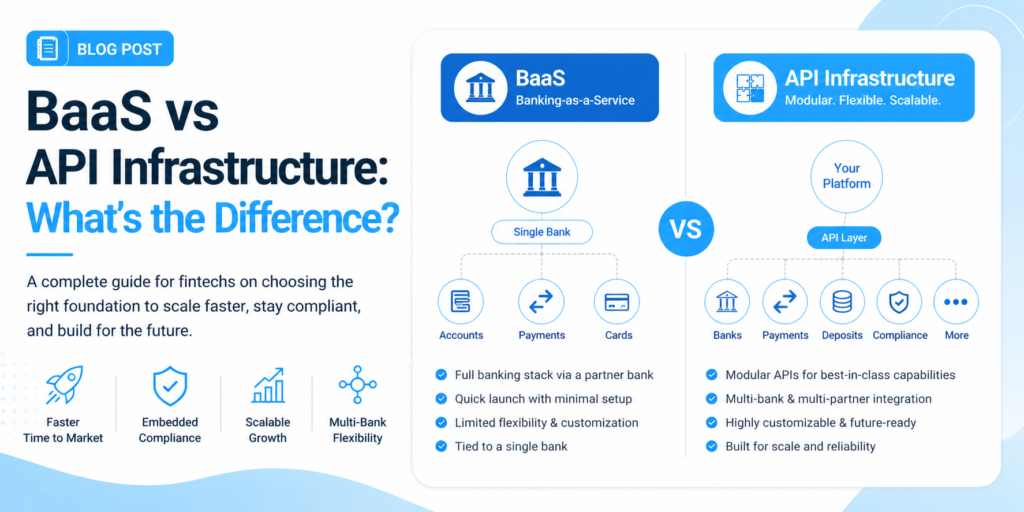
The fintech ecosystem is evolving rapidly, and with it, the underlying infrastructure powering financial products is also changing. Two terms that often come up in this space are Banking-as-a-Service (BaaS) and API infrastructure. While they are sometimes used interchangeably, they represent fundamentally different approaches to building financial systems. For startups, fintech platforms, and even traditional institutions, understanding this difference is critical—especially when evaluating API banking infrastructure companies. The choice between BaaS and API-first infrastructure can directly impact speed, compliance, scalability, and long-term flexibility. This article breaks down the difference between BaaS and API infrastructure, explains when to use each, and positions how platforms like Finspring fit into this evolving landscape. What is Banking-as-a-Service (BaaS)? Banking-as-a-Service refers to a model where licensed banks provide their core banking capabilities—such as account creation, payments, and lending—through APIs to third-party platforms. In this model, the fintech platform essentially builds on top of a bank’s infrastructure. BaaS providers typically offer: Bank accounts (savings/current) Payment processing Card issuance Lending capabilities Regulatory coverage via the partner bank This allows fintech companies to launch financial products without obtaining their own banking license. What is API Infrastructure in Fintech? API infrastructure, on the other hand, refers to a modular, API-first system that enables platforms to integrate specific financial capabilities without being tightly coupled to a single bank or provider. Instead of offering a full banking stack, API infrastructure focuses on: Specific product layers (e.g., deposits, payments, compliance) Multi-partner integrations Real-time monitoring and reliability Scalability across use cases This is where API banking infrastructure companies differentiate themselves—they provide the building blocks, not the entire bank. Key Differences: BaaS vs API Infrastructure Aspect Banking-as-a-Service (BaaS) API Infrastructure Core Model Full banking stack via a partner bank Modular APIs for specific capabilities Flexibility Limited (tied to one bank) High (multi-bank / multi-partner) Speed to Market Fast initially Fast and scalable long-term Customization Restricted by provider Highly customizable Compliance Handled by partner bank Embedded and automated across systems Scalability Can become restrictive Designed for scale Why the Confusion Exists The confusion between BaaS and API infrastructure comes from the fact that both use APIs and both enable fintech products. However, the depth and purpose of these APIs are very different. BaaS APIs expose banking capabilities API infrastructure exposes financial building blocks This distinction becomes important as platforms grow and require more flexibility. When BaaS Works Best BaaS is ideal for platforms that want to: Launch quickly with minimal setup Offer full banking services (accounts, cards, etc.) Avoid dealing directly with regulatory frameworks Typical use cases: Neobanks Wallet apps Early-stage fintech startups In these cases, BaaS provides a shortcut to market entry. Limitations of BaaS at Scale While BaaS is effective for initial launches, it often creates challenges as platforms grow. Key limitations: Vendor Lock-InPlatforms are tightly coupled with a single bank, making it difficult to switch or expand. Limited CustomizationProduct features are restricted by what the BaaS provider supports. Scaling ConstraintsAs transaction volumes increase, performance and flexibility can become bottlenecks. Dependency RiskAny issue with the partner bank directly impacts the platform. Why API Infrastructure is Gaining Momentum As fintech platforms mature, they move toward API-first infrastructure to overcome the limitations of BaaS. This approach allows them to: Integrate multiple banks and partners Customize product flows Scale independently Maintain control over user experience This is why modern API banking infrastructure companies are becoming central to fintech growth. The Rise of Specialized API Infrastructure Instead of relying on a single provider for everything, fintech platforms are now adopting a best-of-breed approach: Payments via one provider Data via another Deposits via a specialized infrastructure platform This shift enables platforms to: Optimize performance Reduce dependency Improve scalability Where Finspring Fits In Finspring operates in the API infrastructure layer, specifically focusing on fixed deposit (FD) and deposit distribution infrastructure. Unlike BaaS providers that offer full banking stacks, Finspring provides: Plug-and-play FD APIs Multi-bank integration Embedded compliance workflows Real-time monitoring and SLA tracking Full lifecycle management (booking, maturity, reporting) This positions Finspring as a specialized API banking infrastructure company focused on deposits—a category that is becoming increasingly important as users seek stability alongside growth. Why API Infrastructure is Better for FD Distribution FD distribution requires: Access to multiple banks Real-time confirmation and tracking Compliance-heavy workflows Reliable lifecycle management BaaS models are not optimized for this because they are: Bank-specific Limited in flexibility API infrastructure platforms like Finspring solve this by: Aggregating multiple banks Standardizing workflows Automating compliance Ensuring real-time reliability BaaS vs API Infrastructure for FD Use Case Stage BaaS Approach API Infrastructure Approach Integration Single bank Multi-bank via APIs Product Flexibility Limited High Compliance Bank-dependent Embedded and automated Scalability Restricted Designed for scale User Experience Standardized Customizable Strategic Decision: What Should You Choose? The choice between BaaS and API infrastructure depends on your stage and goals. Choose BaaS if: You need to launch quickly You want a full banking stack You are in early-stage development Choose API Infrastructure if: You want flexibility and control You plan to scale across products You need multi-partner integrations You are building specialized financial products like FDs The Future: Hybrid Infrastructure The future of fintech is not about choosing one over the other—it is about combining both. Platforms will: Use BaaS for core banking capabilities Use API infrastructure for specialized layers This hybrid approach allows them to: Launch quickly Scale efficiently Optimize performance Why API Banking Infrastructure Companies Will Define the Next Phase As fintech evolves, the focus is shifting from building products to building systems that enable products. API banking infrastructure companies are at the center of this shift because they: Enable modular development Support multi-product ecosystems Reduce operational complexity Improve scalability They are not just service providers—they are growth enablers. Conclusion The debate between BaaS and API infrastructure is not about which is better—it is about what fits your stage and strategy. BaaS provides speed at the beginning.API infrastructure provides flexibility and scale over time. For platforms looking to expand into deposit products like FDs, specialized API infrastructure providers like

real-time FD infrastructure
Fixed Deposit

Real-Time FD Infrastructure: Alerts, SLA Tracking & Production Reliability

Fixed Deposits (FDs) have traditionally been viewed as simple, stable financial products. But in today’s API-driven financial ecosystem, the simplicity users experience on the surface is powered by highly complex, real-time infrastructure underneath. For fintech platforms, wealth apps, and banks, offering FDs is no longer just about enabling bookings. It’s about ensuring real-time visibility, zero-failure execution, and consistent reliability at scale. This is where real-time FD infrastructure becomes critical. What is Real-Time FD Infrastructure? Real-time FD infrastructure refers to the technology layer that enables continuous monitoring, instant alerts, SLA tracking, and production reliability for FD products across their lifecycle. It ensures that: Every FD booking is processed without delay Every status update is reflected instantly Every failure or disruption is detected and resolved proactively In short, it transforms FDs from a static banking product into a live, trackable financial service. Why Real-Time Infrastructure Matters for FDs FDs are fundamentally trust-driven products. Unlike high-risk investments, users choose FDs because they expect: Stability Predictability Immediate confirmation Zero ambiguity Any delay, failure, or inconsistency directly impacts user confidence. The Reality: Even a few minutes of delay in confirmation, or a missed maturity update, can: Break user trust Increase support tickets Create reconciliation issues Impact regulatory compliance This makes real-time infrastructure not optional—but essential. Key Components of Real-Time FD Infrastructure 1. Real-Time Alerts & Monitoring In a production environment, issues don’t announce themselves. They need to be detected instantly. Real-time alerting systems monitor: FD booking failures Delayed confirmations API latency spikes Partner bank response issues These alerts allow teams to: Identify issues instantly Take corrective action before users notice Maintain system reliability Without alerts, teams operate reactively.With alerts, they operate proactively. 2. SLA Tracking (Service Level Agreements) SLA tracking ensures that every part of the FD journey meets predefined performance standards. This includes: Time taken for FD booking confirmation API response times Partner bank processing timelines Status update intervals SLA tracking helps platforms: Maintain consistency across partners Identify bottlenecks in the system Ensure compliance with regulatory expectations More importantly, it creates accountability across the entire FD ecosystem. 3. Production Issue Detection & Resolution Production issues are inevitable.What matters is how quickly they are detected and resolved. Common FD production issues include: Failed transactions Duplicate bookings Status mismatches Reconciliation errors A robust infrastructure: Detects these issues in real time Flags them automatically Enables faster resolution workflows This reduces: Manual intervention Operational overhead Risk exposure 4. End-to-End Visibility Real-time FD infrastructure provides complete visibility across the FD lifecycle, including: Booking Confirmation Interest accrual Maturity Renewal or withdrawal This visibility ensures: Accurate reporting Better customer support Improved internal decision-making When systems are transparent, operations become predictable. The Cost of Not Having Real-Time FD Infrastructure Many platforms underestimate the operational risks of inadequate infrastructure. Without real-time capabilities, platforms face: 1. Delayed Issue Detection Problems are discovered only after user complaints. 2. Increased Operational Load Manual tracking, reconciliation, and troubleshooting become necessary. 3. Poor User Experience Users experience delays, inconsistencies, or lack of clarity. 4. Compliance Risks Missing SLAs or reporting gaps can lead to regulatory challenges. 5. Loss of Trust In financial products, trust once lost is difficult to regain. Real-Time Infrastructure as a Competitive Advantage Platforms that invest in real-time FD infrastructure gain a clear edge. They can: Launch confidently at scale Maintain consistent performance Deliver seamless user experiences Build long-term trust Most importantly, they can operate without friction even as volumes grow. This is critical because FD growth is not driven by persuasion—it is driven by: Accessibility Reliability Consistency How Modern FD Infrastructure Solves This Modern FD infrastructure platforms (like Finspring) are built with real-time capabilities at their core. They provide: Built-in monitoring systems Automated alert mechanisms SLA tracking dashboards Production issue management workflows This means: Teams don’t need to build these systems from scratch Reliability is embedded from day one Launch timelines are significantly reduced Instead of managing infrastructure, teams can focus on: Product strategy User experience Distribution Real-Time FD Infrastructure in Action Let’s break this into a simple flow: A user books an FD The system processes the request via APIs Real-time monitoring checks for delays or failures SLA tracking ensures confirmation happens within defined timelines Alerts are triggered if anything deviates Issues are resolved instantly before impacting the user This creates a closed-loop system of reliability. The Future of FD Infrastructure As fintech ecosystems evolve, expectations will continue to rise. Future-ready FD infrastructure will focus on: Predictive issue detection (before failures occur) AI-driven monitoring systems Deeper integration across financial products Real-time analytics for decision-making The direction is clear: FDs will remain simple for users—but the infrastructure behind them will become increasingly intelligent. Conclusion Fixed Deposits may be one of the oldest financial products—but delivering them in today’s digital ecosystem requires modern, real-time infrastructure. Monitoring, alerts, SLA tracking, and production reliability are no longer backend concerns.They are core to product success. Platforms that recognize this early will: Launch faster Scale confidently Build lasting user trust At Finspring, we enable wealth tech and fintech platforms to launch and manage FDs with real-time, production-ready infrastructure through our plug-and-play FD SDK. Because in financial services, reliability is not a feature.It is the foundation.

API infrastructure
Fixed Deposit

What is API Infrastructure? A Beginner-Friendly Guide to the Backbone of Fintech

If you’ve spent any time exploring modern fintech systems, you’ve likely come across the term API infrastructure. It often sounds technical, abstract, and difficult to grasp—especially for beginners. But in reality, API infrastructure is one of the most important concepts in today’s digital financial ecosystem. It is the invisible layer that allows apps, platforms, and banks to communicate, transact, and scale seamlessly. Understanding API infrastructure is not just useful for developers. It is critical for founders, product managers, and operators who want to build or scale fintech products efficiently. This guide simplifies the concept, breaking it down into clear components, real-world examples, and practical understanding. What is API Infrastructure? API infrastructure refers to the set of systems, tools, and frameworks that enable applications to communicate with each other through APIs (Application Programming Interfaces). An API acts as a bridge that allows one system to request data or trigger actions in another system without needing to understand its internal complexity. Think of API infrastructure as the plumbing of digital systems. Just as plumbing connects different parts of a building to ensure water flows smoothly, API infrastructure connects different software systems to ensure data and functionality flow reliably and securely. In fintech, this means enabling: A user app to connect with a bank A platform to process transactions A system to verify user identity A product to integrate financial services like FDs Why API Infrastructure Exists Before APIs became standard, systems were built as closed environments. Any new feature or integration required: Custom development Direct system access Complex coordination between teams This made scaling slow and inefficient. API infrastructure solves this by: Standardizing communication between systems Enabling modular development Allowing systems to scale independently As a result, platforms can build faster, integrate quicker, and expand more easily. Key Components of API Infrastructure To understand API infrastructure clearly, it helps to break it down into its core components. Each component plays a specific role in ensuring that systems communicate effectively. 1. APIs (Application Programming Interfaces) APIs are the actual endpoints that allow systems to: Send requests Receive responses Trigger actions For example, an FD API might allow a platform to: Create a fixed deposit Fetch interest rates Check status updates 2. API Gateway An API gateway acts as a central entry point for all API requests. It: Routes requests to the correct service Manages traffic Ensures security This helps platforms handle multiple integrations efficiently. 3. Authentication & Authorization Layer This layer ensures that: Only authorized users or systems can access APIs Sensitive data is protected It typically includes: API keys Tokens Access controls 4. Data Processing Systems Once a request is received, backend systems process the data and generate responses. This includes: Transaction processing Data validation Business logic execution 5. Monitoring & Logging API infrastructure must track: Requests Errors Performance metrics This ensures reliability and helps identify issues quickly. How API Infrastructure Works (Simple Flow) Let’s simplify the process with a basic example: A user clicks “Book FD” on an app The app sends a request via an API The API gateway routes the request The backend processes the request A response is sent back to the app The user sees confirmation This entire process happens in seconds, powered by API infrastructure. API Infrastructure in Fintech In fintech, API infrastructure is especially important because it connects multiple systems that must work together seamlessly. These include: Banks Payment systems Compliance systems Investment products For example, when a platform offers FDs: APIs connect the platform to banks Compliance APIs verify user identity Transaction APIs process the deposit Reporting APIs track activity Without API infrastructure, each of these steps would require separate systems and manual coordination. Traditional Systems vs API Infrastructure Aspect Traditional Systems API Infrastructure Integration Custom-built Standardized APIs Speed Slow Fast Scalability Limited High Flexibility Rigid Modular Maintenance Complex Simplified Benefits of API Infrastructure 1. Faster Development APIs allow teams to reuse existing functionality instead of building everything from scratch. This significantly reduces development time and speeds up product launches. 2. Scalability API-based systems can handle increased demand by scaling individual components rather than the entire system. This makes them more efficient and cost-effective. 3. Flexibility Platforms can: Add new features Integrate new partners Update existing systems without disrupting the entire architecture. 4. Better User Experience Faster and more reliable systems lead to: Instant responses Smooth transactions Consistent performance 5. Easier Integration APIs make it simple to connect with: Banks Payment gateways Third-party services This enables rapid expansion of product offerings. Common Use Cases in Fintech API infrastructure powers a wide range of fintech use cases, including: Payments: Processing transactions between users and merchants KYC Verification: Verifying user identity instantly FD Distribution: Enabling platforms to offer fixed deposits Lending: Managing loan applications and approvals Reporting: Generating compliance and transaction reports Challenges in API Infrastructure While API infrastructure offers many benefits, it also comes with challenges: Security risks, especially when handling sensitive financial data Integration complexity, particularly with legacy systems Performance issues, if systems are not optimized Dependency on external services, which can affect reliability These challenges make it important to use robust, well-designed infrastructure platforms. Example: API Infrastructure for FD Platforms Stage API Role Outcome Onboarding KYC API User verified instantly Booking FD API Deposit created Confirmation Status API User receives update Reporting Reporting API Data tracked and stored This demonstrates how APIs handle each step, creating a seamless user experience. The Role of Finspring Finspring simplifies API infrastructure for FD distribution by providing: Plug-and-play APIs Pre-built compliance workflows Real-time monitoring systems Scalable architecture This allows platforms to integrate once and: Launch faster Operate efficiently Scale without complexity The Future of API Infrastructure As fintech evolves, API infrastructure will become even more advanced, with: AI-driven automation Real-time analytics Deeper integrations across ecosystems More modular and composable systems The goal is to make infrastructure: Invisible to users Powerful for platforms Scalable for growth Conclusion API infrastructure is the backbone of modern fintech systems. It enables platforms to connect, communicate, and scale efficiently, making it

API-first payment platforms
Fixed Deposit

API-First Payment Platforms: Structure, Benefits, and Why They Matter

Payments are at the core of every financial system. Whether it is transferring money, booking a fixed deposit, or completing a transaction, payments infrastructure determines how smoothly and reliably money moves across systems. Traditionally, payment systems were rigid, slow to integrate, and difficult to scale. Today, API-first payment platforms are redefining how payments are built, integrated, and expanded. An API-first approach means that the entire payment system is designed around programmable interfaces from the ground up, rather than adding APIs later. This creates a flexible, scalable, and developer-friendly infrastructure that aligns with the needs of modern fintech platforms. What is an API-First Payment Platform? An API-first payment platform is a system where all payment capabilities—such as transaction processing, settlement, reconciliation, and reporting—are exposed through well-defined APIs. These APIs act as the primary interface for interacting with the platform, allowing developers to integrate payment functionality directly into their applications. Unlike traditional systems, where APIs are often an afterthought, API-first platforms are built with: Standardized endpoints Clear documentation Modular architecture Scalable backend systems This ensures that payments can be integrated quickly and managed efficiently. Why API-First Platforms Are Replacing Traditional Payment Systems Traditional payment systems were designed for closed environments, where banks controlled both infrastructure and distribution. Integrations required: Custom development Long approval cycles Complex coordination This made scaling slow and expensive. API-first platforms solve these challenges by: Enabling plug-and-play integration Reducing dependency on internal systems Allowing faster product launches As fintech ecosystems grow, the need for speed, flexibility, and interoperability makes API-first platforms the preferred choice. Core Structure of an API-First Payment Platform Understanding the structure of these platforms helps clarify why they are so effective. Each layer is designed to handle a specific function while remaining independent and scalable. 1. API Layer (Core Interface) The API layer is the primary interface through which all interactions occur. It includes endpoints for: Initiating payments Checking transaction status Managing refunds Accessing reports This layer ensures that developers can interact with the system programmatically without dealing with internal complexity. 2. Payment Processing Engine This is the backend system that: Executes transactions Validates payment details Routes requests to the appropriate networks or banks It ensures that payments are processed accurately and efficiently. 3. Settlement & Reconciliation Layer Once a transaction is processed, the system must: Settle funds between parties Reconcile transaction data This layer ensures financial accuracy and consistency across systems. 4. Compliance & Risk Management Layer Payments must adhere to regulatory requirements. This layer handles: KYC checks Fraud detection Transaction monitoring By embedding compliance into the system, API-first platforms ensure secure and compliant transactions. 5. Monitoring & Analytics Layer This layer tracks: Transaction performance System health Error rates It provides insights that help platforms optimize performance and detect issues early. API-First vs Traditional Payment Platforms Aspect Traditional Payment Systems API-First Payment Platforms Integration Complex and time-consuming Fast and standardized Flexibility Limited High Scalability Difficult Seamless Developer Experience Poor Developer-friendly Innovation Speed Slow Rapid Key Benefits of API-First Payment Platforms 1. Faster Time to Market With pre-built APIs, platforms can integrate payment capabilities quickly, reducing development time and enabling faster launches. This is especially important in competitive markets where timing directly impacts success. 2. Modular and Scalable Architecture API-first systems are built in modules, allowing platforms to: Add new features Scale individual components Adapt to changing requirements This flexibility ensures that systems can grow without major rebuilds. 3. Improved Developer Experience Clear documentation, standardized endpoints, and predictable behavior make it easier for developers to: Integrate systems Debug issues Maintain code This reduces development effort and improves efficiency. 4. Enhanced Reliability With built-in monitoring and standardized processes, API-first platforms offer: Higher uptime Faster response times Consistent performance This reliability is critical in financial systems. 5. Seamless Integration Across Ecosystems API-first platforms can connect with: Banks Fintech apps Payment networks Financial products like FDs This enables platforms to create integrated financial experiences. Use Cases in Fintech API-first payment platforms power a wide range of applications: Digital wallets: Enabling seamless fund transfers E-commerce payments: Processing transactions instantly Subscription billing: Managing recurring payments FD booking flows: Handling deposit transactions Cross-platform integrations: Connecting multiple financial services Example: Payment Flow Using API-First Infrastructure Step Action API Role 1 User initiates payment Payment API receives request 2 System validates details Validation API checks data 3 Transaction processed Processing engine executes payment 4 Confirmation sent Status API updates user 5 Funds settled Settlement layer reconciles data This flow demonstrates how APIs handle each step, creating a smooth and efficient payment experience. Challenges in API-First Payment Platforms While powerful, these platforms must address several challenges: Security risks, especially with sensitive financial data Latency issues, if systems are not optimized Dependency on external services, which can impact performance Regulatory compliance, which must be maintained across all transactions Addressing these challenges requires robust infrastructure and continuous monitoring. The Role of Finspring Finspring applies the API-first approach to FD infrastructure, enabling platforms to: Integrate financial products quickly Automate compliance workflows Ensure reliable transaction processing Scale without operational complexity By combining API-first design with compliance-first principles, Finspring helps platforms build fast, reliable, and scalable financial systems. The Future of API-First Payment Platforms As fintech continues to evolve, API-first platforms will become more advanced, incorporating: AI-driven transaction optimization Real-time analytics and insights Deeper integration across financial ecosystems Fully composable financial architectures These advancements will make payment systems more intelligent, adaptive, and efficient. Conclusion API-first payment platforms represent a fundamental shift in how financial systems are built and operated. By prioritizing APIs as the core interface, these platforms enable faster integration, better scalability, and improved reliability. For fintech platforms, adopting an API-first approach is not just a technical decision—it is a strategic one. It allows them to move faster, innovate more effectively, and deliver seamless user experiences. In modern financial ecosystems, the ability to integrate and scale payments efficiently is what defines success.And API-first platforms are the foundation that makes it possible.

API-first infrastructure
Fixed Deposit

Best API-First Financial Infrastructure Companies (2026): Leaders Powering Modern Fintech

The financial ecosystem is no longer built on monolithic systems. Today, the most successful fintech platforms are powered by API-first infrastructure—modular, scalable systems that allow companies to launch, integrate, and expand financial products without rebuilding their entire stack. As a result, a new category of companies has emerged: API-first financial infrastructure providers. These companies are not just vendors. They are foundational enablers of modern fintech, providing the building blocks for payments, deposits, lending, compliance, and more. In this article, we explore the best API-first infrastructure companies in 2026, their strengths, and how they fit into the evolving financial landscape. What Defines an API-First Infrastructure Company? Before diving into the list, it is important to understand what separates API-first infrastructure companies from traditional providers. These platforms are designed with APIs at their core, meaning every function—from onboarding to transaction processing—is exposed programmatically. Key characteristics include: Modular architecture, allowing flexible integration Developer-first design, with clear documentation and predictable behavior Scalable systems, capable of handling high transaction volumes Embedded compliance, ensuring regulatory alignment Real-time capabilities, including monitoring and reporting These features make API-first companies essential for fintech platforms looking to move fast without compromising reliability. Top API-First Financial Infrastructure Companies 1. Stripe (Global Payments Infrastructure Leader) Stripe has become synonymous with API-first payments. It provides a comprehensive suite of APIs for: Payment processing Subscription management Financial operations Stripe’s strength lies in its developer-friendly ecosystem, which allows companies to integrate complex payment workflows quickly. Its global reach and reliability make it a default choice for many startups and enterprises. 2. Plaid (Financial Data Connectivity) Plaid focuses on connecting applications to users’ bank accounts, enabling: Account verification Transaction data access Financial insights By simplifying data access, Plaid enables fintech platforms to build products faster and deliver more personalized experiences. 3. Razorpay (India-Focused Payments & Banking APIs) Razorpay has established itself as a leading API-first platform in India, offering: Payment gateway services Banking APIs Lending infrastructure Its strength lies in local market expertise combined with scalable infrastructure, making it a key player in the Indian fintech ecosystem. 4. Solaris (Embedded Finance Platform) Solaris provides a full-stack embedded finance platform, enabling companies to offer: Banking services Payment capabilities Compliance support Its API-first approach allows businesses to integrate regulated financial services seamlessly. 5. Unit (Banking-as-a-Service Infrastructure) Unit enables companies to build financial products by providing: Banking APIs Compliance frameworks Operational support It simplifies the process of launching fintech products by handling complex backend requirements. 6. Finspring (FD & Deposit Infrastructure Specialist) Finspring operates in a highly specialized but rapidly growing category: fixed deposit (FD) and deposit infrastructure. While most API-first companies focus on payments or banking, Finspring addresses the need for deposit distribution, compliance, and lifecycle management through a single integration. Finspring’s infrastructure enables platforms to: Launch FD products quickly Access multiple banks through one API Automate compliance and reporting Manage the entire FD lifecycle This positions Finspring as a category-defining player in deposit infrastructure, particularly for platforms looking to integrate stable financial products alongside growth-oriented offerings. Comparison of Leading API-First Infrastructure Companies Company Core Focus Key Strength Ideal Use Case Stripe Payments Developer ecosystem Global payment processing Plaid Data connectivity Bank integrations Financial data access Razorpay Payments & banking India market expertise Local fintech scaling Solaris Embedded finance Full-stack services Banking integration Unit BaaS Compliance + APIs Fintech product launches Finspring FD infrastructure Deposit distribution & compliance FD product integration How to Choose the Right API-First Infrastructure Partner Selecting the right infrastructure partner depends on your product strategy and target market. Key factors to consider include: 1. Product Alignment Choose a provider that specializes in your core use case. For example: Payments → Stripe, Razorpay Data → Plaid Deposits → Finspring 2. Speed of Integration Evaluate how quickly you can: Integrate APIs Test workflows Go live Faster integration means faster time to market. 3. Compliance Capabilities Ensure that the platform: Handles regulatory requirements Provides audit-ready systems Supports reporting This is especially critical in regulated products like FDs. 4. Scalability The infrastructure should handle: Increasing transaction volumes Multiple integrations Expanding product lines 5. Reliability and Monitoring Look for platforms with: High uptime Real-time monitoring SLA tracking Why Specialized Infrastructure is the Next Wave While general-purpose API platforms are essential, the market is moving toward specialized infrastructure layers. Instead of one platform handling everything, companies are adopting best-in-class solutions for specific functions. For example: Payments handled by Stripe or Razorpay Data handled by Plaid Deposits handled by Finspring This approach allows platforms to: Optimize performance Reduce complexity Scale efficiently The Strategic Role of Finspring Finspring stands out because it addresses a gap that most API-first platforms do not cover—deposit infrastructure. As market conditions shift and users demand stability alongside growth, FDs are becoming a critical product layer. Finspring enables platforms to: Integrate FDs without complex bank partnerships Launch quickly using plug-and-play APIs Maintain compliance and operational reliability Scale distribution efficiently This makes it a key player for fintechs looking to expand beyond payments into investment and wealth products. The Future of API-First Financial Infrastructure The next phase of fintech will be defined by: Composable systems Real-time capabilities Embedded compliance Specialized infrastructure layers API-first companies will continue to evolve, offering: Deeper integrations More automation Better scalability Platforms that adopt these systems early will be better positioned to: Innovate Launch faster Scale sustainably Conclusion API-first infrastructure companies are the backbone of modern fintech. They enable platforms to build, launch, and scale financial products without the limitations of traditional systems. While global players like Stripe and Plaid dominate broad categories, specialized providers like Finspring are defining new segments within the ecosystem. By focusing on FD and deposit infrastructure, Finspring is helping platforms unlock stable, scalable revenue streams. Choosing the right infrastructure is not just a technical decision—it is a strategic one.Because in fintech, the systems you build on determine how far you can grow.

FD sales
Fixed Deposit

Scaling FD Sales Without Branches: The Digital Playbook for 2026

For decades, FD sales were built on a simple foundation: bank branches, relationship managers, and physical paperwork. Growth depended on geographic presence and human-driven distribution. That model is now being completely rewritten. Today, banks, NBFCs, and fintech platforms are learning how to scale FD sales without branches—using APIs, digital onboarding, and embedded finance. This shift isn’t just operational; it’s strategic. It unlocks exponential growth without the constraints of physical infrastructure. Let’s break down how this works and how you can leverage it. Why Branch-Based FD Sales Don’t Scale Anymore Traditional FD distribution has clear limitations: High operational costs (rent, staff, maintenance) Limited geographic reach Manual onboarding processes Slow customer acquisition Even with digital banking portals, growth is still often tied to the bank’s own ecosystem. In a world where users expect instant, seamless experiences, this model falls short. The New Model: Branchless FD Distribution Scaling FD sales without branches means leveraging technology-driven distribution channels instead of physical locations. This includes: API banking Deposit aggregators Third-party platforms Embedded finance Instead of waiting for users to come to a bank, FD products are taken directly to where users already are. How Branchless FD Scaling Works 1. API Infrastructure as the Backbone Banks expose their FD products via APIs, allowing platforms to: Fetch FD rates and options Enable digital booking Handle transactions seamlessly This eliminates the need for manual processes. 2. Distribution Through Platforms FDs are distributed through: Fintech apps Neobanks Wealth platforms Consumer apps These platforms already have engaged users, making them powerful distribution channels. 3. Digital Onboarding & eKYC Modern FD sales rely on: Aadhaar-based verification PAN validation Instant KYC This reduces onboarding time from days to minutes. 4. Seamless Payment Systems Integration with: UPI Net banking Wallets ensures fast and secure transactions. Key Strategies to Scale FD Sales Without Branches 1. Leverage Embedded Finance Instead of building your own audience, plug into existing ecosystems. Example: A shopping app offering FDs A SaaS platform offering treasury options This allows you to tap into pre-existing user bases. 2. Partner with Distribution Platforms Distribution is the new growth engine. By partnering with fintech platforms, you can: Reach new customer segments Scale faster Reduce acquisition costs 3. Optimize the User Journey Conversion depends heavily on experience. Focus on: Simple onboarding Clear FD comparisons Minimal steps to invest 4. Use Data for Personalization Recommend FDs based on: User income Behavior Financial goals Personalization increases conversion rates significantly. 5. Build Trust Digitally Without branches, trust must be built through: Transparent communication Strong branding Secure systems Regulatory backing from institutions like the Reserve Bank of India also plays a key role in maintaining confidence. Benefits of Scaling FD Sales Without Branches For Banks & NBFCs Lower operational costs Faster customer acquisition Access to wider markets Scalable growth For Platforms New revenue streams Increased user engagement Ability to offer financial products For Users Convenience Faster investment process Access to multiple FD options Real-World Use Cases 1. Fintech Platforms Offer FDs alongside mutual funds and stocks. 2. Neobanks Provide FD options without holding deposits directly. 3. E-commerce Apps Embed FDs to increase user lifetime value. 4. Corporate Platforms Offer FDs as part of employee financial wellness programs. Challenges in Branchless FD Scaling 1. Trust Gap Users may initially trust physical banks more than digital platforms. 2. Regulatory Compliance Strict adherence to financial regulations is required. 3. Technology Dependency Performance depends on API reliability and infrastructure. 4. Competition As more players enter, differentiation becomes critical. How Technology Enables Scale APIs Enable seamless integration and distribution. Cloud Infrastructure Supports scalability and uptime. AI & Analytics Drive personalization and optimization. Digital KYC Simplifies onboarding and compliance. The Future of FD Sales 1. Fully Embedded Experiences FDs will be offered within everyday apps without friction. 2. Hyper-Personalization Users will receive tailored FD recommendations instantly. 3. Multi-Asset Platforms FDs will be part of broader investment ecosystems. 4. Global Distribution Cross-border FD offerings may emerge. Strategic Insight: Distribution is the New Moat In the branchless world: Banks provide products Platforms control distribution The real power lies in: Owning user relationships Embedding financial products seamlessly If you can control distribution, you can scale infinitely. How to Get Started Step 1: Build or Integrate API Infrastructure Choose a reliable FD API provider. Step 2: Identify Distribution Channels Partner with platforms that align with your target audience. Step 3: Design the User Experience Focus on simplicity and speed. Step 4: Ensure Compliance Align with regulatory standards. Step 5: Launch and Optimize Continuously improve based on data. Final Thoughts Scaling FD sales without branches is not just a trend—it’s the future of financial distribution. It transforms: Physical limitations into digital scalability Slow processes into instant experiences Local reach into global potential For businesses, this is an opportunity to grow faster than ever before.For users, it’s a chance to access investments effortlessly. Because in the new financial world, growth doesn’t come from more branches—It comes from better distribution.

third-party FD
Fixed Deposit

Third-Party FD Platforms: The New Distribution Engine for Fixed Deposits

Fixed deposits (FDs) have long been one of the most trusted financial products, especially for investors seeking stability and predictable returns. But while the product has remained consistent, how FDs are distributed has completely transformed. Enter third-party FD platforms—the new layer that is reshaping how users discover, compare, and invest in fixed deposits. These platforms are not banks. Yet, they are becoming the primary interface through which users access FD products. Let’s break down how this works, why it’s growing rapidly, and how you can leverage it. What are Third-Party FD Platforms? Third-party FD platforms are applications, websites, or digital ecosystems that allow users to invest in fixed deposits from multiple banks and NBFCs, without directly interacting with those institutions. They act as an intermediary layer between: Financial institutions (banks/NBFCs) End users (investors) Unlike traditional banking channels, these platforms focus on: Better user experience Product comparison Seamless digital journeys How Third-Party FD Platforms Work At a high level, these platforms are powered by APIs and aggregator infrastructure. The Flow A platform integrates with an FD API or deposit aggregator It fetches FD options from multiple banks Users browse and compare: Interest rates Tenure Returns The user selects an FD The platform handles: KYC verification Payment processing Deposit booking The FD is created with the partner bank From the user’s perspective, everything happens within a single app. Why Third-Party FD Platforms Are Growing Fast 1. Convenience Wins Users no longer want to: Visit multiple bank websites Compare rates manually Handle paperwork Third-party platforms simplify everything into a single experience. 2. Better Discovery & Comparison These platforms allow users to: Compare FD rates across institutions Choose the best option instantly Make informed decisions 3. Embedded Finance Trend FDs are no longer limited to banking apps. They are now embedded in: Fintech platforms Investment apps Consumer ecosystems 4. Faster Digital Onboarding With advancements in eKYC and API banking, onboarding is: Instant Paperless User-friendly Key Features of Third-Party FD Platforms 1. Multi-Bank Access Users can invest in FDs from multiple banks in one place. 2. Real-Time Data Interest rates and FD options are updated dynamically. 3. Digital KYC Seamless onboarding using PAN, Aadhaar, and other digital verification methods. 4. Secure Transactions Integrated payment systems ensure safe fund transfers. 5. Investment Dashboard Users can track: Active FDs Maturity timelines Returns Benefits of Third-Party FD Platforms For Users Convenience and speed Better comparison of FD options Fully digital investment journey Access to competitive rates For Platforms New revenue streams via commissions Increased user engagement Higher retention Ability to enter fintech without a banking license For Banks & NBFCs Expanded distribution channels Lower customer acquisition costs Increased deposit inflows Third-Party FD Platforms vs Traditional Banking Feature Traditional Banks Third-Party Platforms Access Single bank Multiple banks Experience Bank-centric User-centric Comparison Limited Easy Onboarding Slower Instant Scalability Limited High Role of Regulation in Third-Party FD Platforms Since these platforms deal with financial products, compliance is critical. In India, regulations guided by the Reserve Bank of India ensure: Secure transactions Data protection Transparent operations Platforms must work with regulated financial institutions and follow strict compliance frameworks. Challenges in Third-Party FD Platforms While the model is powerful, there are some challenges: 1. Trust & Credibility Users must trust platforms with their money. 2. Regulatory Complexity Compliance requirements can be demanding. 3. Dependency on Infrastructure Platforms rely on API providers and aggregators. 4. Competition As the space grows, differentiation becomes key. Use Cases Across Industries Third-party FD platforms are not limited to fintech startups. 1. Wealth Management Apps Offer FDs alongside mutual funds and stocks. 2. Neobanks Provide FD options without holding deposits directly. 3. E-commerce Platforms Embed FDs to increase user lifetime value. 4. Corporate Platforms Offer FDs as part of employee financial wellness programs. The Future of Third-Party FD Platforms 1. Hyper-Personalization AI-driven recommendations for: Best FD rates Optimal tenure 2. Expansion Beyond FDs Platforms will offer: Bonds Government securities Hybrid investment products 3. Invisible Finance FDs will be embedded so seamlessly that users won’t even notice the transition. 4. Global Expansion Cross-border FD access may become possible. How to Build or Leverage a Third-Party FD Platform If you’re planning to enter this space, here’s a strategic roadmap: Step 1: Choose the Right Infrastructure Select a reliable FD API or aggregator. Step 2: Design a Seamless UX Focus on: Easy onboarding Clear comparison Smooth transactions Step 3: Ensure Compliance Align with regulatory requirements and partner with trusted institutions. Step 4: Monetize Strategically Earn through: Commissions Partnerships Value-added services Step 5: Optimize Continuously Track: User engagement Conversion rates Revenue growth Strategic Insight: Why This Matters Third-party FD platforms represent a major shift in financial distribution. They are turning: Static products into dynamic offerings Banks into backend providers Platforms into financial ecosystems This creates a powerful opportunity for businesses to: Monetize financial intent Build deeper user relationships Scale rapidly in the fintech space Final Thoughts Third-party FD platforms are redefining how fixed deposits are accessed and experienced. They bring together: Technology Distribution User-centric design In a way that makes investing simpler, faster, and more accessible. As embedded finance continues to grow, these platforms will play a central role in shaping the future of investing. Because the real evolution isn’t in the product—It’s in how effortlessly that product reaches the user.

fixed deposit ecosystem
Fixed Deposit

Fixed Deposit Ecosystem: How It Works and Why It’s Evolving Fast

The fixed deposit (FD) has long been one of the most trusted financial instruments—especially in markets like India where stability and predictable returns are highly valued. But while the product itself has remained relatively unchanged, the fixed deposit ecosystem around it has undergone a massive transformation. What was once a simple bank-to-customer interaction is now a multi-layered, technology-driven network involving banks, NBFCs, fintech platforms, API providers, and regulators. Understanding this ecosystem is crucial if you’re looking to build, distribute, or scale financial products in 2026 and beyond. What is the Fixed Deposit Ecosystem? The fixed deposit ecosystem refers to the entire network of participants, technologies, processes, and regulations involved in the creation, distribution, and management of fixed deposit products. It includes: Financial institutions (banks and NBFCs) Infrastructure providers (APIs, aggregators) Distribution platforms (apps, websites) End users (investors) Regulatory bodies Together, these components create a seamless environment where fixed deposits can be offered, discovered, and invested in. Key Players in the Fixed Deposit Ecosystem To truly understand the ecosystem, you need to break it down into its core layers. 1. Banks and NBFCs (Product Creators) These are the institutions that actually create fixed deposit products. They define: Interest rates Tenure options Minimum investment amounts Terms and conditions Banks remain the backbone of the FD ecosystem, providing trust and security. 2. Infrastructure Providers (The Enablers) This layer includes: FD APIs Deposit aggregators Banking infrastructure platforms They act as the bridge between banks and distribution platforms, enabling seamless digital access to FD products. Without this layer, scaling FD distribution would be extremely difficult. 3. Distribution Platforms (The Growth Engine) These are the platforms that bring FDs to users: Fintech apps Neobanks Investment platforms Consumer apps They control: User experience Discovery Engagement This is where the biggest shift is happening—distribution is no longer owned by banks alone. 4. End Users (Investors) Users interact with the ecosystem by: Comparing FD options Investing digitally Tracking returns Today’s users expect: Zero paperwork Instant onboarding Transparent comparisons 5. Regulators (The Guardians) In India, the ecosystem operates under the guidance of the Reserve Bank of India. They ensure: Financial stability Consumer protection Compliance standards How the Fixed Deposit Ecosystem Works Let’s look at how all these components come together in a real-world scenario. Step-by-Step Flow A bank creates an FD product The product is made available via an API or aggregator A fintech platform integrates the API A user logs into the platform They browse FD options from multiple institutions The user selects: Amount Tenure The system handles: KYC verification Payment processing Deposit booking The FD is created and confirmation is issued All of this happens digitally, often within minutes. Evolution of the Fixed Deposit Ecosystem Phase 1: Offline Banking Era Branch visits Paper forms Limited access Phase 2: Digital Banking Online portals Basic FD booking Bank-controlled distribution Phase 3: API & Embedded Finance Era Multi-platform distribution Seamless onboarding API-driven infrastructure Embedded investment experiences We are currently in Phase 3—and it’s expanding rapidly. Why the Fixed Deposit Ecosystem is Transforming 1. Rise of Embedded Finance Financial products are no longer standalone—they are embedded into everyday platforms. This means: Users don’t go to banks Banks come to users 2. Distribution Power Shift Earlier: Banks owned distribution Now: Platforms own user relationships Infrastructure layers enable scale 3. Demand for Simplicity Users want: Quick decisions Easy comparisons Minimal friction The ecosystem is evolving to meet these expectations. Benefits of a Modern Fixed Deposit Ecosystem For Platforms New revenue streams through commissions Increased user retention Ability to offer financial products without becoming a bank For Banks & NBFCs Wider reach Lower customer acquisition cost Faster deposit growth For Users Access to multiple FD options Better rates and flexibility Seamless digital experience Challenges in the Ecosystem Despite its advantages, the ecosystem comes with complexities: 1. Regulatory Compliance Platforms must adhere to strict financial regulations. 2. Data Security Handling sensitive financial data requires robust systems. 3. Trust Building Users must trust platforms with their investments. 4. Integration Complexity Choosing the right infrastructure provider is critical. The Role of Technology in the FD Ecosystem Technology is the backbone of this transformation. Key Technologies Include: APIs for integration Cloud infrastructure for scalability AI for personalization Digital KYC systems for onboarding These technologies make the ecosystem: Faster More scalable User-friendly Future Trends in the Fixed Deposit Ecosystem 1. Hyper-Personalization Users will receive FD recommendations based on: Income Risk profile Financial goals 2. Expansion Beyond FDs The ecosystem will include: Bonds Government securities Hybrid investment products 3. Invisible Finance Financial services will be embedded so deeply that users won’t even notice them. 4. Cross-Platform Financial Experiences Users will manage investments across multiple apps seamlessly. Strategic Insight: Why This Matters If you’re building a platform today, the fixed deposit ecosystem offers a powerful opportunity: You can monetize financial intent You can increase user lifetime value You can position your platform as a trusted financial destination This is not just about adding a feature—it’s about becoming part of a financial infrastructure layer. Final Thoughts The fixed deposit ecosystem is no longer just about banks offering deposits—it’s a dynamic, interconnected network powered by technology and driven by distribution. It represents a major shift: From products → to platforms From banks → to ecosystems From transactions → to experiences As this ecosystem continues to evolve, the biggest winners will be those who understand how to integrate, distribute, and scale financial products seamlessly. Because in the future of finance, success won’t come from just offering a product—It will come from owning the entire ecosystem around it.

FD Distribution
Fixed Deposit

FD Distribution in API Banking: The Future of Fixed Deposit Growth

The financial ecosystem is undergoing a massive shift—from traditional, branch-led distribution to API-driven, embedded finance models. At the center of this evolution is FD distribution in API banking. Fixed deposits (FDs) have always been one of the most trusted investment products, especially in markets like India. But how they are distributed is changing rapidly. Today, instead of relying solely on banks, FDs are being offered across fintech apps, platforms, and digital ecosystems—all powered by APIs. Let’s break down how FD distribution works in API banking, why it matters, and how you can leverage it. What is FD Distribution in API Banking? FD distribution in API banking refers to the process of offering and managing fixed deposit products through Application Programming Interfaces (APIs), allowing third-party platforms to embed FD offerings directly into their apps or websites. In simple terms: Banks create FD products API providers make them accessible Platforms distribute them to users This creates a seamless ecosystem where users can invest in FDs without ever visiting a bank. The Shift from Traditional to API-Driven Distribution Traditional FD Distribution Historically, FD distribution looked like this: Users visited bank branches Filled out physical forms Completed manual KYC Waited for confirmation Even when digital banking came in, distribution remained largely bank-controlled. API Banking Model With API banking: FDs are embedded into apps Onboarding is fully digital Users compare multiple options instantly Deposits are booked in minutes This shift is transforming FDs from a static product into a dynamic, scalable financial offering. How FD Distribution in API Banking Works The system involves three core layers: 1. Financial Institutions Banks and NBFCs that provide FD products. 2. API Infrastructure Layer This layer standardizes and distributes FD products through APIs. 3. Distribution Platforms These include: Fintech apps Neobanks Marketplaces Consumer platforms Step-by-Step Flow A platform integrates an FD API FD options are fetched in real-time Users browse and compare deposits User selects amount and tenure API handles: KYC verification Payment processing Deposit booking Confirmation is generated instantly Why FD Distribution via APIs is Exploding 1. Embedded Finance is Becoming Standard Users no longer want separate apps for everything. They expect financial services to be embedded within their existing digital experiences. FD APIs make this possible. 2. Distribution Power is Shifting Earlier: Banks controlled both product and distribution Now: Banks control products Platforms control distribution This shift is one of the biggest changes in fintech. 3. Faster Go-To-Market for Businesses Instead of building complex systems, companies can: Integrate once Launch quickly Scale efficiently 4. Regulatory Enablement In India, frameworks guided by the Reserve Bank of India are encouraging digital innovation while ensuring compliance and security. Key Benefits of FD Distribution in API Banking For Platforms Add a new revenue stream through commissions Increase user engagement and retention Offer trusted investment options Enter fintech without heavy infrastructure For Banks & NBFCs Access new customer segments Reduce acquisition costs Scale deposit books faster For Users Seamless, digital investment experience Access to multiple FD options in one place Better comparison and decision-making Use Cases Across Industries FD distribution via APIs is not limited to fintech. 1. Fintech & Wealth Apps Offer FDs alongside mutual funds and stocks. 2. Neobanks Provide FD products without holding deposits directly. 3. E-commerce Platforms Embed FDs to increase user lifetime value. 4. SaaS Platforms Offer financial products to business users. 5. Creator Ecosystems Enable audiences to invest within trusted communities. Key Components of FD API Distribution To successfully implement FD distribution, platforms rely on several API components: 1. FD Listings API Fetch available FD options with: Interest rates Tenure Minimum investment 2. KYC & Onboarding APIs Enable: Digital identity verification Compliance checks 3. Transaction APIs Handle: Payments Deposit creation Receipt generation 4. Portfolio Management APIs Allow users to: Track deposits View maturity timelines Monitor returns 5. Analytics & Reporting Provide insights on: User behavior Conversion rates Revenue performance Challenges in FD API Distribution While powerful, there are some considerations: 1. Compliance Requirements Platforms must ensure adherence to financial regulations. 2. Data Security Handling financial data requires strong safeguards. 3. User Trust Trust is critical when dealing with investments. 4. Dependency on API Providers Platform performance depends on API reliability. The Future of FD Distribution in API Banking The next phase of growth is incredibly exciting. 1. Hyper-Personalization AI-driven recommendations for: Best FD rates Optimal tenure 2. Expansion into New Assets Beyond FDs, APIs will enable distribution of: Bonds Government securities Structured investments 3. Invisible Finance Financial services will become so embedded that users won’t even notice them. 4. Global Distribution Models Cross-border access to deposit products may become a reality. How to Get Started with FD Distribution If you’re planning to leverage FD distribution in API banking: Step 1: Choose the Right API Provider Look for: Strong bank partnerships High uptime Compliance support Step 2: Design a Seamless User Journey Focus on: Simple onboarding Clear comparison Fast checkout Step 3: Integrate and Test Ensure: Smooth API performance Secure transactions Step 4: Launch and Optimize Track: User engagement Conversion rates Revenue growth Final Thoughts FD distribution in API banking is not just a technological upgrade—it’s a complete transformation of how financial products are delivered. It enables: Platforms to become financial ecosystems Banks to scale beyond traditional channels Users to access investments effortlessly As embedded finance continues to rise, FD distribution will become a core feature across digital platforms. Because the future of finance isn’t about where you go to invest—It’s about how seamlessly investing comes to you.

Scroll to Top
Good move, automating your backend!