Finspring

Fixed Deposit

future-proof FD offerings
Fixed Deposit

How to Future-Proof Your FD Offering Against Regulatory or Rate Changes

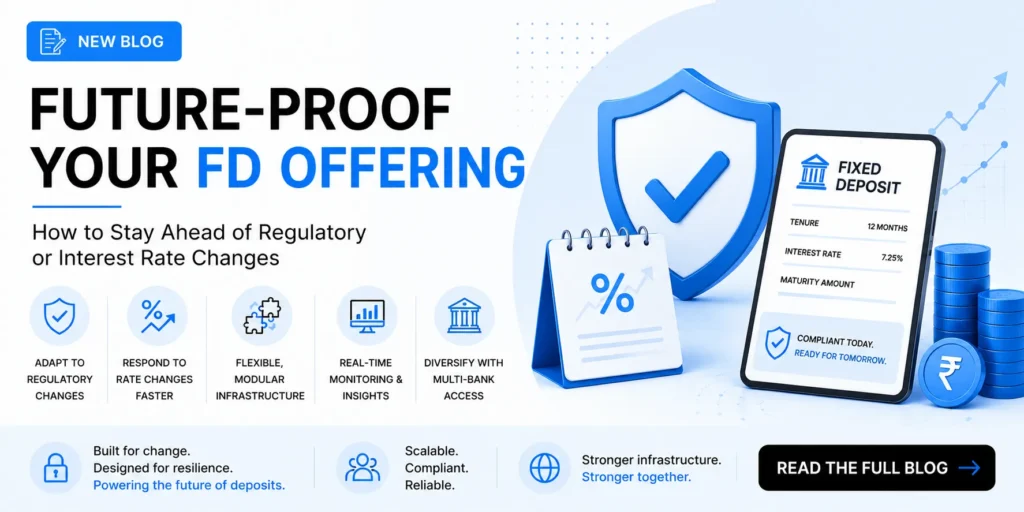
Fixed Deposits (FDs) have remained one of the most trusted financial products for decades because they offer something users consistently value: predictability. However, for the banks and fintech platforms distributing FDs, predictability is becoming harder to maintain. This raises an important question for banks, fintechs, and infrastructure providers: How do you future-proof FD offerings against regulatory or rate changes? The answer lies in infrastructure, flexibility, and compliance-first design. Why FD Products Face Increasing Volatility FDs are considered stable investments, but the ecosystem around them is not static. Institutions distributing FDs must respond to multiple external forces simultaneously. These include: Changes in RBI guidelines and reporting requirements Interest rate fluctuations driven by inflation or monetary policy Shifts in customer demand during economic uncertainty New digital compliance expectations Competition from newer financial products Without adaptive systems, every change creates friction. The Two Biggest Risks to FD Offerings 1. Regulatory Risk Financial products operate in regulated environments. Even small changes in: Documentation requirements KYC norms Reporting obligations Audit expectations can require significant operational updates. If infrastructure is rigid, adapting becomes slow and expensive. 2. Interest Rate Risk FD attractiveness depends heavily on prevailing rates. When rates rise: Demand often increases When rates fall: Customers may move toward alternative products Platforms need the ability to: Update offerings quickly Communicate changes clearly Reposition products dynamically What Future-Proofing Actually Means Future-proofing does not mean predicting every regulatory update or market shift. It means building systems capable of adapting quickly when change happens. A future-proof FD infrastructure should enable: ✓ Rapid compliance updates✓ Flexible product configurations✓ Multi-bank diversification✓ Real-time monitoring✓ Scalable distribution Traditional FD Systems vs Future-Proof Infrastructure Area Traditional FD Systems Future-Proof FD Infrastructure Compliance Updates Manual Embedded & automated Rate Changes Slow updates Real-time adjustments Product Flexibility Limited Modular Scaling Difficult High Monitoring Reactive Continuous Strategy 1: Build Compliance into Infrastructure, Not Operations Many institutions treat compliance as a separate team or workflow. This creates bottlenecks. Instead, compliance should be embedded directly into infrastructure, allowing systems to automatically align with changing requirements. Examples include: Automated KYC workflows Audit-ready logging Built-in reporting systems API-driven compliance checks When regulations change, updates occur at the infrastructure layer instead of requiring operational overhauls. This dramatically reduces adaptation time. Strategy 2: Use Modular, API-Driven Architecture Rigid systems struggle during change because everything is interconnected. Modular systems isolate functions: Onboarding FD booking Reporting Compliance Notifications This means updates can happen to one component without disrupting the entire system. API-driven infrastructure becomes critical here. A modular architecture allows institutions to: Introduce new rules faster Add new banks Update workflows quickly Strategy 3: Diversify Across Multiple Banks Dependence on a single institution increases vulnerability. Future-proof FD ecosystems often rely on multi-bank access, enabling platforms to: Offer different rates Reduce concentration risk Maintain competitiveness during market shifts If one bank changes offerings, distribution remains intact. Diversification increases resilience. Strategy 4: Implement Real-Time Monitoring Many institutions discover problems after users do. Future-proof infrastructure includes: SLA tracking Alert systems Transaction monitoring Compliance monitoring Real-time visibility enables proactive action. Example Monitoring Metrics Metric Why It Matters FD booking success rate Detect friction quickly API latency Maintain reliability Compliance alerts Reduce regulatory risk Rate update frequency Ensure accuracy Strategy 5: Make Product Configuration Dynamic Traditional FD systems often require manual updates whenever rates or terms change. Future-proof platforms enable: Dynamic rate updates Flexible tenure configurations Instant product modifications This improves responsiveness and reduces operational burden. Strategy 6: Prepare for Audit Requirements Continuously Audit preparation should not begin before an audit. Future-ready infrastructure maintains: Immutable logs Automated records Continuous reporting Audit readiness becomes a byproduct of operations rather than a separate effort. Why Infrastructure Matters More Than Predictions Organizations often focus on forecasting: “What will RBI change next?” “Will rates increase?” These questions matter—but infrastructure matters more. Because institutions rarely win by predicting perfectly. They win by adapting quickly. How Finspring Helps Future-Proof FD Offerings Finspring is designed around compliance-first, API-driven FD infrastructure, helping banks and fintechs respond faster to change. Key capabilities include: 1. Multi-Bank FD Infrastructure Allows platforms to diversify offerings and reduce dependency. 2. Embedded Compliance Systems Supports: KYC workflows Reporting Audit readiness making regulatory adaptation easier. 3. Real-Time Monitoring Tracks: Performance Reliability SLA metrics to maintain operational resilience. 4. Plug-and-Play APIs Enable rapid updates without rebuilding systems. Example: Responding to an RBI Update Imagine new reporting requirements are introduced. Legacy setup: Manual review Process redesign Team coordination Delayed implementation API-first infrastructure: Compliance layer updated Workflows adjusted automatically Reporting standardized Response time shrinks dramatically. The Future of FD Distribution The next generation of FD infrastructure will likely include: AI-driven compliance monitoring Predictive risk detection Dynamic product optimization Automated regulatory adaptation The institutions that succeed will not necessarily have the highest rates. They will have the most adaptable infrastructure. Conclusion Future-proofing FD offerings is no longer optional. Regulatory expectations will continue evolving, and market conditions will continue shifting. The question is not whether change will happen. The question is whether your infrastructure is designed to absorb it. Banks and fintechs that invest in: Compliance-first systems API-driven architecture Real-time monitoring Modular infrastructure will be better positioned to maintain trust, scale distribution, and adapt without disruption. Because in financial services, long-term success does not come from avoiding change. It comes from building systems that evolve with it.

Fixed Deposit

Audit Trails in Fintech: Requirements, Architecture, and Implementation for FD Systems

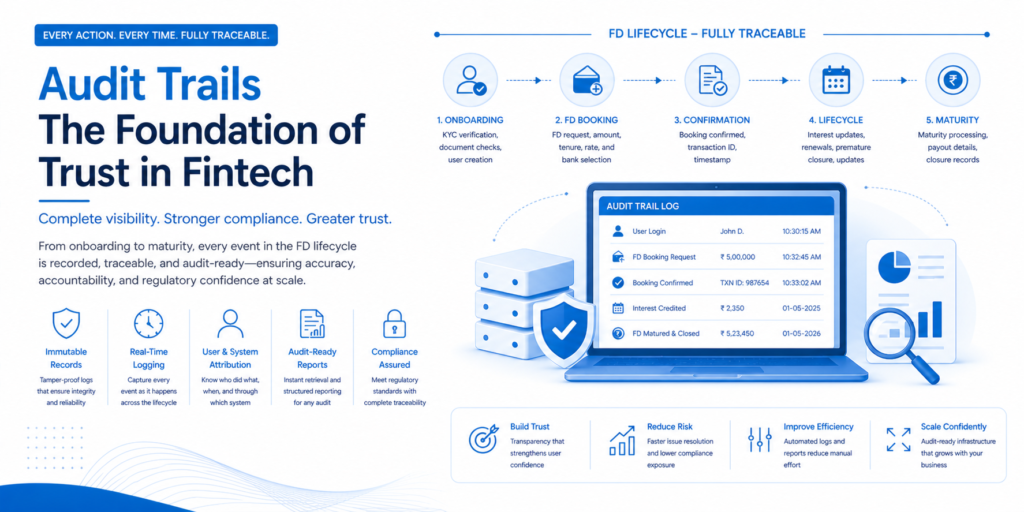
In fintech, every transaction tells a story. But without a reliable way to record, trace, and verify that story, even the most advanced systems become fragile. This is where FD audit trails become essential. Particularly in fixed deposit (FD) infrastructure, audit trails are not just compliance artifacts—they are the foundation of trust, accountability, and operational clarity. As financial systems scale and regulatory scrutiny increases, fintech platforms must move beyond basic logging and adopt structured, real-time, and audit-ready systems. This article explores what audit trails mean in fintech, why they are critical for FD systems, and how to implement them effectively. What is an Audit Trail in Fintech? An audit trail is a chronological, immutable record of all activities, transactions, and system events that occur within a financial platform. It captures not only what happened, but also: Who performed the action When it occurred What data was involved What changes were made What the system response was In the context of FD systems, audit trails track the entire lifecycle of a deposit—from onboarding and booking to maturity and closure—ensuring that every step is traceable and verifiable. Why Audit Trails Are Critical in FD Infrastructure Fixed Deposits are inherently trust-driven products. Users expect: Accurate records Timely updates Transparent communication At the same time, regulators require: Complete transaction visibility Accurate reporting Verifiable compliance Audit trails bridge these expectations by ensuring that every action within the FD lifecycle is documented and accessible. Without strong audit trails, platforms face: Disputes without evidence Compliance gaps Delayed audits Increased operational risk Regulatory Expectations for Audit Trails In regulated environments like India, audit trails must meet strict standards. While exact requirements vary, the following principles are universally expected: Key Requirements: Immutability: Records cannot be altered or deleted once created Completeness: Every critical action must be logged Timestamp Accuracy: Events must be recorded with precise timestamps User Attribution: Each action must be linked to a specific user or system Data Integrity: Logs must remain consistent and tamper-proof Accessibility: Records must be retrievable for audits and investigations Core Components of an Effective Audit Trail System 1. Event Logging Layer At the foundation is a system that captures every relevant event, including: User onboarding actions FD booking requests Transaction confirmations Status updates Lifecycle events (renewals, withdrawals) This layer ensures that no critical activity goes unrecorded. 2. Immutable Data Storage Audit logs must be stored in a way that prevents modification. This can include: Write-once storage systems Blockchain-inspired append-only logs Encrypted databases with restricted access Immutability ensures that audit trails remain trustworthy and legally defensible. 3. Timestamping and Sequencing Every event must include: Accurate timestamps Sequential ordering This allows auditors and internal teams to reconstruct the exact sequence of events, which is critical for: Dispute resolution Compliance verification Incident analysis 4. User and System Attribution Audit trails must clearly indicate: Which user initiated an action Which system processed it This creates accountability and ensures that every action can be traced back to its source. 5. Retrieval and Reporting Layer Audit data is only useful if it can be accessed easily. Systems must provide: Searchable logs Structured reporting Export capabilities This ensures that audits can be conducted efficiently without manual data compilation. FD Lifecycle Audit Trail Example Stage Event Logged Key Data Captured Onboarding KYC submission User details, timestamp, verification status Booking FD creation request Amount, tenure, bank, request ID Confirmation FD booked Confirmation ID, processing time Lifecycle Interest accrual updates Periodic updates, calculated values Maturity FD closure Final amount, payout details This structured logging ensures that every stage of the FD journey is fully traceable. Common Challenges in Audit Trail Implementation 1. Incomplete Logging Many systems log only major events, missing critical intermediate steps. This creates gaps that make audits difficult and unreliable. 2. Data Silos Audit data is often stored across multiple systems, making it difficult to: Consolidate information Maintain consistency Generate unified reports 3. Performance Trade-Offs Extensive logging can impact system performance if not designed correctly. Platforms must balance: Data capture requirements System efficiency 4. Manual Retrieval Processes In some systems, retrieving audit data requires: Manual queries Cross-team coordination This slows down audits and increases operational overhead. Best Practices for Implementing Audit Trails 1. Log Everything That Matters Focus on capturing: User actions System responses Data changes Avoid selective logging that creates blind spots. 2. Design for Immutability Ensure that once data is written: It cannot be altered It remains tamper-proof This is critical for regulatory compliance. 3. Standardize Across Systems Use consistent formats and structures for: Event logs Data fields Reporting templates This simplifies integration and analysis. 4. Enable Real-Time Logging Logs should be captured: Instantly Continuously This ensures that no events are missed and data remains accurate. 5. Build Audit-Ready Reporting Design systems that can: Generate reports instantly Provide structured data outputs This reduces audit preparation time significantly. Traditional vs Modern Audit Trail Systems Aspect Traditional Systems Modern Audit Trail Systems Logging Partial and manual Comprehensive and automated Storage Editable databases Immutable storage systems Retrieval Manual and slow Real-time and searchable Scalability Limited High and system-driven Audit Readiness Reactive Continuous The Role of Audit Trails in Building Trust Audit trails are not just for regulators—they directly impact user trust. When systems are transparent and reliable: Users feel confident about their investments Disputes can be resolved quickly Platforms demonstrate accountability In FD systems, where trust is paramount, audit trails become a core product capability, not just a backend requirement. How Finspring Enables Audit-Ready FD Infrastructure Finspring integrates audit trail capabilities directly into its FD infrastructure, ensuring that: Every transaction is logged in real time Data is stored securely and immutably Reports can be generated instantly Systems remain audit-ready at all times This allows platforms to: Launch with confidence Scale without compliance concerns Maintain transparency across operations The Future of FD Audit Trails in Fintech As fintech systems evolve, audit trails will become more advanced, incorporating: AI-driven anomaly detection Real-time compliance monitoring Predictive risk analysis Cross-platform audit integration The goal is not just to record what happened, but to

FD Products Image
Fixed Deposit

Can We Launch FD Products Across Multiple Partner Banks Using a Single Integration?

Fixed Deposits (FDs) continue to be one of India’s most trusted investment products. Despite the rapid rise of equities, digital assets, and alternative investments, millions of users still prefer FDs for stability, predictable returns, and lower risk exposure. For fintechs, wealth platforms, neo-banks, payroll apps, employee benefit platforms, and consumer-facing digital ecosystems, this creates a large opportunity: Can FD products become a monetizable offering without building relationships and infrastructure with multiple banks individually? The short answer: Yes — modern API infrastructure allows businesses to launch FD products across multiple partner banks through a single integration layer. This approach dramatically reduces operational complexity while accelerating go-to-market timelines. In this article, we explore how multi-bank FD integration works, why it matters, and what platforms should evaluate before adopting it. Why Multi-Bank FD Products Access Matters Traditionally, launching Fixed Deposit offerings required businesses to: Build partnerships with individual banks Undergo separate compliance processes Develop bank-specific integrations Maintain multiple APIs Handle fragmented reporting systems Support different onboarding workflows For a platform wanting access to 5–10 FD issuers, this often meant months of engineering and business development work. The result: Higher costs, slower launches, and significant maintenance overhead. Meanwhile, user expectations have changed. Consumers increasingly expect: Choice between institutions Comparative interest rates Flexible tenure options Instant onboarding Digital journeys with minimal paperwork Providing only one bank’s FD product can limit competitiveness. The Shift Toward Embedded Finance Infrastructure Embedded finance has transformed how financial products reach end users. Instead of customers visiting separate institutions for investments, insurance, or lending products, platforms can distribute these offerings directly inside their existing ecosystems. Examples include: Investment features inside payroll platforms Wealth products inside banking apps Savings products within employee wellness portals FD offerings integrated into consumer fintech applications This shift creates demand for plug-and-play financial infrastructure. Multi-bank FD integrations are part of this evolution. What Does “Single Integration for Multiple Partner Banks” Actually Mean? A single integration model means: Your platform integrates once with an infrastructure provider, while that provider manages connectivity with multiple partner banks behind the scenes. Instead of: Platform → Bank APlatform → Bank BPlatform → Bank CPlatform → Bank D The architecture becomes: Platform → FD Infrastructure Layer → Multiple Banks This infrastructure layer handles: Bank connectivity Product availability Compliance workflows KYC coordination Reporting Transaction orchestration Updates and maintenance For platforms, this significantly simplifies deployment. How Multi-Bank FD products Infrastructure Typically Works Although implementation varies, the process often follows these stages: 1. Platform Integration The business integrates APIs or SDKs into its application. This may include: User onboarding flows FD listings Eligibility checks Investment journeys Dashboard visibility 2. User Selection Users can compare available FD products options based on: Interest rates Tenure Lock-in periods Premature withdrawal policies Institution preference Providing options can improve conversion and engagement. 3. Compliance & Verification Identity verification processes may be initiated as required. Infrastructure providers often streamline compliance requirements across partner institutions. 4. FD Booking Once users select a product: Funds are processed Bank-specific workflows execute Confirmation is generated The experience remains within the host platform. 5. Portfolio Visibility Users may track investments from one interface rather than navigating multiple banking portals. Unified experiences often increase retention. Advantages of Launching Across Multiple Banks Through One Integration Faster Go-To-Market Building separate bank integrations can significantly delay product launches. Single integration models reduce implementation timelines and enable faster deployment. For startups and growth-stage platforms, speed often matters as much as functionality. Wider Product Coverage Different banks offer: Different FD rates Different tenure structures Different investment thresholds Multi-bank access increases user choice. More options can lead to better product-market fit across diverse customer segments. Reduced Engineering Complexity Maintaining multiple APIs introduces ongoing challenges: Version updates Downtime monitoring Documentation changes Support requirements A unified infrastructure layer minimizes these burdens. Easier Scalability Launching with two banks is one thing. Expanding to ten or twenty institutions is another. Single integrations help platforms scale product distribution without rebuilding infrastructure repeatedly. Improved User Experience Users increasingly prefer marketplaces rather than limited offerings. Comparison capability can improve trust and decision-making. Potential Revenue Expansion Financial products often create monetization opportunities through distribution models. Adding FD products may support: New revenue streams Increased user lifetime value Higher engagement frequency Expanded financial ecosystems Who Benefits Most From Multi-Bank FD Integration? Several business categories can benefit: Fintech Platforms Apps focused on wealth, savings, payroll, or investing can expand offerings quickly. Neo-Banks Digital-first banking experiences can increase product depth without building internally. Wealth Management Platforms Advisory ecosystems may broaden investment choices. Employee Benefit Platforms Organizations offering financial wellness tools can introduce savings products. Consumer Internet Platforms Large user ecosystems increasingly explore embedded financial products as monetization layers. Questions Businesses Should Ask Before Choosing an FD Products Infrastructure Partner Not all solutions are equal. Evaluate: 1. How many partner banks are available? Breadth affects product diversity. 2. Is onboarding unified? Fragmented onboarding can reduce conversion. 3. How are compliance workflows handled? Financial distribution requires robust compliance processes. 4. What reporting capabilities exist? Operational visibility matters. 5. How scalable is the infrastructure? Growth should not require rebuilding systems. 6. Are APIs developer-friendly? Integration speed often depends on documentation quality and implementation simplicity. 7. How are updates managed? Partner bank changes should not create recurring engineering burdens. The Future: Financial Products as Modular Infrastructure A larger industry trend is emerging. Financial products are increasingly becoming infrastructure components rather than standalone institutions. Businesses no longer need to become banks to distribute financial products. Instead, they can embed capabilities through APIs. This evolution is reshaping: Savings Investments Insurance Lending Wealth products Deposits Fixed Deposits are part of this transformation. Platforms capable of integrating multiple institutions efficiently may gain an advantage in speed, flexibility, and monetization potential. So, Can You Launch FD Products Across Multiple Partner Banks Using a Single Integration? Yes. Modern financial infrastructure increasingly enables businesses to access multiple partner bank FD offerings through a unified integration layer. The result can include: ✓ Faster deployment✓ Reduced engineering effort✓ Expanded product choice✓ Better scalability✓ Improved user experience✓ Potential new

Fixed Deposit

Compliance Bottlenecks in Fintech: Why Growth Slows Without API-Driven Infrastructure

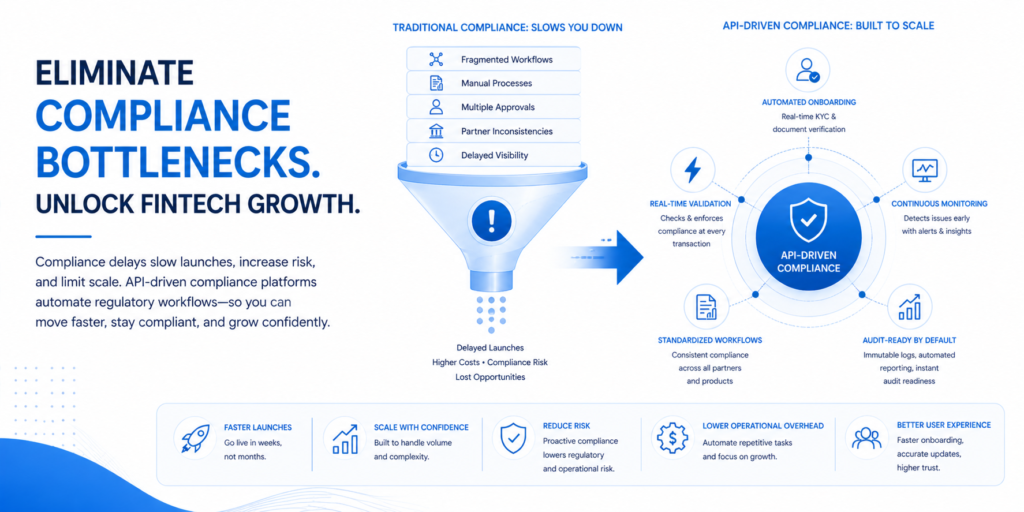
Fintech is designed to move fast. Product teams are built around speed, iteration, and rapid market entry. Yet, despite strong product ideas and clear user demand, many fintech platforms experience unexpected delays in launching and scaling financial products. In most cases, the root cause is not technology, talent, or strategy—it is compliance. Compliance bottlenecks are one of the most underestimated constraints in fintech growth. While innovation pushes forward, compliance requirements operate on a different timeline, often creating friction between what can be built and what can be legally deployed. This gap slows down execution, increases operational complexity, and limits scalability. What Are Compliance Bottlenecks in Fintech? Compliance bottlenecks occur when regulatory requirements, approval processes, and operational checks delay or restrict product development and deployment. These bottlenecks are especially pronounced in sectors involving: Deposits (FDs, savings products) Lending Payments Investment platforms Unlike traditional industries, fintech operates in a highly regulated environment, where every transaction, user interaction, and data flow must align with regulatory frameworks. When systems are not designed to handle this complexity efficiently, compliance becomes a point of friction rather than a support system. Why Compliance Slows Fintech Growth 1. Fragmented Regulatory Workflows In many fintech setups, compliance processes are scattered across: Legal teams Operations teams External vendors Manual documentation systems This fragmentation creates delays because no single system owns the full compliance lifecycle. Each step requires coordination, validation, and often repeated checks, slowing down execution timelines significantly. 2. Manual Processes and Human Dependency A large portion of compliance work still relies on: Manual KYC verification Document validation Approval chains Reporting compilation These processes are not only time-consuming but also prone to errors. As transaction volumes increase, manual systems fail to scale, creating bottlenecks that directly impact growth. 3. Delayed Product Launch Cycles Even when a product is technically ready, compliance validation can delay launches by weeks or months. This includes: Regulatory approvals Documentation checks Risk assessments In fast-moving markets, these delays mean: Missed demand windows Lost competitive advantage Reduced revenue potential 4. Inconsistent Standards Across Partners Fintech platforms often integrate with multiple partners, including banks and financial institutions. Each partner may have: Different compliance requirements Unique documentation formats Varying processing timelines This lack of standardization forces platforms to customize workflows for each integration, increasing complexity and slowing down scalability. 5. Limited Real-Time Visibility Many compliance systems lack real-time monitoring capabilities. As a result: Issues are detected late Violations are identified after the fact Teams react instead of preventing problems This reactive approach increases risk and operational burden. Traditional Compliance vs Api-driven Compliance Platforms Aspect Traditional Compliance Approach API-Driven Compliance Platforms Workflow Management Fragmented and manual Centralized and automated Speed Slow and approval-heavy Fast with real-time validation Scalability Limited High and system-driven Error Rate High due to manual work Reduced through automation Visibility Delayed Real-time monitoring and alerts The Real Cost of Compliance Bottlenecks Compliance delays are often viewed as operational issues, but their impact is far more strategic. They affect: 1. Revenue Growth Delayed launches mean lost opportunities to capture user demand, especially in time-sensitive products like FDs. 2. Product Velocity Teams spend more time managing compliance than building new features, reducing innovation speed. 3. Operational Efficiency Manual processes increase costs and reduce productivity. 4. User Experience Delays in onboarding, transaction processing, or confirmations reduce trust and satisfaction. 5. Risk Exposure Inconsistent or delayed compliance increases the likelihood of regulatory violations. Key Bottlenecks Across the Fintech Lifecycle 1. Onboarding Bottlenecks Slow KYC verification Document mismatches Manual approvals 2. Transaction Bottlenecks Delayed validations Partner dependencies Lack of real-time checks 3. Reporting Bottlenecks Manual data aggregation Inconsistent formats Audit preparation delays 4. Lifecycle Bottlenecks Renewal processing delays Status update inconsistencies Poor tracking systems How API-Driven Compliance Platforms Solve This API-driven compliance platforms are designed to embed compliance directly into the infrastructure layer, eliminating the need for separate processes and manual interventions. Key Capabilities: 1. Automated Compliance Workflows APIs handle: KYC validation Document verification Transaction checks This reduces human dependency and speeds up execution. 2. Real-Time Validation Instead of post-processing checks, API-driven systems validate compliance: During onboarding During transactions During lifecycle events This ensures issues are prevented rather than detected later. 3. Standardization Across Partners API platforms create a uniform compliance layer across multiple banks and partners, removing the need for custom workflows. 4. Continuous Monitoring & Alerts Real-time systems track: Anomalies SLA breaches Compliance deviations This enables proactive issue resolution. 5. Audit-Ready Infrastructure All data is: Logged Structured Accessible This ensures that audits can be handled instantly without additional preparation. Compliance as a Growth Enabler When compliance is automated and embedded, it no longer slows down fintech growth. Instead, it enables: Faster product launches Scalable operations Reduced risk Better user experiences This shift transforms compliance from a bottleneck into a strategic advantage. Example: FD Distribution Without vs With Api-driven Compliance Platforms Stage Without API-Driven Compliance With API-Driven Compliance Onboarding Manual KYC delays Instant automated verification Booking Multiple approval layers Pre-validated workflows Reporting Manual compilation Real-time automated reporting Audit Time-consuming Instant readiness The Role of Finspring Finspring addresses compliance bottlenecks by embedding regulatory workflows directly into its FD infrastructure. Through API-driven systems, platforms can: Launch FD products faster Ensure consistent compliance across partners Reduce operational overhead Maintain audit-ready systems at all times This allows fintech teams to focus on growth and distribution, while compliance runs seamlessly in the background. The Future of Compliance in Fintech As fintech ecosystems become more complex, compliance requirements will continue to evolve. The future will be defined by: Real-time regulatory updates AI-driven anomaly detection Fully automated reporting systems Deeper integration across financial products Platforms that adopt API-driven compliance early will be better equipped to: Scale efficiently Navigate regulatory changes Maintain long-term trust Conclusion Compliance bottlenecks are one of the biggest hidden barriers to fintech growth. While they are often seen as unavoidable, they are largely a result of outdated systems and fragmented workflows. By adopting API-driven compliance platforms, fintechs can eliminate these bottlenecks and transform compliance into a scalable, automated, and reliable system. In modern financial

Fixed Deposit

Compliance-First Infrastructure: Defining the Next Layer of Embedded Finance

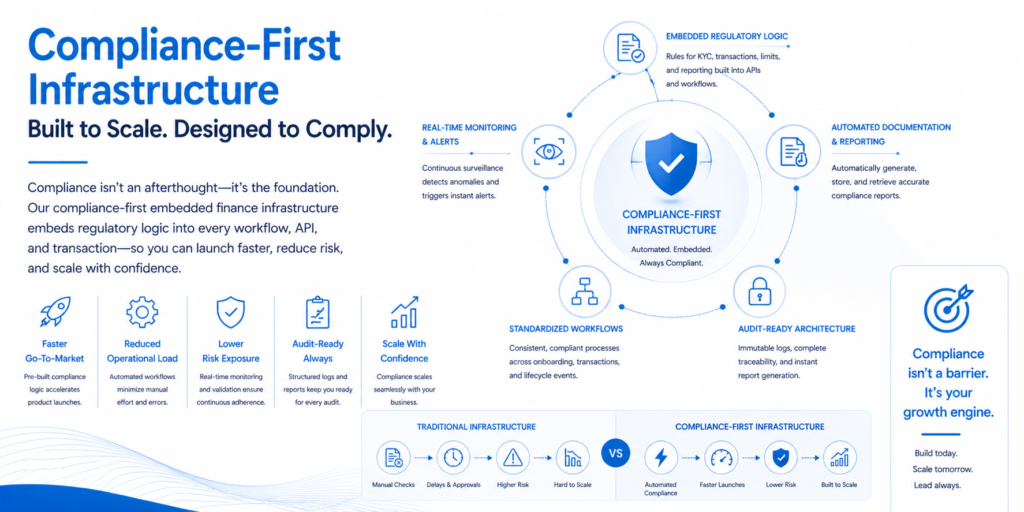
As embedded finance continues to evolve, most conversations focus on speed, user experience, and distribution. However, beneath all of this lies a more fundamental requirement—compliance. In regulated financial ecosystems like India, compliance is not an additional layer; it is the foundation upon which everything else must operate. This is where compliance-first embedded finance infrastructure emerges as a defining category. Compliance-first embedded finance infrastructure refers to systems that are designed with regulatory logic at their core, rather than treating compliance as a post-build requirement. Instead of adding compliance checks after product development, this approach ensures that every workflow, API call, transaction, and lifecycle event is inherently aligned with regulatory expectations from day one. What is Compliance-first Embedded Finance Infrastructure? Compliance-first infrastructure is a design philosophy and technical architecture where regulatory requirements are embedded directly into the infrastructure layer, ensuring that every financial operation automatically adheres to applicable laws, audit standards, and reporting norms without requiring manual intervention or retrofitting. In traditional systems, compliance is often handled through: Manual checks External tools Post-transaction audits In contrast, compliance-first systems: Automate regulatory workflows Standardize documentation and reporting Enable real-time validation and monitoring This fundamentally shifts compliance from being a bottleneck to becoming an accelerator of growth. Traditional vs Compliance-First Infrastructure Aspect Traditional Infrastructure Compliance-First Infrastructure Compliance Approach Added after development Built into core architecture Speed to Market Slower due to approvals and rework Faster due to pre-built regulatory logic Risk Management Reactive Proactive and automated Audit Readiness Periodic and manual Continuous and real-time Operational Load High Reduced through automation Why Compliance-First Infrastructure is Becoming Critical In today’s fintech ecosystem, regulatory scrutiny is increasing alongside innovation. Financial products—especially those involving deposits, lending, and payments—require strict adherence to frameworks defined by regulators such as the Reserve Bank of India (RBI). As platforms scale, managing compliance manually becomes not only inefficient but also risky. A compliance-first approach addresses this challenge by ensuring that regulatory alignment scales with product growth, rather than becoming a limiting factor. This is particularly important for products like Fixed Deposits (FDs), where trust, documentation accuracy, and reporting integrity are critical. Core Components of Compliance-First Infrastructure 1. Embedded Regulatory Logic At the heart of compliance-first systems is embedded regulatory logic, where rules governing KYC, documentation, transaction limits, and reporting are integrated directly into APIs and workflows. This ensures that every transaction automatically adheres to regulatory requirements without additional checks. 2. Automated Documentation & Reporting Compliance involves extensive documentation, including: KYC records Transaction logs Audit trails A compliance-first system automates the generation, storage, and retrieval of these records, ensuring that platforms remain audit-ready at all times, rather than preparing for audits reactively. 3. Real-Time Monitoring & Alerts Modern compliance is not just about static rules—it requires continuous monitoring. Compliance-first infrastructure includes real-time systems that: Track anomalies Detect irregular transactions Trigger alerts for potential violations This allows platforms to respond immediately, reducing risk exposure. 4. Standardized Workflows One of the biggest sources of compliance risk is inconsistency. Compliance-first systems standardize workflows across: Onboarding Transactions Lifecycle events This ensures that every user and every transaction follows the same compliant process, regardless of scale. 5. Audit-Ready Architecture Instead of scrambling during audits, compliance-first infrastructure ensures that: Data is structured and accessible Reports can be generated instantly Historical records are complete and accurate This transforms audits from a stressful process into a routine check. Key Benefits of Compliance-First Infrastructure 1. Faster Go-To-Market When compliance is already built into the system, platforms can launch products faster without waiting for extensive validation cycles. This is especially important in time-sensitive markets where user demand shifts quickly. 2. Reduced Operational Complexity By automating compliance workflows, platforms reduce the need for: Manual checks Reconciliation efforts Cross-team coordination This leads to cleaner operations and better efficiency. 3. Lower Risk Exposure Compliance failures can result in: Financial penalties Reputational damage Regulatory restrictions Compliance-first infrastructure minimizes these risks by ensuring continuous adherence. 4. Improved Trust & Credibility In financial services, trust is directly linked to reliability and compliance. Platforms that consistently deliver compliant experiences build stronger user confidence and long-term credibility. Challenges Without Compliance-First Infrastructure Platforms that do not adopt this approach often face: Delayed product launches due to compliance bottlenecks Increased dependency on manual processes Higher probability of errors and inconsistencies Difficulty scaling operations across multiple products Over time, these challenges compound, slowing growth and increasing risk. Compliance-first Embedded Finance Infrastructure in Action (FD Example) Let’s consider how this applies to FD distribution: Stage Without Compliance-First Infra With Compliance-First Infra User Onboarding Manual KYC checks, delays Automated KYC validation FD Booking Multiple approvals required Pre-approved compliant workflows Reporting Manual compilation Real-time automated reporting Audit Time-consuming preparation Instant audit readiness This illustrates how compliance-first infrastructure transforms execution speed, reliability, and scalability. The Shift Toward Compliance as a Growth Enabler Historically, compliance has been viewed as a constraint—something that slows down innovation. However, the shift toward compliance-first infrastructure reframes this perspective. When compliance is: Automated Standardized Embedded It no longer delays execution. Instead, it enables platforms to: Launch confidently Scale without friction Operate within regulatory boundaries effortlessly This turns compliance into a competitive advantage. The Role of Finspring in Compliance-First Infrastructure Finspring is built on the principle that financial infrastructure should be compliance-ready from day one. By embedding regulatory workflows directly into its FD infrastructure, Finspring enables platforms to: Launch FD products without compliance delays Maintain audit-ready systems at all times Scale distribution without increasing operational risk Through its plug-and-play SDK and API-driven architecture, Finspring ensures that compliance is not something platforms need to manage separately—it is already part of the system. The Future of Compliance-first Embedded Finance Infrastructure As fintech continues to evolve, compliance-first infrastructure will become the standard rather than the exception. Future systems will likely include: AI-driven compliance monitoring Predictive risk detection Real-time regulatory updates Deeper integration across financial products The platforms that adopt this approach early will be better positioned to: Navigate regulatory changes Scale across markets Build long-term trust Conclusion Compliance-first infrastructure represents a fundamental shift in how financial systems are designed and

cooperative bank digital compliance tools
Fixed Deposit

Compliance Tools for Co-op Banks: Building Scalable, Audit-Ready Systems

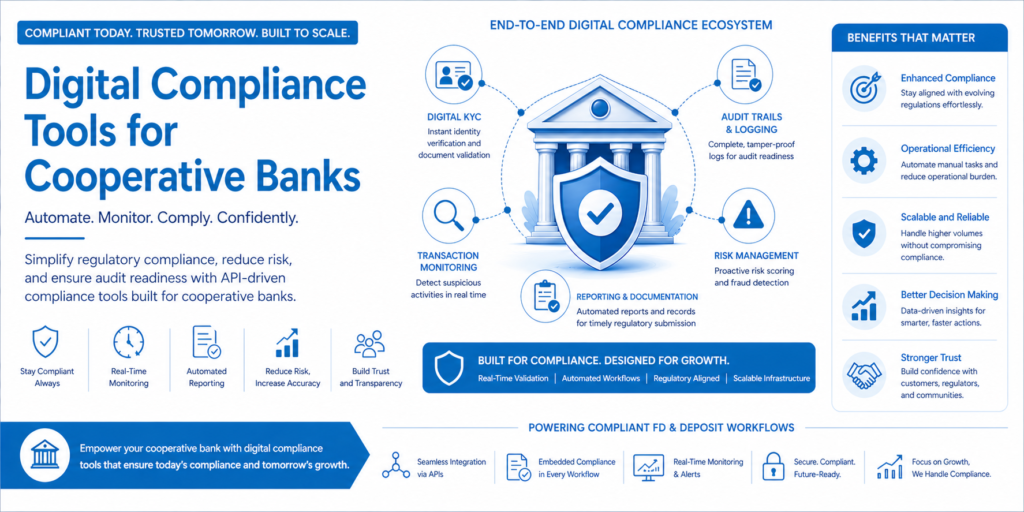
Cooperative banks operate in one of the most tightly regulated environments in the financial ecosystem. While their strength lies in community trust and localized operations, the increasing complexity of regulations, reporting requirements, and digital transactions has made compliance more demanding than ever. This is where cooperative bank digital compliance tools become essential. Compliance is no longer just a backend requirement—it is a core operational layer that directly impacts scalability, trust, and long-term sustainability. For cooperative banks aiming to modernize and compete with fintech platforms, adopting digital compliance tools is not optional—it is foundational. In this article, we explore what digital compliance tools are, why they matter for cooperative banks, and how infrastructure platforms like Finspring enable compliant, scalable systems. What Are Cooperative Bank Digital Compliance Tools? Cooperative bank digital compliance tools are software systems and infrastructure layers that automate, manage, and enforce regulatory requirements across all banking operations. These tools are designed to handle: KYC (Know Your Customer) verification Transaction monitoring Reporting and audit trails Risk management Regulatory compliance workflows Instead of relying on manual processes, these tools ensure that compliance is integrated into daily operations, reducing errors and improving efficiency. Why Compliance is More Challenging for Cooperative Banks Cooperative banks face unique challenges when it comes to compliance, largely due to their structure and legacy systems. 1. Manual and Paper-Based Processes Many cooperative banks still rely on: Physical documentation Manual verification Offline record-keeping This increases: Processing time Error rates Compliance risks 2. Evolving Regulatory Requirements Regulators are continuously updating guidelines related to: KYC norms Reporting standards Data security Keeping up with these changes manually is difficult. 3. Limited Technical Resources Compared to large banks, cooperative banks often have: Smaller IT teams Limited budgets This makes building compliance systems internally challenging. 4. Increased Transaction Volumes As digital adoption grows, transaction volumes increase, making manual compliance processes unsustainable at scale. The Shift to Digital Compliance Digital compliance tools address these challenges by automating workflows and embedding compliance directly into the infrastructure. Key advantages: Real-time validation of transactions Automated reporting and documentation Reduced manual intervention Improved accuracy and consistency This shift transforms compliance from a reactive process into a proactive system. Core Components of Digital Compliance Tools To effectively support cooperative banks, compliance tools must include several critical components. 1. Digital KYC Systems KYC is the foundation of compliance. Digital tools enable: Instant identity verification Document validation Automated onboarding workflows This ensures that all customers meet regulatory requirements before accessing services. 2. Transaction Monitoring Compliance tools must track: Transaction patterns Suspicious activities Threshold breaches Real-time monitoring helps detect and prevent fraud or regulatory violations. 3. Audit Trails and Logging Every action must be recorded, including: User activities System events Transaction details This ensures transparency and audit readiness. 4. Reporting and Documentation Compliance requires: Accurate reports Timely submissions Standardized formats Digital tools automate these processes, reducing the burden on teams. 5. Risk Management Systems Advanced tools include: Risk scoring models Fraud detection algorithms Alert systems These help banks identify and mitigate risks proactively. Traditional vs Digital Compliance Systems Aspect Traditional Compliance Digital Compliance Tools Process Manual Automated Speed Slow Real-time Accuracy Error-prone High Scalability Limited High Audit Readiness Reactive Continuous Challenges Without Digital Compliance Tools Cooperative banks that do not adopt digital compliance tools often face: Delays in onboarding and transactions Increased risk of regulatory violations High operational costs Difficulty scaling operations Poor audit readiness Over time, these issues can impact both growth and reputation. The Role of API Infrastructure in Compliance API infrastructure plays a crucial role in enabling digital compliance by: Connecting compliance systems with core banking platforms Automating workflows across systems Enabling real-time validation and monitoring Standardizing processes across partners This makes compliance seamless, scalable, and efficient. How Finspring Enables Digital Compliance Finspring provides API-first infrastructure that integrates compliance directly into FD and deposit workflows, making it a powerful enabler of cooperative bank digital compliance tools. 1. Embedded Compliance Workflows Finspring integrates: KYC validation Documentation checks Regulatory workflows This ensures that every transaction is compliant by design. 2. Automated Reporting Banks can: Generate reports in real time Maintain accurate records Ensure timely submissions 3. Audit-Ready Systems Finspring provides: Complete audit trails Structured data storage Easy retrieval of records This simplifies audits and reduces preparation time. 4. Real-Time Monitoring Finspring tracks: Transaction performance Compliance metrics System health This enables proactive issue detection and resolution. Example: Compliance Workflow with Finspring Stage Traditional Process Digital Process with Finspring Onboarding Manual KYC Instant verification Transaction Monitoring Periodic checks Real-time tracking Reporting Manual compilation Automated reporting Audit Time-consuming Instant readiness Benefits of Digital Compliance Tools for Cooperative Banks 1. Improved Efficiency Automation reduces: Manual workload Processing time Errors 2. Enhanced Compliance Digital tools ensure: Consistent adherence to regulations Accurate reporting Reduced risk of violations 3. Scalability Banks can handle: Higher transaction volumes More customers Complex workflows without increasing operational burden. 4. Better Transparency Audit trails and real-time monitoring provide: Clear visibility into operations Improved accountability 5. Stronger Trust Reliable compliance systems build: Customer confidence Regulatory trust Long-term credibility Best Practices for Implementation 1. Start with Core Compliance Areas Focus on: KYC Transaction monitoring Reporting 2. Use API-First Solutions Adopt platforms that: Integrate easily Automate workflows Scale efficiently 3. Ensure Data Security Implement: Encryption Access controls Secure storage 4. Train Teams Ensure staff understand: Digital tools Compliance workflows System usage The Future of Compliance for Cooperative Banks Digital compliance will continue to evolve with: AI-driven risk detection Real-time regulatory updates Automated decision-making systems Deeper integration with financial products These advancements will make compliance: Faster Smarter More efficient Conclusion Cooperative bank digital compliance tools are essential for modern banking operations. By automating workflows, ensuring real-time validation, and maintaining audit readiness, these tools enable cooperative banks to scale efficiently while staying compliant. Platforms like Finspring play a critical role by embedding compliance directly into financial infrastructure, particularly in FD and deposit systems. This allows cooperative banks to focus on growth while maintaining regulatory alignment. Because in today’s financial ecosystem, compliance is not just a requirement.It is a

digital onboarding solutions for cooperative banks
Fixed Deposit

Digital Onboarding for Co-op Banks: Building Scalable Entry Points with Modern Infrastructure

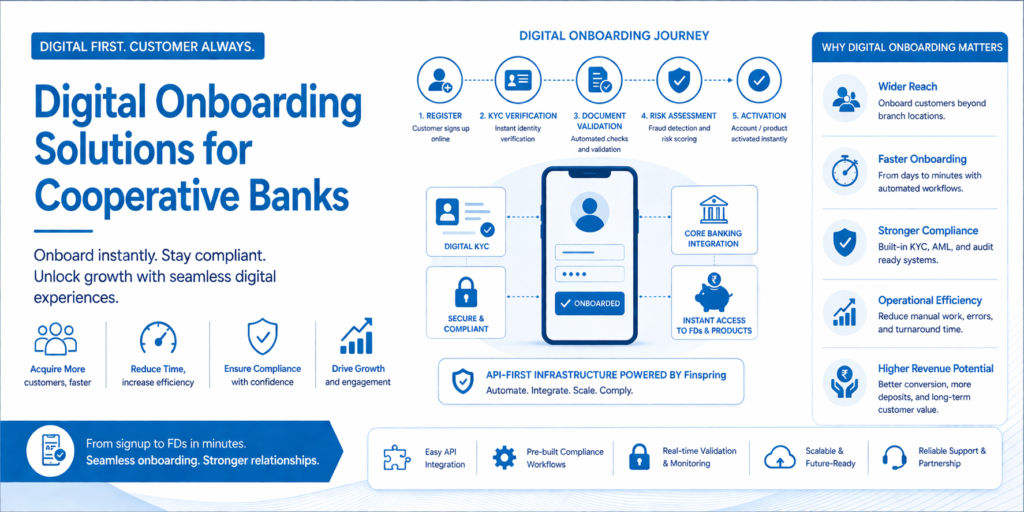
For cooperative banks, the first interaction with a customer has traditionally happened at a branch. Forms, document verification, and manual approvals have defined onboarding for decades. While this model built trust locally, it is no longer aligned with how users expect to access financial services today. Customers now expect instant, seamless, and digital onboarding experiences, regardless of the type of bank. This is why digital onboarding solutions for cooperative banks are becoming a critical part of transformation strategies. Onboarding is no longer just an operational step—it is a growth lever that directly impacts acquisition, conversion, and long-term engagement. In this article, we explore how digital onboarding works, why it matters for cooperative banks, and how infrastructure platforms like Finspring enable compliant and scalable onboarding systems. What is Digital Onboarding for Cooperative Banks? Digital onboarding refers to the process of acquiring, verifying, and activating customers entirely through digital channels, without requiring physical branch visits. It replaces manual workflows with automated systems that handle: Identity verification (KYC) Document submission and validation Risk assessment Account or product activation For cooperative banks, digital onboarding solutions enable them to extend their reach beyond physical locations, allowing customers to access services through mobile apps, websites, or partner platforms. Why Digital Onboarding is Critical Today The shift toward digital onboarding is not just a trend—it is a necessity driven by structural changes in the financial ecosystem. 1. Changing User Expectations Today’s users expect: Instant account creation Minimal paperwork Real-time confirmations If onboarding takes days instead of minutes, users drop off. 2. Competition from Fintech Platforms Fintech companies have set new standards for onboarding: Fully digital journeys Simple interfaces Fast processing Cooperative banks must match this experience to remain competitive. 3. Expansion Beyond Local Markets Digital onboarding allows cooperative banks to: Acquire customers outside their immediate geography Scale without opening new branches Reach younger, tech-savvy users 4. Regulatory Alignment Regulators are increasingly supporting digital KYC and verification methods, making it easier for banks to adopt digital onboarding while remaining compliant. Traditional vs Digital Onboarding Aspect Traditional Onboarding Digital Onboarding Process Manual and paper-based Automated and digital Time Days to weeks Minutes Reach Limited to branch location Nationwide Error Rate High Low User Experience Friction-heavy Seamless Key Components of Digital Onboarding Solutions To build effective digital onboarding solutions for cooperative banks, several components must work together seamlessly. 1. Digital KYC (Know Your Customer) Digital KYC enables identity verification using: Aadhaar-based verification PAN validation Document uploads This replaces manual verification and ensures compliance with regulatory requirements. 2. Document Processing & Validation Automated systems handle: Document uploads Data extraction Validation checks This reduces errors and speeds up processing. 3. Risk and Fraud Detection Onboarding systems must include: Risk scoring Fraud detection mechanisms Transaction monitoring This ensures that only legitimate users are onboarded. 4. Workflow Automation Automation handles: Approval processes Data validation Status updates This eliminates manual bottlenecks. 5. Integration with Core Systems Onboarding systems must connect with: Core banking systems Compliance platforms Product modules (like FDs) This ensures a smooth transition from onboarding to usage. Challenges in Implementing Digital Onboarding While the benefits are clear, cooperative banks face several challenges in adopting digital onboarding solutions. 1. Legacy Systems Existing infrastructure may not support: API integrations Real-time processing Automation 2. Compliance Complexity Onboarding must meet strict regulatory standards, including: KYC requirements Data security norms Audit readiness 3. Limited Technical Resources Many cooperative banks lack: Large engineering teams Advanced technical expertise 4. User Trust and Adoption Customers accustomed to branch interactions may: Hesitate to adopt digital processes Require additional support How API Infrastructure Enables Digital Onboarding API-first infrastructure simplifies onboarding by providing pre-built, reusable components that handle key processes. Benefits include: Faster integration with KYC providers Automated compliance workflows Real-time validation and monitoring Scalable systems that handle increasing volumes Instead of building onboarding systems from scratch, cooperative banks can use APIs to assemble digital onboarding capabilities quickly and efficiently. The Role of Finspring in Digital Onboarding Finspring plays a critical role in enabling digital onboarding within the context of FD and deposit infrastructure. While onboarding itself involves identity verification and compliance, the real value comes from what happens after onboarding—product access and activation. Finspring enables: 1. Seamless Transition from Onboarding to FD Booking Once a user is onboarded: They can instantly access FD products Booking can happen within the same flow 2. Embedded Compliance Workflows Finspring integrates: KYC validation Documentation checks Audit-ready systems ensuring that onboarding remains compliant. 3. Multi-Platform Integration Cooperative banks can onboard users through: Their own apps Fintech platforms Partner ecosystems 4. Real-Time Infrastructure Finspring ensures: Instant confirmations Reliable transaction processing Continuous monitoring Example: Digital Onboarding Flow with Finspring Stage Traditional Process Digital Process User Registration Branch visit Online signup KYC Verification Manual Instant API-based Approval Delayed Automated Product Access Separate process Immediate FD access Benefits of Digital Onboarding for Cooperative Banks 1. Higher Conversion Rates Faster onboarding reduces drop-offs and increases: Customer acquisition Product adoption 2. Operational Efficiency Automation reduces: Manual workload Errors Processing time 3. Scalable Growth Digital systems allow banks to: Handle more users Expand reach Scale without additional infrastructure 4. Improved Customer Experience Seamless onboarding leads to: Higher satisfaction Increased trust Better retention Best Practices for Implementing Digital Onboarding 1. Start with Core Use Cases Focus on: Account opening FD onboarding Basic transactions 2. Use API-First Solutions Adopt platforms that: Simplify integration Provide pre-built workflows Ensure compliance 3. Ensure Compliance from Day One Build systems that: Meet regulatory requirements Maintain audit trails Protect user data 4. Educate Customers Help users: Understand digital processes Build trust in the system Transition smoothly The Future of Digital Onboarding Digital onboarding will continue to evolve with: AI-driven identity verification Biometric authentication Real-time risk assessment Fully automated onboarding journeys These advancements will make onboarding: Faster More secure More user-friendly Conclusion Digital onboarding solutions for cooperative banks are no longer optional—they are essential for growth in a digital-first financial ecosystem. By replacing manual processes with automated, API-driven systems, cooperative banks can deliver faster, more reliable, and scalable onboarding experiences. Platforms like

digital transformation for cooperative banks
Fixed Deposit

Digital Transformation for Cooperative Banks: A Practical Guide to Modernizing with API Infrastructure

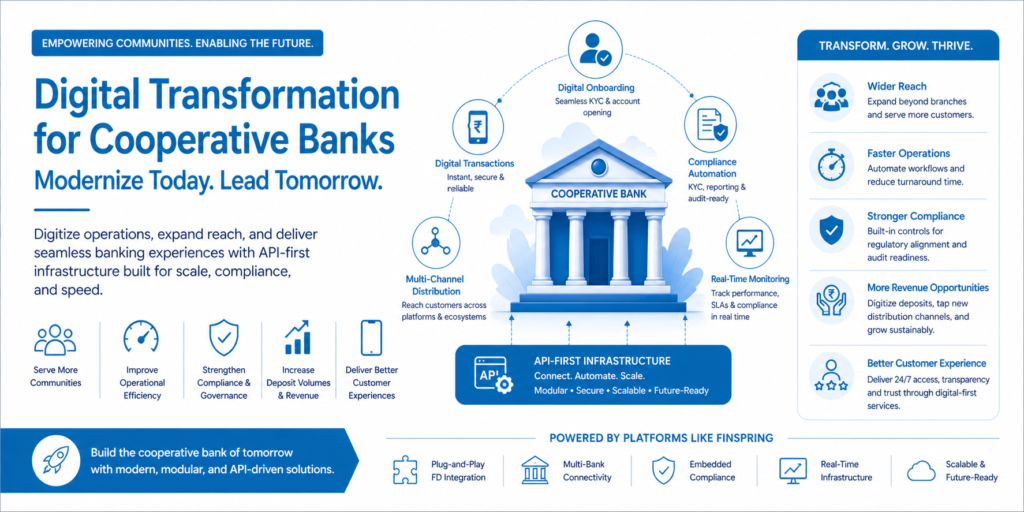
Cooperative banks have long played a vital role in India’s financial ecosystem, especially in serving Tier 2, Tier 3, and rural communities. Built on trust, relationships, and local reach, these institutions have historically focused on stability over speed. However, the rapid shift toward digital financial services is reshaping expectations. Today, customers expect instant access, seamless transactions, and transparent experiences—even from cooperative banks. This is where digital transformation for cooperative banks becomes essential. It is no longer about incremental upgrades or isolated technology projects. It is about rebuilding systems, processes, and distribution models to operate effectively in a digital-first world. In this article, we break down what digital transformation means for cooperative banks, the challenges involved, and how API infrastructure platforms like Finspring enable this shift. What is Digital Transformation for Cooperative Banks? Digital transformation for cooperative banks refers to the process of modernizing core systems, customer interfaces, and operational workflows to deliver financial services digitally, efficiently, and at scale. This includes: Moving from manual to automated processes Enabling online onboarding and transactions Integrating with fintech platforms Ensuring compliance through digital systems Expanding distribution beyond physical branches The goal is not just to digitize existing processes, but to reimagine how banking services are delivered. Why Cooperative Banks Need Digital Transformation Now The urgency for digital transformation is driven by multiple factors: 1. Changing Customer Expectations Customers today expect: Mobile-first experiences Instant confirmations 24/7 access Traditional branch-based models cannot meet these expectations. 2. Increasing Competition Fintech platforms and private banks are: Offering faster services Providing better user experiences Expanding into rural markets Without digital capabilities, cooperative banks risk losing relevance. 3. Regulatory Requirements Regulators are emphasizing: Transparency Real-time reporting Strong compliance frameworks Digital systems are essential to meet these standards efficiently. 4. Operational Efficiency Manual processes lead to: Delays Errors High operational costs Digital transformation reduces these inefficiencies. Key Challenges in Digital Transformation Despite the need, cooperative banks face several challenges when attempting to modernize. 1. Legacy Infrastructure Many cooperative banks rely on: Outdated core banking systems Limited integration capabilities This makes modernization complex and time-consuming. 2. Limited Technical Resources Unlike large banks, cooperative banks often have: Smaller IT teams Limited budgets This restricts their ability to build advanced systems internally. 3. Compliance Complexity Meeting regulatory requirements involves: KYC processes Reporting standards Audit readiness Managing this manually slows down transformation. 4. Integration Challenges Connecting with: Fintech platforms Payment systems External services requires standardized infrastructure, which is often missing. The Role of API Infrastructure in Digital Transformation API infrastructure is the backbone of modern digital systems. It allows cooperative banks to: Connect with external platforms Automate workflows Scale operations Deliver real-time services Instead of rebuilding entire systems, banks can use APIs to add capabilities incrementally, making transformation faster and more manageable. Core Components of Digital Transformation 1. Digital Onboarding Enable customers to: Open accounts online Complete KYC digitally Access services instantly This reduces dependency on physical branches. 2. Transaction Automation Automate: Payments Deposits Transfers to ensure faster and more reliable processing. 3. Compliance Automation Use API-driven systems to handle: KYC validation Reporting Audit trails This ensures regulatory alignment without manual effort. 4. Multi-Channel Distribution Expand beyond branches by integrating with: Mobile apps Fintech platforms Wealth platforms This increases reach and accessibility. 5. Real-Time Monitoring Track: Transactions System performance Compliance metrics to ensure reliability and transparency. Traditional vs Digitally Transformed Cooperative Banks Aspect Traditional Model Digital Model Customer Access Branch-based Multi-channel Processing Speed Slow Real-time Compliance Manual Automated Scalability Limited High User Experience Basic Seamless The Role of Finspring in Digital Transformation Finspring enables cooperative banks to accelerate digital transformation by providing API-first infrastructure for FD and deposit distribution. Key capabilities include: 1. FD Digitization Finspring allows banks to: Offer FDs digitally Integrate with fintech platforms Reach new customer segments 2. Multi-Platform Distribution Banks can distribute FD products across: Wealth apps Investment platforms Digital ecosystems without building new channels. 3. Embedded Compliance Finspring integrates: KYC workflows Reporting systems Audit trails ensuring compliance at scale. 4. Real-Time Infrastructure Banks gain access to: Instant booking confirmations SLA tracking Monitoring systems improving reliability and trust. Example: Digital FD Transformation Stage Traditional Process Digital Process with Finspring Onboarding Manual KYC Instant digital verification Booking Branch visit Online booking Confirmation Delayed Real-time Reporting Manual Automated Benefits of Digital Transformation for Cooperative Banks 1. Increased Customer Reach Digital channels allow banks to: Serve more users Expand beyond local geographies 2. Improved Efficiency Automation reduces: Processing time Errors Operational costs 3. Enhanced Compliance Digital systems ensure: Accurate reporting Audit readiness Regulatory alignment 4. Higher Revenue Potential By integrating with platforms, banks can: Increase deposit volumes Monetize distribution Expand product offerings Best Practices for Implementation 1. Start with High-Impact Areas Focus on: Onboarding Deposits (FDs) Payments to see immediate benefits. 2. Use API-First Infrastructure Adopt modular systems that: Are easy to integrate Scale efficiently Reduce development effort 3. Partner with Infrastructure Providers Work with platforms like Finspring to: Accelerate implementation Reduce complexity Ensure compliance 4. Train Internal Teams Ensure staff can: Use digital systems Manage workflows Support customers The Future of Cooperative Banking Digital transformation will redefine cooperative banks as: Digitally enabled institutions Integrated ecosystem players Scalable financial platforms Banks that embrace this shift will: Compete effectively with fintechs Retain customer trust Grow sustainably Conclusion Digital transformation for cooperative banks is no longer optional—it is essential for survival and growth in a digital-first financial ecosystem. By adopting API-driven infrastructure and modern systems, cooperative banks can overcome legacy limitations and deliver seamless, scalable services. Platforms like Finspring play a crucial role in this journey by enabling banks to digitize FD products, automate compliance, and expand distribution without heavy infrastructure investments. Because the future of cooperative banking is not just about serving communities.It is about serving them faster, better, and at scale through digital systems.

Fixed Deposit

Composable Banking Explained: The Rise of API-First Composable Solutions for Banks

The banking industry is undergoing a structural transformation. Traditional, monolithic systems are no longer able to keep up with the pace of digital innovation, evolving customer expectations, and the need for rapid product deployment. In response, a new model is emerging—composable banking. At the center of this shift are api-first composable solutions for banks, which allow financial institutions to build flexible, modular systems instead of relying on rigid, all-in-one architectures. This approach is not just a technical upgrade—it is a strategic shift in how banks operate, innovate, and scale. In this article, we break down what composable banking means, how it works, and why platforms like Finspring are becoming critical to enabling this transformation. What is Composable Banking? Composable banking is an architectural approach where banks build their systems using modular, interchangeable components rather than a single, monolithic core system. Each component handles a specific function—such as payments, deposits, compliance, or reporting—and can be independently integrated, updated, or replaced. This modularity is made possible through APIs, which act as connectors between different components. Instead of building everything internally, banks can assemble their systems using api-first composable solutions for banks, selecting the best tools for each function. Why Traditional Banking Systems Fall Short Traditional banking infrastructure is built around: Centralized core systems Tight coupling between components Long development cycles While this worked in the past, it creates significant limitations today: Key challenges: Slow innovation: Adding new features requires changes across the entire system High costs: Maintaining and upgrading monolithic systems is expensive Limited flexibility: Adapting to market changes is difficult Integration complexity: Connecting with external platforms is time-consuming These challenges make it clear that a new approach is needed—one that prioritizes speed, flexibility, and scalability. How Composable Banking Works Composable banking breaks down the financial system into independent modules that communicate through APIs. Each module performs a specific function and can be managed separately. Typical components include: Payments module Deposit and FD module Compliance and KYC module Reporting and analytics module Customer onboarding module Each of these components can be powered by different providers, creating a best-of-breed architecture. API-First Composable Solutions for Banks API-first composable solutions are the foundation of this architecture. These solutions are designed to: Expose functionality through APIs from the start Enable seamless integration between modules Support real-time communication Ensure scalability and reliability This approach allows banks to: Build faster Integrate easily Scale efficiently Traditional vs Composable Banking Aspect Traditional Banking Composable Banking Architecture Monolithic Modular Flexibility Low High Speed of Innovation Slow Fast Integration Complex API-driven Scalability Limited High Benefits of Composable Banking 1. Faster Product Launches With modular systems, banks can: Launch new products quickly Test ideas without full system changes Respond to market demand in real time 2. Greater Flexibility Banks can: Replace individual components Integrate new partners Adapt to changing requirements without disrupting the entire system. 3. Improved Scalability Each module can scale independently, allowing banks to: Handle increased demand Optimize performance Reduce system bottlenecks 4. Cost Efficiency Instead of maintaining large monolithic systems, banks can: Use specialized providers Reduce development costs Optimize resource allocation 5. Better User Experience Composable systems enable: Faster transactions Seamless integrations Consistent performance The Role of API Infrastructure in Composable Banking API infrastructure is what makes composable banking possible. It provides: Standardized communication between modules Real-time data exchange Security and compliance layers Monitoring and reliability systems Without strong API infrastructure, composable systems would become fragmented and difficult to manage. Where Finspring Fits In Finspring operates as a specialized API infrastructure provider within the composable banking ecosystem, focusing on FD and deposit distribution. In a composable architecture, Finspring acts as the deposit module, enabling banks and fintech platforms to: Integrate FD products quickly Access multiple banks through a single API Automate compliance workflows Manage the entire FD lifecycle This allows banks to add a deposit layer to their system without building it from scratch. Example: Composable Banking with Finspring Module Provider Type Function Payments Payment API provider Process transactions Deposits (FDs) Finspring FD distribution and lifecycle Compliance KYC/AML provider Regulatory checks Reporting Analytics platform Data insights This modular setup allows banks to: Combine best-in-class solutions Scale each component independently Maintain flexibility Why Composable Banking Matters for FD Distribution Fixed Deposits are becoming increasingly important as users seek stable financial products. However, traditional systems make it difficult to: Integrate multiple banks Manage compliance Scale distribution Composable banking solves this by allowing banks to: Add FD infrastructure as a module Use API-first solutions like Finspring Scale distribution across platforms Challenges in Composable Banking While powerful, composable banking comes with challenges: 1. Integration Complexity Managing multiple modules requires: Strong API management Clear documentation Robust monitoring systems 2. Vendor Coordination Working with multiple providers requires: SLA management Performance tracking Consistent standards 3. Security and Compliance Each module must: Meet regulatory requirements Maintain data security Ensure system integrity Best Practices for Implementing Composable Banking 1. Start with Core Modules Identify key functions such as: Payments Deposits Compliance and build modular systems around them. 2. Choose API-First Providers Ensure that all components: Are API-driven Support real-time operations Provide scalability 3. Standardize Integration Use consistent: Data formats API structures Communication protocols 4. Invest in Monitoring Track: Performance SLAs System health to ensure reliability. The Future of Composable Banking Composable banking will continue to evolve, driven by: Increased API adoption Growth of fintech ecosystems Demand for faster innovation Regulatory changes Future systems will become: More modular More automated More interconnected Conclusion Composable banking represents the future of financial infrastructure. By adopting api-first composable solutions for banks, institutions can move beyond the limitations of traditional systems and build flexible, scalable architectures. Platforms like Finspring play a critical role in this ecosystem by providing specialized infrastructure for FD and deposit distribution. This allows banks to integrate new capabilities quickly and scale efficiently. In a world where speed and flexibility define success, composable banking is not just an option—it is a necessity. Because the banks that win will not build everything themselves.They will assemble the best systems and connect them

api monetization for banks
Fixed Deposit

API Monetization for Banks: Turning Infrastructure into Revenue

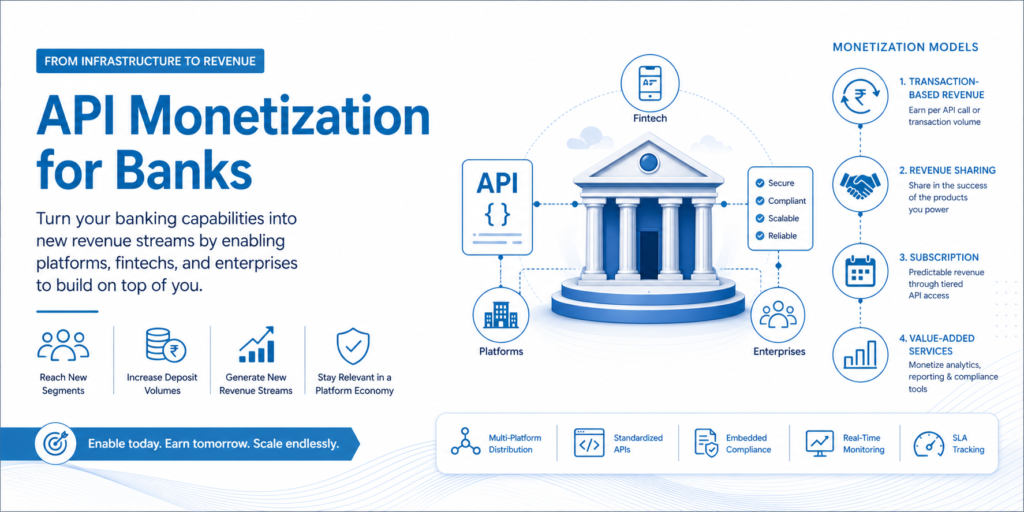
Banks have always been custodians of capital. But in today’s digital economy, they are also custodians of something equally valuable: infrastructure. From payments and deposits to compliance and reporting, banks operate complex systems that fintech platforms increasingly want to access. This shift has created a powerful opportunity—API monetization for banks. Instead of using infrastructure only for internal operations, banks can expose capabilities via APIs and generate revenue by enabling fintechs, platforms, and enterprises to build on top of them. In this article, we break down what API monetization means, how banks can implement it, and how platforms like Finspring fit into this evolving ecosystem. What is API Monetization for Banks? API monetization for banks refers to the process of generating revenue by exposing banking capabilities through APIs. These APIs allow third-party platforms to integrate financial services such as: Payments Fixed deposits (FDs) Account services Compliance workflows Transaction processing Instead of building everything from scratch, fintech platforms can integrate these APIs and offer financial products to their users. In return, banks earn revenue through structured monetization models. Why API Monetization is Becoming Critical The traditional banking model relies heavily on: Branch networks Direct customer acquisition Product-centric distribution However, digital platforms have changed how users interact with financial services. Today, users discover and use financial products within: Apps Marketplaces Wealth platforms This shift means banks must move from owning distribution to enabling distribution. API monetization allows banks to: Reach new customer segments Increase deposit volumes Generate new revenue streams Stay relevant in a platform-driven economy Core API Monetization Models for Banks Banks can monetize APIs in multiple ways depending on their strategy and product offerings. 1. Transaction-Based Revenue In this model, banks earn revenue based on: Number of API calls Volume of transactions processed Example: A fintech platform uses a bank’s FD API to create deposits. The bank earns a fee for each successful booking. 2. Revenue Sharing Model Banks share a portion of the revenue generated through the product. Example: A platform distributes FDs The bank earns deposits Revenue is shared between the bank and the platform This aligns incentives and encourages long-term partnerships. 3. Subscription-Based Access Banks charge platforms for access to their APIs through: Monthly fees Tiered pricing based on usage This model provides predictable revenue. 4. Value-Added Services Banks can monetize additional capabilities such as: Analytics Reporting Compliance tools These services enhance the value of the core API offering. API Monetization in FD Distribution One of the most compelling use cases for API monetization is fixed deposit (FD) distribution. Traditionally, banks relied on: Branches Direct sales Limited digital channels With API infrastructure, banks can now: Distribute FDs across multiple platforms Reach users where they already are Scale without increasing operational overhead FD API Monetization Flow Step Action Revenue Impact 1 Platform integrates FD API Bank gains distribution access 2 User books FD Deposit volume increases 3 Transaction processed Bank earns fees/spread 4 Lifecycle managed Ongoing engagement and revenue Challenges in API Monetization for Banks While the opportunity is significant, banks face several challenges when implementing API monetization strategies. 1. Legacy Systems Many banks operate on legacy infrastructure that is: Difficult to integrate Slow to adapt Not designed for external access 2. Compliance Complexity Exposing APIs requires: Strict regulatory adherence Secure data handling Audit-ready systems 3. Partner Management Working with multiple platforms introduces: Integration challenges SLA management requirements Operational dependencies 4. Lack of Standardization Different banks have different: API formats Data structures Processing timelines This creates friction for platforms integrating multiple providers. How API Infrastructure Platforms Enable Monetization This is where API banking infrastructure companies play a critical role. Instead of banks building everything internally, infrastructure platforms act as a bridge between banks and fintechs. They provide: Standardized APIs Multi-bank integration Compliance automation Real-time monitoring This makes API monetization: Faster to implement Easier to scale More reliable The Role of Finspring in API Monetization Finspring operates as a specialized infrastructure layer focused on FD and deposit distribution. It enables banks to monetize their deposit products without managing complex integrations or distribution channels directly. How Finspring helps banks monetize APIs: 1. Multi-Platform Distribution Finspring connects banks to: Fintech platforms Wealth apps Digital ecosystems This expands reach without requiring additional effort from the bank. 2. Standardized API Layer Instead of dealing with multiple custom integrations, banks can: Plug into a unified API system Offer consistent experiences across platforms 3. Embedded Compliance Finspring integrates: KYC workflows Reporting systems Audit trails This ensures that API monetization remains compliant at scale. 4. Real-Time Monitoring & SLA Tracking Banks gain visibility into: Transaction performance API usage System reliability This ensures consistent service quality. API Monetization vs Traditional Banking Revenue Aspect Traditional Banking API Monetization Distribution Limited to owned channels Multi-platform Scalability Slow High Revenue Streams Product-based Usage-based + product Customer Reach Restricted Expanded Flexibility Low High Benefits of API Monetization for Banks 1. New Revenue Streams Banks can generate income beyond traditional products by monetizing infrastructure. 2. Increased Deposit Volumes By distributing products across platforms, banks can: Acquire more users Increase deposits Improve liquidity 3. Faster Market Expansion APIs enable banks to: Enter new markets Partner with multiple platforms Scale without physical expansion 4. Stronger Ecosystem Positioning Banks become: Infrastructure providers Strategic partners Key enablers of fintech growth The Future of API Monetization The future of banking is not just about products—it is about platforms and ecosystems. API monetization will evolve toward: Real-time revenue tracking AI-driven optimization Deeper integration with fintech ecosystems Specialized infrastructure layers Banks that adopt API monetization early will be better positioned to: Compete with fintech platforms Scale efficiently Build long-term partnerships Conclusion API monetization for banks represents a fundamental shift in how financial institutions generate revenue. By exposing their infrastructure through APIs, banks can move beyond traditional distribution models and become core enablers of the fintech ecosystem. Platforms like Finspring accelerate this transition by providing the infrastructure needed to: Connect banks with fintechs Standardize integrations Automate compliance Scale distribution In the modern financial landscape, the most valuable asset is not

Scroll to Top
Good move, automating your backend!