Finspring

Fixed Deposit

FD Aggregator ROI
Fixed Deposit

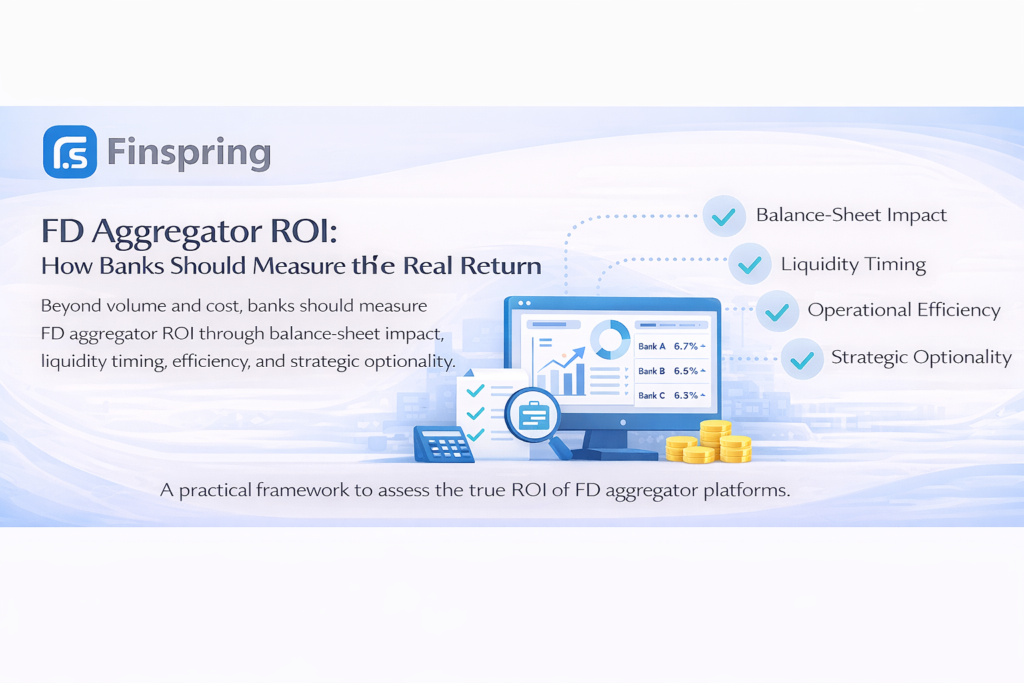
Measuring ROI for FD Aggregator Platforms

Fixed Deposit (FD) aggregator platforms are often evaluated through a narrow lens: How many FDs did we sell, and what did it cost? While volume and cost matter, they are insufficient to measure the true return on FD aggregation. For banks and regulated institutions, FD Aggregator ROI ROI must account for speed, control, predictability, and balance-sheet impact—not just distribution metrics. This article outlines a practical framework for measuring ROI from FD aggregator platforms, grounded in how banks actually operate. Why Traditional ROI Metrics Fall Short Many teams default to metrics like: Cost per FD booking Commission paid vs branch acquisition cost Gross deposit inflows These are useful—but incomplete. They ignore: Liquidity timing benefits Tenure mix improvements Operational cost reductions Governance and compliance efficiency Opportunity cost of slower channels As a result, FD aggregators may appear expensive on paper while quietly delivering net-positive outcomes across the system. A Better Way to Think About FD Aggregator ROIROI FD Aggregator ROI should be measured across four layers: Distribution Efficiency Balance Sheet Impact Operational Leverage Strategic Optionality Each layer answers a different question—and together, they reflect the full return. 1) Distribution Efficiency ROI This is the most visible layer—and the one most teams start with. Key Metrics Time to market for FD campaigns Incremental deposit volumes (net new, not cannibalised) Conversion rates by tenure Campaign responsiveness to rate changes What to Look For Speed advantage: How quickly can the bank mobilise deposits when needed? Incrementality: Are these deposits additive, or would they have arrived anyway? Precision: Can specific tenures be promoted selectively? ROI Insight:If an aggregator enables faster, more targeted deposit mobilisation than branches or static channels, it delivers ROI even if per-booking costs are higher. 2) Balance Sheet ROI (Often Missed) For treasury and ALM teams, this is where ROI becomes tangible. Key Metrics Alignment of inflows to liquidity gaps Tenure-wise deposit composition improvement Reduction in short-term funding reliance Predictability of inflows during campaigns What to Look For Did aggregator-led inflows reduce reliance on bulk deposits or interbank borrowing? Did they improve duration matching? Were inflows timed to actual liquidity needs? ROI Insight:Deposits mobilised at the right time and tenure can be more valuable than cheaper deposits mobilised late. 3) Operational ROI Aggregator platforms often replace or simplify multiple manual processes. Key Metrics Reduction in manual processing per FD Lower servicing and reconciliation effort Fewer exceptions and rework cases Audit readiness and reporting efficiency What to Look For Are teams spending less time on coordination and fixes? Has documentation standardisation reduced friction? Are audits easier to prepare for? ROI Insight:Operational efficiency compounds. Small per-transaction savings add up significantly at scale—and reduce hidden costs that traditional ROI models miss. 4) Strategic Optionality ROI This is the least quantified—but most important—layer. Key Metrics Ability to launch short-term campaigns without system changes Flexibility to pause or cap inflows quickly Ease of onboarding additional aggregators Readiness to expand into adjacent products What to Look For Does the bank gain more control levers? Can strategies be executed without long lead times? Is the institution less dependent on any single channel? ROI Insight:Optionality is value. Infrastructure that increases strategic choices delivers ROI even when not exercised continuously. Separating Gross FD Aggregator ROI from Net ROI A common mistake is to measure gross inflows instead of net impact. To calculate net ROI, banks should: Exclude cannibalised branch volumes Account for tenure and stability differences Factor in cost of alternative funding sources Include operational and treasury offsets Only then does the real return become visible. Short-Term vs Long-Term ROI FD aggregators often look different depending on the timeframe. Short-Term Higher visibility of commissions Faster inflows Immediate reporting improvements Long-Term Better predictability Improved liquidity planning Reduced dependency on reactive funding Stronger governance through standardisation ROI improves over time as patterns stabilise and teams learn how to use the channel intentionally. The Role of Governance in FD Aggregator ROI Outcomes Poor ROI outcomes are rarely caused by aggregators themselves. They usually result from: Lack of inflow caps Unclear campaign objectives Weak coordination between treasury and distribution Overuse instead of targeted use When governance is embedded into the infrastructure—rate controls, tenure rules, caps—ROI becomes predictable. Aggregators as ROI Multipliers, Not Cost Centres The most mature institutions stop viewing FD aggregators as “another channel.” They treat them as: Execution layers for treasury strategy Acceleration layers for distribution Standardisation layers for operations In this model, ROI is not a single number.It is a system-wide improvement. A Practical FD Aggregator ROI Checklist Before concluding whether an FD aggregator “works,” ask: Did it improve timing, not just volume? Did it reduce reliance on emergency liquidity? Did it simplify operations? Did it give treasury more control? Did it increase optionality? If the answer to several of these is yes, the ROI is real—even if it doesn’t show up cleanly in a single metric. Closing Thoughts Measuring ROI for FD aggregator platforms requires moving beyond transactional thinking. The real returns lie in: Faster execution Better balance-sheet outcomes Lower operational friction Greater strategic control Banks that evaluate aggregators purely on cost risk underestimating their value.Banks that evaluate them as infrastructure understand where the true ROI lives. Read the impact on on-boarding FD Aggregator platforms on the treasury teams of banks, here.
FD Aggregators Treasury Impact
Fixed Deposit

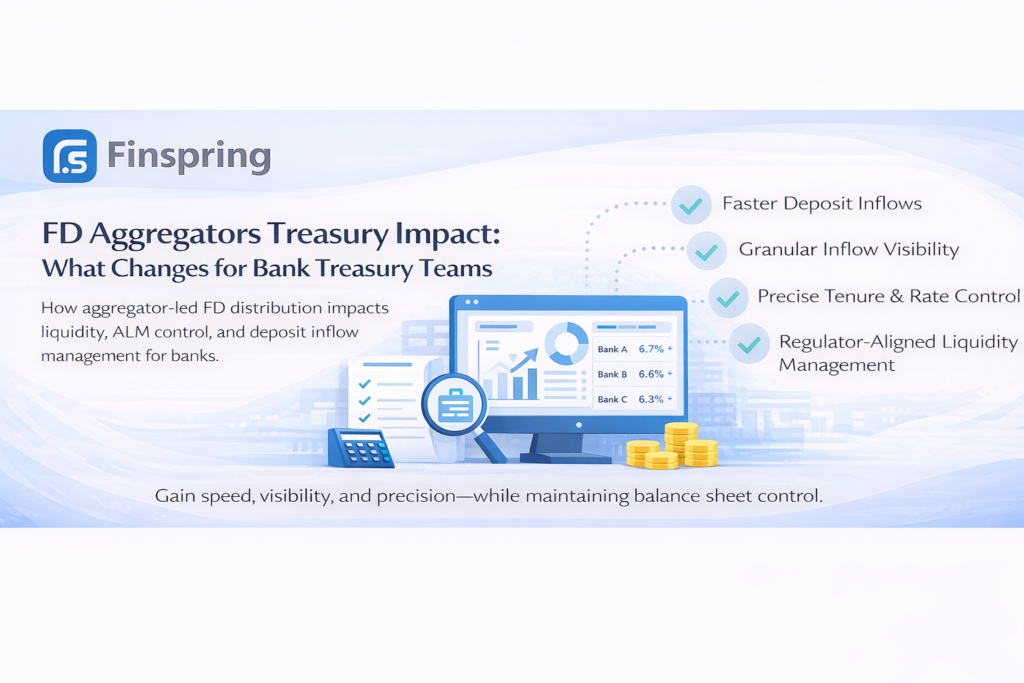
What Changes for Treasury Teams When Banks List FDs on Aggregators

When banks consider listing Fixed Deposits (FDs) on aggregators, the conversation often starts in distribution or digital teams. For treasury teams, however, the implications run deeper. FD aggregators do not merely introduce a new sales channel. They have a larger FD Aggregators Treasury Impact. They change the speed, visibility, and controllability of deposit inflows, which directly affects liquidity planning, pricing discipline, and balance sheet strategy. Understanding what actually changes—and what does not—is essential for treasury teams to engage confidently with aggregator-led FD distribution. What Does Not Change for Treasury Teams Before examining the shifts, it is important to establish what remains constant. Even when FDs are sold via aggregators: The bank remains the issuer of the deposit Funds continue to sit on the bank’s balance sheet Regulatory liquidity requirements (LCR, NSFR) remain unchanged ALM ownership stays fully with the treasury Aggregators do not alter the fundamental financial responsibility of the bank. The FD Aggregators Treasury Impact alters how deposits are acquired, paced, and observed. What Actually Changes: FD Aggregators Treasury Impact 1. Faster Deposit Inflows Aggregator-led distribution accelerates deposit mobilisation. Instead of gradual, branch-driven inflows, treasury teams may observe: Shorter inflow cycles Faster response to rate changes Higher participation during campaigns This speed requires treasury teams to: Monitor inflows more frequently Adjust short-term liquidity buffers proactively Coordinate more closely with pricing teams The change is not volatility—it is velocity. 2. Improved Granularity of Deposit Visibility Traditional FD acquisition often provides delayed or aggregated visibility. With aggregator distribution, treasury teams gain: Near real-time visibility into booking volumes Clear tenure-wise inflow distribution Early signals on concentration risks This improves decision-making around: Duration matching Liquidity ladder planning Funding mix optimisation Treasury decisions become more data-backed, less assumption-driven. 3. Greater Control Over Tenure Mix One of the most significant benefits for treasury teams is tenure-level precision. Aggregators allow banks to: Promote specific tenures selectively Temporarily incentivise short- or long-term deposits De-emphasise tenures that create ALM stress This is far more difficult to achieve through branches or static digital channels. Treasury teams gain a lever, not just an outcome. 4. Rate Strategy Becomes More Tactical When banks list FDs on aggregators, rate changes become more immediately visible—and more immediately effective. For treasury teams, this enables: Targeted rate adjustments Campaign-based pricing strategies Faster liquidity gap correction Crucially, rates are still set by the bank, not the aggregator. What changes is execution speed, not pricing authority. 5. Reduced Reliance on Emergency Liquidity Measures Banks with limited digital reach often rely on: Bulk deposits Interbank borrowing Short-term instruments Aggregator-led FD inflows provide an alternative: Retail-like stability Faster mobilisation Lower operational friction For treasury teams, this can reduce dependence on reactive funding tools—when used strategically. 6. Better Coordination Between Treasury and Distribution Listing FDs on aggregators forces internal alignment. Treasury, product, and distribution teams must agree on: Inflow targets Tenure preferences Rate boundaries Campaign durations This alignment often improves governance by: Making assumptions explicit Reducing siloed decision-making Creating shared ownership of outcomes Treasury teams gain earlier involvement in distribution planning—rather than reacting after the fact. 7. Predictability Improves Over Time While initial aggregator usage may feel unfamiliar, patterns stabilise quickly. Treasury teams begin to observe: Repeatable inflow behaviour Clear seasonality Predictable response to pricing signals Over time, aggregator-led inflows become modelable, allowing them to be incorporated into liquidity forecasting frameworks. Common Treasury Concerns—and How They Are Addressed Concern: Sudden Surge Risk Mitigated through: Inflow caps Tenure-specific rate controls Campaign-level limits Concern: Rate Sensitivity Addressed by: Using aggregators selectively, not continuously Avoiding blanket rate increases Maintaining internal pricing discipline Concern: Concentration Risk Managed by: Monitoring source-level inflows Distributing volumes across tenures Avoiding over-reliance on a single aggregator These are governance questions, not structural flaws. Aggregators as Treasury Tools, Not Just Channels For mature banks, FD aggregators evolve into treasury instruments. They provide: Faster execution of funding strategies Cleaner signalling to the market More control over deposit composition The key is intentional usage. Banks that treat aggregators as opportunistic channels see mixed results.Banks that integrate them into treasury planning see consistency. Regulatory and ALM Alignment Remains Intact From a regulatory perspective: Deposits sourced via aggregators are treated no differently ALM classification remains unchanged Reporting obligations remain bank-owned Treasury teams remain the final authority on: Liquidity ratios Maturity profiles Funding stability Aggregators do not override governance—they operate within it. The Strategic Shift for Treasury Teams The biggest change is philosophical. Treasury teams move from: Passive receipt of deposit inflowsto Active orchestration of deposit sourcing Aggregators make funding programmable, not unpredictable. Closing Thoughts Listing Fixed Deposits on aggregators does not complicate treasury management—it modernises it. For treasury teams, the FD Aggregators Treasury Impact is not about surrendering control.It is about gaining speed, visibility, and precision—while retaining full accountability. In a digital-first banking environment, treasury strategies that ignore aggregator-led distribution risk becoming slower than the market. Those that embrace it—carefully and intentionally—gain a measurable advantage. Read how multi-bank FD aggregation works, here.

Multi-Bank FD Aggregation
Fixed Deposit

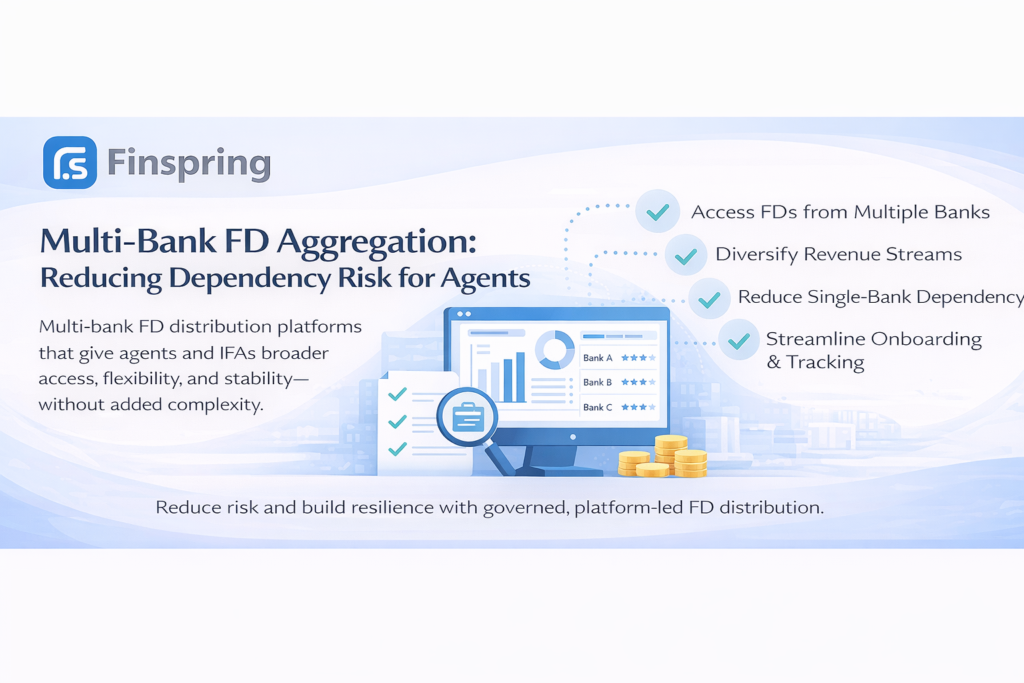
Multi-Bank FD Aggregation: Reducing Dependency for Agents

Fixed Deposits remain one of the most trusted investment products in India, especially for conservative and income-focused investors. For agents, IFAs, and distribution-led platforms, FDs are also a critical part of their offering—providing steady volumes, predictable commissions, and strong customer trust. However, many agents still operate with a single-bank or limited-bank dependency, often due to historical relationships, operational constraints, or lack of access to broader infrastructure. This dependency creates hidden risks. Multi-bank FD aggregation addresses these risks by redesigning how agents access, distribute, and manage FD products—without compromising regulatory discipline or operational efficiency. The Hidden Cost of Single-Bank Dependency Agents tied to one bank (or a very small set of banks) face several structural challenges: Rate dependencyIf the bank’s FD rates become uncompetitive, agents have little flexibility. Product rigidityTenure options, payout structures, and special schemes are limited to what one institution offers. Operational bottlenecksAny process change, downtime, or policy shift at the bank directly impacts the agent’s business. Revenue concentration riskA single partner controls a disproportionate share of the agent’s income stream. While these risks may not be visible during stable market conditions, they surface quickly during periods of rate volatility, liquidity tightening, or regulatory change. What Multi-Bank FD Aggregation Actually Means Multi-bank FD aggregation does not mean agents lose structure or discipline. It means: Access to FD products from multiple regulated banks and NBFCs A single interface or workflow for discovery, booking, and tracking Consistent onboarding and documentation flows Centralized visibility across issuers Importantly, aggregation is about choice with governance, not fragmentation. How Aggregation Reduces Dependency Risk for Agents 1. Rate Optionality Without Rate Chasing With access to multiple banks: Agents are no longer locked into one rate narrative They can recommend options aligned with client needs Short-term rate shifts do not stall business activity This does not encourage reckless rate chasing.It enables measured, client-appropriate recommendations. Agents move from “selling what’s available” to “advising with options.” 2. Continuity of Business Despite Bank-Level Changes Banks regularly update: Internal policies KYC interpretations Tenure availability Campaign participation In a single-bank setup, every such change directly impacts the agent’s pipeline. Multi-bank aggregation ensures: Business continuity even if one issuer pauses or revises offerings Reduced downtime during partner-level transitions Lower operational shock from policy changes Dependency shifts from institution-specific to infrastructure-led. 3. Better Alignment With Client Profiles Different banks are better suited for different client needs: Some excel at short-term tenures Others are preferred for senior citizens Some offer more flexible payout options Aggregation allows agents to: Match client profiles to issuer strengths Avoid forced-fit recommendations Improve long-term trust and retention This strengthens the advisory relationship, not just transaction volume. 4. Simplified Operations Across Multiple Issuers Traditionally, working with multiple banks meant: Separate portals Different documentation standards Inconsistent tracking and reporting Modern FD aggregation platforms eliminate this complexity. Agents operate through: A unified onboarding flow Standardized documentation Centralized tracking of bookings, maturities, and renewals Operational simplicity is what makes diversification viable at scale. 5. Reduced Revenue Concentration Risk From a business resilience standpoint, multi-bank aggregation is critical. When commissions, volumes, and renewals are distributed across issuers: Revenue becomes more stable Dependency on one partner reduces Negotiating position improves over time This is especially important for large IFAs and agent networks aiming to build sustainable practices. Why Banks Also Benefit From Reduced Agent Dependency Multi-bank aggregation is not a zero-sum game. Banks benefit when: Agents are not forced to over-concentrate volumes Distribution relationships become more balanced Platform-led governance ensures compliance consistency Banks participate as part of an ecosystem—not as the sole dependency point—leading to healthier, longer-term partnerships. The Role of Infrastructure in Making Aggregation Work Multi-bank aggregation only works when supported by the right infrastructure. Key requirements include: Single integration layer for agents and platforms Uniform compliance workflows across issuers Centralized reporting and audit trails Clear separation of issuer responsibility and distributor role Without this, aggregation increases complexity instead of reducing it. With the right infrastructure, complexity is absorbed at the system level—not pushed onto agents. From Relationship-Led to Platform-Led Distribution Historically, agent distribution was relationship-driven: One bank relationship Manual coordination Informal dependency Aggregation enables a shift to platform-led distribution, where: Access is system-driven Choices are structured Governance is embedded Dependency is reduced without chaos This transition is essential as agent businesses scale. Regulatory Alignment Remains Intact Crucially, multi-bank FD aggregation does not dilute regulation. Each bank: Remains the issuer of its FD Retains full regulatory responsibility Owns KYC, AML, and reporting obligations Agents: Act strictly as distributors Follow standardized, bank-approved workflows Operate within clearly defined roles Aggregation reorganizes access—not accountability. Long-Term Impact on Agent Businesses Agents using multi-bank FD aggregation experience: Greater resilience during market shifts Improved client trust through choice More predictable revenue streams Lower operational fatigue Over time, this allows agents to evolve from product sellers into portfolio-oriented advisors. Closing Thoughts Dependency is one of the most underestimated risks in agent-led distribution. Multi-bank FD aggregation addresses this risk structurally—not by adding more relationships, but by redesigning how access, governance, and operations are handled. For agents, it means: More choice without more complexity More stability without loss of discipline More control over their business trajectory In a market where both clients and regulators expect professionalism at scale, multi-bank aggregation is no longer optional—it is foundational. Read how banks offer competitive rates while working with FD Aggregator platforms, here.

FD Aggregator Rate Strategy
Fixed Deposit

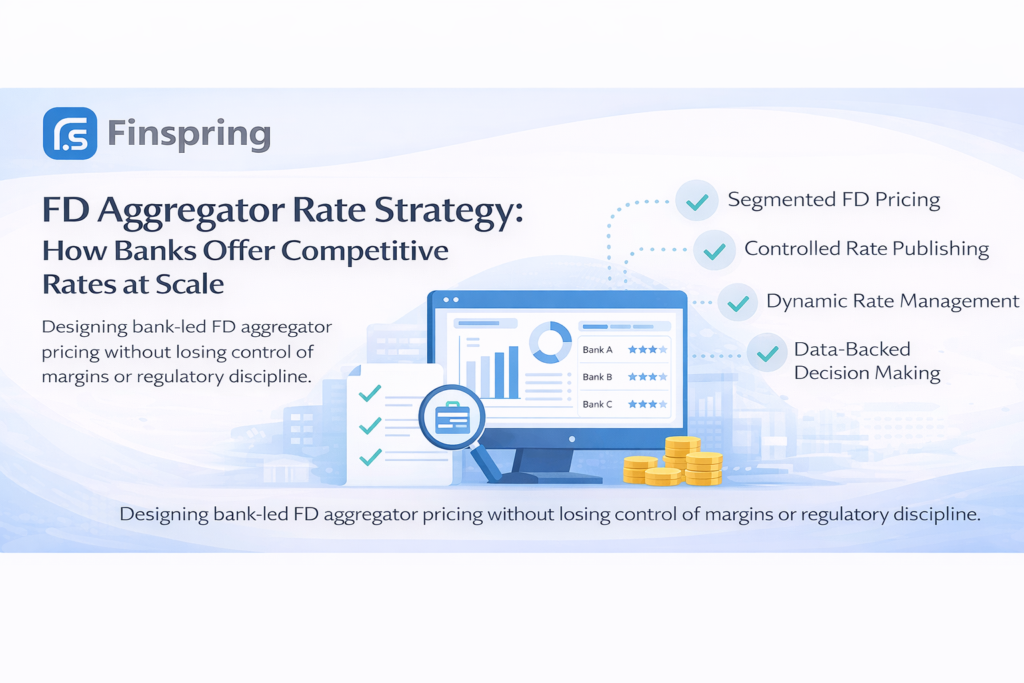
How FD Aggregators Help Banks Offer Competitive Rates at Scale

In an increasingly digital deposit market, interest rates have become both a competitive lever and a strategic constraint for banks. On one hand, banks need to offer attractive FD rates to remain relevant in a crowded marketplace. On the other, they must protect margins, liquidity discipline, and regulatory alignment. This tension often leads to a misconception: Selling Fixed Deposits via aggregators forces banks into a rate race. In reality, when designed correctly, FD Aggregator Rate Strategy helps banks offer competitive rates at scale—without losing pricing control. This article explains how. The Changing Nature of FD Competition Historically, FD rates were communicated through: Branch networks Relationship managers Static websites Rate discovery was fragmented and slow. Banks could adjust pricing with minimal immediate competitive pressure. Today, digital platforms have changed that dynamic. Customers compare: Tenures Rates Credibility Ease of booking …all in one place. This has made pricing more visible—but not necessarily more reckless. Competitive Rates Do Not Mean Uniform Rates One of the biggest misunderstandings around FD aggregators is the assumption that: Banks must offer their highest possible rate to everyone. In practice, aggregators enable structured, segmented, and controlled pricing, not blanket discounting. Banks retain the ability to: Offer rate differentiation by tenure Adjust rates by deposit size Introduce campaign-based rates Respond dynamically to liquidity needs The difference is speed and precision, not loss of control. Aggregators as Market Intelligence Layers FD aggregators provide banks with real-time visibility into market positioning. Instead of relying on delayed competitor analysis, banks can observe: How their rates compare across tenures Where demand concentrates Which tenures attract more inflows How rate changes impact conversion This visibility allows banks to price strategically, not reactively. Competitive rates become a tool—not a reflex. Controlled Rate Publishing Through Infrastructure In well-designed aggregator integrations: Rates are published via APIs controlled by the bank Aggregators do not set or alter rates Any rate change originates from bank-approved systems This ensures: Rate governance remains centralized Compliance sign-off is enforced Changes are logged and auditable Banks gain distribution reach without relinquishing pricing authority. Scaling Without Cannibalisation A common concern is that aggregator-led FD sales may cannibalise a bank’s existing deposit base. In practice, banks use aggregators to: Reach new customer segments Access digitally-native investors Supplement branch-led acquisition Aggregators function as incremental distribution channels, not replacements. This allows banks to: Offer competitive rates on select tenures Limit exposure through caps and thresholds Balance portfolio composition Scale is achieved with boundaries, not blindly. Dynamic Rate Management at Scale One of the strongest advantages of aggregator distribution is the ability to manage rates dynamically. Banks can: Increase rates temporarily to meet liquidity targets Reduce exposure once targets are met Shift focus across tenures based on inflow patterns Without aggregators, executing such strategies across multiple channels is operationally complex. With aggregators, rate changes propagate instantly—but still under bank control. Better Price Discovery Without Margin Erosion Transparency does not automatically lead to margin erosion. In fact, FD aggregators: Encourage clearer product positioning Reduce dependence on informal rate negotiations Shift competition from relationships to structure Banks that understand their cost of funds and liquidity requirements can compete confidently—without unsustainable pricing. The result is disciplined competitiveness, not rate wars. Operational Efficiency Supports Better Pricing Offering competitive rates is not only about headline numbers. Operational efficiency plays a significant role. Aggregator-led digital journeys: Reduce acquisition costs Minimise manual processing Lower servicing overhead When operational costs decrease, banks gain more room to price attractively without impacting margins. In this sense, technology enables pricing flexibility. Rate Innovation Becomes Possible Aggregators allow banks to experiment with: Short-duration promotional rates Digital-only FD products Targeted offers for specific platforms These innovations would be difficult to execute consistently through traditional channels. By separating product experimentation from core banking systems, aggregators give banks room to innovate without risk. Why Scale Matters in FD Aggregator Rate Strategy Offering competitive rates to a small audience is easy. Doing it at scale, predictably, and compliantly is not. Aggregators provide the infrastructure for: Consistent execution Controlled expansion Data-backed decision-making Banks move from intuition-driven pricing to infrastructure-led pricing. Aggregators as Strategic Enablers, Not Price Disruptors When viewed narrowly, aggregators appear to increase pricing pressure. When viewed strategically, they: Improve market responsiveness Enable disciplined competitiveness Support better asset-liability management The key difference lies in how banks integrate and govern aggregator relationships. Closing Thoughts FD aggregators do not force banks into competing on price alone. They give banks the tools to: Offer competitive rates intelligently Scale distribution without losing control Respond to market conditions in real time Balance growth with governance In a digital-first deposit landscape, rate competitiveness is no longer about who offers the highest number. It is about who can price confidently, consistently, and at scale. Read about how banks maintain compliance while scaling FD distribution with the help of FD aggregators, here.

https://finspring.ai/choosing-the-right-fd-aggregator-platform/
Fixed Deposit

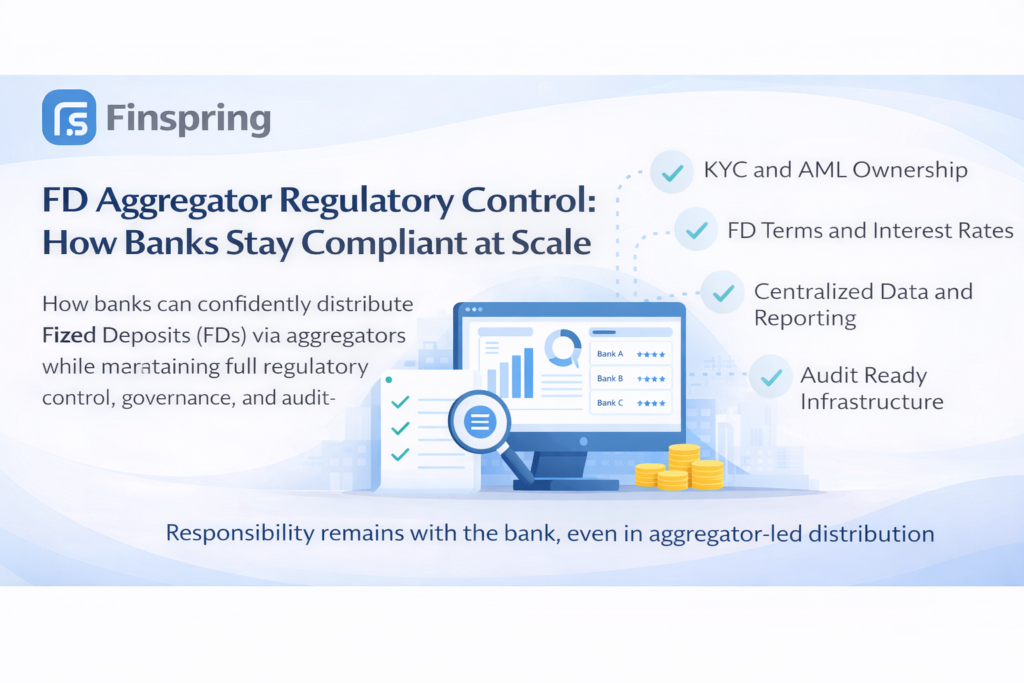
How Banks Retain Regulatory Control While Selling Fixed Deposits via Aggregators

As digital distribution becomes central to how financial products reach customers, banks are increasingly partnering with fintech platforms and aggregators to distribute Fixed Deposits (FDs) at scale. This shift often raises an important question inside banks and NBFCs: If FDs are sold through aggregators, how does the bank retain FD Aggregator Regulatory Control ? The answer lies in understanding the difference between distribution and ownership, and in designing the right infrastructure, governance, and controls at the outset. This article explores how banks can confidently distribute FDs via aggregators while remaining fully compliant, accountable, and in control. The FD Aggregator Regulatory Control Reality: Control Cannot Be Delegated From a regulatory standpoint, one principle is non-negotiable: The bank remains fully responsible for the FD, regardless of the distribution channel. This includes responsibility for: KYC and AML compliance Product terms and disclosures Interest rate setting Customer communication Reporting and audits Aggregators do not replace the bank’s regulatory obligations. They operate strictly as distribution and technology partners, not as issuers or custodians of the deposit. The challenge, therefore, is not whether banks can retain control — it is how that control is operationalized at scale. Distribution vs Ownership: The Core Distinction When banks sell FDs through aggregators, roles must be clearly defined. The Bank Owns: The FD product Regulatory accountability Customer funds Compliance interpretation Reporting to regulators The Aggregator Enables: Digital discovery and reach User interfaces and journeys API-driven onboarding Operational efficiency Problems arise only when this distinction becomes blurred — typically due to fragmented systems or loosely governed integrations. Where Banks Typically Fear Loss of Control Banks exploring aggregator-led distribution often worry about: Loss of visibility into end customers Inconsistent KYC or onboarding standards Data fragmentation across partners Difficulty in audit and reporting Over-dependence on third-party systems These are valid concerns — but they are infrastructure problems, not distribution problems. The Infrastructure-First Approach to Retaining FD Aggregator Regulatory Control Banks that successfully scale FD distribution through aggregators adopt a compliance-first infrastructure model, where governance is embedded into the system itself. Key principles include: 1. Bank-Led Product Definition Even when FDs are sold via aggregators: Product terms are defined by the bank Interest rates are controlled by the bank Eligibility rules are set by the bank Aggregators consume these rules via APIs.They do not interpret or modify them. This ensures that product governance remains centralized, regardless of how many platforms distribute the FD. 2. Controlled Digital Onboarding Modern FD distribution relies on digital onboarding, but control does not mean manual intervention. Banks retain control by: Defining KYC and AML workflows centrally Approving onboarding logic once, at the infrastructure level Enforcing uniform checks across all distribution partners When onboarding flows are standardized and API-driven, every aggregator follows the same regulatory logic — eliminating variability. 3. Single Source of Truth for Data One of the biggest risks in aggregator-led distribution is data fragmentation. Banks mitigate this by ensuring: All FD data flows back to a central system Customer, transaction, and maturity data are unified Aggregators never become the system of record In this model: Aggregators are interfaces The bank (or its designated infrastructure layer) remains the system of truth This is critical for audits, reconciliations, and regulatory reporting. 4. Centralized Reporting and Audit Readiness Regulators do not audit aggregators — they audit banks. Banks that retain control ensure that: Reporting formats are standardized Data is available in regulator-ready formats Aggregator activity is fully traceable This is achieved when reporting is designed at the infrastructure layer, not assembled manually across partners. The result: audits become predictable, repeatable, and defensible. 5. Governance Through Architecture, Not Oversight Traditional oversight relies heavily on: Manual checks Partner reviews Operational controls At scale, this becomes unsustainable. Modern banks retain control by embedding governance directly into the architecture: Rule-based validations Permissioned access Automated alerts and controls When governance is architectural, control does not weaken as distribution expands — it strengthens. Why Aggregators Do Not Dilute FD Aggregator Regulatory Control Contrary to common belief, well-structured aggregator partnerships can increase regulatory discipline. Why? Because they force banks to: Standardize processes Eliminate ad-hoc exceptions Formalize onboarding and reporting logic Reduce manual interventions In many cases, banks achieve better compliance outcomes through digital distribution than through fragmented offline channels. The Role of Multi-Aggregator Distribution As banks scale, they often work with multiple aggregators. This is where infrastructure design becomes critical. Without a unified integration layer: Each aggregator introduces variation Compliance becomes partner-dependent Reporting becomes complex With a single, expansion-ready integration: Aggregators plug into the same governed system Compliance logic scales uniformly Control remains centralized The bank’s regulatory posture stays consistent — regardless of how many platforms distribute its FDs. From Channel Risk to Strategic Advantage Banks that approach aggregator distribution defensively often limit scale. Banks that approach it architecturally unlock: Wider reach without compliance dilution Faster go-to-market Better data visibility Stronger governance The key shift is this: FD Aggregator Regulatory Control is not preserved by restricting channels, but by designing the right infrastructure. Closing Thoughts Selling Fixed Deposits via aggregators does not require banks to give up control. It requires them to: Clearly separate ownership from distribution Embed compliance into infrastructure Centralize data and reporting Govern through architecture, not manual oversight When these principles are applied, aggregators become a controlled extension of the bank’s distribution strategy, not a regulatory risk. In a digital-first financial ecosystem, this is not just a safe approach — it is a necessary one. Read more about choosing the right FD aggregator platform for your business, here.

FD Aggregator Platform
Fixed Deposit

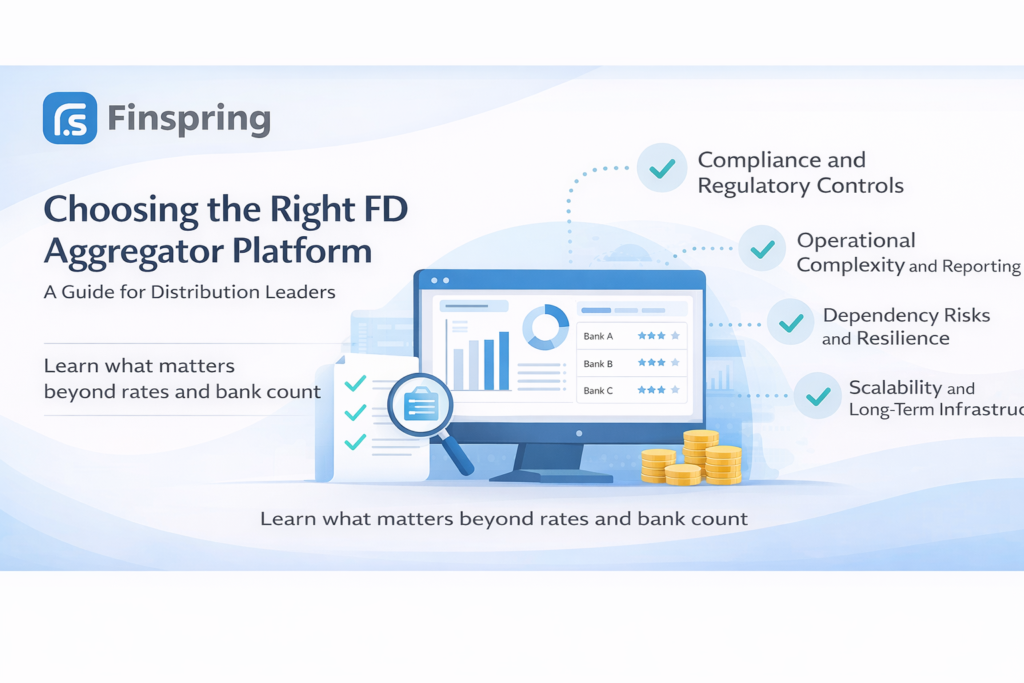
Choosing the Right FD Aggregator Platform: A Guide for Distribution Leaders

For distribution leaders, Fixed Deposits remain one of the most dependable products in the investment stack. They are trusted by clients, well understood by regulators, and operationally stable. Yet the way FDs are distributed has changed significantly. Aggregator platforms now play a central role in how agents, IFAs, and wealth platforms access and sell FD products across multiple banks. Choosing the right FD aggregator platform, however, is not a tactical decision. It is an infrastructure choice that shapes how distribution scales, how compliance is handled, and how resilient the business becomes over time. This guide is written for distribution leaders who want to evaluate a FD aggregator platform beyond surface-level features and understand what truly matters in the long run. Start by Clarifying the Role the FD Aggregator Platform Will Play in Your Business Before evaluating any platform, distribution leaders must be clear about why they need an aggregator in the first place. Aggregators can play very different roles depending on how a distribution business is structured. For some, an aggregator is primarily a way to expand product choice quickly. For others, it is a mechanism to reduce dependency on individual bank relationships. For more mature platforms, an aggregator becomes the operational backbone that standardises compliance, reporting, and servicing across issuers. Without clarity on this role, platform selection tends to focus on convenience or short-term economics. Over time, this leads to misalignment between what the business needs and what the aggregator actually enables. Look Beyond Bank Count and Rate Visibility One of the most common evaluation traps is to focus heavily on the number of banks listed or the competitiveness of rates visible on the platform. While these factors matter, they are not durable differentiators. Bank participation changes over time. Rates fluctuate continuously. What does not change as easily is the infrastructure that sits underneath. Distribution leaders should ask deeper questions: How are new banks integrated? How quickly can offerings be updated? What happens operationally when a bank pauses or modifies its FD program? Platforms that treat bank integrations as point solutions tend to struggle as complexity increases. Platforms that treat them as modular components scale far more predictably. The quality of integration matters more than the quantity of integrations. Evaluate Compliance as a System, Not a Promise Compliance is often discussed in reassuring language during sales conversations. What matters more is how compliance is actually executed. Distribution leaders should understand whether the aggregator enforces compliance through: Standardised, bank-approved workflows Embedded checks at each stage of the journey Centralised audit trails Or whether compliance is handled through manual oversight, post-facto reviews, and exception handling. The former scales quietly and consistently. The latter becomes fragile as volumes grow. Over time, compliance risk is not driven by intent, but by process design. The right aggregator absorbs regulatory complexity at the system level instead of pushing it onto agents or operations teams. Understand Where Operational Complexity Lives Every FD distribution model has complexity. The question is where that complexity sits. In weaker aggregation models, complexity is pushed outward. Agents must manage multiple dashboards, reconcile different reporting formats, and coordinate with individual banks when issues arise. This may seem manageable at low volumes, but it creates operational drag as the business grows. Stronger aggregator platforms internalise complexity. They normalise workflows, unify reporting, and provide a single operational interface regardless of how many banks or issuers are involved. Distribution leaders should assess whether the platform simplifies day-to-day execution or merely centralises access. Operational simplicity is not a UI feature. It is an architectural outcome. Assess Reporting and Visibility Through a Leadership Lens Reporting is often framed as an operational requirement, but for distribution leaders it is a strategic tool. The right aggregator platform should provide visibility that enables decision-making, not just record-keeping. Leaders should ask whether the platform offers: Clear, real-time visibility into volumes and flows Tenure-wise and issuer-wise breakdowns Renewal and maturity tracking Clean, exportable data for internal analysis If reporting is fragmented or delayed, leadership decisions become reactive. Platforms that treat reporting as a core capability—not an afterthought—enable better planning and stronger governance. Think About Dependency and Resilience Early Dependency is one of the most underestimated risks in distribution businesses. Over-reliance on a single bank, a single relationship, or a single process creates fragility. A strong FD aggregator platform reduces dependency without introducing chaos. It allows distribution leaders to diversify issuers, balance volumes, and maintain continuity even when individual banks change policies or pause offerings. The key is not diversification alone, but managed diversification. Platforms should make it easy to shift focus without forcing teams to relearn systems or rebuild processes. Consider How the Platform Supports Growth, Not Just Launch Many platforms perform well during initial rollout but struggle as scale increases. Distribution leaders should evaluate how the aggregator supports growth over time. Questions worth asking include: How does the platform handle higher volumes? How does it support agent team expansion? How easily can new products or asset classes be introduced later? FD distribution rarely remains static. Platforms that are designed with expansion in mind—whether across banks, agents, or asset classes—protect leaders from costly migrations in the future. Examine the Quality of Partnership, Not Just the Technology FD aggregation is not a plug-and-play utility. It requires ongoing coordination with banks, regulators, and distribution teams. The right aggregator behaves like a long-term partner rather than a transactional vendor. This shows up in how proactively they handle regulatory changes, how transparently they communicate limitations, and how willing they are to align with the distributor’s operating model. Distribution leaders should assess whether the platform’s incentives are aligned with long-term stability or short-term volume. Avoid Over-Optimising for Economics at the Cost of Structure Commercial terms matter, but they should not dominate the decision. Higher commissions or lower fees often come with trade-offs in control, reporting quality, or operational burden. Leaders should evaluate economics in the context of: Operational efficiency gained Risk reduced Time saved Scalability enabled When these factors are considered, the true cost—or value—of an

Aggregator-led FD Distribution vs Direct Bank Sales
Fixed Deposit

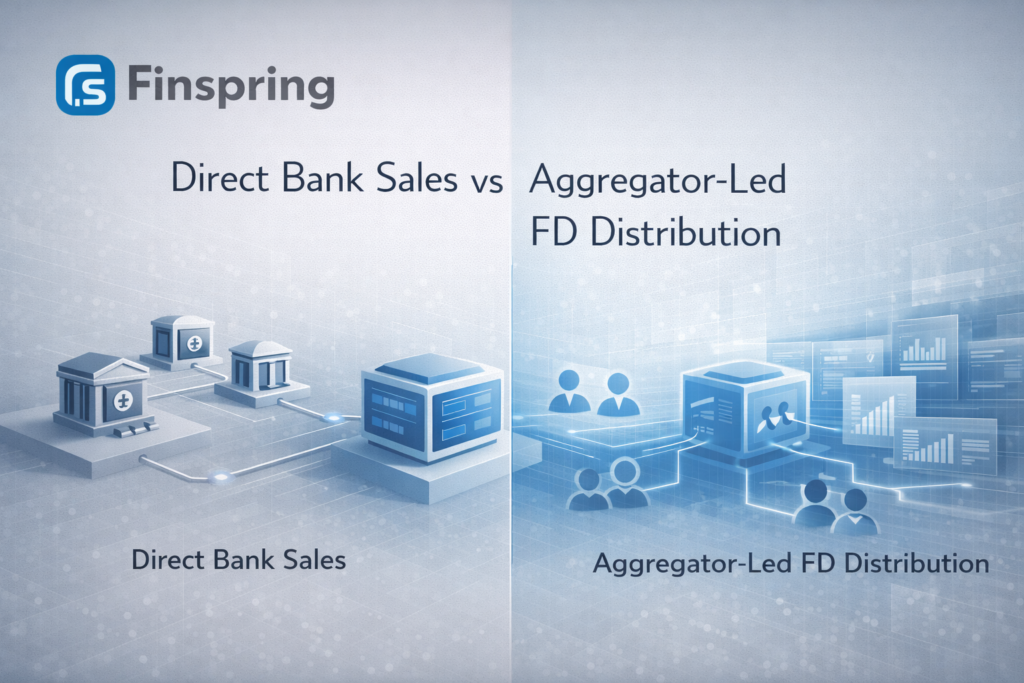
Direct Bank Sales vs Aggregator-Led FD Distribution: What Actually Scales

Fixed deposits remain one of the most important liability products for banks. They provide stable funding, predictable costs, and regulatory comfort. Yet the way fixed deposits are distributed has become a strategic question. For years, banks relied on direct sales models: branches, relationship managers, and bank-owned digital channels. While these channels still play a role, many banks are discovering that direct sales alone do not scale efficiently in today’s competitive, rate-sensitive environment. At the same time, aggregator-led FD distribution has emerged as a parallel model, enabling banks to grow fixed deposit volumes through agent networks, wealth platforms, and digital intermediaries. This raises a critical question:Which model actually scales, and why? This article compares direct bank sales and aggregator-led FD distribution across cost, speed, reach, and operational efficiency to understand what drives sustainable scale. Understanding Direct Bank FD Sales Direct bank sales refer to fixed deposits sold through channels fully owned and managed by the bank. Common Direct Sales Channels Physical branches Relationship managers Bank websites and mobile apps Call centers and in-house sales teams Strengths of Direct Bank Sales Full control over customer experience Strong trust for existing customers Tight integration with core banking systems Clear compliance ownership For renewals and existing customer deposits, direct sales work well. However, challenges arise when banks try to scale beyond their existing base. Where Direct Bank Sales Hit Scaling Limits 1. Linear Growth With High Fixed Costs Every incremental unit of growth requires: More branches or staff More training and compliance oversight More operational expenditure This creates a linear cost curve that becomes difficult to sustain at scale. 2. Limited New Customer Reach Bank apps and branches largely serve: Existing account holders Customers already within the bank’s ecosystem Acquiring new FD customers directly often requires expensive digital marketing or physical expansion. 3. Slow Market Response Launching new FD campaigns or adjusting rates through bank-owned channels often involves: App updates Branch communication cycles Internal approvals This slows responsiveness in competitive rate environments. What Aggregator-Led FD Distribution Looks Like Aggregator-led distribution introduces an external digital layer between banks and customers. Instead of selling FDs only through owned channels, banks distribute fixed deposits through: Financial advisors Wealth managers Digital agents Wealth and investment platforms All of this is enabled through a single aggregator platform that standardizes onboarding, booking, reporting, and compliance. Banks retain product ownership. Aggregators enable distribution. Why Aggregator-Led FD Distribution Scales Better 1. Distribution Without Headcount Expansion Aggregator platforms connect banks to existing agent and advisor networks. Banks gain: Immediate geographic reach Access to relationship-driven demand Distribution scale without hiring This breaks the linear relationship between growth and internal cost. 2. Lower and More Predictable Acquisition Costs Direct sales rely on: Paid digital acquisition Fixed staff costs Aggregator-led models rely on: Outcome-based distribution Revenue sharing on funded deposits This converts customer acquisition cost from a fixed burden into a controllable variable. Cost Dimension Direct Bank Sales Aggregator-Led Distribution Marketing spend High Minimal Sales cost Fixed Variable CAC predictability Low High 3. Faster Conversion Through Trusted Intermediaries Fixed deposits are trust-heavy products. Customers often prefer: Known advisors Long-term relationship managers Local agents Aggregator-led distribution digitizes these trust relationships, leading to: Higher conversion rates Faster closures Lower follow-up overhead Higher conversion directly improves scalability. 4. Single Integration, Multiple Channels In a direct model, every new distribution initiative requires incremental setup. With aggregators: One integration unlocks many agents New distributors onboard without bank-side effort Scale compounds over time This creates exponential reach instead of incremental reach. Comparing What Actually Scales Dimension Direct Bank Sales Aggregator-Led FD Distribution Cost structure High fixed Variable, outcome-based Geographic reach Limited Nationwide Speed to market Slow Fast Scalability Linear Network-driven Conversion efficiency Moderate High Operational load Bank-owned Platform-managed Does Aggregator-Led Distribution Reduce Bank Control? A common concern is loss of control. In practice, modern aggregator platforms often increase governance quality. Banks retain control through: Product rule engines Eligibility and validation checks Mandatory disclosures Audit logs and reporting Control shifts from physical presence to rule-based enforcement. The Role of Direct Channels in a Scalable Model This is not a zero-sum choice. The most scalable banks use a layered distribution strategy: Branches for trust-heavy and relationship-led deposits Bank apps for existing customers and renewals Aggregators for external reach and incremental growth Each channel plays a distinct role without cannibalizing the others. When Aggregator-Led Distribution Delivers the Most Impact Aggregator-led FD distribution is especially effective when: Banks want rapid geographic expansion Fixed deposit rates are competitive and dynamic Agent-led distribution remains strong Cost-to-liability ratios matter In these scenarios, direct sales alone struggle to keep pace. How Platforms Like Finspring Enable Scalable FD Distribution Finspring.ai enables banks to scale fixed deposit distribution by: Connecting them to large agent and wealth networks Providing single-platform, multi-bank access Automating onboarding, booking, and reporting Preserving full control over products and compliance Banks grow FD volumes without expanding branches, rebuilding apps, or inflating acquisition costs. What Actually Scales in the Long Run Scaling fixed deposits is not about pushing harder through existing channels. It is about changing distribution architecture. Direct bank sales scale well for: Existing customers Renewals Relationship-led volumes Aggregator-led distribution scales better for: New customer acquisition Nationwide reach Cost-efficient growth Banks that combine both models gain structural advantages that are difficult to replicate. Conclusion Direct bank sales provide control and trust but scale slowly and expensively. Aggregator-led FD distribution provides reach, speed, and cost efficiency without compromising governance. The banks that grow fastest are not choosing one over the other. They are building hybrid, platform-led distribution strategies where direct channels and aggregators work together. In a competitive deposit market, the question is no longer whether aggregator-led distribution scales better.It is whether banks can afford to rely on direct sales alone. Read how modern FD Aggregator platforms work, here.

FD Aggregator Platforms
Fixed Deposit

What Modern FD Aggregator Platforms Offer to Banks & Agents

Fixed deposit distribution is no longer defined by branches, isolated bank portals, or manual agent workflows. As competition for deposits increases and operational efficiency becomes critical, FD aggregator platforms have evolved from simple connectors into core financial infrastructure. Modern FD aggregators are not marketplaces. They are distribution engines that align the interests of banks and agents while preserving governance, compliance, and scalability. This article explains what contemporary FD aggregator platforms actually offer to banks and agents, why these capabilities matter, and how they reshape fixed deposit distribution at scale. The Evolution of FD Aggregators Early FD aggregation focused on basic connectivity. Platforms enabled agents to access multiple banks instead of logging into separate portals. That phase is over. Today’s FD aggregator platforms are designed to solve systemic distribution challenges, including: Rising customer acquisition costs Fragmented agent workflows Compliance complexity at scale Limited visibility into external distribution As a result, modern aggregators operate as infrastructure layers, not sales tools. What Banks Gain From Modern FD Aggregator Platforms 1. Scalable Distribution Without Branch Expansion Aggregator platforms allow banks to distribute fixed deposits through: Independent agents Wealth managers Digital platforms without adding branches or internal sales teams. Banks gain access to existing trust networks rather than creating demand from scratch. This enables rapid geographic expansion without proportional increases in cost. 2. Control Without Operational Burden A key misconception is that external distribution reduces control. Modern FD aggregators allow banks to define and enforce: Product eligibility rules Tenure and ticket-size constraints Rate applicability Mandatory disclosures Geographic or agent-level restrictions These controls are enforced programmatically, not manually. Banks retain governance while avoiding day-to-day agent management. 3. Real-Time Visibility Into External Distribution Traditional external distribution often feels opaque to banks. Modern aggregator platforms solve this by providing: Live dashboards Agent-level performance data Conversion metrics Rate sensitivity insights Drop-off analysis This level of visibility is often superior to branch-led reporting. 4. Faster Time to Market for FD Products Launching or modifying FD offerings through branches or bank apps can be slow. Aggregator platforms allow banks to: Update rates centrally Activate or pause products instantly Launch campaigns across networks in real time This agility is critical in competitive fixed deposit rate environments. 5. Lower and More Predictable Acquisition Costs Instead of spending on: Paid digital acquisition Branch expansion Headcount-heavy sales teams banks pay primarily for successful deposit outcomes. This converts CAC from a fixed burden into a variable, performance-linked cost. What Agents Gain From Modern FD Aggregator Platforms 1. Single-Platform Multi-Bank Access Agents prefer simplicity. Modern FD aggregators offer: One login One onboarding flow One booking workflow with access to multiple banks and fixed deposit products. This eliminates system fragmentation and reduces cognitive load. 2. Real-Time Fixed Deposit Comparison Agents can instantly compare: Fixed deposit rates Tenures Minimum investment amounts across banks. This enables better recommendations and faster client decisions, directly improving conversion rates. 3. Faster Onboarding and Execution Modern aggregators standardize: KYC workflows Document validation Application submission Agents spend less time on paperwork and follow-ups, and more time on client engagement. This directly increases productivity per agent. 4. Earnings Transparency and Predictability Aggregator platforms provide: Unified commission dashboards Clear payout tracking Reduced reconciliation issues Agents know exactly what they earn and when, which improves retention and long-term engagement. 5. Ability to Serve More Clients Without Scaling Effort By reducing non-selling activities such as: System switching Manual reconciliation Bank-specific follow-ups aggregator platforms allow agents to handle more clients without increasing effort proportionally. This improves the effort-to-income ratio, a key driver of agent preference. Shared Benefits for Banks and Agents Standardized Compliance Modern FD aggregators embed: Mandatory disclosures Eligibility checks Audit trails Time-stamped consent This protects banks while simplifying agent workflows. Compliance becomes automatic rather than manual. Consistent Customer Experience Regardless of the bank selected, customers experience: Faster onboarding Clear documentation Transparent rate comparison This consistency strengthens trust in both agents and banks. Better Data and Feedback Loops Aggregator platforms generate actionable data for both sides: Banks optimize product pricing and availability Agents understand client preferences and close faster This feedback loop improves distribution quality over time. What Differentiates Modern Aggregators From Legacy Models Dimension Legacy FD Distribution Modern FD Aggregators Bank access Single or limited Multi-bank Agent workflow Fragmented Unified Compliance Manual, post-facto Embedded Reporting Siloed Centralized Scalability Linear Platform-led CAC High, fixed Variable, outcome-based The difference is architectural, not cosmetic. Why Aggregators Are Becoming Core Infrastructure FD aggregators are increasingly treated as strategic infrastructure partners, not distribution channels. They provide: Technology abstraction Distribution leverage Operational efficiency Regulatory confidence Banks that integrate aggregators deeply gain structural advantages over those relying solely on owned channels. How Finspring Fits Into This Model Finspring.ai is built as a modern FD aggregation infrastructure platform designed for both banks and agents. It enables: Single-platform, multi-bank access Rule-based product governance Real-time reporting and analytics Secure, compliant onboarding and booking Scalable, low-CAC distribution Banks grow fixed deposit volumes without losing control.Agents grow earnings without increasing operational friction. The Direction of FD Distribution Fixed deposit distribution is no longer about pushing products through owned channels. It is about: Enabling trusted intermediaries digitally Scaling reach efficiently Maintaining governance through systems, not proximity Modern FD aggregator platforms make this possible. Conclusion Modern FD aggregator platforms offer far more than connectivity. For banks, they provide scalable distribution, control, visibility, and cost efficiency.For agents, they deliver simplicity, choice, speed, and predictable earnings. As fixed deposits remain a core liability product, the platforms that distribute them will increasingly define who grows fastest and most sustainably. Aggregator infrastructure is no longer optional.It is becoming foundational to how fixed deposits are distributed in a platform-driven financial ecosystem. Read how the FD Aggregator infrastructure works, here.

FD Aggregator Infrastructure
Fixed Deposit

FD Aggregator Infrastructure: Compliance, Reporting & Bank Controls

As fixed deposit distribution shifts from branch-led models to platform-led ecosystems, one concern consistently surfaces for banks: control. Scaling fixed deposits through aggregators unlocks reach, speed, and cost efficiency. But it also raises legitimate questions around compliance, reporting, governance, and regulatory accountability. Modern FD aggregator infrastructure exists precisely to solve this problem. This article explains how FD aggregators are designed to meet banking-grade compliance requirements, how reporting and controls are embedded into the infrastructure, and why aggregator-led distribution does not weaken bank governance. In many cases, it strengthens it. Why Infrastructure Matters in FD Aggregation FD aggregation is not a marketplace experiment. It is regulated financial distribution. Banks distributing fixed deposits through external networks must ensure: Regulatory compliance Data integrity Auditability Product governance Agent accountability Without robust infrastructure, aggregation would be operationally and regulatorily unviable. This is why serious FD aggregators are built as infrastructure platforms, not lead-generation tools. The Core Compliance Challenge Banks Face When banks distribute FDs directly through branches or bank apps, compliance is enforced through proximity and ownership. In aggregator-led models, distribution is externalized. This introduces new questions: How are disclosures enforced? Who validates eligibility? How are audit trails maintained? How do banks retain control without managing agents directly? The answer lies in rule-based, system-enforced infrastructure. Compliance by Design, Not by Process Traditional compliance relies heavily on manual checks, supervision, and post-facto audits. FD aggregator platforms flip this approach. Compliance is embedded into the workflow itself. Key Principles of Aggregator Compliance Infrastructure No step can be skipped Rules are enforced programmatically Every action is logged automatically Exceptions are minimized by design This reduces human error while increasing regulatory defensibility. Core Compliance Components in FD Aggregator Infrastructure 1. Product-Level Rule Engines Banks define the rules. Aggregators enforce them. Each FD product on an aggregator platform is configured with: Eligible customer categories Minimum and maximum ticket sizes Tenure constraints Rate applicability Documentation requirements If an application violates any rule, it cannot proceed. Result: No non-compliant bookings, regardless of agent behavior. 2. Mandatory Disclosure Enforcement Disclosures are a regulatory cornerstone in deposit distribution. Aggregator platforms ensure: Mandatory disclosures are shown before booking Acceptance is digitally captured Time-stamped consent is logged Records are immutable Agents cannot bypass disclosures, and customers cannot proceed without acknowledging them. This is often more reliable than branch-led processes. 3. Digital KYC and Verification Controls FD aggregators integrate with verified KYC and identity services to ensure: Identity validation PAN and document verification Bank account checks Consistency across banks Banks receive clean, standardized data instead of fragmented submissions from multiple channels. Reporting Infrastructure: Visibility at Scale One of the strongest advantages of aggregator-led distribution is centralized reporting. What Banks Gain Through Aggregator Reporting Banks can monitor: Application volumes Conversion ratios Agent-wise performance Rate sensitivity Drop-off points Regional demand patterns All without manually consolidating data across channels. Standard Reporting Dimensions in FD Aggregators Reporting Area What It Enables Application funnel Conversion efficiency Product-level data Pricing and tenure optimization Agent performance Network effectiveness Time-to-book metrics Operational bottlenecks Exception tracking Compliance risk monitoring This data is often richer than what branch or app-only models provide. Auditability and Traceability Regulators care less about who sold the FD and more about whether it can be audited. Aggregator infrastructure provides: Full transaction logs User-level action trails Time-stamped approvals Immutable records Every FD booking can be traced from: Agent → Platform → Bank → Confirmation This end-to-end traceability is critical during audits, inspections, or disputes. Bank Controls Without Operational Overhead A common misconception is that banks lose control when they stop owning the channel. In reality, aggregator platforms allow banks to enforce control without operational burden. Controls Banks Retain Through Aggregators Product availability toggles Rate update controls Agent eligibility filters Geographic restrictions Campaign-specific rules Real-time suspension or rollback Banks control what can be sold, how it can be sold, and under what conditions. They simply do not manage who sells it day-to-day. Agent Governance Without Direct Management Banks do not need to manage agents directly to govern them effectively. Aggregator platforms handle: Agent onboarding Eligibility checks Activity monitoring Performance thresholds Compliance enforcement Banks receive a governed distribution layer, not an unmanaged network. This separation reduces operational risk while preserving accountability. Why Aggregator Infrastructure Often Improves Compliance Compared to branch-led or fragmented digital processes, aggregator infrastructure offers: Fewer manual interventions Standardized workflows Lower exception rates Better documentation quality Stronger audit readiness In many cases, banks discover that compliance outcomes improve after adopting aggregator-led distribution. Regulatory Alignment Is Easier at Platform Level Regulatory changes are inevitable. Aggregator platforms allow banks to: Update rules centrally Apply changes instantly across networks Enforce new requirements without retraining thousands of agents This adaptability is critical in fast-evolving regulatory environments. How Finspring Approaches Compliance and Control Finspring.ai is built as a bank-first FD aggregation infrastructure, not a marketplace. Its architecture is designed to give banks: Full control over products and rules Real-time visibility into distribution Embedded compliance workflows Detailed reporting and analytics Secure, auditable integrations Banks scale FD distribution without compromising governance, auditability, or regulatory comfort. The Bigger Picture: Infrastructure Over Intermediation FD aggregators are not removing banks from the equation. They are modernizing how banks distribute. Strong infrastructure ensures that: Growth does not come at the cost of control Scale does not increase risk External distribution remains regulator-friendly The future of FD distribution belongs to platforms that treat compliance and reporting as first-class infrastructure, not afterthoughts. Conclusion FD aggregation only works when supported by strong infrastructure. Modern FD aggregator platforms embed compliance, reporting, and bank controls directly into the distribution layer, allowing banks to scale fixed deposit volumes confidently and transparently. For banks evaluating aggregation strategies, the key question is not whether control is lost, but whether existing models offer the same level of visibility, consistency, and auditability. In most cases, aggregator infrastructure does not weaken control.It institutionalizes it. Read whether agents prefer FD Aggregators or White-label providers, here.

Aggregator FD Distribution
Fixed Deposit

White-Label vs Aggregator FD Distribution: What Agents Prefer

As fixed deposit distribution becomes more digital, banks and platforms are rethinking how they enable agents and advisors. Two models dominate these conversations: white-label FD distribution and aggregator-led FD distribution. Both aim to digitize agent workflows. Both promise scale. But in practice, agents show a clear preference once they start using these systems. This article compares white-label and aggregator FD distribution models from the agent’s perspective, explains how each works, and highlights why aggregator platforms are increasingly becoming the preferred choice for scalable fixed deposit sales. Understanding the Two Models Before comparing preferences, it’s important to clarify what each model actually represents. What Is White-Label FD Distribution? In a white-label model, a bank or platform provides agents with a branded interface that appears as an extension of the bank’s own system. Key characteristics include: Single-bank product access Bank-branded dashboards Agents operate within the bank’s ecosystem Distribution tightly coupled with one institution White-label systems are often positioned as “digital enablement” for agents, but they remain institution-specific. What Is Aggregator FD Distribution? Aggregator FD distribution uses a neutral platform that connects multiple banks and multiple agents through a single interface. Key characteristics include: Multi-bank access Neutral, non-bank-branded workflows Standardized onboarding and booking Centralized reporting across banks Aggregators decouple agent workflows from any single bank. How Agents Evaluate FD Distribution Platforms Agents evaluate distribution systems very differently from banks. Their priorities typically include: Ease of use Product choice Speed of execution Earnings visibility Scalability of effort The question is not “Which system gives the bank more control?” but “Which system helps the agent close more FDs with less friction?” Key Differences That Matter to Agents 1. Product Choice and Flexibility White-Label Model Agents can sell fixed deposits from only one bank Limited ability to compare fixed deposit rates Recommendations may feel constrained Aggregator Model Access to multiple banks in one system Real-time comparison of fixed deposit rates Ability to match products to client needs From an agent’s perspective, broader choice directly improves advisory quality and conversion. Agent preference: Aggregator model 2. Workflow Simplicity White-Label Model Agents need separate logins for each bank they work with Different banks mean different dashboards and processes Cognitive and operational load increases with scale Aggregator Model One login, one workflow Same process regardless of bank Easier training and faster execution Agents value consistency over customization. Agent preference: Aggregator model 3. Onboarding and Documentation White-Label Model Bank-specific onboarding rules Repeated KYC and documentation across institutions Slower onboarding during peak cycles Aggregator FD Distribution Model One-time onboarding Standardized compliance workflows Faster application submission This difference becomes critical when agents manage multiple clients daily. Agent preference: Aggregator model 4. Speed and Conversion Speed directly impacts agent income. White-Label Model Slower rate discovery Manual follow-ups Delays due to bank-specific constraints Aggregator FD Distribution Model Instant rate visibility Faster booking Fewer drop-offs In competitive fixed deposit markets, speed often determines which agent wins the business. Agent preference: Aggregator model Earnings Transparency and Predictability White-Label Distribution Commission structures vary by bank Reporting formats differ Reconciliation often manual Agents spend time tracking earnings instead of selling. Aggregator FD Distribution Unified commission dashboards Clear payout tracking Fewer disputes Predictable earnings improve agent retention and motivation. Agent preference: Aggregator model Scalability From the Agent’s Perspective Agents think in terms of effort-to-output ratio. Dimension White-Label Model Aggregator FD Distribution Model Banks covered One Multiple Effort per FD Higher Lower Learning curve Repeated One-time Scalability Limited High White-label systems scale linearly with effort. Aggregator platforms scale multiplicatively. Why Some Banks Still Choose White-Label Models Despite agent preferences, banks may opt for white-label solutions because: Branding control feels stronger Governance appears simpler Channel ownership is clearer However, these benefits are primarily bank-centric, not agent-centric. Over time, agent adoption tends to stagnate if the system restricts choice or flexibility. The Real Trade-Off: Control vs Adoption The core trade-off between the two models is not technology. It is philosophy. White-label models prioritize institutional control Aggregator models prioritize distribution efficiency In practice, low agent adoption undermines even the most controlled system. Modern aggregator platforms now offer: Embedded compliance Bank-level rules and validations Audit logs and reporting This reduces the traditional control advantage of white-label models. What Agents Actually Say With Their Behavior Agent preference becomes clear when given a choice. When agents have access to both: White-label systems are used selectively Aggregator platforms become primary tools Agents gravitate toward systems that help them: Serve clients better Close faster Earn more predictably Behavior reveals preference more accurately than surveys. When White-Label Still Makes Sense White-label FD distribution can still be useful when: A bank targets a tightly controlled, exclusive agent group Products are highly differentiated Distribution volumes are limited However, for broad, scalable fixed deposit distribution, white-label models struggle to keep pace. How Platforms Like Finspring Support Agent-Preferred Distribution Finspring.ai is designed around the aggregator model while preserving bank governance. It enables: Single-platform, multi-bank access Standardized, agent-friendly workflows Real-time fixed deposit rate visibility Transparent reporting and controls This aligns bank objectives with agent preferences rather than forcing a compromise. The Direction of FD Distribution Going Forward As fixed deposit markets become more competitive, agent productivity becomes a strategic lever. Distribution models that: Limit choice Increase friction Fragment workflows will struggle to scale. Aggregator-led distribution reflects how agents already operate in reality: multi-bank, client-centric, and efficiency-driven. Conclusion When comparing white-label and aggregator FD distribution, agent preference is clear. Agents prefer systems that offer: Multiple banks Simple workflows Faster execution Predictable earnings White-label models optimize for institutional control. Aggregator models optimize for distribution outcomes. In a world where scale, speed, and efficiency define fixed deposit growth, platforms that align with agent preferences are the ones that win. Read how modern day agents are selling FDs without replacing banks, here.

Scroll to Top
Good move, automating your backend!